Skip to content
Android waitlistTry on iPad
Get started

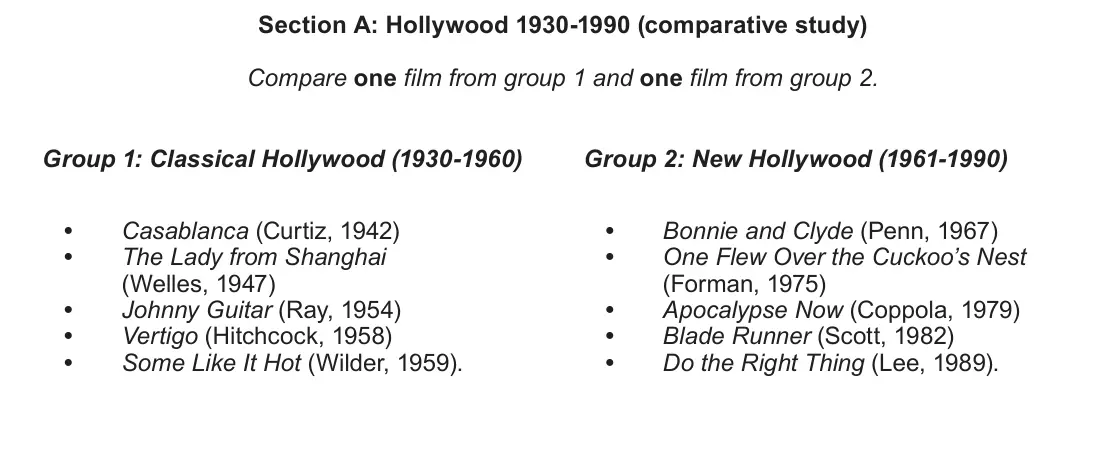
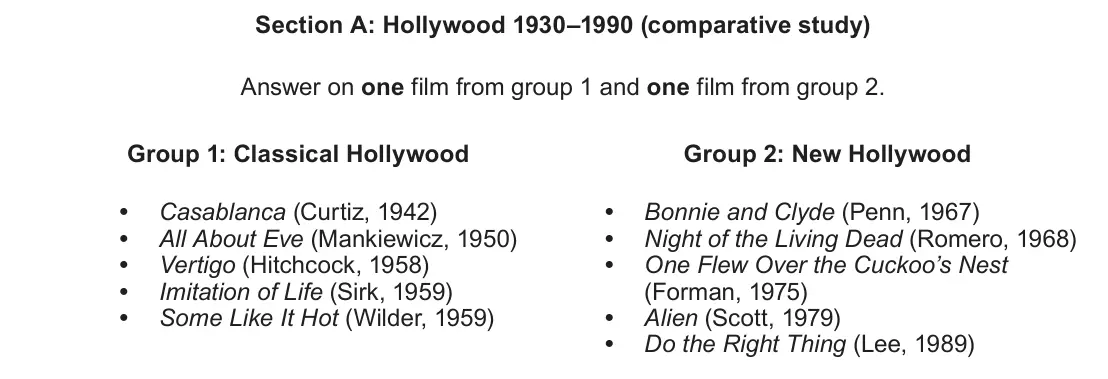
Hollywood 1930–1990: Eduqas A‑Level Film Studies questions

Eduqas A-Level Film Studies past-paper questions on Hollywood 1930–1990, 2019–2025, with mark schemes and examiner’s reports where available.

Paper
All papers
Exam
All years

Loading the full question list…
98 questions

  1. Q11

    June 2025 · Component 1

    The whole paper ↗
    1
    Setup for original question 11

    Loading the question setup…

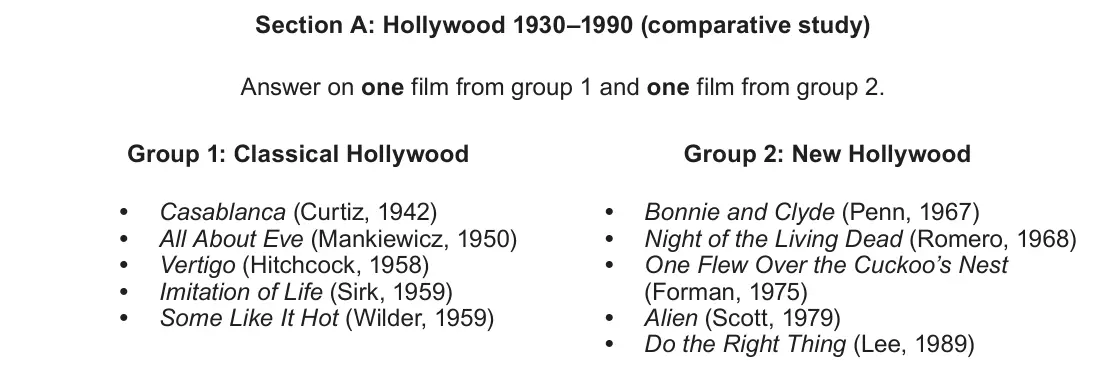
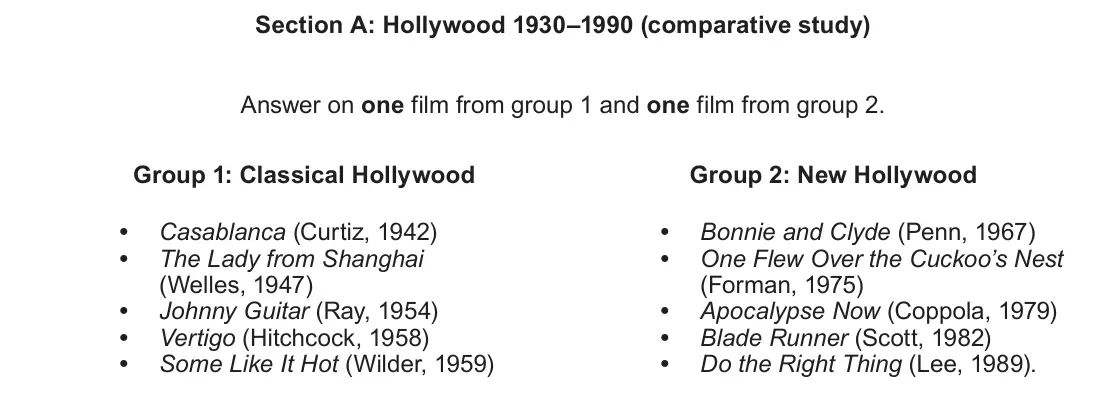
    Original question 11: ‘It is the director who makes the most important contribution to the aesthetic of a film.’ Compare how far this is true of the Hollywood films you have studied.

    Loading the question…

  2. Q12

    June 2025 · Component 1

    The whole paper ↗
    2
    Setup for original question 12

    Loading the question setup…

    Original question 12: ‘New Hollywood allowed filmmakers to express their personal interests more than Classical Hollywood.’ Compare how far this is true of the Hollywood films you ha

    Loading the question…

  3. Q11

    June 2024 · Component 1

    The whole paper ↗
    3
    Setup for original question 11

    Loading the question setup…

    Original question 11: Compare how far the Hollywood films you have studied challenge the idea that films are created by auteurs.

    Loading the question…

  4. Q12

    June 2024 · Component 1

    The whole paper ↗
    4
    Setup for original question 12

    Loading the question setup…

    Original question 12: ‘The shift from Classical to New Hollywood production created a revolution in the use of cinematography and editing.’ Compare the films you have studied in rela

    Loading the question…

  5. Q11

    June 2023 · Component 1

    The whole paper ↗
    5
    Setup for original question 11

    Loading the question setup…

    Original question 11: Compare how far the films you have studied show an auteur filmmaker’s influence. Refer in detail to at least one sequence from each film.

    Loading the question…

  6. Q12

    June 2023 · Component 1

    The whole paper ↗
    6
    Setup for original question 12

    Loading the question setup…

    Original question 12: Compare how the films you have studied were shaped by their cultural and/or political contexts. Refer in detail to at least one sequence from each film.

    Loading the question…

  7. Q11

    June 2022 · Component 1

    The whole paper ↗
    7
    Setup for original question 11

    Loading the question setup…

    Original question 11: ‘Cinematography and editing are crucial in expressing a clear auteur signature.’ Compare the films you have studied in relation to this statement.

    Loading the question…

  8. Q12

    June 2022 · Component 1

    The whole paper ↗
    8
    Setup for original question 12

    Loading the question setup…

    Original question 12: Compare how representations of ethnicity and/or gender are shaped by the historical contexts of the films you have studied.

    Loading the question…

  9. Q11

    Autumn 2021 · Component 1

    The whole paper ↗
    9
    Setup for original question 11

    Loading the question setup…

    Original question 11: ‘Film is a collaborative art form, so to focus on the contribution of one individual as the auteur is misleading.’ Compare the two films you have studied in rel

    Loading the question…

  10. Q12

    Autumn 2021 · Component 1

    The whole paper ↗
    10
    Setup for original question 12

    Loading the question setup…

    Original question 12: ‘An auteur’s signature is always apparent in the messages and values of the films they make.’ Compare the two films you have studied in relation to this stateme

    Loading the question…

  11. Q11

    Autumn 2020 · Component 1

    The whole paper ↗
    11
    Setup for original question 11

    Loading the question setup…

    Original question 11: Compare some of the ways in which the look and style of the films you have studied reflect the influence of auteurs. Refer in detail to one sequence from each f

    Loading the question…

  12. Q12

    Autumn 2020 · Component 1

    The whole paper ↗
    12
    Setup for original question 12

    Loading the question setup…

    Original question 12: ‘New Hollywood allowed filmmakers more creative freedom than Classical Hollywood did’. Compare the two films you have studied in relation to this statement.

    Loading the question…

  13. Q11

    June 2019 · Component 1

    The whole paper ↗
    13
    Setup for original question 11

    Loading the question setup…

    Original question 11: ‘The director is always the most important influence on a film.’ Compare how far your two chosen films support this statement.

    Loading the question…

  14. Q12

    June 2019 · Component 1

    The whole paper ↗
    14
    Setup for original question 12

    Loading the question setup…

    Original question 12: Compare how far the two films you have studied reflect the times they were made.

    Loading the question…

All 14 questions on Hollywood 1930–1990, as a list
  1. June 2025, Component 1, Q11 (40 marks): ‘It is the director who makes the most important contribution to the aesthetic of a film.’ Compare how far this is true of the Hollywood films you have studied.
  2. June 2025, Component 1, Q12 (40 marks): ‘New Hollywood allowed filmmakers to express their personal interests more than Classical Hollywood.’ Compare how far this is true of the Hollywood films you ha
  3. June 2024, Component 1, Q11 (40 marks): Compare how far the Hollywood films you have studied challenge the idea that films are created by auteurs.
  4. June 2024, Component 1, Q12 (40 marks): ‘The shift from Classical to New Hollywood production created a revolution in the use of cinematography and editing.’ Compare the films you have studied in rela
  5. June 2023, Component 1, Q11 (40 marks): Compare how far the films you have studied show an auteur filmmaker’s influence. Refer in detail to at least one sequence from each film.
  6. June 2023, Component 1, Q12 (40 marks): Compare how the films you have studied were shaped by their cultural and/or political contexts. Refer in detail to at least one sequence from each film.
  7. June 2022, Component 1, Q11 (40 marks): ‘Cinematography and editing are crucial in expressing a clear auteur signature.’ Compare the films you have studied in relation to this statement.
  8. June 2022, Component 1, Q12 (40 marks): Compare how representations of ethnicity and/or gender are shaped by the historical contexts of the films you have studied.
  9. Autumn 2021, Component 1, Q11 (40 marks): ‘Film is a collaborative art form, so to focus on the contribution of one individual as the auteur is misleading.’ Compare the two films you have studied in rel
  10. Autumn 2021, Component 1, Q12 (40 marks): ‘An auteur’s signature is always apparent in the messages and values of the films they make.’ Compare the two films you have studied in relation to this stateme
  11. Autumn 2020, Component 1, Q11 (40 marks): Compare some of the ways in which the look and style of the films you have studied reflect the influence of auteurs. Refer in detail to one sequence from each f
  12. Autumn 2020, Component 1, Q12 (40 marks): ‘New Hollywood allowed filmmakers more creative freedom than Classical Hollywood did’. Compare the two films you have studied in relation to this statement.
  13. June 2019, Component 1, Q11 (40 marks): ‘The director is always the most important influence on a film.’ Compare how far your two chosen films support this statement.
  14. June 2019, Component 1, Q12 (40 marks): Compare how far the two films you have studied reflect the times they were made.

Questions, mark schemes and examiner’s reports are © WJEC Eduqas, from their published past papers. Plumi isn’t affiliated with any exam board. Want whole papers? Eduqas A-Level Film Studies past papers.

The Plumi iPad app also offers exam-style questions with AI feedback on your handwritten working.