 plumi
The ideal gas equation (core practical 14): Edexcel International A Level Physics questions
Edexcel International A Level Physics past-paper questions on 5.3.2.2 The ideal gas equation (core practical 14), 2019–2025, with mark schemes and examiner’s reports where available.
Paper
All papers
Exam
All years
Calculations
Q17(a)
The whole paper ↗
Q19(a)
The whole paper ↗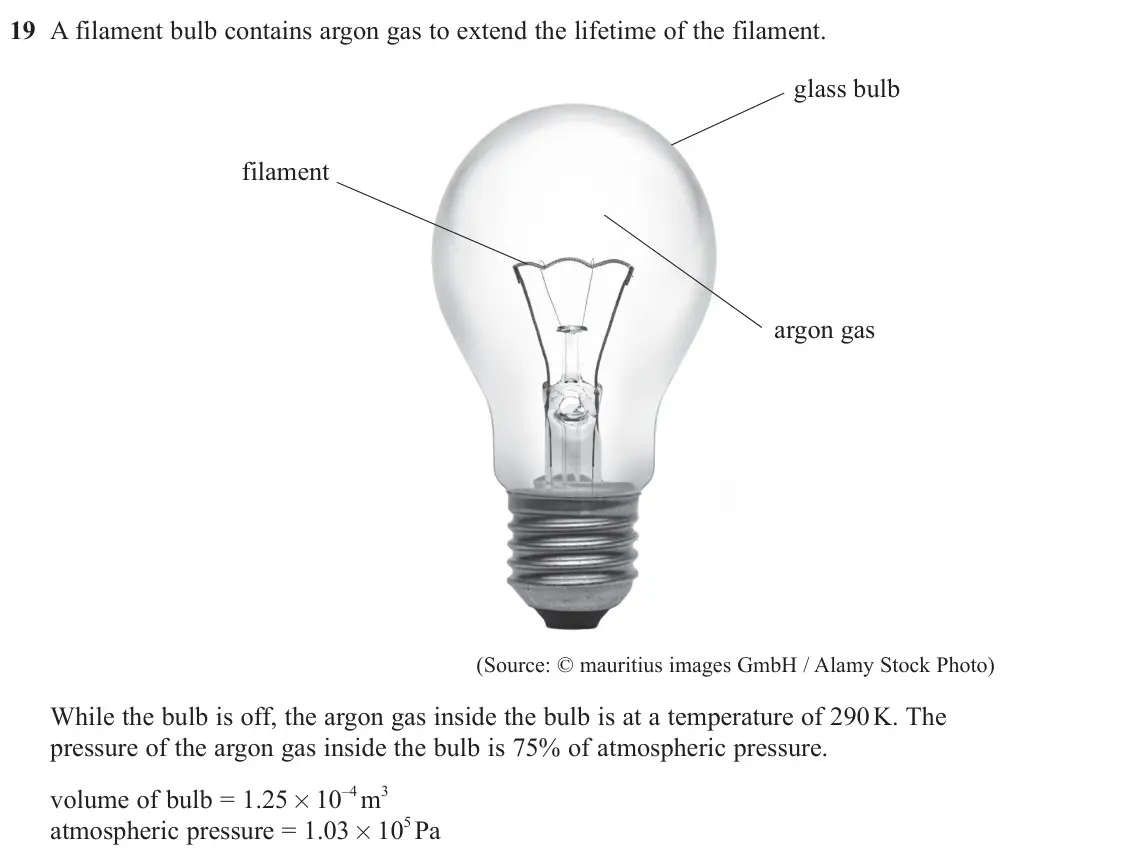
Q19(b)
The whole paper ↗Q1(b)
The whole paper ↗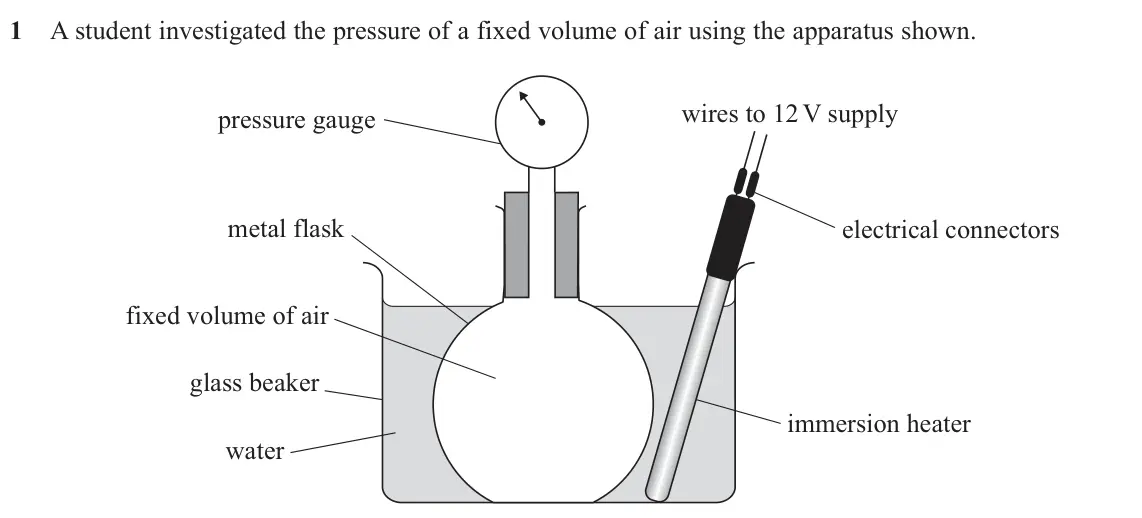
Q1(c)(iii)
The whole paper ↗Q13(b)
The whole paper ↗
- Your answer
Q12(a)
The whole paper ↗
Q12(b)
The whole paper ↗Q17(a)
The whole paper ↗
Q17(b)
The whole paper ↗- Your answer
- Your answer
- Your answer
Q13(a)
The whole paper ↗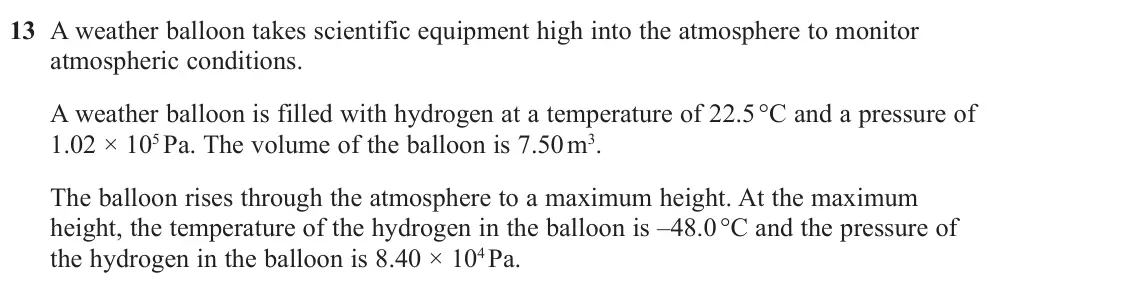
All 26 questions on The ideal gas equation (core practical 14), as a list
- June 2025, Unit 5, Q17(a) (5 marks): Calculate the mass of nitrogen gas needed to exert a pressure of 1.12 × 10 5 Pa inside the globe, at a temperature of 22.0 °C. mass of a nitrogen molecule = 4.6
- January 2025, Unit 5, Q19(a) (3 marks): Calculate the number of argon atoms in the bulb. (3) Number of argon atoms =
- January 2025, Unit 5, Q19(b) (3 marks): While the bulb is on, the pressure of the argon gas is 83% of atmospheric pressure. The manufacturer states that the temperature of the gas inside the bulb is a
- January 2025, Unit 6, Q1(b) (3 marks): The student determined the temperature θ of the fixed volume of air. Describe an accurate method to determine a single value of θ. (3)
- January 2025, Unit 6, Q1(c)(iii) (4 marks): The diameter of the flask was 15 cm. Determine the number of air molecules in the flask. You may assume the volume of air is spherical. (4) Number of air molecu
- October 2024, Unit 5, Q14 (5 marks): Microbes at the bottom of a lake release methane gas. The gas rises to the surface of the lake as bubbles. A methane bubble with a diameter of 1.5 × 10 –3 m is
- June 2024, Unit 5, Q13(b) (4 marks): The pressure of helium inside the balloon is 1.08 × 10 5 Pa at a temperature of 25 °C. Calculate the mass of helium gas in the balloon. volume of balloon = 7020
- January 2024, Unit 5, Q14 (5 marks): A tyre on a racing bicycle contains nitrogen at a temperature of 22 °C. The nitrogen in the tyre has a volume of 2.85 × 10 –4 m 3. The pressure of the nitrogen
- October 2023, Unit 5, Q11 (3 marks): Air is used to inflate a balloon. The inflated balloon has a volume of 1.77 × 10 –3 m 3 and contains 5.15 × 10 22 air molecules. The air inside the balloon exer
- October 2023, Unit 5, Q12 (4 marks): A student investigated the relationship between the pressure and volume of a fixed mass of gas at constant temperature. He used his data to plot the following g
- June 2023, Unit 5, Q9 (1 mark): Two gas cylinders have the same volume. One cylinder contains nitrogen gas. The other cylinder contains oxygen gas. Both gases are at the same temperature and p
- June 2023, Unit 5, Q12(a) (3 marks): Show that the number of molecules of nitrogen gas released into the airbag is about 2 × 10 24. temperature of gas in airbag = 25 °C (3)
- June 2023, Unit 5, Q12(b) (2 marks): Nitrogen gas escapes from small holes in the inflated airbag. The pressure decreases to 3.45 × 10 4 Pa. Calculate the number of nitrogen molecules that escape f
- January 2023, Unit 5, Q17(a) (4 marks): A scuba tank contains air at a pressure of 1.28 × 10 7 Pa and a temperature of 17.5 °C. The scuba tank is left outside on a sunny day and the temperature of the
- January 2023, Unit 5, Q17(b) (6 marks): Explain why the pressure of the air inside the scuba tank increases as the temperature increases. Your answer should refer to the motion of the air molecules. (
- October 2022, Unit 5, Q2 (1 mark): The pressure law states that, if certain conditions are met, the pressure exerted by an ideal gas is proportional to the temperature of the gas. Which of the fo
- October 2022, Unit 5, Q12 (5 marks): A cylinder contains oxygen gas at a temperature of 25 °C and a pressure of 1.4 × 10⁷ Pa. Calculate the density of the oxygen gas in the cylinder. mass of an oxy
- June 2022, Unit 5, Q8 (1 mark): Boyle’s law states that, under certain conditions, the pressure exerted by a gas is inversely proportional to the volume occupied by the gas. Which of the follo
- January 2022, Unit 5, Q5 (1 mark): A fixed mass of an ideal gas has a volume V and exerts a pressure p. The absolute temperature of the gas is T. When the gas is heated, the new pressure is 4p. W
- January 2022, Unit 5, Q13(a) (3 marks): Calculate the volume of the balloon at the maximum height. (3) Volume of balloon =
- January 2022, Unit 6, Q1(a) (1 mark): Suggest why one end of the tube is left open. (1)
- October 2021, Unit 5, Q14(a) (3 marks): At a temperature of 20.0 °C and a pressure of 1.01 × 10⁵ Pa the volume occupied by 1 mole of carbon dioxide is 0.0241 m3. Show that the number of molecules in 1
- June 2021, Unit 5, Q11(b) (2 marks): The apparatus is used in a laboratory where the temperature is 293 K. When the air occupies a volume of 2.43 × 10⁻³ m3 the reading on the pressure gauge is 1.05
- January 2021, Unit 5, Q14(a) (3 marks): The gas in the cylinder is at a temperature of 20 °C. Calculate the pressure exerted by the gas. (3) Pressure exerted by gas =
- January 2021, Unit 5, Q14(b) (2 marks): Gas is removed from the cylinder. The temperature of the gas decreases by 5.0 °C and the new pressure of the gas is 4.50 ´ 105 Pa. Calculate the percentage of t
- October 2020, Unit 5, Q17(a) (6 marks): A football was inflated with air at a temperature of 16.0 °C. When inflated, the circumference of the football was 68.5 cm and it contained 2.50 × 10²³ molecule
Questions, mark schemes and examiner’s reports are © Pearson Edexcel, from their published past papers. Plumi isn’t affiliated with any exam board. Want whole papers? Edexcel International A Level Physics past papers.
The Plumi iPad app also offers exam-style questions with AI feedback on your handwritten working.