 plumi
Reflection, transmission and pulse-echo techniques: Edexcel International A Level Physics questions
Edexcel International A Level Physics past-paper questions on 2.3.5.1 Reflection, transmission and pulse-echo techniques, 2019–2025, with mark schemes and examiner’s reports where available.
Paper
All papers
Exam
All years
Calculations
Q13(a)
The whole paper ↗
Q13(b)
The whole paper ↗- Your answer
- Your answer
Q13(a)
The whole paper ↗
Q13(b)
The whole paper ↗Q13(c)
The whole paper ↗Q3(b)
The whole paper ↗
- Your answer
Q15(a)
The whole paper ↗
Q15(b)
The whole paper ↗Q15(c)
The whole paper ↗- Your answer
- Your answer
Q12(a)
The whole paper ↗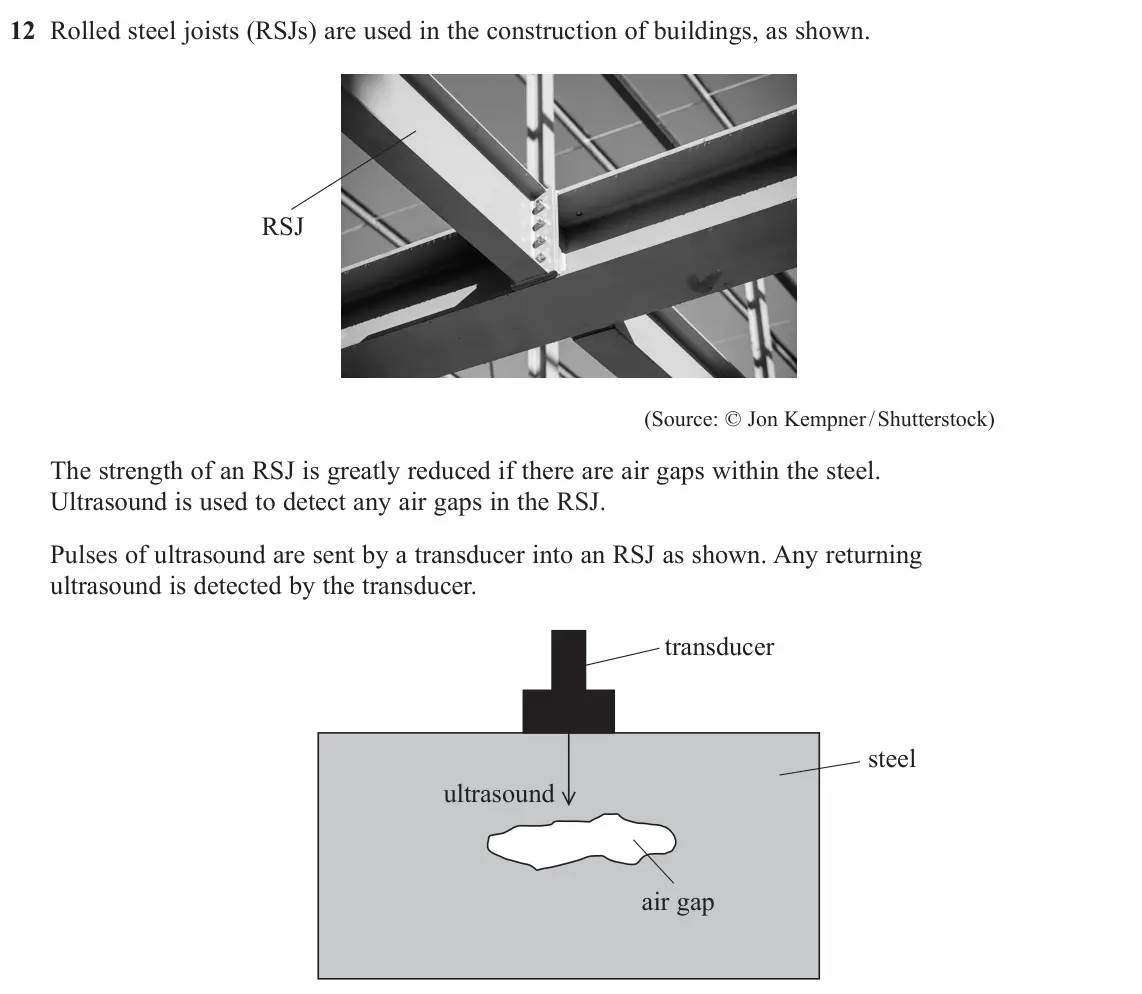
Q12(b)
The whole paper ↗Q18(c)(i)
The whole paper ↗
Q18(d)
The whole paper ↗- Your answer
All 24 questions on Reflection, transmission and pulse-echo techniques, as a list
- June 2025, AS Unit 2, Q13(a) (4 marks): In this piece of concrete, the speed v of ultrasound varies with temperature, as shown. 4250 4200 4150 v / m s–1 4100 4050 4000 0 5 10 15 20 25 30 35 40 Tempera
- June 2025, AS Unit 2, Q13(b) (2 marks): Pulses of ultrasound with a higher frequency can be used to find cracks of shorter length. Explain why a higher frequency is used. (2)
- January 2025, AS Unit 2, Q3 (1 mark): A car has a distance sensor that uses a pulse-echo technique to determine the distance between the car and a nearby object. The sensor emits a pulse of sound an
- October 2024, AS Unit 2, Q3 (1 mark): A student stands a distance d from a wall. She makes a loud sound. She hears the echo of the sound from the wall after a time t. Which of the following expressi
- June 2024, AS Unit 2, Q13(a) (3 marks): The transducer emits a pulse of sound and detects an echo from a fish after a time of 37 ms. speed of sound in water = 1500 m s –1 Calculate the distance betwee
- June 2024, AS Unit 2, Q13(b) (2 marks): After each pulse is emitted by the transducer, there is a fixed time T before the next pulse is emitted. Explain how T affects the maximum distance at which a f
- June 2024, AS Unit 2, Q13(c) (2 marks): The transducer can emit pulses of sound waves of different frequency. Explain how the frequency should be adjusted to improve the accuracy when detecting the lo
- June 2024, AS Unit 3, Q3(b) (4 marks): The ultrasonic transducer emitted pulses of ultrasound. The emitted pulses were reflected at the water surface and then detected when they returned to the ultra
- October 2023, AS Unit 2, Q3 (1 mark): Which of the following would increase the detail in an ultrasound scan? A increasing the duration of the pulses B increasing the frequency of the ultrasound C i
- October 2023, AS Unit 2, Q11 (3 marks): Some animals use a pulse-echo technique to collect information about their surroundings. Describe how this technique provides information about the surroundings
- June 2023, AS Unit 2, Q15(a) (3 marks): Explain why there is a returning pulse from crack B. (3)
- June 2023, AS Unit 2, Q15(b) (3 marks): One pulse returns 1.4 × 10 −5 s after being emitted by the transducer. Deduce whether the pulse has returned from crack A, crack B or crack C. You should take m
- June 2023, AS Unit 2, Q15(c) (2 marks): Explain why ultrasound used to detect cracks in metal beams usually has frequencies of MHz, rather than kHz. (2)
- January 2023, AS Unit 2, Q5 (1 mark): A bat is an animal that locates objects using a pulse‑echo technique. A bat emits a pulse of sound waves that travel to an object. The bat detects the reflected
- October 2022, AS Unit 2, Q9 (1 mark): Ultrasound scans can be used to create an image of a patient’s kidneys. For each ultrasound pulse sent into the body, a number of pulses are detected. Which of
- January 2022, AS Unit 2, Q12(a) (4 marks): Explain how this arrangement can be used to show whether the RSJ contains an air gap. (4)
- January 2022, AS Unit 2, Q12(b) (3 marks): Ultrasound is a sound wave with a frequency greater than 20 kHz. The frequency of ultrasound used by the transducer in this method is 5 MHz. Explain why a much
- October 2021, AS Unit 2, Q18(c)(i) (2 marks): Calculate the height that ICESat-2 orbits above the surface of the Earth. (2) Height above Earth =
- October 2021, AS Unit 2, Q18(d) (2 marks): At one point, ICESat-2 passes over a flat ice sheet. The ice sheet is 1000 m above sea level. Explain how the measurements taken by ICESat-2 can be used to show
- June 2021, AS Unit 2, Q9 (1 mark): A pulse of ultrasound is emitted from the bottom of a boat. The ultrasound reflects from the seabed and is detected at the bottom of the boat after time t. The
- January 2021, AS Unit 2, Q3 (1 mark): Ultrasound can be used to investigate organs inside the human body. Which of the following statements about ultrasound is correct? A All of the ultrasound is re
- October 2020, AS Unit 2, Q5 (1 mark): Ultrasound has a number of different uses in medicine. Which of the following is the main reason why ultrasound is not used to perform scans of the chest and lu
- January 2020, AS Unit 2, Q13 (6 marks): * 13 A pulse‑echo technique, using ultrasound, can be used to produce images of an unborn baby as shown. Explain how the ultrasound scan of the unborn baby is p
- June 2019, AS Unit 2, Q7 (1 mark): An ultrasound transducer is placed on the surface of a solid object as shown. transducer solid object 10 cm A pulse of ultrasound is transmitted into the object
Questions, mark schemes and examiner’s reports are © Pearson Edexcel, from their published past papers. Plumi isn’t affiliated with any exam board. Want whole papers? Edexcel International A Level Physics past papers.
The Plumi iPad app also offers exam-style questions with AI feedback on your handwritten working.