 plumi
Doppler effect, redshift and Hubble’s law: Edexcel International A Level Physics questions
Edexcel International A Level Physics past-paper questions on 5.6.4.1 Doppler effect, redshift and Hubble’s law, 2019–2025, with mark schemes and examiner’s reports where available.
Paper
All papers
Exam
All years
Calculations
- Your answer
Q18(b)
The whole paper ↗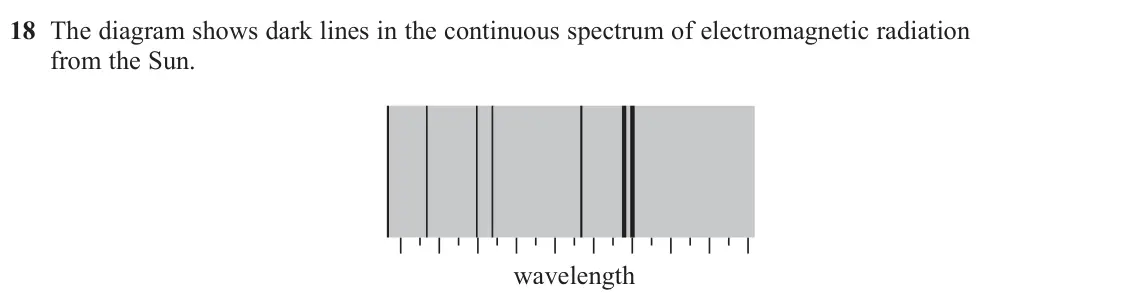
Q17(a)(i)
The whole paper ↗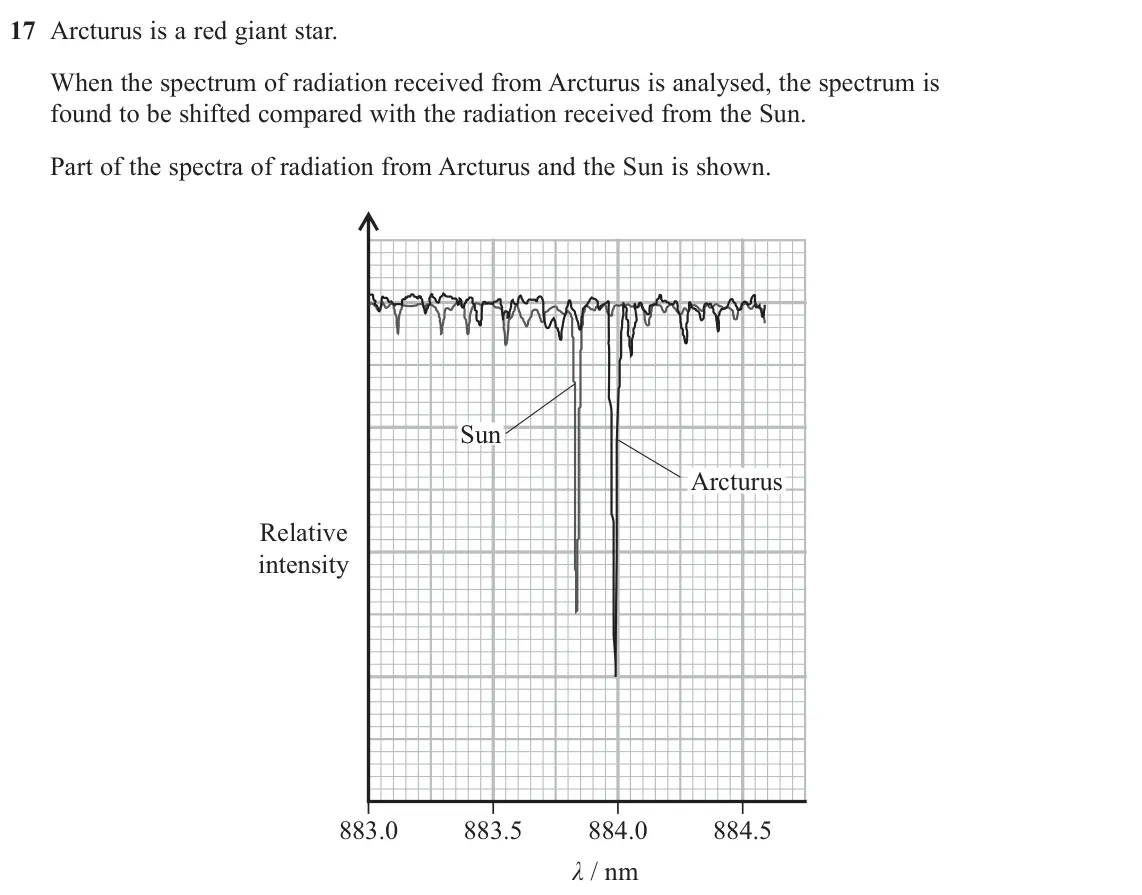
Q17(a)(ii)
The whole paper ↗Q17(b)
The whole paper ↗Q16(b)
The whole paper ↗
Q18(c)
The whole paper ↗
- Your answer
Q14(a)
The whole paper ↗
Q14(b)
The whole paper ↗Q21(b)
The whole paper ↗
- Your answer
- Your answer
- Your answer
- Your answer
Q15(a)
The whole paper ↗
Q15(b)
The whole paper ↗Q15(c)
The whole paper ↗
All 35 questions on Doppler effect, redshift and Hubble’s law, as a list
- June 2025, Unit 5, Q5 (1 mark): On Earth, hydrogen is observed to emit a spectral line with a wavelength of 410 nm. The same spectral line is observed in the radiation received from a galaxy t
- January 2025, Unit 5, Q18(b) (5 marks): The Sun rotates on its axis. The diagram shows the Sun rotating at its ‘equator’. Sun equator of Sun (Source: © NASA / SDO / SCIENCE PHOTO LIBRARY) One of the d
- October 2024, Unit 5, Q17(a)(i) (2 marks): Explain why the spectrum of radiation received from Arcturus is shifted as shown. (2)
- October 2024, Unit 5, Q17(a)(ii) (3 marks): Determine the speed of Arcturus relative to the Sun. (3) Speed of Arcturus =
- October 2024, Unit 5, Q17(b) (3 marks): When light from galaxies is analysed, a shift towards greater wavelengths in the spectra of radiation is observed. Describe how astronomers use a knowledge of t
- June 2024, Unit 5, Q16(b) (3 marks): ε-Eridani is moving away from the Earth with a velocity of 1.55 × 10 A scientist observed the light received from ε-Eridani using a spectrometer. Deduce whether
- January 2024, Unit 5, Q13 (3 marks): A particular line in the spectrum of light from a source in the laboratory has a frequency of 6.173 × 10 14 Hz. The same line in the spectrum of light from a di
- January 2024, Unit 5, Q18(c) (4 marks): NGC 1357 is a spiral galaxy moving away from the Milky Way at a speed of 2.02 × 10 6 m s –1. The spiral galaxy is 8.70 × 10 23 m from the Earth. Calculate a val
- October 2023, Unit 5, Q5 (1 mark): A star is moving away from the Earth. The wavelengths of spectral lines in the light received from the star are measured. These wavelengths are not the same as
- October 2023, Unit 5, Q14(a) (1 mark): State how astronomers knew that galaxies were moving away from the Earth. (1)
- October 2023, Unit 5, Q14(b) (3 marks): Hubble suggested that the recessional velocity v of a galaxy was related to the distance d of the galaxy from the Earth by the expression v = H0 d where H0 is a
- October 2023, Unit 5, Q21(b) (6 marks): The final stage of evolution for a massive star may be a rotating neutron star. One neutron star rotates with a period of 33.5 ms. As this star rotates, one sid
- June 2023, Unit 5, Q2 (1 mark): A hydrogen source on Earth emits a spectral line with a wavelength of 410 nm. An observer determines the wavelength of the same line in the spectrum of a star.
- June 2023, Unit 5, Q5 (1 mark): Measurements related to a distant galaxy may be used to determine the value of the Hubble constant. Which two measurements related to a distant galaxy must be u
- January 2023, Unit 5, Q5 (1 mark): Absorption lines in the spectrum of light from a star are shifted to higher frequencies than the same lines viewed from a source on Earth. Which of the followin
- January 2023, Unit 5, Q13 (5 marks): The following statement appears on a website: Messier 87 (M87) is 55 million light‑years from Earth. The spectrum of light from M87 includes an absorption line
- October 2022, Unit 5, Q6 (1 mark): A graph of red shift against distance in metres was plotted for a range of nearby galaxies. The value of the gradient of the graph was 5.4 × 10⁻²⁷ Which of the
- October 2022, Unit 5, Q15(a) (2 marks): Radiation with a wavelength of 134 nm was emitted from GN-z11. Calculate the wavelength λo of this radiation when it is detected at the HST. (2) λo =
- October 2022, Unit 5, Q15(b) (3 marks): The graph shows how z, for light emitted from a galaxy, varies with the distance the light has travelled in reaching the Earth. A light year (ly) is the distanc
- October 2022, Unit 5, Q15(c) (2 marks): The recently launched James Webb Space Telescope is designed to operate in the infrared region of the spectrum. Explain why this will be helpful for studying ve
- June 2022, Unit 5, Q3 (1 mark): Which of the following does not have the base unit s–1? A angular velocity B frequency C redshift D rate of decay
- June 2022, Unit 5, Q12(a)(i) (2 marks): Show that 72 km s–1 Mpc–1 is equivalent to a Hubble constant of about 2.3 × 10⁻¹⁸ s–1. 1 Mpc = 3.09 × 10²² m (2)
- June 2022, Unit 5, Q19(b) (4 marks): One line in the spectrum of light from Chi Lupi has a wavelength of 576.933 nm. The equivalent line in a mercury spectrum produced on Earth is 576.959 nm. A stu
- January 2022, Unit 5, Q6 (1 mark): Current theory suggests that the universe is expanding. Which of the following is evidence to support this theory? A All galaxies appear to be rotating in space
- January 2022, Unit 5, Q9 (1 mark): The spectrum of electromagnetic radiation from a galaxy is observed to have a redshift. Which of the following is a correct statement about lines in this spectr
- October 2021, Unit 5, Q16(a) (1 mark): Complete the table with the letters A, B and C to indicate the point corresponding to each wavelength. (1) λα / nm Point 656.2837 656.2797 656.2757
- October 2021, Unit 5, Q16(b) (2 marks): Explain why there is a variation in the wavelength of the light from different points on the Sun. (2)
- October 2021, Unit 5, Q16(c) (4 marks): In the laboratory, the wavelength of the alpha line in the hydrogen spectrum is 656.2797 nm. Assess whether this is consistent with the Sun having a period of r
- October 2021, Unit 5, Q17(b) (4 marks): Explain how a knowledge of the distances to distant galaxies has enabled astronomers to determine a value for the age of the universe. (4)
- June 2021, Unit 5, Q15(b) (5 marks): Radiation from the star is analysed. The radiation from the star has spectral lines at different wavelengths from the same spectral lines produced by a source i
- January 2021, Unit 5, Q16(a)(i) (2 marks): Explain what is meant by redshift. (2)
- January 2021, Unit 5, Q16(a)(ii) (3 marks): Calculate the distance of NGC 6052 from Earth. H0 = 1.62 ´ 10−18 s−1 (3) Distance of NGC 6052 from Earth =
- January 2021, Unit 5, Q20(b)(i) (4 marks): The graph shows part of the spectrum of radiation received from Andromeda. Relative intensity 390 395 400 Wavelength / nm (Source: © Nasa) The two intensity min
- October 2020, Unit 5, Q12(a) (3 marks): Explain how a massive planet orbiting a star can cause a change in the wavelength of light received from the star. (3)
- October 2020, Unit 5, Q12(b) (2 marks): The maximum shift in a spectral line of wavelength 4.35 × 10⁻⁷ m in the light received from Gliese 876 is 3.19 × 10⁻¹³ m. Calculate the maximum velocity of Glie
Questions, mark schemes and examiner’s reports are © Pearson Edexcel, from their published past papers. Plumi isn’t affiliated with any exam board. Want whole papers? Edexcel International A Level Physics past papers.
The Plumi iPad app also offers exam-style questions with AI feedback on your handwritten working.