 plumi
Charging and discharging curves, time constant (core practical 11): Edexcel International A Level Physics questions
Edexcel International A Level Physics past-paper questions on 4.4.2.2 Charging and discharging curves, time constant (core practical 11), 2019–2025, with mark schemes and examiner’s reports where available.
Paper
All papers
Exam
All years
Calculations
Q17(a)
The whole paper ↗
Q17(b)(i)
The whole paper ↗Q17(b)(iii)
The whole paper ↗Q20(a)(i)
The whole paper ↗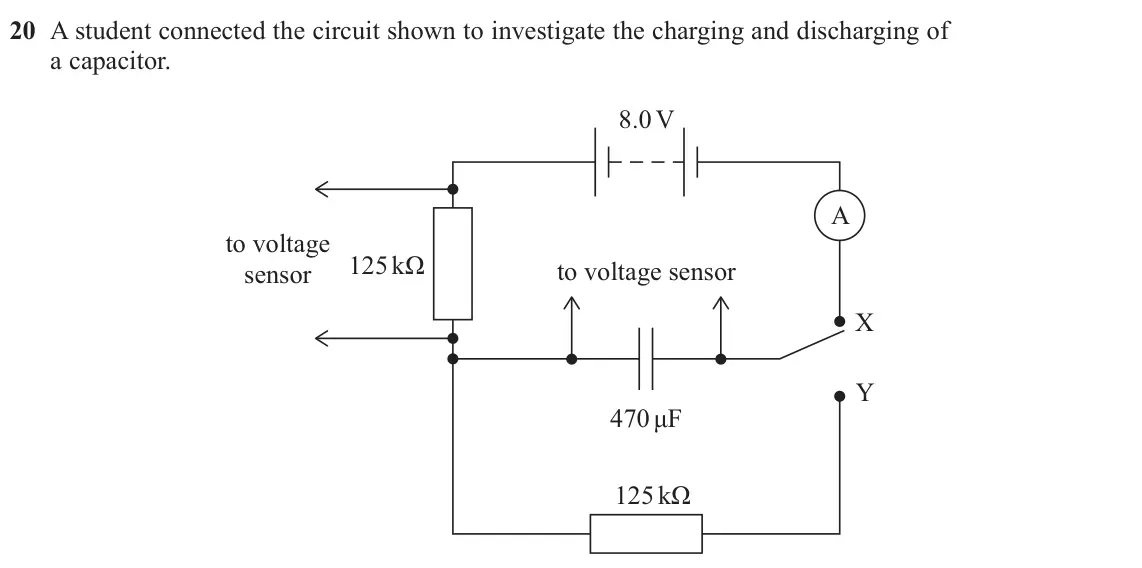
Q20(a)(ii)
The whole paper ↗Q20(b)(i)
The whole paper ↗Q20(b)(ii)
The whole paper ↗Q12(a)
The whole paper ↗
Q12(b)(i)
The whole paper ↗Q18(a)(i)
The whole paper ↗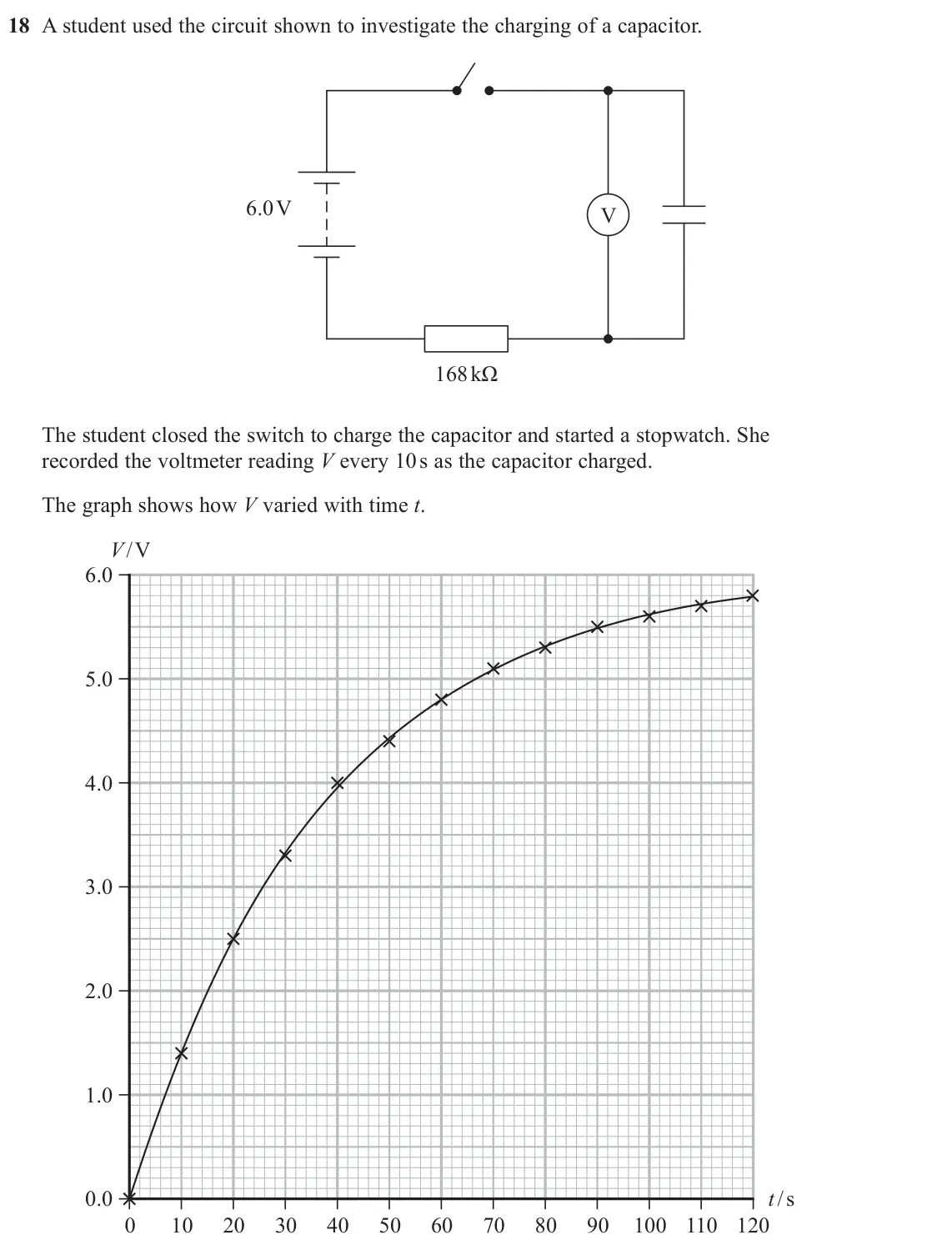
Q18(a)(ii)
The whole paper ↗Q18(b)
The whole paper ↗Q18(a)
The whole paper ↗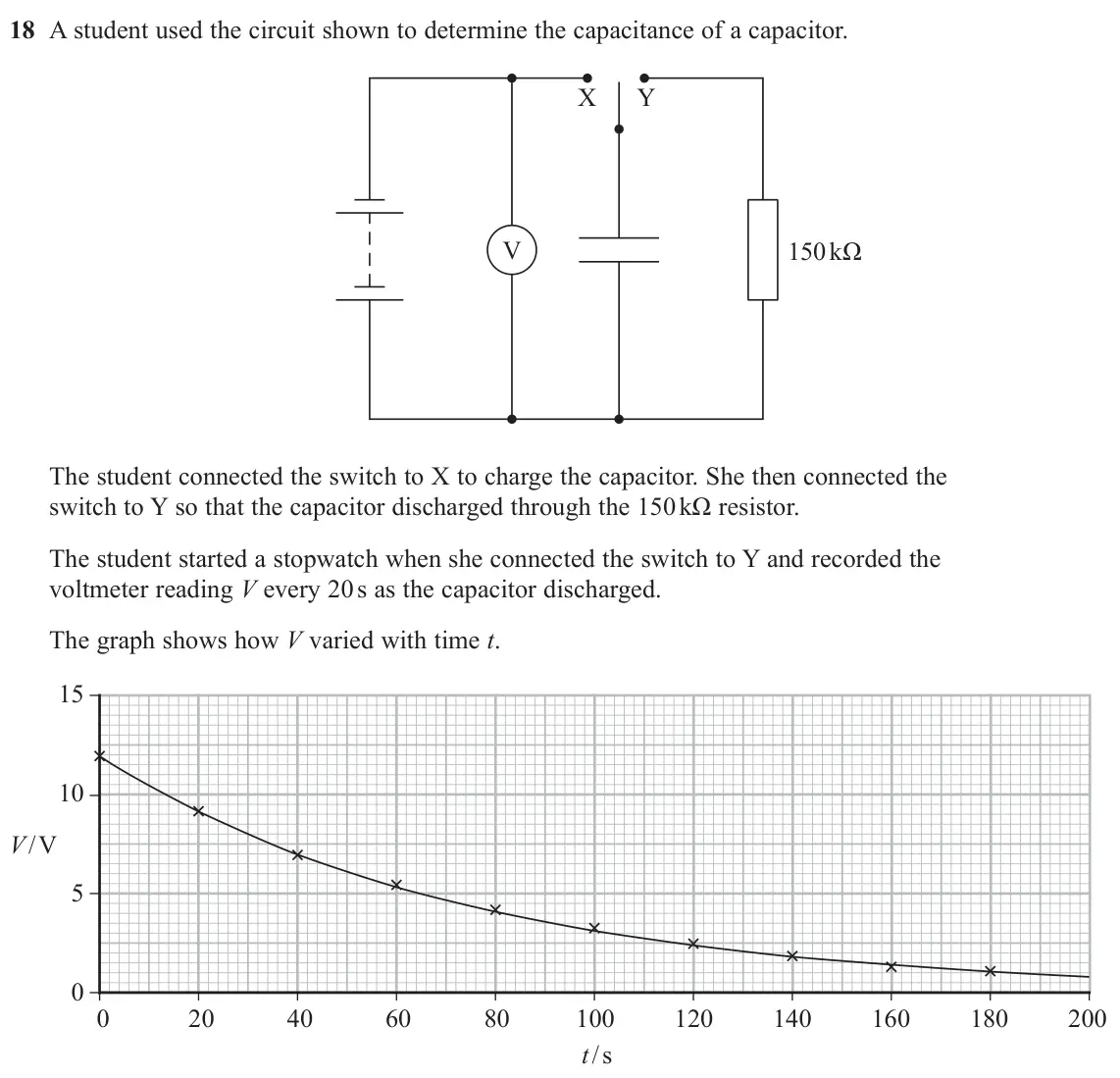
Q16(a)
The whole paper ↗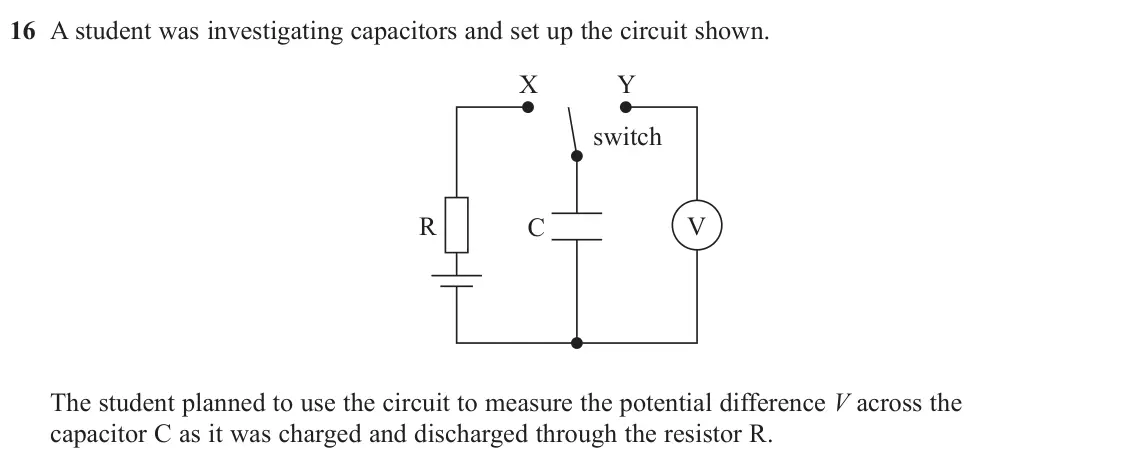
Q16(b)(i)
The whole paper ↗Q12(a)
The whole paper ↗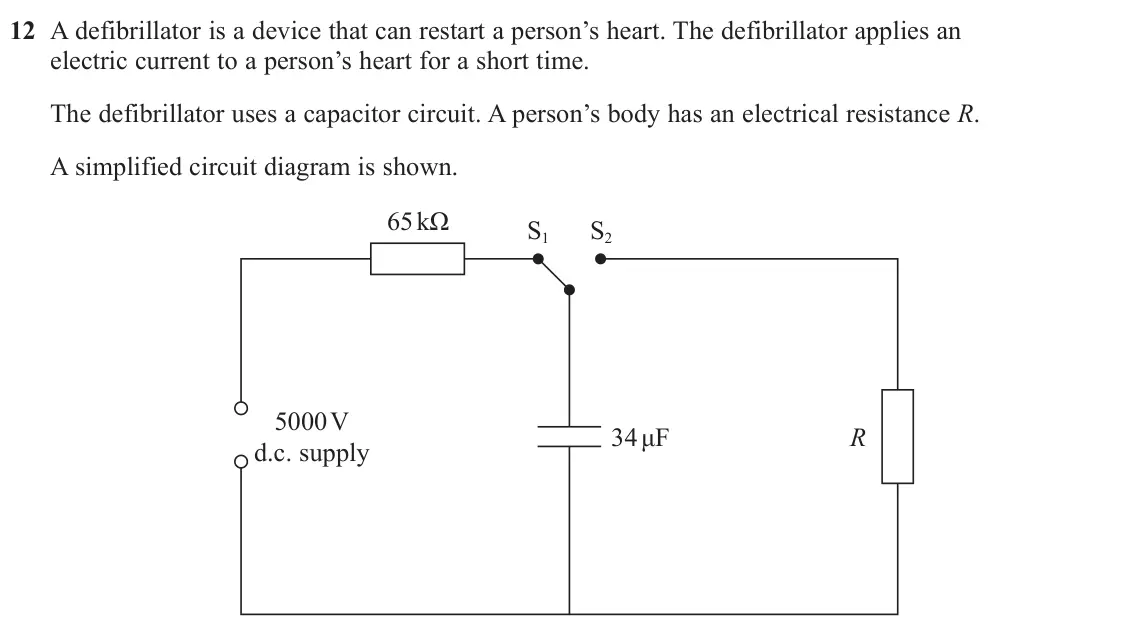
Q15(a)(i)
The whole paper ↗
Q15(a)(ii)
The whole paper ↗Q14(a)
The whole paper ↗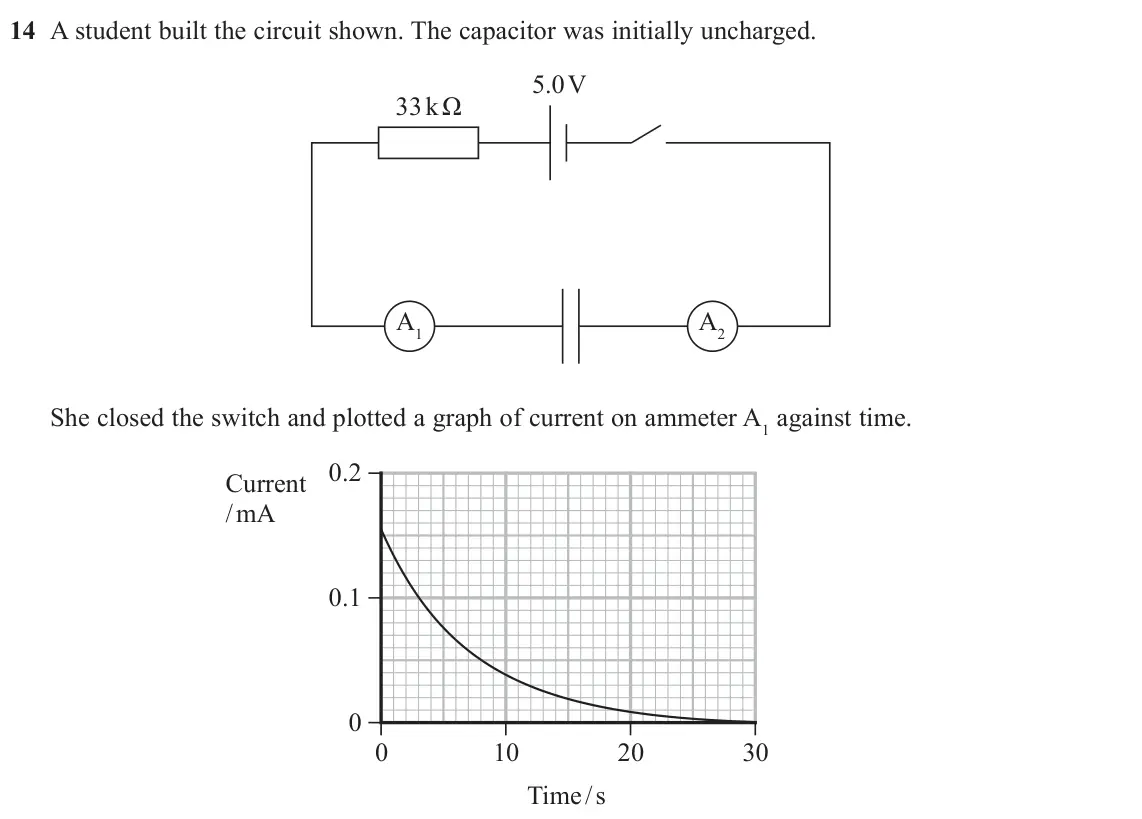
All 32 questions on Charging and discharging curves, time constant (core practical 11), as a list
- June 2025, Unit 4, Q17(a) (1 mark): State the potential difference across the capacitor at the end of a period of discharge. (1) Potential difference =
- June 2025, Unit 4, Q17(b)(i) (5 marks): Deduce whether the output with the capacitor shown on the graph is consistent with a resistor tolerance of ± 5%. (5)
- June 2025, Unit 4, Q17(b)(iii) (3 marks): The resistor is replaced by a bulb with a much lower resistance than 6.8 kΩ. Explain why the output is now very similar to the original output of the power supp
- January 2025, Unit 4, Q20(a)(i) (4 marks): Explain how the current in the circuit varies when the switch is connected to position X. You do not need to do any calculations. (4)
- January 2025, Unit 4, Q20(a)(ii) (3 marks): Sketch a graph to show the variation of current in the circuit as the capacitor is charged. Include the maximum value of current in the circuit. (3)
- January 2025, Unit 4, Q20(b)(i) (2 marks): Show that the time constant of the circuit is about 60 s. (2)
- January 2025, Unit 4, Q20(b)(ii) (3 marks): The student connected the switch to position Y for a time of 3 minutes. Determine, using the time constant of the circuit, the percentage of the original potent
- October 2024, Unit 4, Q14 (6 marks): *14 The diagram shows a circuit with a cell of potential difference (p.d.) V0 in series with a capacitor, a resistor and a switch. A voltmeter measures the pote
- June 2024, Unit 4, Q12(a) (1 mark): Add to the diagram to show a suitable circuit for measuring the current as the capacitor charged. (1)
- June 2024, Unit 4, Q12(b)(i) (3 marks): The resistance of the resistor is 5.1 kΩ. Show that the capacitance of the capacitor is about 0.02 F. (3)
- January 2024, Unit 4, Q18(a)(i) (4 marks): Determine a value for the capacitance C of the capacitor. (4) C =
- January 2024, Unit 4, Q18(a)(ii) (3 marks): Sketch on the axes below how current I in the circuit would vary with t. You should include the value of the maximum current. (3) I 0 t
- January 2024, Unit 4, Q18(b) (3 marks): The student connected a second 168 kΩ resistor in parallel with the first resistor. Explain how the time taken to charge the capacitor would change. You do not
- October 2023, Unit 4, Q18(a) (4 marks): The capacitor is labelled as 470 µF, with a tolerance of ±10%. Evaluate whether the capacitance of the capacitor is within the stated tolerance. (4)
- January 2023, Unit 4, Q16(a) (2 marks): Give two reasons why the circuit did not operate as intended. (2)
- January 2023, Unit 4, Q16(b)(i) (3 marks): Determine the resistance in the circuit when the switch was at position Y. (3) Resistance =
- October 2022, Unit 4, Q12(a) (4 marks): When the capacitor is completely discharged, the two-way switch is moved to position S1 at time t = 0 s. Complete the graph to show how the current varies with
- June 2022, Unit 4, Q15(a)(i) (2 marks): Sketch a graph to show how the potential difference VC across the capacitor varies with time t as the switch is closed. The time constant T for this circuit is
- June 2022, Unit 4, Q15(a)(ii) (2 marks): Explain how the potential difference VR across the resistor varies with time after the switch is closed. (2)
- January 2022, Unit 4, Q14(a) (2 marks): Determine whether the initial value of current on the graph is consistent with the values stated on the circuit diagram. (2)
- January 2022, Unit 4, Q14(b) (2 marks): Explain how the current on ammeter A2 would vary over the same time interval. (2)
- January 2022, Unit 4, Q14(d) (2 marks): Determine the charge stored on the capacitor after 30 s. (2) Charge stored on capacitor after 30 s =
- October 2021, Unit 4, Q14(a) (3 marks): Explain how this circuit can maintain power to the electronic controller if the switch is opened for a short time. (3)
- October 2021, Unit 4, Q14(c) (4 marks): The switch is closed at time t = 0 and then opened at t = 20 s. Sketch a graph on the axes below to show how current I through the resistor varies with t. (4) I
- June 2021, Unit 4, Q17(a) (3 marks): Add to the diagram to show a suitable circuit for charging and discharging the capacitor while measuring the p.d. across it. (3)
- June 2021, Unit 4, Q17(b)(i) (2 marks): Sketch, on the same axes, a graph to show how the p.d. across the resistor varies with time. (2)
- June 2021, Unit 4, Q17(b)(iii) (4 marks): During the charging process, the student recorded the p.d. across the capacitor and the resistance of the resistor. The capacitors available had the following v
- January 2021, Unit 4, Q5 (1 mark): An uncharged capacitor, a resistor, a switch and a cell are connected in series as shown. C R Which of the following shows how the charge stored on the capacito
- January 2021, Unit 6, Q2(a) (3 marks): Draw an appropriate circuit diagram for this investigation. (3)
- January 2021, Unit 6, Q2(c) (6 marks): The student had a stopwatch. Describe how the student should determine an accurate value for the total capacitance of the capacitors. (6)
- October 2020, Unit 4, Q15(c) (5 marks): The student tested the capacitor by charging it until the p.d. across the capacitor was 600 V and recording the p.d. as it was discharged through a resistor of
- January 2020, Unit 4, Q17(b) (3 marks): In practice, the resistance of the LED does not stay constant. The graph shows how current varies with potential difference (p.d.) for the LED. current 0 1.4 V
Questions, mark schemes and examiner’s reports are © Pearson Edexcel, from their published past papers. Plumi isn’t affiliated with any exam board. Want whole papers? Edexcel International A Level Physics past papers.
The Plumi iPad app also offers exam-style questions with AI feedback on your handwritten working.