 plumi
Methods: Edexcel A‑Level Psychology questions
Every Edexcel A-Level Psychology exam question on 9.1 Methods, 2016–2025, with its mark scheme and examiner’s report.
Find questions946
Exam
All years
Calculations
Q1(a)
The whole paper ↗
Q1(b)
The whole paper ↗
Q1(c)
The whole paper ↗
Q1(d)
The whole paper ↗
Q1(e)
The whole paper ↗
Q1(f)
The whole paper ↗
Q2(a)
The whole paper ↗
Q2(b)
The whole paper ↗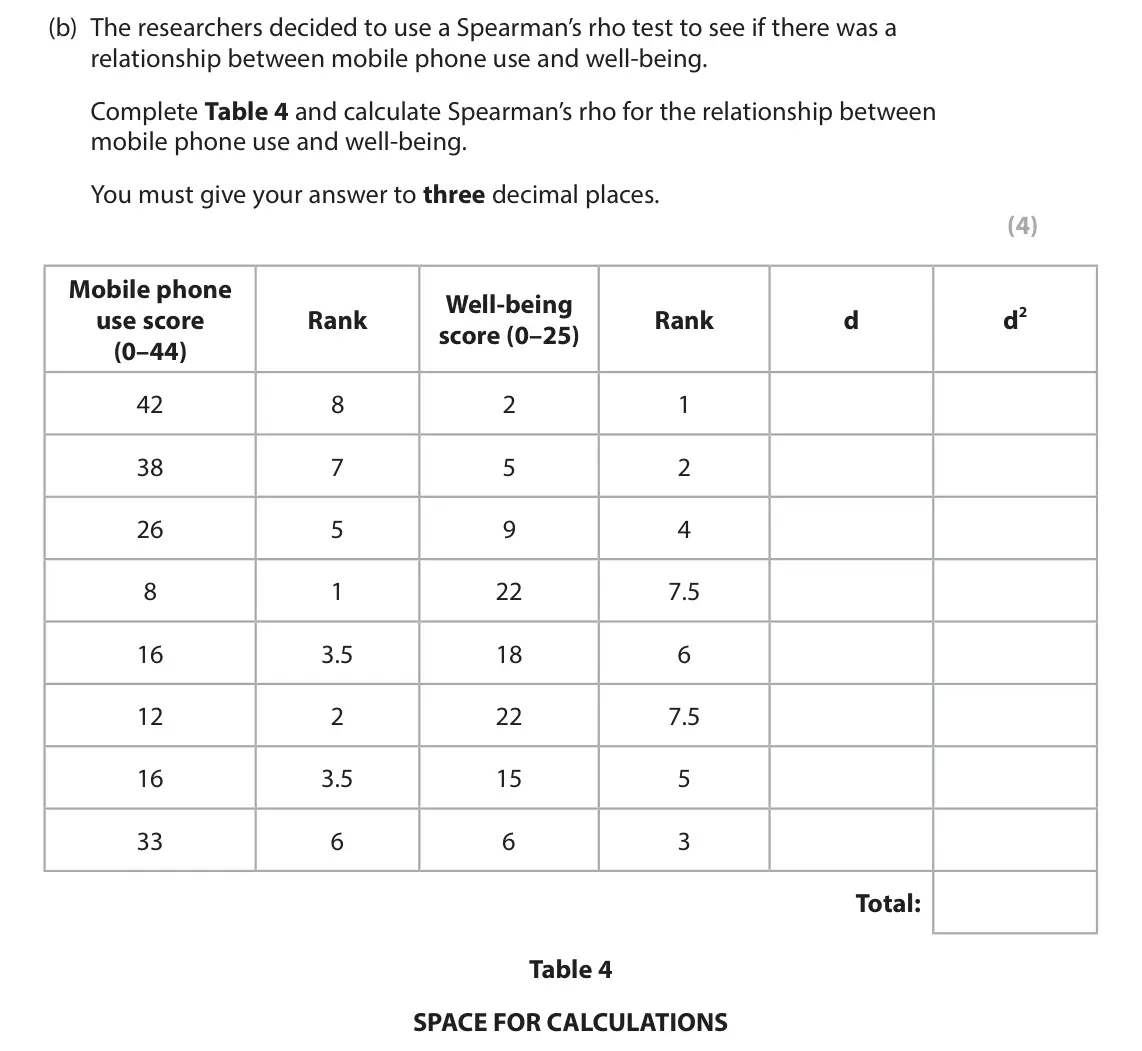
Q2(c)
The whole paper ↗
Q2(d)
The whole paper ↗
Q1(a)
The whole paper ↗
Q1(b)
The whole paper ↗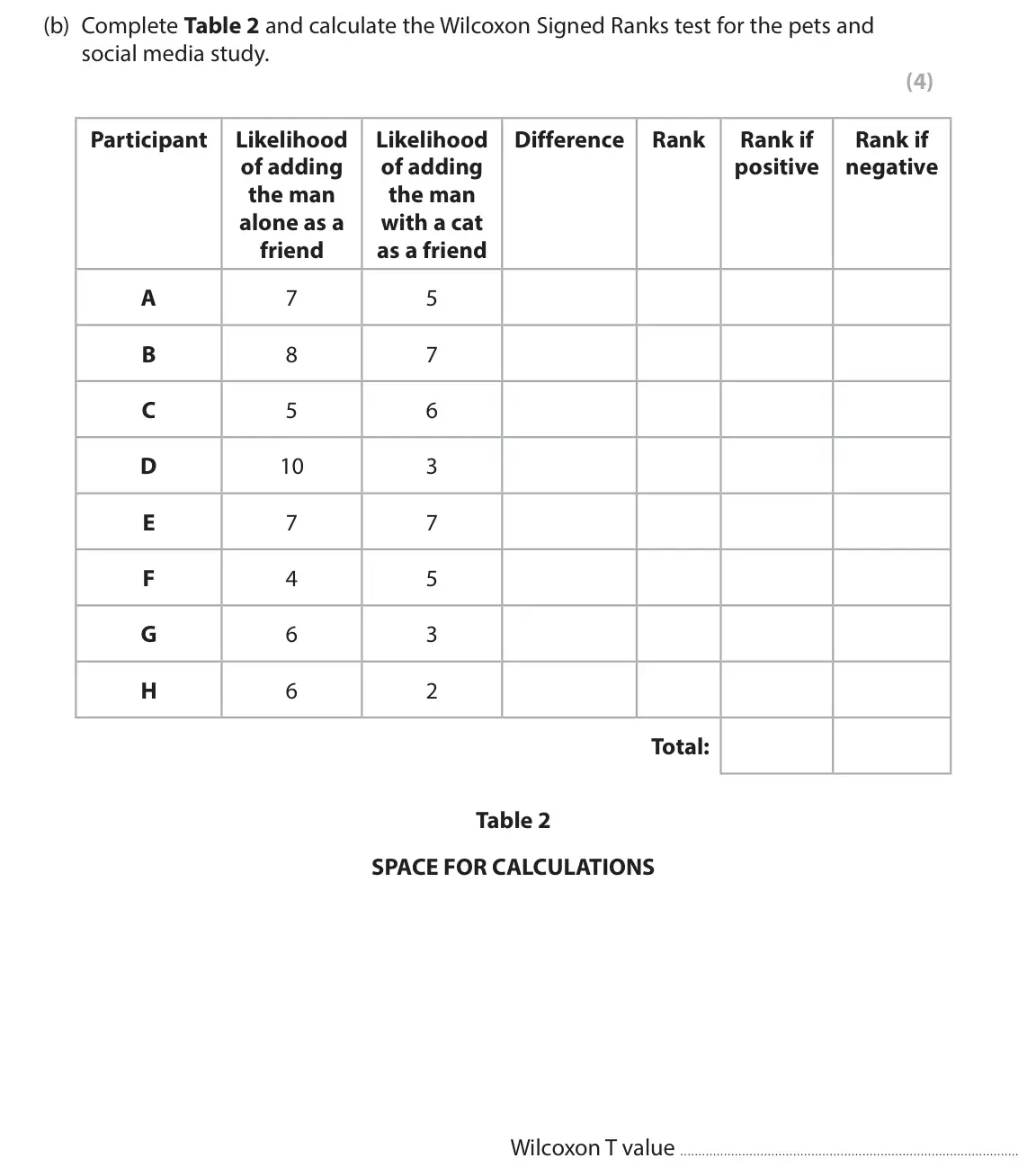
Q1(c)
The whole paper ↗
Q2(a)
The whole paper ↗
Q2(b)
The whole paper ↗
Q2(c)
The whole paper ↗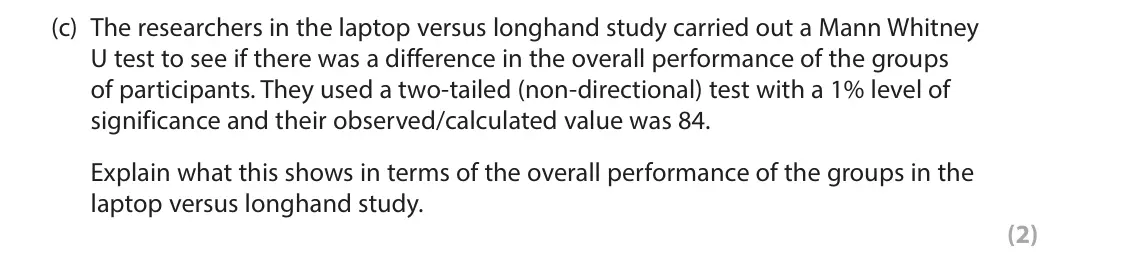
Q2(d)
The whole paper ↗
Q2(e)
The whole paper ↗
Q3(a)
The whole paper ↗
Q1(a)
The whole paper ↗
All 84 questions on Methods, as a list
- June 2025, Paper 3, Q1(a) (2 marks): Explain one conclusion that could be made from the data in Figure 1 in terms of the quantity of screen use. (2) 1 Screen use and language skills Researchers wan
- June 2025, Paper 3, Q1(b) (1 mark): Calculate the percentage of studies that found children’s language skills to be greater than the mean of 100, out of all the studies which considered quantity o
- June 2025, Paper 3, Q1(c) (2 marks): Explain one conclusion that could be made from the data in Table 1 in terms of the quality of screen use. (2) 1 Screen use and language skills Researchers wante
- June 2025, Paper 3, Q1(d) (2 marks): Explain one conclusion that could be made from the data in Table 2 in terms of the onset of screen use. (2) 1 Screen use and language skills Researchers wanted
- June 2025, Paper 3, Q1(e) (4 marks): All of the research studies considered by the researchers had been through the process of peer review. Explain one strength and one weakness of using studies th
- June 2025, Paper 3, Q1(f) (2 marks): Explain one improvement that could have been made to the screen use and language skills study. (2) 1 Screen use and language skills Researchers wanted to invest
- June 2025, Paper 3, Q2(a) (1 mark): Calculate the mean score for the participants’ satisfaction with life using the data in Table 3. You must give your answer to one decimal place. (1) 2 Mobile ph
- June 2025, Paper 3, Q2(b) (4 marks): The researchers decided to use a Spearman’s rho test to see if there was a relationship between mobile phone use and well-being. Complete Table 4 and calculate
- June 2025, Paper 3, Q2(c) (2 marks): The researchers in the mobile phone use and well-being study used primary data. Explain one weakness of using primary data for the mobile phone use and well‑bei
- June 2025, Paper 3, Q2(d) (4 marks): Explain one strength and one weakness of using correlational research for the mobile phone use and well-being study. (4) 2 Mobile phone use and well-being study
- June 2024, Paper 3, Q1(a) (4 marks): Explain two conclusions you can make using the data in Table 1. (4) 1 Pets and social media study Researchers wanted to investigate the perceptions of people wi
- June 2024, Paper 3, Q1(b) (4 marks): Complete Table 2 and calculate the Wilcoxon Signed Ranks test for the pets and social media study. (4) Participant Likelihood Likelihood Difference Rank Rank if
- June 2024, Paper 3, Q1(c) (4 marks): Explain one strength and one weakness of using a questionnaire in the pets and social media study. (4) 1 Pets and social media study Researchers wanted to inves
- June 2024, Paper 3, Q2(a) (2 marks): Describe how the researchers of the laptop versus longhand study could have used a stratified sampling technique to recruit the participants. (2) 2 Laptop versu
- June 2024, Paper 3, Q2(b) (2 marks): Explain one conclusion you can make using the data in Table 3. (2) 2 Laptop versus longhand study Researchers wanted to investigate the effectiveness of differe
- June 2024, Paper 3, Q2(c) (2 marks): The researchers in the laptop versus longhand study carried out a Mann Whitney U test to see if there was a difference in the overall performance of the groups
- June 2024, Paper 3, Q2(d) (2 marks): The researchers in the laptop versus longhand study used a field experiment. Explain one strength of using a field experiment for the laptop versus longhand stu
- June 2024, Paper 3, Q2(e) (4 marks): Explain two improvements that could have been made to the laptop versus longhand study. (4) 2 Laptop versus longhand study Researchers wanted to investigate the
- June 2024, Paper 3, Q3(a) (2 marks): Explain one weakness of using a meta‑analysis for the screen advertising and children study. (2) 3 Screen advertising and children study Researchers wanted to i
- June 2023, Paper 3, Q1(a) (1 mark): Identify the dependent variable (DV) in the eye contact study. (1) 1 Eye contact study Eye contact could be used as a non-verbal cue to help interpret an indivi
- June 2023, Paper 3, Q1(b) (2 marks): Explain one conclusion you can make using the data in Table 1. (2) 1 Eye contact study Eye contact could be used as a non-verbal cue to help interpret an indivi
- June 2023, Paper 3, Q1(c) (3 marks): Using the data in Table 2, draw a bar chart to represent the male and female data for eye contact with a duration of 5 seconds. (3) 1 Eye contact study Eye cont
- June 2023, Paper 3, Q1(d) (2 marks): Explain one improvement that could have been made to the eye contact study. (2) 1 Eye contact study Eye contact could be used as a non-verbal cue to help interp
- June 2023, Paper 3, Q2(a) (4 marks): The researchers in the helping behaviour study used opportunity sampling to recruit the participants for their study. Explain one strength and one weakness of u
- June 2023, Paper 3, Q2(b) (2 marks): Explain one conclusion you can make using the data in Table 3. (2) 2 Helping behaviour study Researchers wanted to see whether being in close proximity to luxur
- June 2023, Paper 3, Q2(c) (2 marks): Explain one conclusion you can make using the data in Table 4. (2) 2 Helping behaviour study Researchers wanted to see whether being in close proximity to luxur
- June 2023, Paper 3, Q2(d) (2 marks): The researchers in the helping behaviour study decided to carry out a chi-squared test on their data from Table 5. They found an observed/calculated value of 1.
- June 2023, Paper 3, Q2(e) (2 marks): State two reasons why the researchers in the helping behaviour study used a chi-squared test to analyse their data in Table 5. (2) 2 Helping behaviour study Res
- June 2023, Paper 3, Q2(f) (2 marks): The researchers collected quantitative data when recording whether the participant would help the confederate or not for the helping behaviour study. Explain on
- June 2023, Paper 3, Q2(g) (2 marks): The researchers used a field experiment for the helping behaviour study. Explain one weakness of using a field experiment for the helping behaviour study. (2) 2
- June 2022, Paper 3, Q1(a) (4 marks): Explain one strength and one weakness of using a cross-sectional design for the junior to senior Pinocchio study. (4) 1 Junior to senior Pinocchio study Approxi
- June 2022, Paper 3, Q1(b) (4 marks): Explain two conclusions you can make using the data in Table 2 regarding the lying ability of the participants in the age categories. (4) 1 Junior to senior Pin
- June 2022, Paper 3, Q1(c) (2 marks): Explain one weakness of the junior to senior Pinocchio study in terms of validity. (2) 1 Junior to senior Pinocchio study Approximately 1000 participants were r
- June 2022, Paper 3, Q1(d) (2 marks): Explain one strength of the junior to senior Pinocchio study in terms of reliability. (2) 1 Junior to senior Pinocchio study Approximately 1000 participants wer
- June 2022, Paper 3, Q1(e) (1 mark): State one conclusion that could be made from Figure 1 with reference to the type of skew shown. (1) 1 Junior to senior Pinocchio study Approximately 1000 partic
- June 2022, Paper 3, Q1(f) (1 mark): Calculate the overall mean lying frequency for the participants using the data in Table 3. You must give your answer to one decimal place. (1) 1 Junior to senio
- June 2022, Paper 3, Q1(g) (2 marks): The researchers used a volunteer sampling technique to gather the participants for the junior to senior Pinocchio study. Explain one weakness with using a volun
- June 2022, Paper 3, Q2(a) (4 marks): Calculate the standard deviation for the vocabulary score using the data in Table 4. Show your working and give your answer to two decimal places. (4) SPACE FOR
- June 2022, Paper 3, Q2(b) (2 marks): Explain one reason for using the standard deviation rather than the range as a measure of dispersion. (2) 2 ‘Textisms’ and literacy study Researchers wanted to
- June 2022, Paper 3, Q2(c) (2 marks): Explain one improvement that could be made to the ‘textisms’ and literacy study. (2) 2 ‘Textisms’ and literacy study Researchers wanted to explore the relations
- June 2022, Paper 3, Q3(a) (2 marks): The researchers wanted to see if there was a significant difference in the perceived effectiveness of crying. They conducted a Mann-Whitney U test and found an
- November 2021, Paper 3, Q1(a) (2 marks): Explain one conclusion you can make regarding ‘extraversion’ using the data in Table 1. (2) 1 Instagram study Researchers investigated whether there was a diffe
- November 2021, Paper 3, Q1(b) (2 marks): Explain one conclusion you can make regarding ‘openness’ using the data in Table 1. (2) 1 Instagram study Researchers investigated whether there was a differenc
- November 2021, Paper 3, Q1(c) (2 marks): Explain one strength of the researchers collecting quantitative data in the Instagram study. (2) 1 Instagram study Researchers investigated whether there was a
- November 2021, Paper 3, Q1(d) (4 marks): The researchers in the Instagram study decided to carry out follow-up unstructured interviews with the observers (group 2). Explain two strengths of using an un
- November 2021, Paper 3, Q2(a) (2 marks): The researchers of the navigation study decided to recruit a sample of participants from the local town. Describe how the researchers could have used a random s
- November 2021, Paper 3, Q2(b) (2 marks): Explain one weakness of using a random sampling technique for the navigation study. (2) Figure 4 shows the strategies used by males and females in the navigatio
- November 2021, Paper 3, Q2(c) (2 marks): Explain one conclusion the researchers of the navigation study could make using the data in Figure 4. (2) 2 Navigation study Researchers wanted to investigate w
- November 2021, Paper 3, Q2(d) (4 marks): The researchers of the navigation study also collected the time taken for males and females to complete the maze task. They summarised their data using categori
- November 2021, Paper 3, Q2(e) (4 marks): Explain two improvements that the researchers could make to the navigation study. (4) 2 Navigation study Researchers wanted to investigate whether there were se
- November 2021, Paper 3, Q3(a) (2 marks): Explain one weakness of the scary and nasty beasts study in terms of validity. (2) 3 Scary and nasty beasts study With animal phobias being one of the most prev
- October 2020, Paper 3, Q1(a) (4 marks): Explain one strength and one weakness of the sampling technique used for the Twitter and Facebook study. (4) 1 Twitter and Facebook study Twitter and Facebook a
- October 2020, Paper 3, Q1(b) (4 marks): Analyse the data provided in Table 1 to explain two conclusions that the researchers in the Twitter and Facebook study might draw from these results. (4) 1 Twit
- October 2020, Paper 3, Q1(c) (2 marks): The Twitter and Facebook study used primary data. Explain one strength of using primary data for the Twitter and Facebook study. (2) 1 Twitter and Facebook stud
- October 2020, Paper 3, Q1(d) (2 marks): The researchers in the Twitter and Facebook study used the mean score to analyse the data from their ranked scale questions. Explain one weakness of using the m
- October 2020, Paper 3, Q2(a) (4 marks): The researchers in the open plan office study used a covert, naturalistic, non- participant observation when measuring face-to-face communication. Explain two s
- October 2020, Paper 3, Q2(b) (4 marks): The researchers in the open plan office study measured electronic communication (emails or instant messages) using quantitative data. Explain one strength and o
- October 2020, Paper 3, Q2(c) (2 marks): Explain one weakness of the open plan office study in terms of generalisability. (2) 2 Open plan office study Researchers wanted to see the impact that removing
- October 2020, Paper 3, Q2(d) (2 marks): Explain one conclusion you can make regarding the open plan office study using the data in Table 2. (2) 2 Open plan office study Researchers wanted to see the i
- October 2020, Paper 3, Q3(a) (2 marks): The researchers decided to use a statistical test for their data to determine significance. They calculated an observed / calculated value of 0.411 for a Spearm
- June 2019, Paper 3, Q1(a) (2 marks): State a fully operationalised directional (one-tailed) experimental hypothesis for the working memory training study. (2) 1 Working memory training Working memo
- June 2019, Paper 3, Q1(b) (1 mark): The number of words correctly recognised (out of 20) by participants was recorded as a measure of memory performance by the researchers. State which level of me
- June 2019, Paper 3, Q1(c) (4 marks): The working memory training study used a laboratory experiment to assess the memory of the participants. Explain two strengths of using a laboratory experiment
- June 2019, Paper 3, Q1(d) (4 marks): The mean results of the working memory training study are shown in Table 1. Performance on memory Performance on memory Group recognition task (out of 20) at re
- June 2019, Paper 3, Q1(e)(i) (3 marks): Draw a histogram to display the data in Table 2. (3) 1 Working memory training Working memory training is where people repeatedly practise increasingly difficul
- June 2019, Paper 3, Q1(e)(ii) (1 mark): Interpret the histogram you have drawn for (e) (i). (1) 1 Working memory training Working memory training is where people repeatedly practise increasingly diffi
- June 2019, Paper 3, Q2(a) (1 mark): Calculate the ratio of those interviewers who reported making their decision in under 1 minute to those interviewers who reported making their decision in more
- June 2019, Paper 3, Q2(b) (2 marks): The researchers also asked the interviewers who made a quick hiring decision to give some information about the factors that helped them make a quick decision.
- June 2019, Paper 3, Q2(c) (4 marks): Explain two ways that subjectivity could have influenced the job interview study. (4) 2 Job interview Researchers wanted to investigate how long it took intervi
- June 2019, Paper 3, Q2(d) (2 marks): Explain one way the researchers could have made sure the job interview study was reliable. (2) 2 Job interview Researchers wanted to investigate how long it too
- June 2018, Paper 3, Q1(a) (1 mark): Identify the experimental/research design used in the lecture notes and learning study. (1) 1 Lecture notes and learning Researchers wanted to see whether provi
- June 2018, Paper 3, Q1(b) (2 marks): Explain how one participant variable could affect the findings of the lecture notes and learning study. (2) 1 Lecture notes and learning Researchers wanted to s
- June 2018, Paper 3, Q1(c) (3 marks): Explain one way the researchers in the lecture notes and learning study could make the study as generalisable as possible to the target population of students.
- June 2018, Paper 3, Q1(d) (4 marks): Complete Table 1 and calculate Mann-Whitney U for the data in Table 1. (4) Experimental Group Control Group Score on test with Score on test with Rank Rank skel
- June 2018, Paper 3, Q1(e) (2 marks): The researchers of the lecture notes and learning study need to decide whether to accept or reject their null hypothesis. They have been warned not to make a Ty
- June 2018, Paper 3, Q1(f) (4 marks): The researchers in the lecture notes and learning study are interested in publishing their work in the British Journal of Educational Psychology. The British Jo
- June 2018, Paper 3, Q2(a) (4 marks): Analyse the data provided in Figure 1 to explain two conclusions that the researchers in the prosocial behaviour and culture study might draw from these results
- June 2018, Paper 3, Q2(b) (4 marks): The prosocial behaviour and culture study used a laboratory experiment. Explain two weaknesses of using a laboratory experiment in the prosocial behaviour and c
- June 2017, Paper 3, Q1(a) (2 marks): State a two-tailed (non-directional) hypothesis for the iPhone effect study. (2) 1 The iPhone Effect Researchers wanted to investigate whether the presence of m
- June 2017, Paper 3, Q1(b) (2 marks): Explain why the experimental/research design used in the iPhone effect study was appropriate. (2) 1 The iPhone Effect Researchers wanted to investigate whether
- June 2017, Paper 3, Q1(c) (2 marks): Explain one strength of using a field experiment for this study. (2) 1 The iPhone Effect Researchers wanted to investigate whether the presence of mobile phones
- June 2017, Paper 3, Q1(d) (4 marks): To measure connectedness and empathetic concern ranked scale questions were used where 1 indicated not close (connectedness) or no concern (empathetic concern)
- June 2017, Paper 3, Q1(e) (6 marks): The results of the study are given below in Table 1. Mobile phone Mobile phone present absent Standard Standard Mean Mean deviation deviation Empathetic concern
- June 2017, Paper 3, Q3(a) (2 marks): The results of the Superman vs The Joker study are given below in Table 2. Superman (hero) The Joker (villain) Pick up and post letter 14 6 Ignore letter 16 24
Questions, mark schemes and examiner’s reports are © Pearson Edexcel, from their published past papers. Plumi isn’t affiliated with any exam board. Want whole papers? Full past papers.
Rather write your answers by hand on iPad? Plumi marks them against the same mark schemes.