 plumi
Methods: Edexcel A‑Level Psychology questions
Every Edexcel A-Level Psychology exam question on 3.2 Methods, 2016–2025, with its mark scheme and examiner’s report.
Find questions946
Exam
All years
Calculations
Q9(a)
The whole paper ↗
Q9(b)
The whole paper ↗
Q9(c)
The whole paper ↗
Q1(b)
The whole paper ↗
Q2(a)
The whole paper ↗
Q2(b)
The whole paper ↗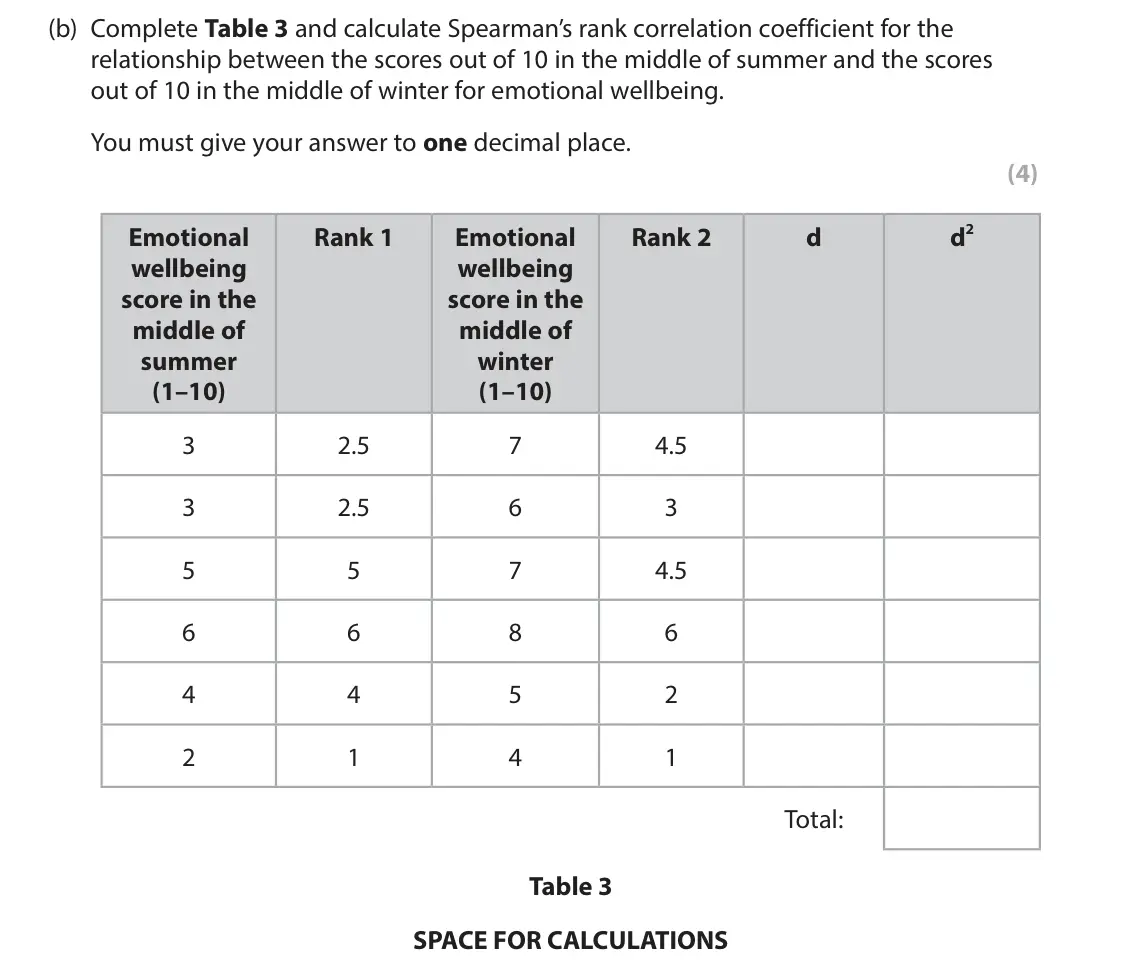
Q2(c)
The whole paper ↗
Q2(d)
The whole paper ↗

Q11(a)
The whole paper ↗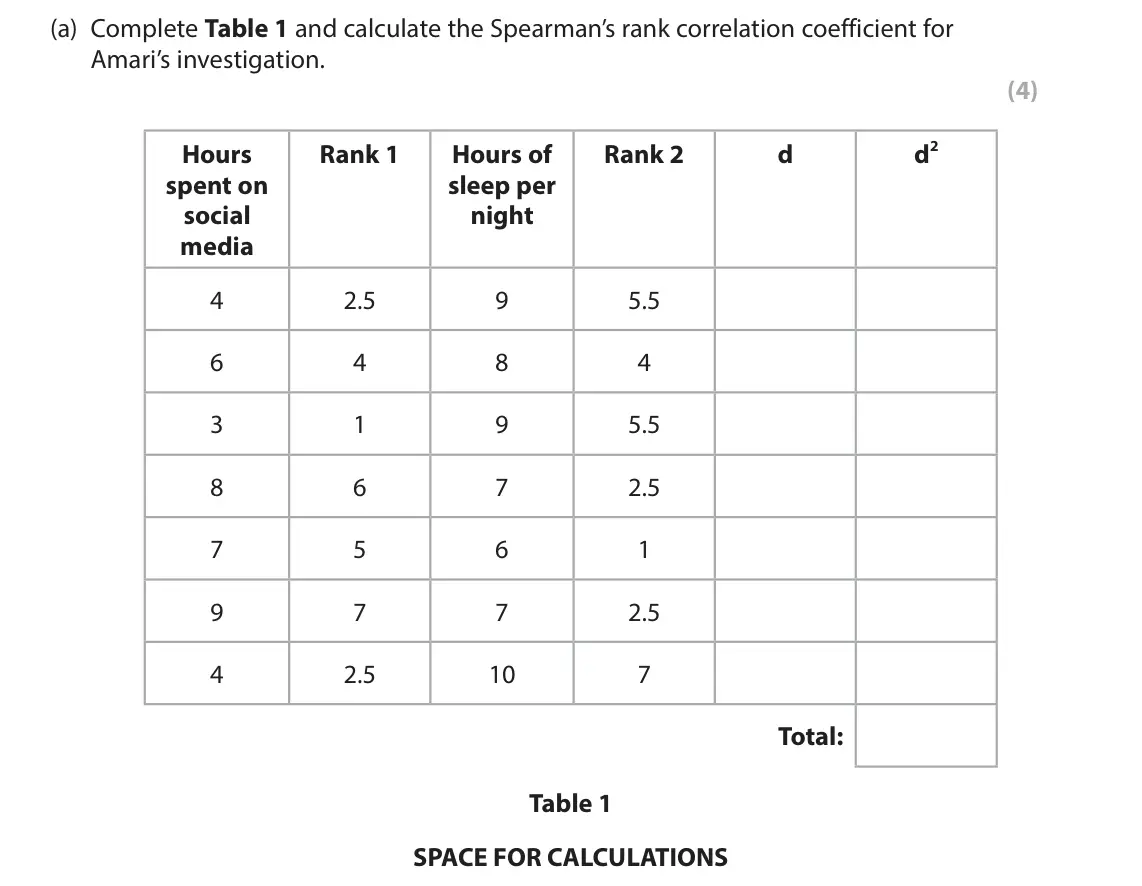
Q11(b)
The whole paper ↗
Q1(a)
The whole paper ↗
Q1(b)
The whole paper ↗
Q2(a)
The whole paper ↗
Q2(b)
The whole paper ↗
Q2(c)
The whole paper ↗
Q2(d)
The whole paper ↗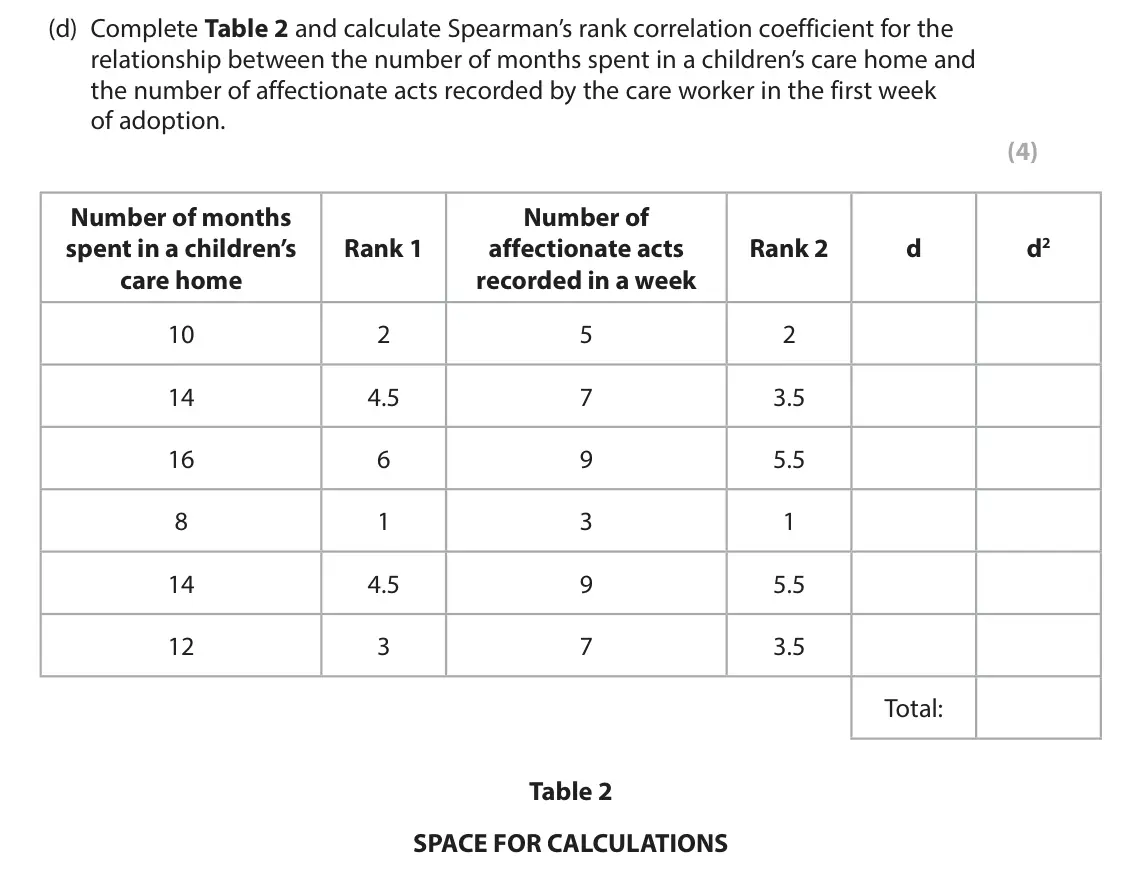
Q2(e)
The whole paper ↗
Q2(f)
The whole paper ↗
Q6(a)
The whole paper ↗
All 66 questions on Methods, as a list
- June 2025, Paper 1, Q9(a) (2 marks): Describe how Mandy could use a volunteer sampling technique to gather participants for her investigation. (2) 9 Mandy is investigating whether there is a relati
- June 2025, Paper 1, Q9(b) (2 marks): Mandy analysed her results using Spearman’s rho. State two reasons why Mandy used Spearman’s rho to analyse her data. (2) 9 Mandy is investigating whether there
- June 2025, Paper 1, Q9(c) (2 marks): Explain one improvement that Mandy could make to her investigation. (2) 9 Mandy is investigating whether there is a relationship between time spent outdoors and
- June 2025, AS Paper 2, Q1(b) (4 marks): Explain two weaknesses of the PET brain-scanning technique. (4)
- June 2025, AS Paper 2, Q2(a) (2 marks): Describe how Amari could use a volunteer sampling technique to gather her sample. (2) 2 Amari investigated whether the time of year influenced a person’s emotio
- June 2025, AS Paper 2, Q2(b) (4 marks): Complete Table 3 and calculate Spearman’s rank correlation coefficient for the relationship between the scores out of 10 in the middle of summer and the scores
- June 2025, AS Paper 2, Q2(c) (4 marks): Explain two strengths of Amari’s investigation. (4) 2 Amari investigated whether the time of year influenced a person’s emotional wellbeing. She decided to recr
- June 2025, AS Paper 2, Q2(d) (4 marks): Explain two improvements that Amari could make to her investigation. (4) 2 Amari investigated whether the time of year influenced a person’s emotional wellbeing
- June 2025, AS Paper 2, Q3 (8 marks): Evaluate one twin study that you have learned about in biological psychology. (8)
- June 2024, Paper 1, Q11(a) (4 marks): Complete Table 1 and calculate the Spearman’s rank correlation coefficient for Amari’s investigation. (4) d2 Hours Rank 1 Hours of Rank 2 d spent on sleep per s
- June 2024, Paper 1, Q11(b) (1 mark): Using the Spearman’s rank correlation coefficient that you calculated for 11(a), determine whether Amari’s data were significant at p0.05 for a non-directional
- June 2024, AS Paper 2, Q1(a) (3 marks): Describe how an fMRI scan can be used to investigate the brain. (3) 1 Brain‑scanning techniques can be used to investigate the brain.
- June 2024, AS Paper 2, Q1(b) (4 marks): Explain one strength and one weakness of fMRI as a brain‑scanning technique. (4) 1 Brain‑scanning techniques can be used to investigate the brain.
- June 2024, AS Paper 2, Q2(a) (2 marks): State a fully operationalised directional (one‑tailed) alternative hypothesis for Margaret’s study. (2) 2 Margaret is a social worker and wants to find out if t
- June 2024, AS Paper 2, Q2(b) (3 marks): Draw a suitable graph to display the data in Table 1. (3) 2 Margaret is a social worker and wants to find out if the time spent in a children’s care home before
- June 2024, AS Paper 2, Q2(c) (1 mark): State the type of correlation shown in the graph you have drawn in 2(b). (1) 2 Margaret is a social worker and wants to find out if the time spent in a children
- June 2024, AS Paper 2, Q2(d) (4 marks): Complete Table 2 and calculate Spearman’s rank correlation coefficient for the relationship between the number of months spent in a children’s care home and the
- June 2024, AS Paper 2, Q2(e) (2 marks): Explain one weakness of Margaret using quantitative data for her study. (2) 2 Margaret is a social worker and wants to find out if the time spent in a children’
- June 2024, AS Paper 2, Q2(f) (2 marks): Explain one improvement that could be made to the sample gathered by Margaret for her study. (2) 2 Margaret is a social worker and wants to find out if the time
- June 2023, Paper 1, Q6(a) (2 marks): Describe how Amelia could use a random sampling technique to gather a sample of 30 participants for her correlational research. (2) 6 Amelia is using a correlat
- June 2023, Paper 1, Q6(b) (2 marks): Explain one weakness of Amelia using a correlational research method for her investigation about recreational drug use and aggression. (2) 6 Amelia is using a c
- June 2022, Paper 1, Q7(a) (2 marks): Describe how Tabitha could use a volunteer sampling technique to gather participants for her investigation. (2) 7 Tabitha wanted to investigate whether there is
- June 2022, Paper 1, Q7(b) (3 marks): Tabitha decides to use a PET brain-scanning technique for her investigation. Describe how Tabitha could use a PET brain-scanning technique for her investigation
- June 2022, Paper 1, Q7(c) (2 marks): Explain one strength of Tabitha using a PET brain-scanning technique for her investigation. (2) 7 Tabitha wanted to investigate whether there is a difference in
- June 2022, Paper 1, Q7(d) (2 marks): Explain one improvement that could be made to Tabitha’s choice of participants. (2) 7 Tabitha wanted to investigate whether there is a difference in brain activ
- June 2022, Paper 1, Q8 (8 marks): Jinal wants to find out about recreational drug use and early childhood experiences. She has decided to focus on nicotine as the recreational drug. She intends
- June 2022, AS Paper 2, Q2(a) (4 marks): Complete Table 3 and calculate Spearman’s rank correlation coefficient between the total number of cups of coffee drunk in one 12-hour shift and the self-report
- June 2022, AS Paper 2, Q2(b) (2 marks): Explain one strength of Phil using a random sampling technique in his investigation. (2) 2 Phil wanted to find out if there was a relationship between drinking
- June 2022, AS Paper 2, Q2(c) (4 marks): Phil also decided to interview the doctors after their shift. He analysed the quantitative data gathered from the doctor’s self-reports and the qualitative data
- June 2022, AS Paper 2, Q2(d) (4 marks): Explain two improvements that Phil could make to his investigation. (4) 2 Phil wanted to find out if there was a relationship between drinking coffee and alertn
- November 2021, Paper 1, Q7(a) (4 marks): Complete Table 1 and calculate the Spearman’s rank correlation coefficient for Oscar’s study. (4) Attitude to Personality d2 Rank 1 recreational Rank 2 d score
- November 2021, Paper 1, Q7(b) (2 marks): Using the critical values table for Spearman’s rank, determine the lowest level of significance Oscar could use for his results to be significant for a directio
- October 2020, Paper 1, Q10 (4 marks): Lauren is a Psychology student at university. For her research project, Lauren wants to investigate whether aggression could be related to hunger. She has permi
- October 2020, AS Paper 2, Q1(a) (2 marks): State what is meant by a positive and a negative correlation. (2) 1 When studying biological psychology you will have learned about different types of correlati
- October 2020, AS Paper 2, Q1(b) (4 marks): Explain one strength and one weakness of the correlational research method. (4) 1 When studying biological psychology you will have learned about different type
- October 2020, AS Paper 2, Q3(a) (1 mark): Calculate the percentage of mistakes made by participant C on day one from the total of mistakes made by all participants on day one. You must give your answer
- October 2020, AS Paper 2, Q3(b) (1 mark): Calculate the mean number of mistakes made on day two. You must give your answer to one decimal place. (1) 3 Isaac is a psychologist who has investigated whethe
- October 2020, AS Paper 2, Q3(c) (2 marks): Explain one strength of the opportunity sampling technique used by Isaac in his investigation. (2) 3 Isaac is a psychologist who has investigated whether alcoho
- October 2020, AS Paper 2, Q3(d) (2 marks): Explain one improvement that Isaac could make to his investigation. (2) 3 Isaac is a psychologist who has investigated whether alcohol affected the ability of p
- October 2020, AS Paper 2, Q4(a) (4 marks): Explain two reasons for Amanda’s doctor sending her for an fMRI scan. (4) 4 Amanda is struggling to control her aggression. Her doctor is considering sending Am
- October 2020, AS Paper 2, Q4(b) (1 mark): Name one brain scanning technique other than fMRI. (1) 4 Amanda is struggling to control her aggression. Her doctor is considering sending Amanda for an fMRI sc
- June 2019, AS Paper 2, Q1(a) (1 mark): State the purpose of the PET brain-scanning technique. (1) 1 Scanning techniques have been used in biological psychology.
- June 2019, AS Paper 2, Q1(b) (4 marks): Explain one strength and one weakness of the PET brain-scanning technique. (4) 1 Scanning techniques have been used in biological psychology.
- June 2019, AS Paper 2, Q3(a) (2 marks): State a fully operationalised non-directional (two-tailed) alternate hypothesis for Daniel’s investigation. (2) 3 Daniel carried out an investigation to find ou
- June 2019, AS Paper 2, Q3(b) (4 marks): Complete Table 2 and calculate Spearman’s rank correlation coefficient between the number of hours exercised in a week and a “wellbeing” score between 4 and 20.
- June 2019, AS Paper 2, Q3(c) (1 mark): The participant sample in Daniel’s investigation consisted of eight males and two females. Calculate what fraction of Daniel’s sample were male. You must expres
- June 2019, AS Paper 2, Q3(d) (2 marks): Explain one improvement that Daniel could make to increase the validity of his investigation. (2) 3 Daniel carried out an investigation to find out if exercise
- June 2018, Paper 1, Q9(a) (4 marks): Complete Table 2 and calculate the Spearman’s rank correlation coefficient for Rafiq’s study. (4) Number of d2 Age Rank 1 Rank 2 d hours sleep 17 2.5 10 6 17 2.
- June 2018, Paper 1, Q9(b) (2 marks): Rafiq used a non-directional (two-tailed) hypothesis. Explain whether Rafiq’s data were significant at p<0.05 and if the research hypothesis should be accepted.
- June 2018, AS Paper 2, Q4 (8 marks): Evaluate one adoption study that you have learned about in biological psychology. (8)
- June 2017, Paper 1, Q8(a) (3 marks): Draw a scatter diagram to show Nadiya and Tamal’s data. (3) 8 Nadiya and Tamal are analysing data they have gathered about students’ exam scores and the number
- June 2017, Paper 1, Q8(b) (1 mark): Identify the type of correlation displayed in the diagram you have drawn. (1) 8 Nadiya and Tamal are analysing data they have gathered about students’ exam scor
- June 2017, Paper 1, Q8(c) (2 marks): State two reasons why they used Spearman’s rho. (2) 8 Nadiya and Tamal are analysing data they have gathered about students’ exam scores and the number of misse
- June 2017, AS Paper 2, Q1(a) (4 marks): Describe the procedure of one twin study that you have learnt about in biological psychology. (4)
- June 2017, AS Paper 2, Q1(b) (4 marks): Explain one strength and one weakness of the twin study you have learnt about in biological psychology. (4)
- June 2017, AS Paper 2, Q2(a)(i) (1 mark): Identify the sampling method used in Hinnah’s study. (1) 2 Hinnah is interested in finding out if there is a relationship between drug taking and aggressive beh
- June 2017, AS Paper 2, Q2(a)(ii) (4 marks): Explain one strength and one weakness of using this sampling method for Hinnah’s study. (4) 2 Hinnah is interested in finding out if there is a relationship bet
- June 2017, AS Paper 2, Q2(b) (1 mark): Figure 1 shows a scatter diagram with the results of Hinnah’s correlational study. Scatter diagram to show the relationship between the number of times drugs we
- June 2017, AS Paper 2, Q2(c) (2 marks): Explain one conclusion Hinnah could make from the results in the scatter diagram. (2) 2 Hinnah is interested in finding out if there is a relationship between d
- June 2017, AS Paper 2, Q4 (8 marks): Evaluate the use of brain scanning techniques to investigate human behaviour. (8)
- June 2016, AS Paper 2, Q1(b) (4 marks): Brain scanning can be used to investigate the brain. Explain two weaknesses of the fMRI scanning technique. (4)
- June 2016, AS Paper 2, Q2(a) (2 marks): State a null hypothesis for this study. (2) 2 Joel was interested in the relationship between environmental temperature and aggression. He noted down the averag
- June 2016, AS Paper 2, Q2(b) (3 marks): Draw a suitable graph to display the data in Table 1. (3) 2 Joel was interested in the relationship between environmental temperature and aggression. He noted d
- June 2016, AS Paper 2, Q2(c) (1 mark): State the type of relationship shown in the graph you have drawn. (1) 2 Joel was interested in the relationship between environmental temperature and aggression
- June 2016, AS Paper 2, Q2(d) (4 marks): Complete Table 2 and calculate Spearman’s rank correlation coefficient between average temperature and number of aggressive incidents. (4) Average No. of aggres
- June 2016, AS Paper 2, Q2(e) (4 marks): Explain one strength and one weakness of using the correlational research method, as it is used in biological psychology, to inform our understanding of aggress
Questions, mark schemes and examiner’s reports are © Pearson Edexcel, from their published past papers. Plumi isn’t affiliated with any exam board. Want whole papers? Full past papers.
Rather write your answers by hand on iPad? Plumi marks them against the same mark schemes.