 plumi
The nuclear atom and particle accelerators: Edexcel A‑Level Physics questions
Every Edexcel A-Level Physics exam question on The nuclear atom and particle accelerators (specification points 130–136), 2016–2025, with its mark scheme and examiner’s report.
Find questions1,540
Calculations
Q15(d)(i)
The whole paper ↗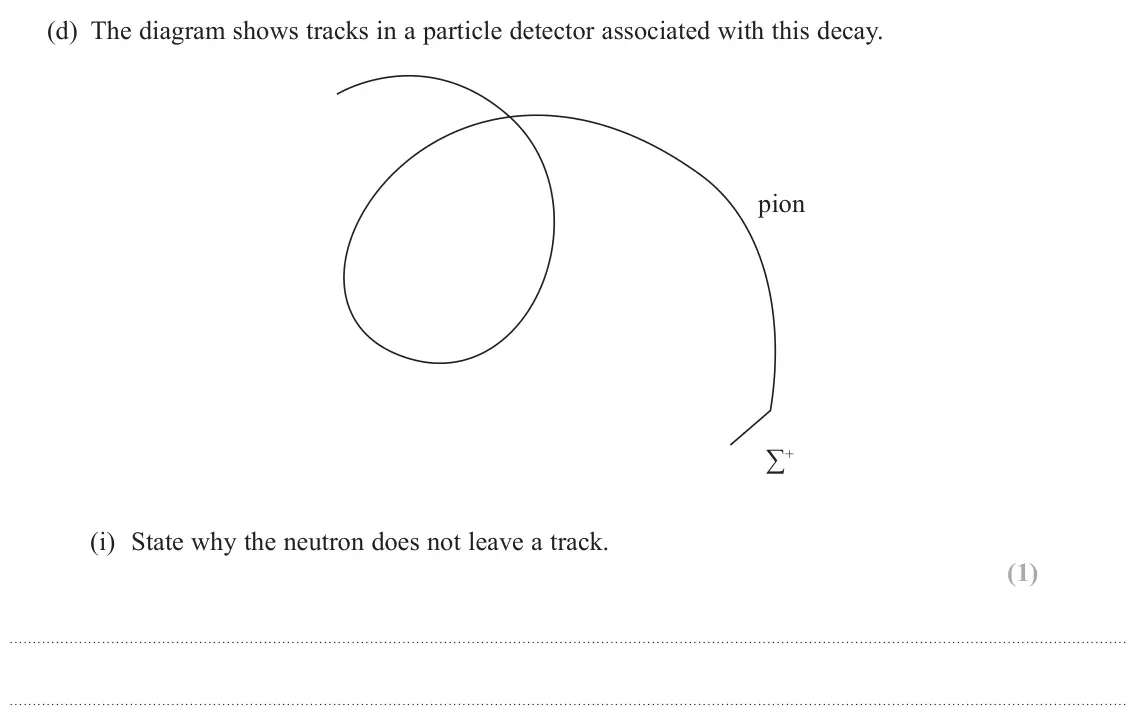
Q15(d)(ii)
The whole paper ↗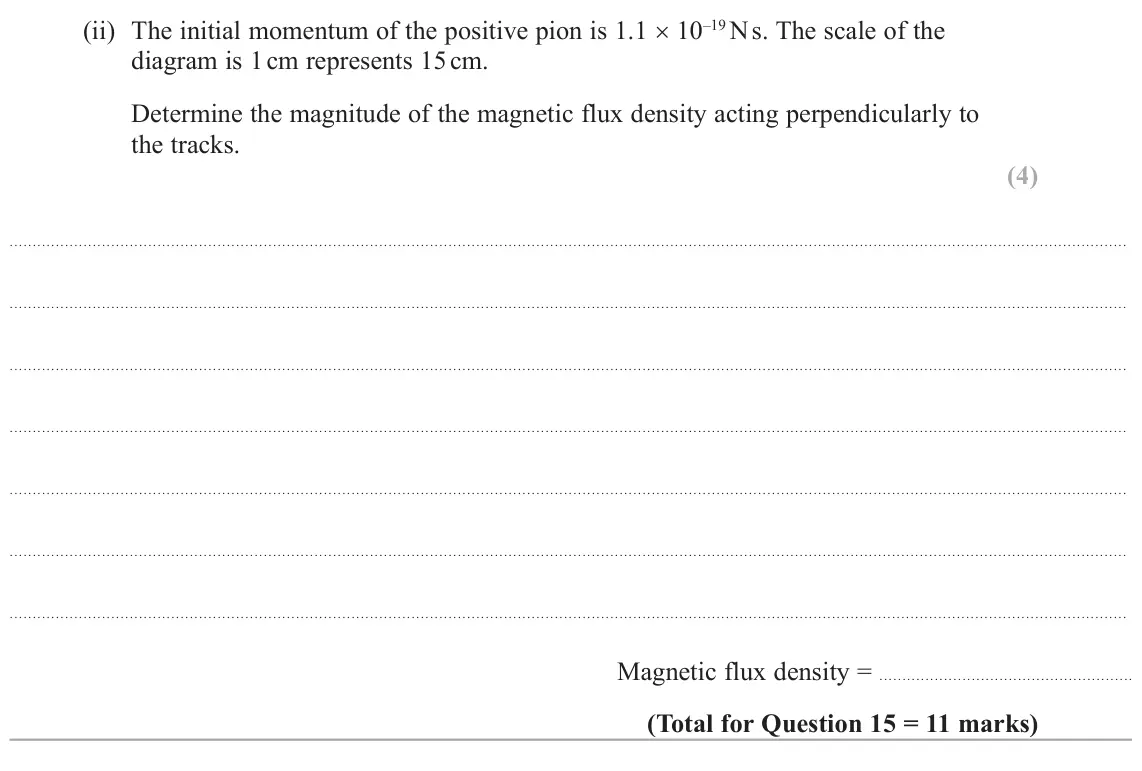
Q18(a)
The whole paper ↗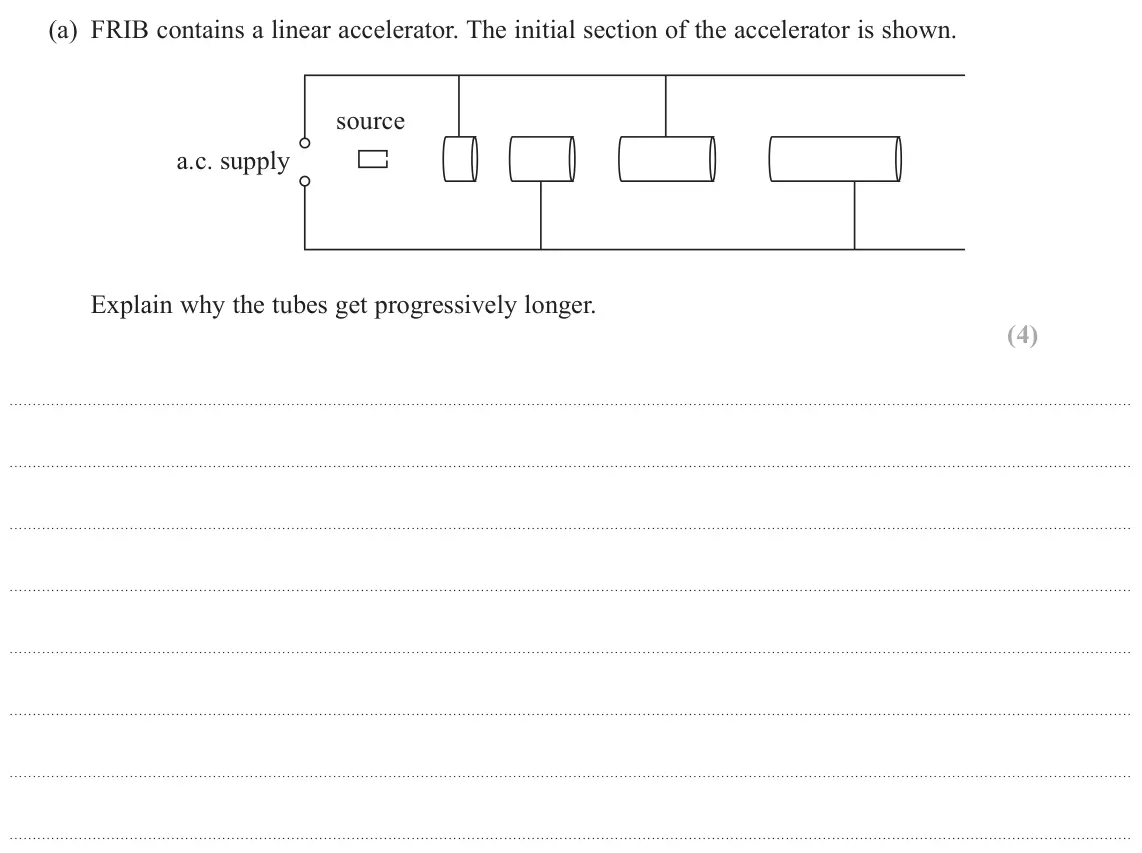
Q18(b)(i)
The whole paper ↗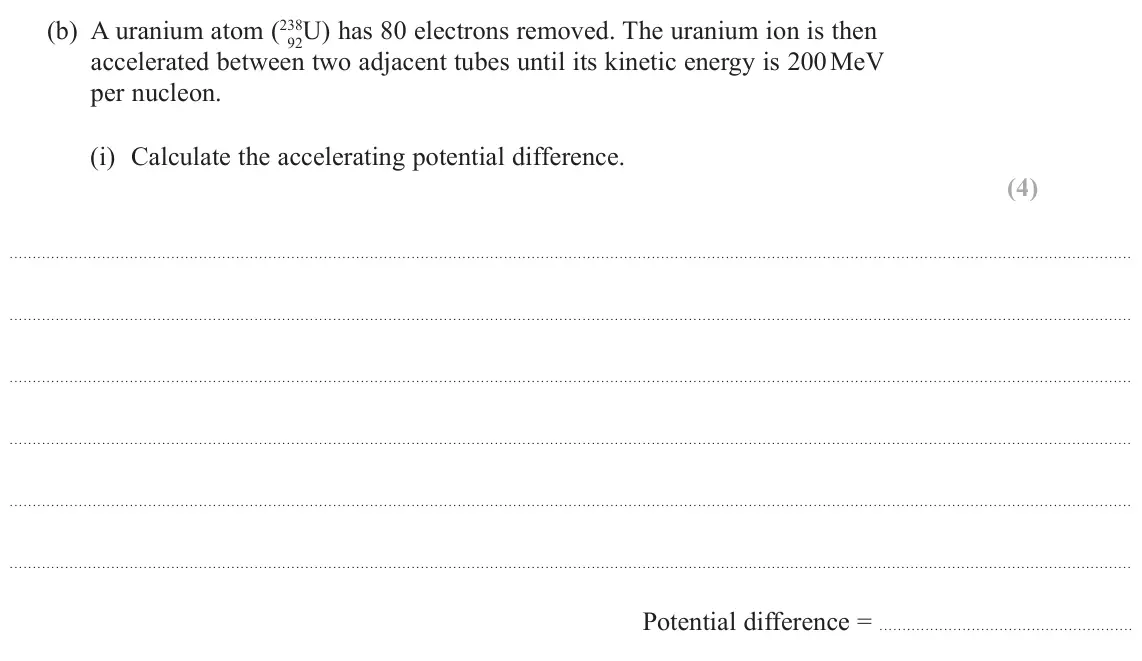
Q18(b)(ii)
The whole paper ↗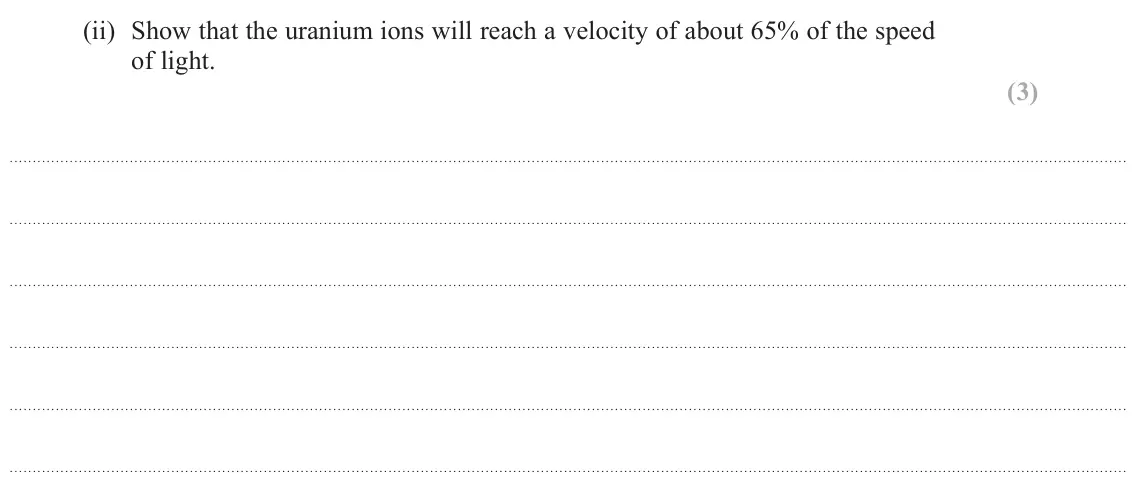
Q18(c)
The whole paper ↗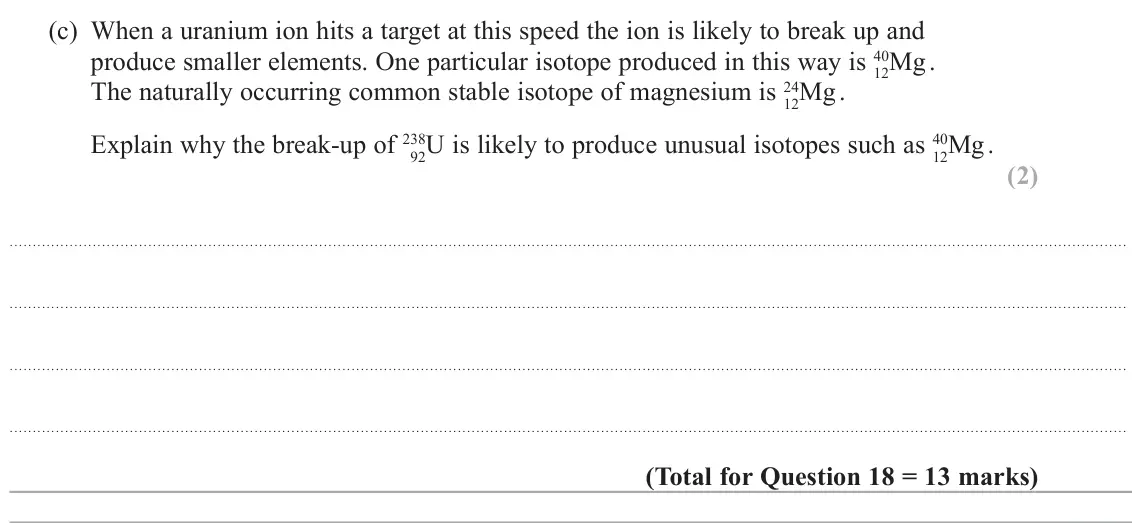
Q11(a)(i)
The whole paper ↗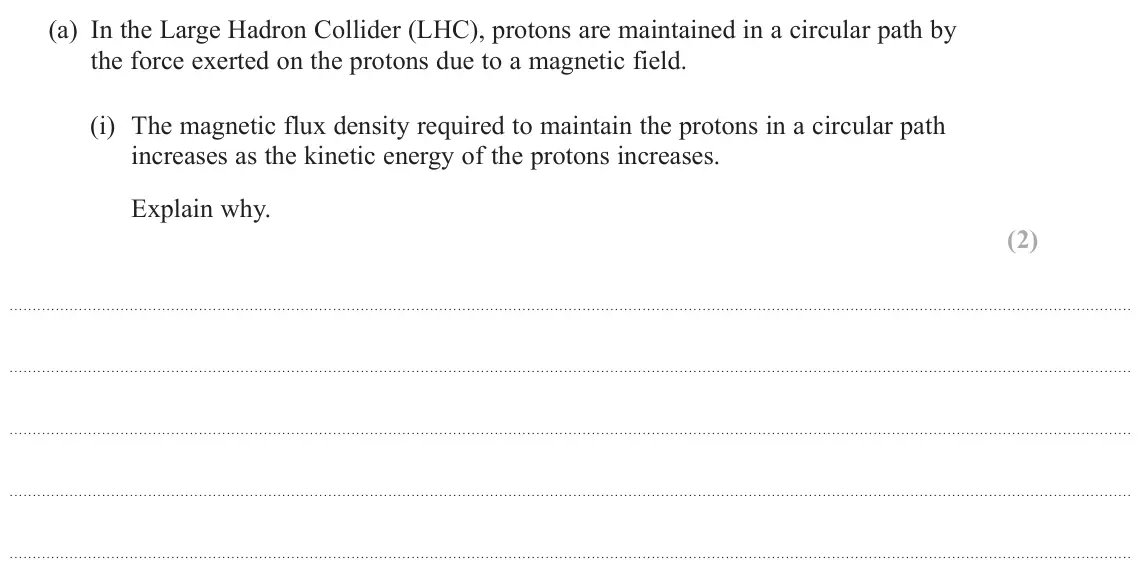
Q11(a)(ii)
The whole paper ↗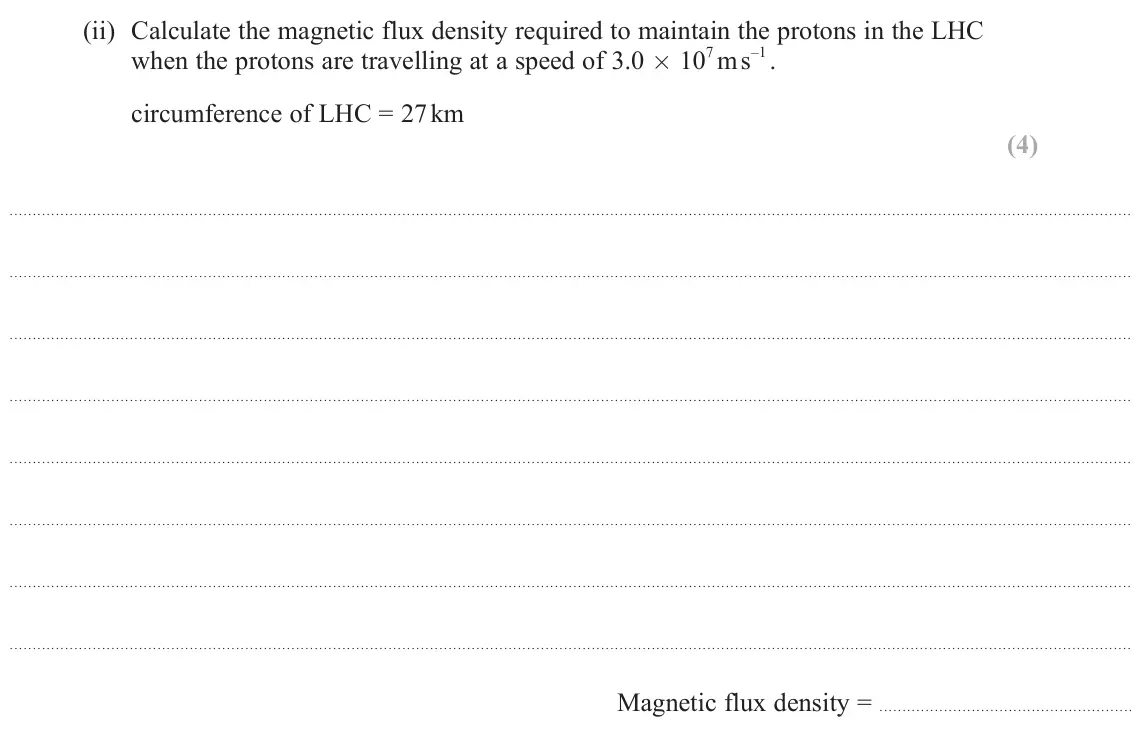
Q11(b)
The whole paper ↗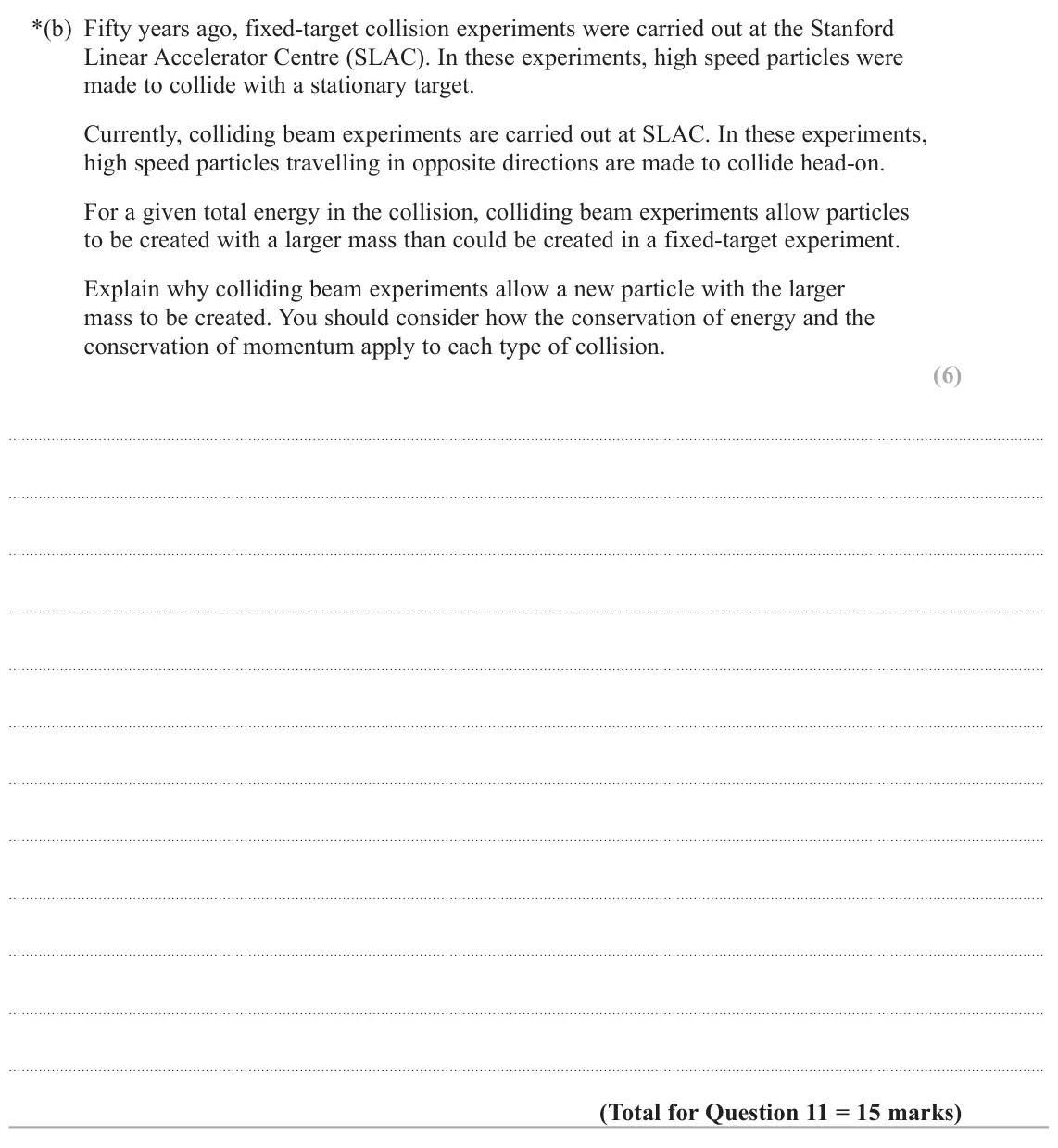
Q14(c)
The whole paper ↗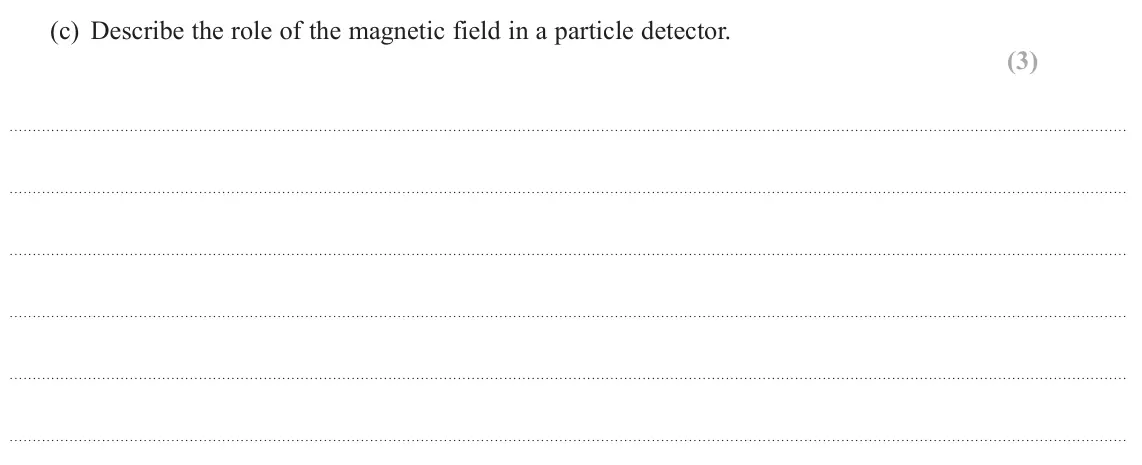
Q14(d)
The whole paper ↗
Q17(a)
The whole paper ↗
Q15(a)(i)
The whole paper ↗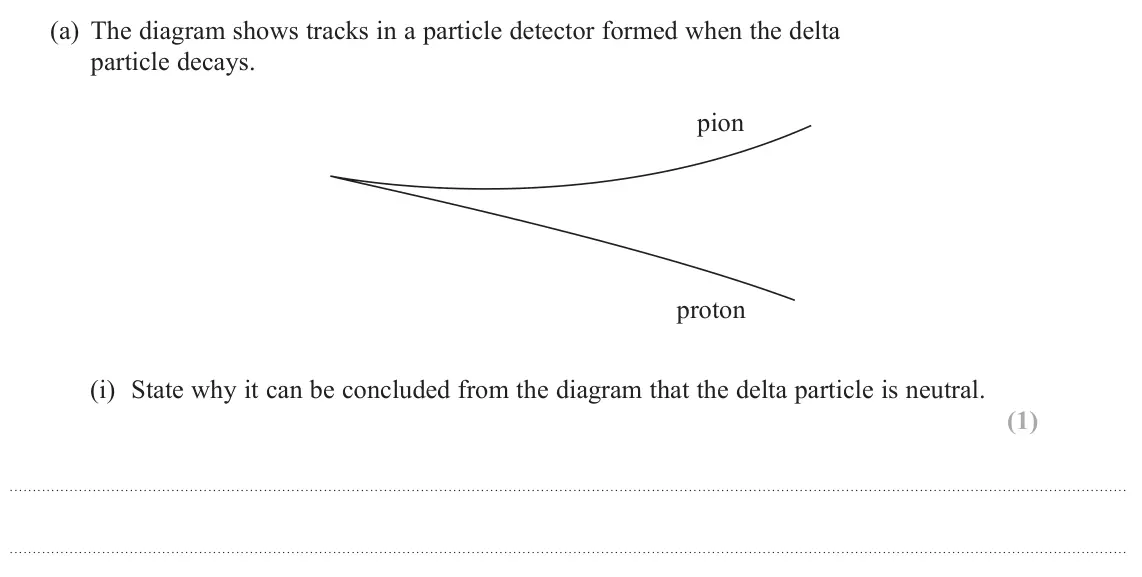
Q15(a)(ii)
The whole paper ↗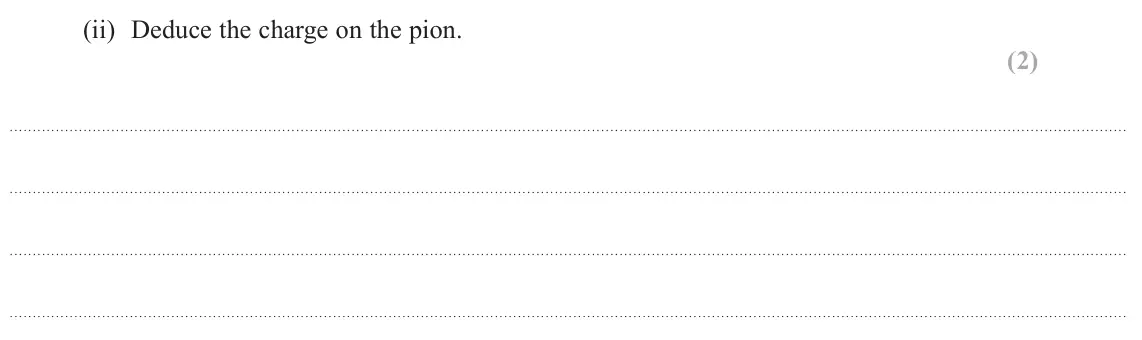
Q15(a)(v)
The whole paper ↗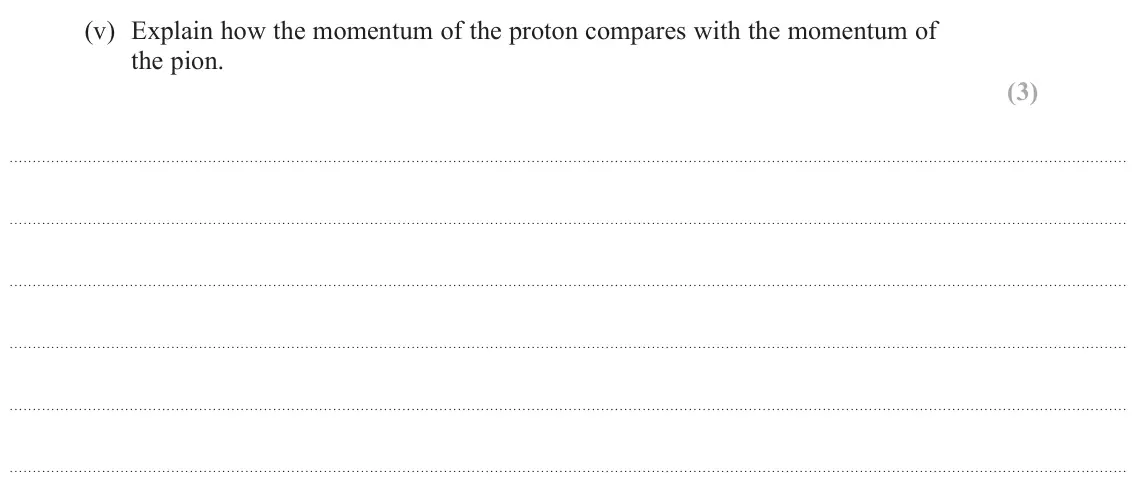
All 44 questions on The nuclear atom and particle accelerators, as a list
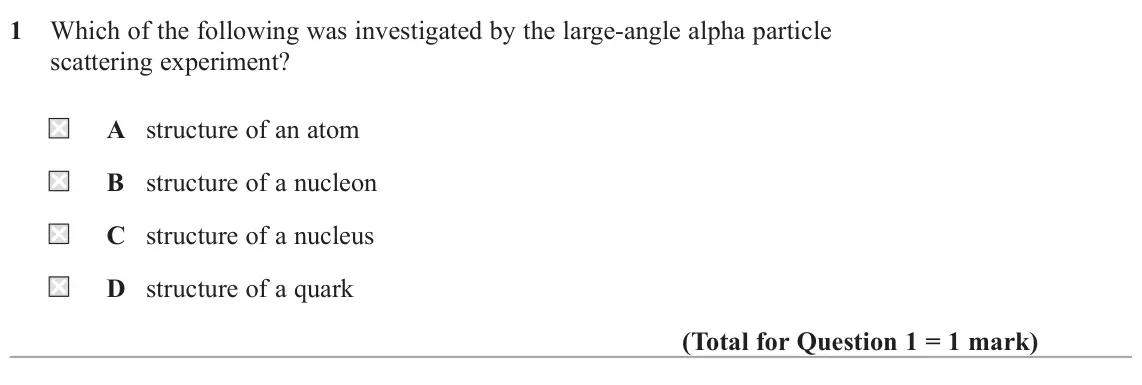
- June 2025, Paper 1, Q1 (1 mark): Which of the following was investigated by the large-angle alpha particle scattering experiment? A structure of an atom B structure of a nucleon C structure of
- June 2025, Paper 1, Q15(d)(i) (1 mark): State why the neutron does not leave a track. (1)
- June 2025, Paper 1, Q15(d)(ii) (4 marks): The initial momentum of the positive pion is 1.1 × 10⁻¹⁹ N s. The scale of the diagram is 1 cm represents 15 cm. Determine the magnitude of the magnetic flux de
- June 2025, Paper 1, Q18(a) (4 marks): FRIB contains a linear accelerator. The initial section of the accelerator is shown. source a.c. supply Explain why the tubes get progressively longer. (4)
- June 2025, Paper 1, Q18(b)(i) (4 marks): Calculate the accelerating potential difference. (4) Potential difference =
- June 2025, Paper 1, Q18(b)(ii) (3 marks): Show that the uranium ions will reach a velocity of about 65% of the speed of light. (3)
- June 2025, Paper 1, Q18(c) (2 marks): When a uranium ion hits a target at this speed the ion is likely to break up and produce smaller elements. One particular isotope produced in this way is 40 12M
- June 2025, Paper 3, Q11(a)(i) (2 marks): The magnetic flux density required to maintain the protons in a circular path increases as the kinetic energy of the protons increases. Explain why. (2)
- June 2025, Paper 3, Q11(a)(ii) (4 marks): Calculate the magnetic flux density required to maintain the protons in the LHC when the protons are travelling at a speed of 3.0 × 10 7 m s –1 . circumference
- June 2025, Paper 3, Q11(b) (6 marks): Fifty years ago, fixed‑target collision experiments were carried out at the Stanford Linear Accelerator Centre (SLAC). In these experiments, high speed particle
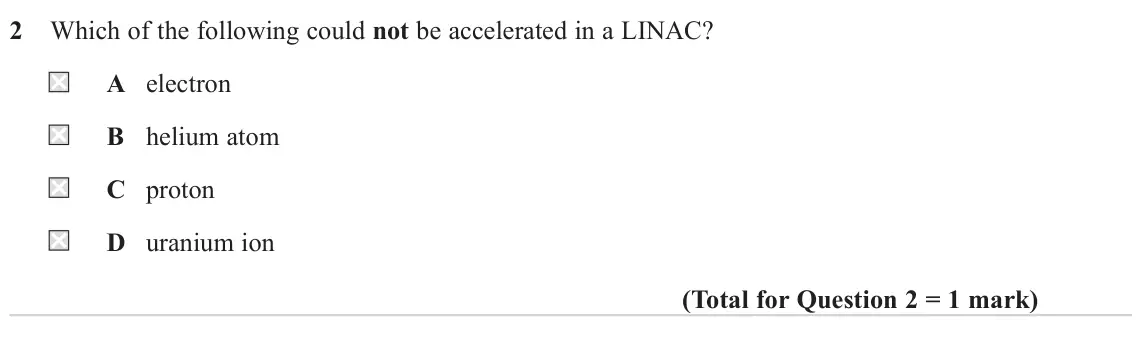
- June 2024, Paper 1, Q2 (1 mark): Which of the following could not be accelerated in a LINAC? A electron B helium atom C proton D uranium ion
- June 2024, Paper 1, Q14(c) (3 marks): Describe the role of the magnetic field in a particle detector. (3)
- June 2024, Paper 1, Q14(d) (4 marks): Explain how the diagram gives evidence that a particle or particles, other than the positron, were produced in this decay. (4)
- June 2024, Paper 1, Q17(a) (3 marks): Describe the model of the atom that Rutherford proposed as a result of this series of experiments. (3)
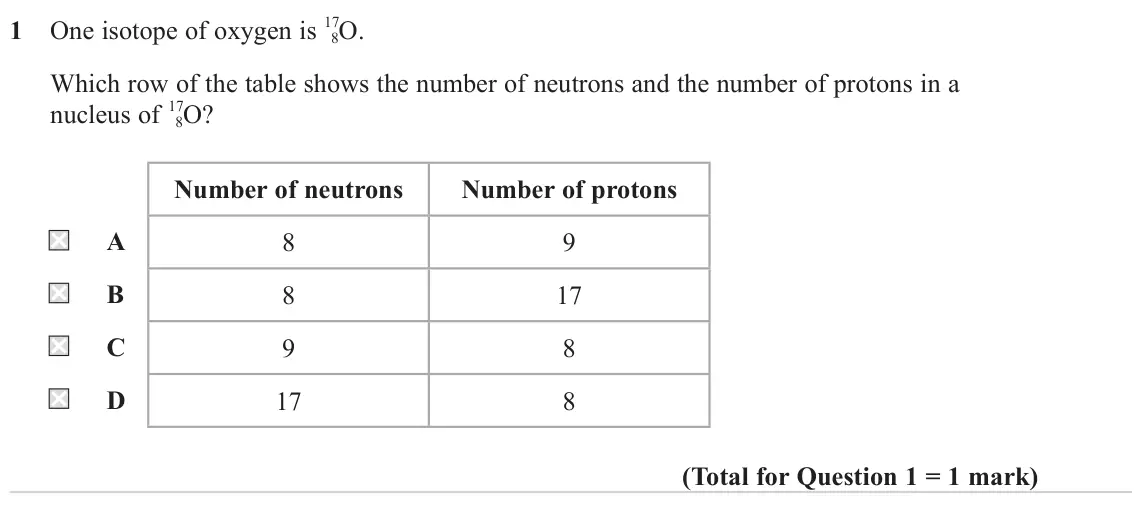
- June 2023, Paper 1, Q1 (1 mark): One isotope of oxygen is 17 8O. Which row of the table shows the number of neutrons and the number of protons in a nucleus of 17 8O? Number of neutrons Number o
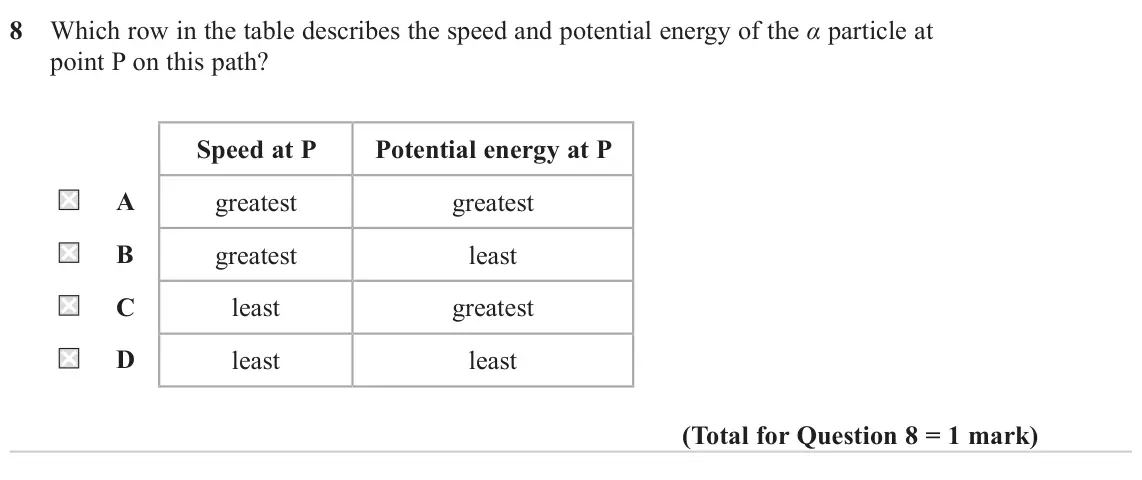
- June 2023, Paper 1, Q8 (1 mark): Which row in the table describes the speed and potential energy of the α particle at point P on this path? Speed at P Potential energy at P A greatest greatest
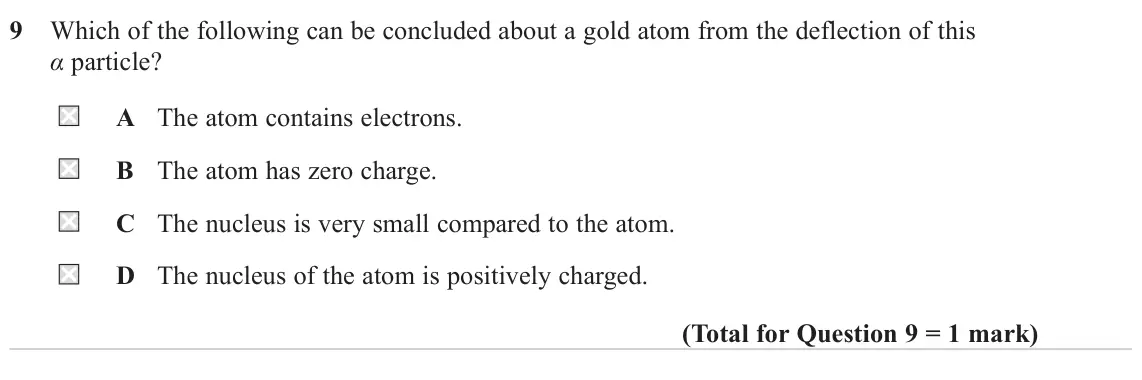
- June 2023, Paper 1, Q9 (1 mark): Which of the following can be concluded about a gold atom from the deflection of this α particle? A The atom contains electrons. B The atom has zero charge. C T
- June 2023, Paper 1, Q15(a)(i) (1 mark): State why it can be concluded from the diagram that the delta particle is neutral. (1)
- June 2023, Paper 1, Q15(a)(ii) (2 marks): Deduce the charge on the pion. (2)
- June 2023, Paper 1, Q15(a)(v) (3 marks): Explain how the momentum of the proton compares with the momentum of the pion. (3)
- June 2023, Paper 3, Q4 (6 marks): *4 Alpha particle scattering experiments led Rutherford to propose the nuclear model of the atom. Alpha particles were directed towards a thin gold foil. Descri
- June 2022, Paper 1, Q4 (1 mark): The electrons are produced by heating a metal filament. Which of the following is the name of this process? A ionisation B scattering C the photoelectric effect
- June 2022, Paper 1, Q10 (1 mark): Which of the following conclusions could not be made as a result of these investigations? A The atom is mostly empty space. B The atom is neutral. C The nucleus
- June 2022, Paper 1, Q15(a) (6 marks): Explain how an electron is accelerated in a linac. (6)
- June 2022, Paper 1, Q15(b) (2 marks): The electron leaves the accelerator with a high energy. Explain why electrons need high energies to investigate the structure of a proton. (2)
- November 2021, Paper 1, Q15(a) (4 marks): Describe how the model of the atom changed, as a consequence of these experiments. (4)
- November 2021, Paper 1, Q15(c) (4 marks): Rutherford also carried out the experiment with aluminium (27 13Al) foil. The aluminium foil had the same thickness as the gold foil and the alpha particles had
- November 2021, Paper 1, Q16(a) (6 marks): Explain how observations and measurements from the photograph can be used to establish information about the lambda particle. (6)
- October 2020, Paper 1, Q14(b) (4 marks): A plan view of the arrangement is shown. ball bearing hill wooden track The wooden track is moved to different positions and the ball bearing is released. Descr
- October 2020, Paper 1, Q18(a) (2 marks): Deduce whether the antineutrino is charged, giving two reasons for your decision. (2)
- October 2020, Paper 1, Q18(d) (4 marks): The momentum of the pion just before it decays is 9.1 × 10 −20 N s. Determine the magnetic flux density of the magnetic field which acts in the detector and sta
- October 2020, Paper 3, Q7(a) (2 marks): Explain how electrons from the source become a beam of high-energy electrons. (2)
- October 2020, Paper 3, Q7(d) (1 mark): In his original experiments, Thompson determined the specific charge of a range of particles. His results indicated that the specific charge of an electron is a
- June 2018, Paper 1, Q9 (1 mark): Electric and magnetic fields can be used in particle accelerators. Which row in the table correctly describes the use of electric and magnetic fields in the par
- June 2018, Paper 1, Q15(c)(ii) (3 marks): The beams of protons are contained within a ring of superconducting magnets. Calculate the momentum of a proton in a beam. (3) magnetic field strength = 8.3 T c
- June 2018, Paper 1, Q15(c)(iii) (1 mark): State the total momentum of the products of the collision between the two beams of protons. (1) Total momentum =
- June 2017, Paper 1, Q8 (1 mark): The alpha particle scattering experiment led to a number of observations and conclusions. Which row in the table gives a correct observation and corresponding c
- June 2017, Paper 1, Q13(a) (6 marks): Explain how the cyclotron produces the high‑energy proton beam. (6)
- June 2017, Paper 1, Q13(b) (2 marks): Conventional treatment may use X‑rays to deliver energy to a tumour. The graph shows the variation of energy delivered with penetration below the skin for a bea
- June 2017, Paper 1, Q13(c) (2 marks): Developing new cancer treatments is expensive. Give two possible reasons why money should be provided for the development of this new cancer treatment. (2)
- June 2017, Paper 1, Q16(e) (3 marks): The Λ0 particle cannot be directly observed in particle experiments, however some of the decay products can. Explain why the Λ0 particle cannot be directly obse
- June 2017, Paper 3, Q13(a) (1 mark): State what is meant by isotopes. (1)
- June 2017, Paper 3, Q13(d)(ii) (2 marks): Calculate the radius of the circular path. (2) Radius =
- June 2017, Paper 3, Q13(d)(iii) (3 marks): The diagram shows the path of the chlorine-35 ions in the field. Chlorine-37 ions enter the magnetic field with the same velocity. uniform magnetic field detect
Questions, mark schemes and examiner’s reports are © Pearson Edexcel, from their published past papers. Plumi isn’t affiliated with any exam board. Want whole papers? Every Edexcel A-Level Physics paper.
Rather write your answers by hand on iPad? Plumi marks them against the same mark schemes.