 plumi
Simple harmonic motion: Edexcel A‑Level Physics questions
Every Edexcel A-Level Physics exam question on Simple harmonic motion (specification points 181–185), 2016–2025, with its mark scheme and examiner’s report.
Find questions1,540
Calculations
Q20(b)(i)
The whole paper ↗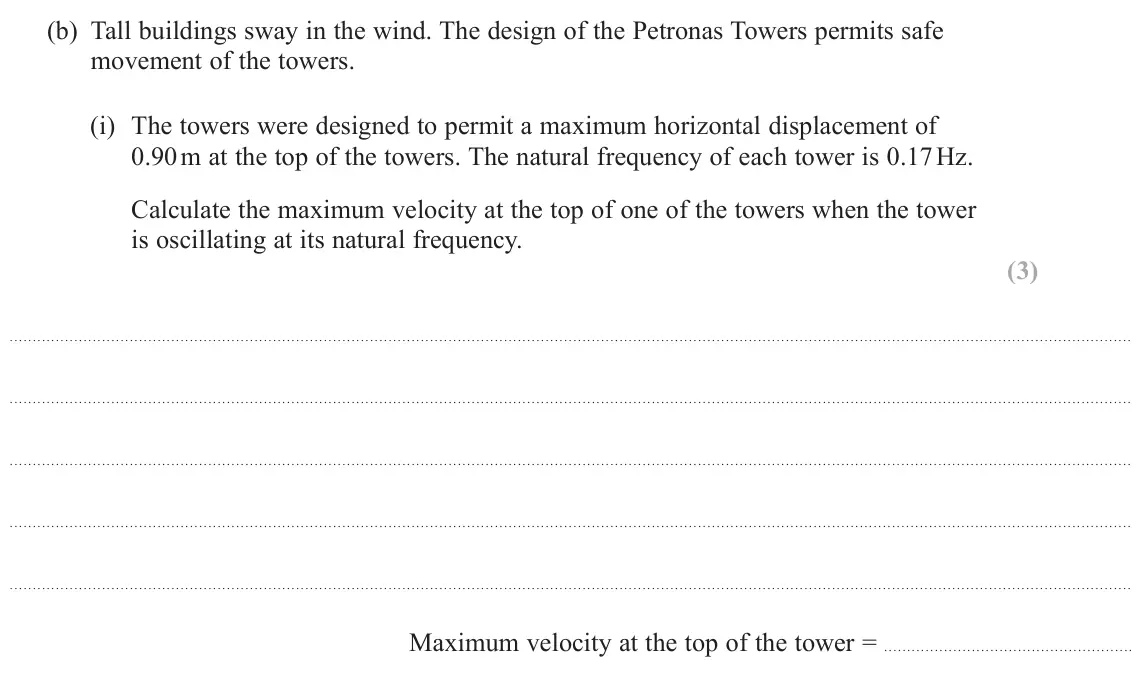
Q9(a)(i)
The whole paper ↗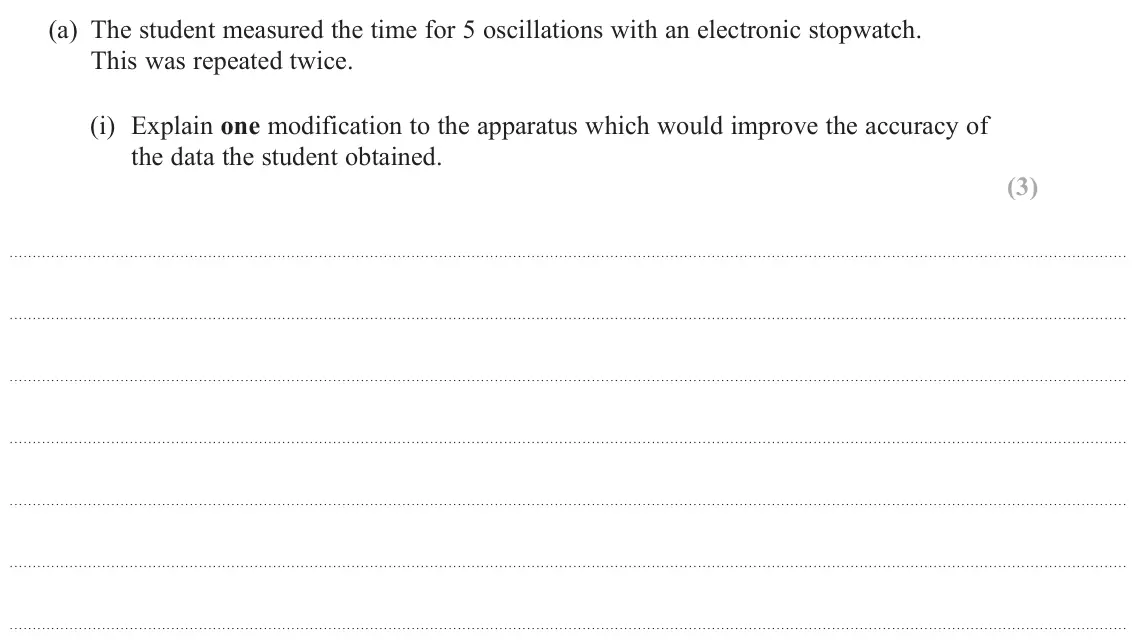
Q9(a)(ii)
The whole paper ↗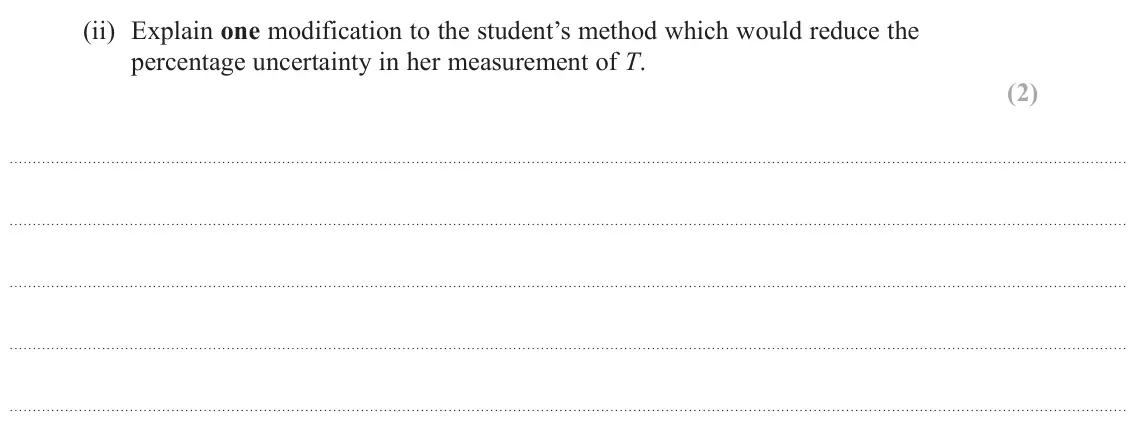
Q9(b)
The whole paper ↗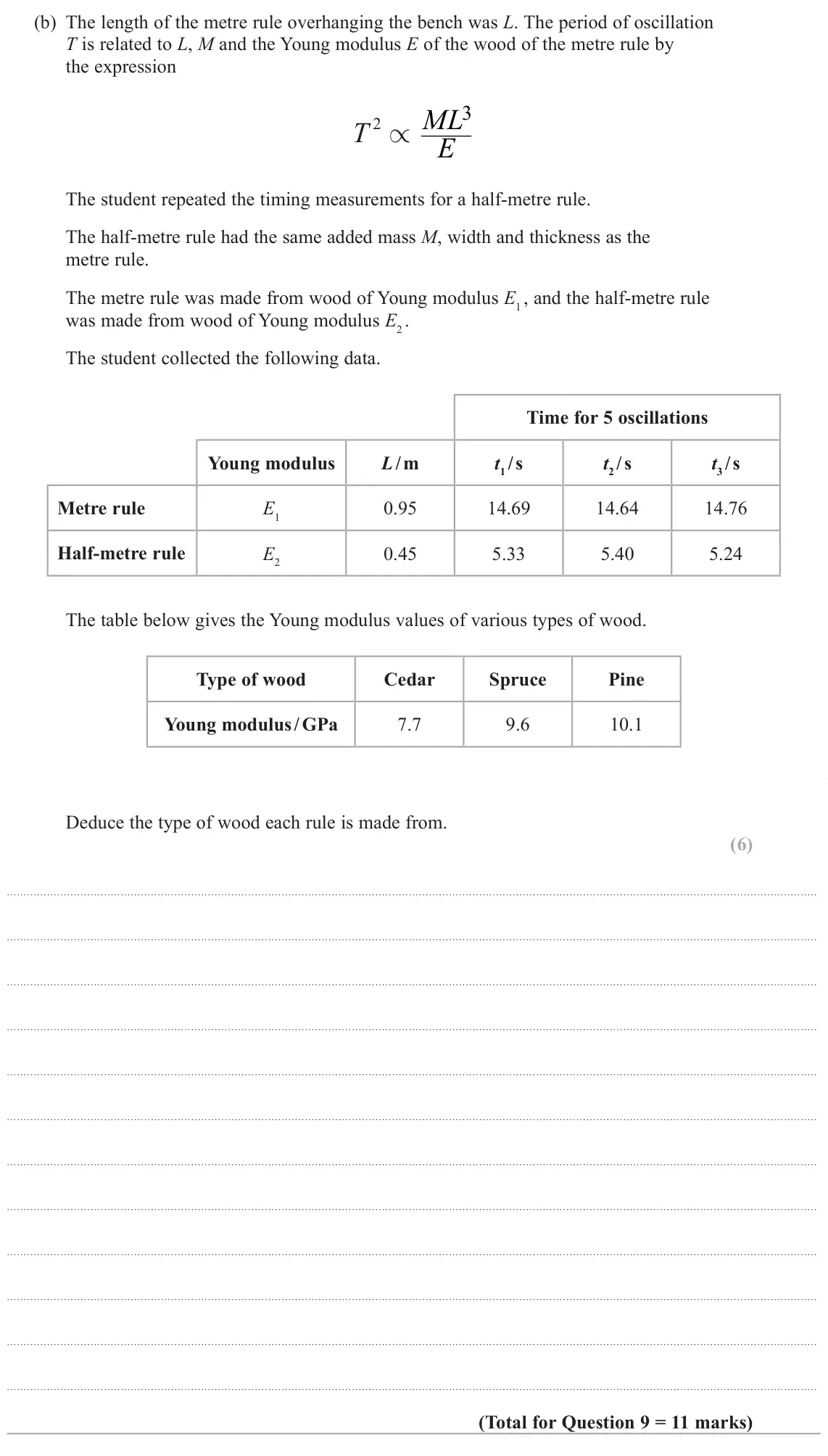
Q16(a)
The whole paper ↗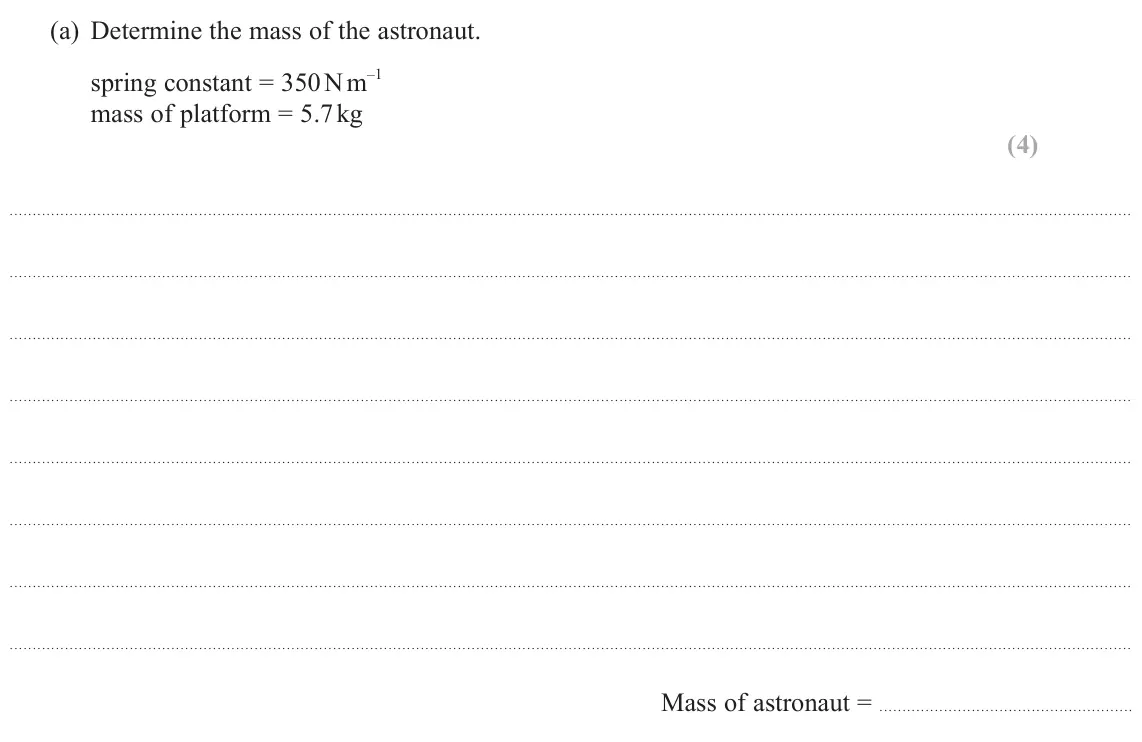
Q16(b)(i)
The whole paper ↗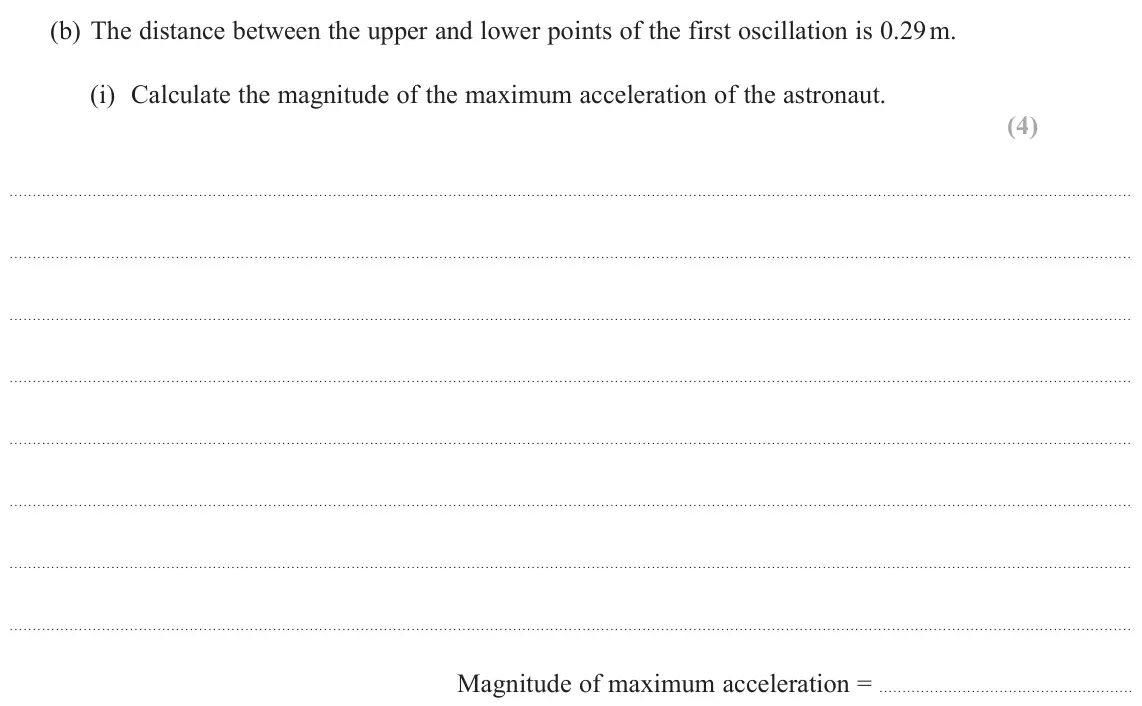
Q16(b)(ii)
The whole paper ↗
Q5(a)
The whole paper ↗
Q5(b)
The whole paper ↗
Q8(b)(i)
The whole paper ↗
Q8(b)(ii)
The whole paper ↗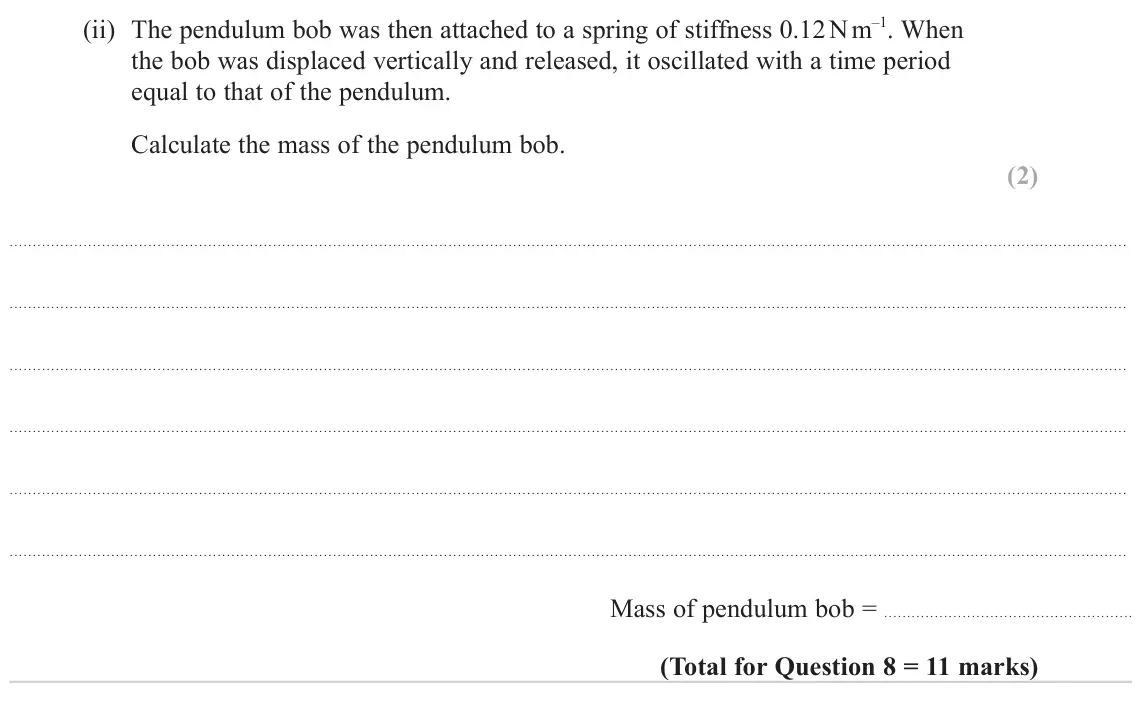
Q10(a)
The whole paper ↗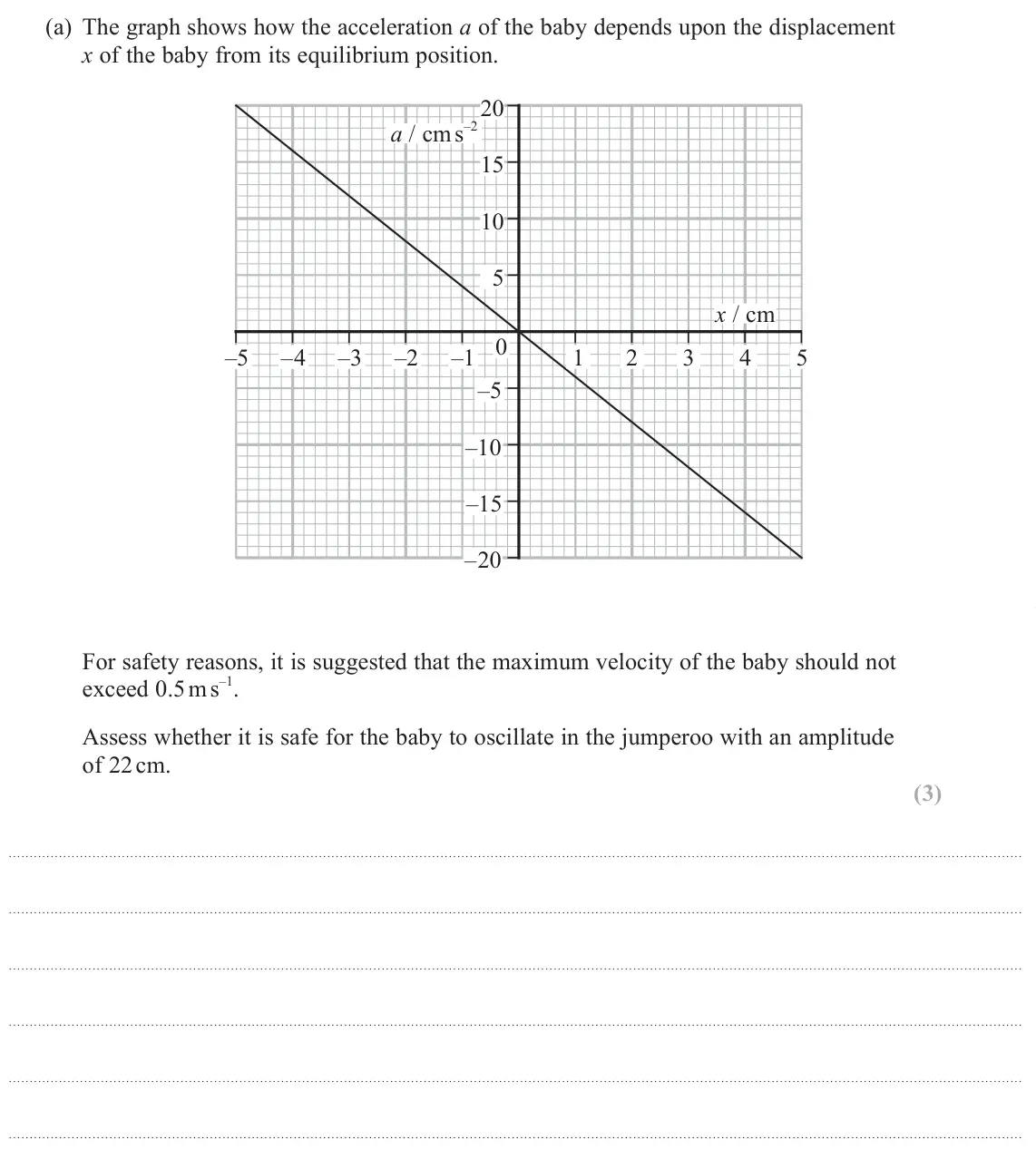
Q16(b)(ii)
The whole paper ↗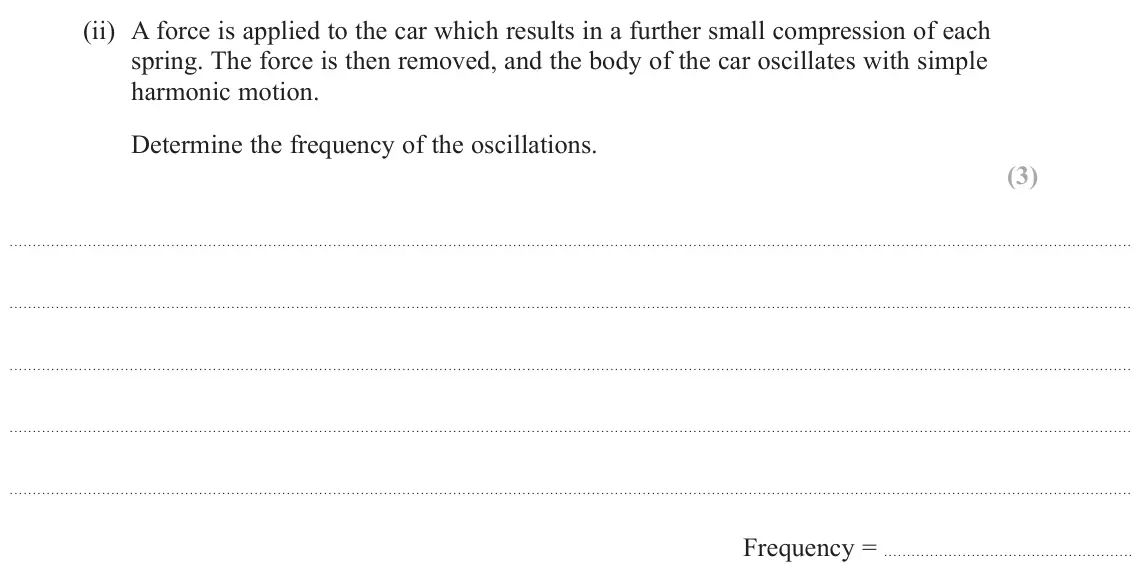
Q16(c)
The whole paper ↗
Q6(a)
The whole paper ↗
Q6(b)
The whole paper ↗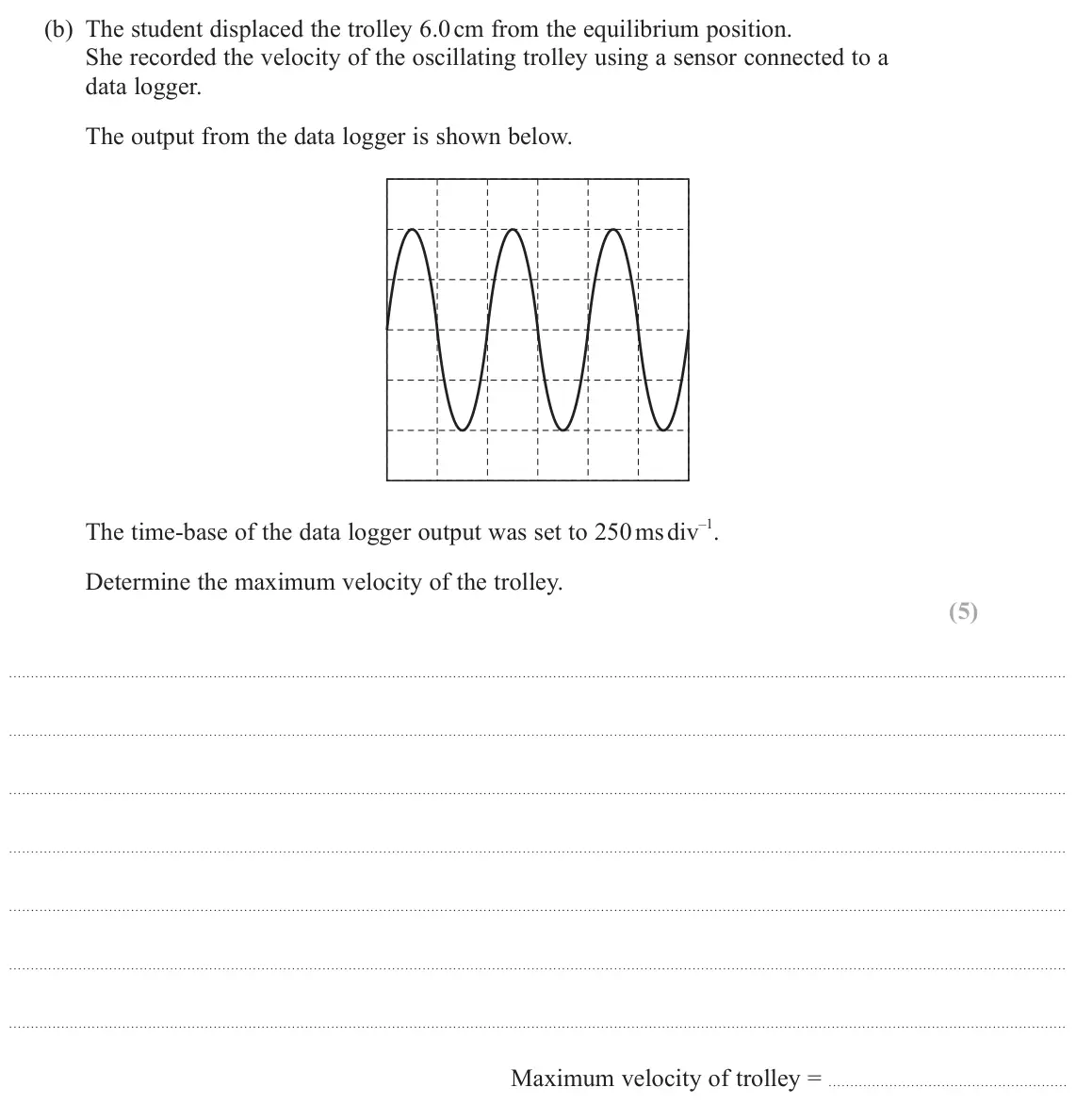
Q6(c)(ii)
The whole paper ↗
All 58 questions on Simple harmonic motion, as a list
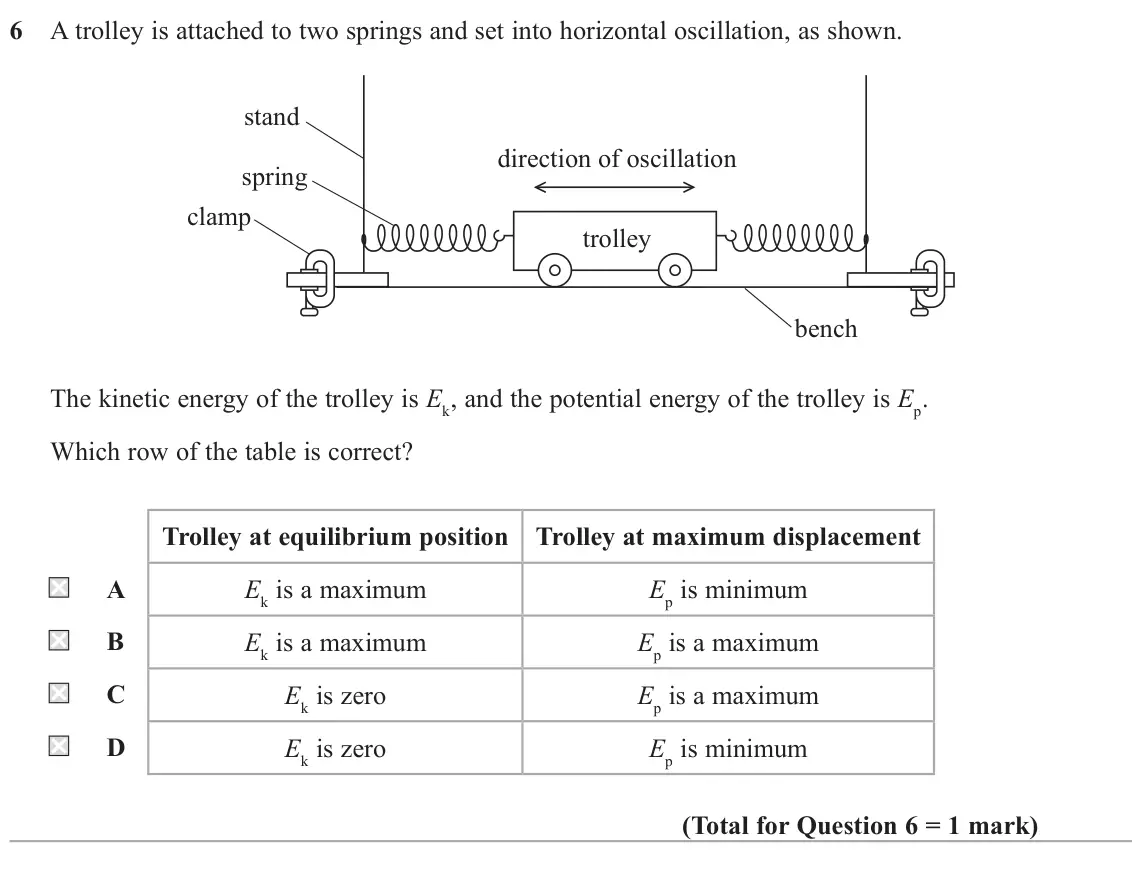
- June 2025, Paper 2, Q6 (1 mark): A trolley is attached to two springs and set into horizontal oscillation, as shown. stand direction of oscillation spring clamp trolley bench The kinetic energy
- June 2025, Paper 2, Q20(b)(i) (3 marks): The towers were designed to permit a maximum horizontal displacement of 0.90 m at the top of the towers. The natural frequency of each tower is 0.17 Hz. Calcula
- June 2025, Paper 3, Q9(a)(i) (3 marks): Explain one modification to the apparatus which would improve the accuracy of the data the student obtained. (3)
- June 2025, Paper 3, Q9(a)(ii) (2 marks): Explain one modification to the student’s method which would reduce the percentage uncertainty in her measurement of T. (2)
- June 2025, Paper 3, Q9(b) (6 marks): The length of the metre rule overhanging the bench was L. The period of oscillation T is related to L, M and the Young modulus E of the wood of the metre rule b
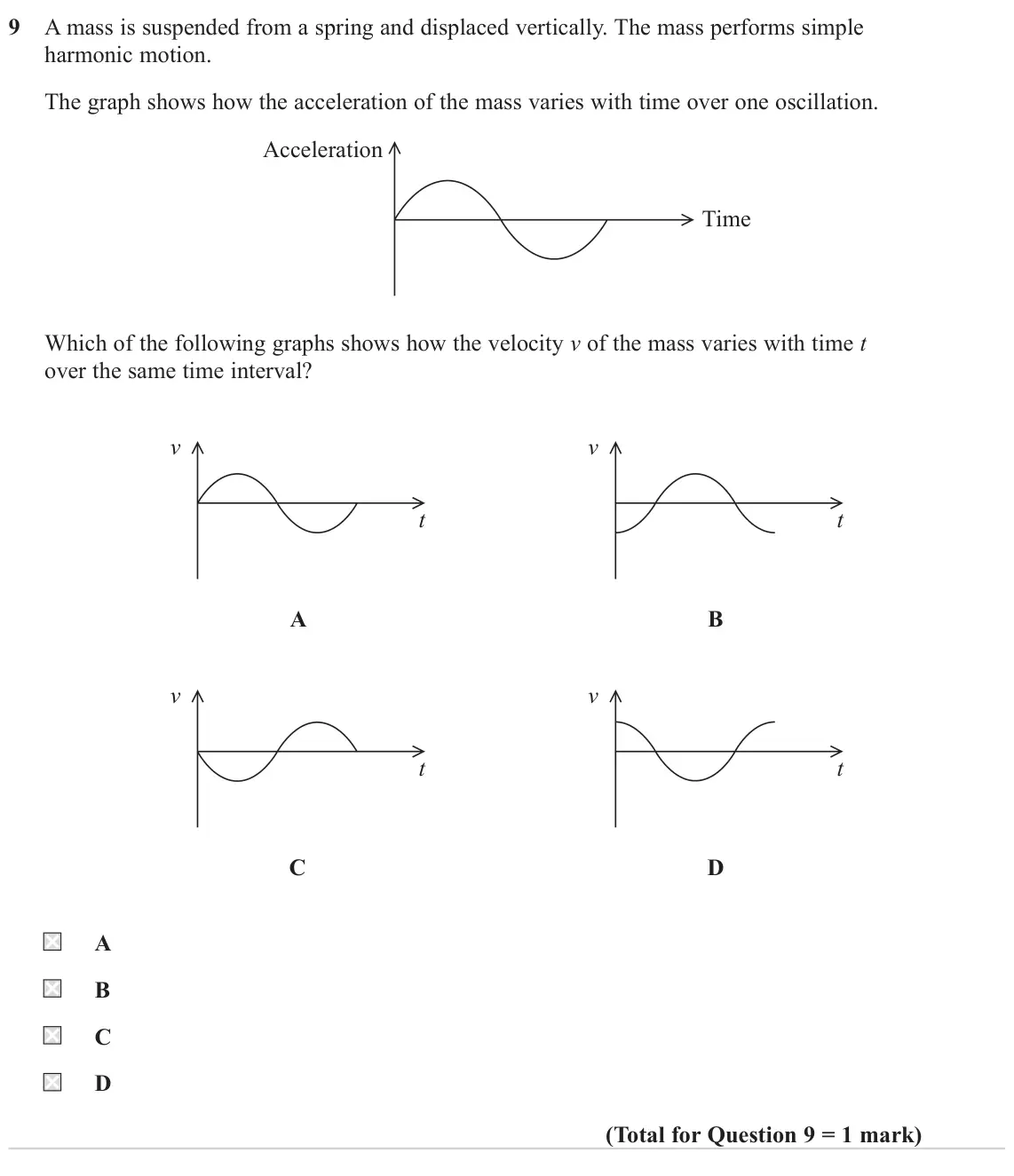
- June 2024, Paper 2, Q9 (1 mark): A mass is suspended from a spring and displaced vertically. The mass performs simple harmonic motion. The graph shows how the acceleration of the mass varies wi
- June 2024, Paper 2, Q16(a) (4 marks): Determine the mass of the astronaut. spring constant = 350 N m –1 mass of platform = 5.7 kg (4) Mass of astronaut =
- June 2024, Paper 2, Q16(b)(i) (4 marks): Calculate the magnitude of the maximum acceleration of the astronaut. (4) Magnitude of maximum acceleration =
- June 2024, Paper 2, Q16(b)(ii) (2 marks): Calculate the speed of the astronaut 3.5 s after the start of the oscillations. (2) Speed =
- June 2024, Paper 3, Q5(a) (6 marks): Explain how the procedure used by the student to determine T could have been improved. (6)
- June 2024, Paper 3, Q5(b) (4 marks): The mass of the trolley was M. The student added a small mass m to the trolley and determined the new value of T. She repeated the procedure for a range of valu
- June 2024, Paper 3, Q8(b)(i) (3 marks): Show that the time taken for the pendulum bob to move from its lowest position to its highest position is about 0.6 s. effective length of pendulum = 1.25 m (3)
- June 2024, Paper 3, Q8(b)(ii) (2 marks): The pendulum bob was then attached to a spring of stiffness 0.12 N m–1. When the bob was displaced vertically and released, it oscillated with a time period equ
- June 2024, Paper 3, Q10(a) (3 marks): The graph shows how the acceleration a of the baby depends upon the displacement x of the baby from its equilibrium position. 20 a / cm s–2 15 10 5 x / cm 0 –5
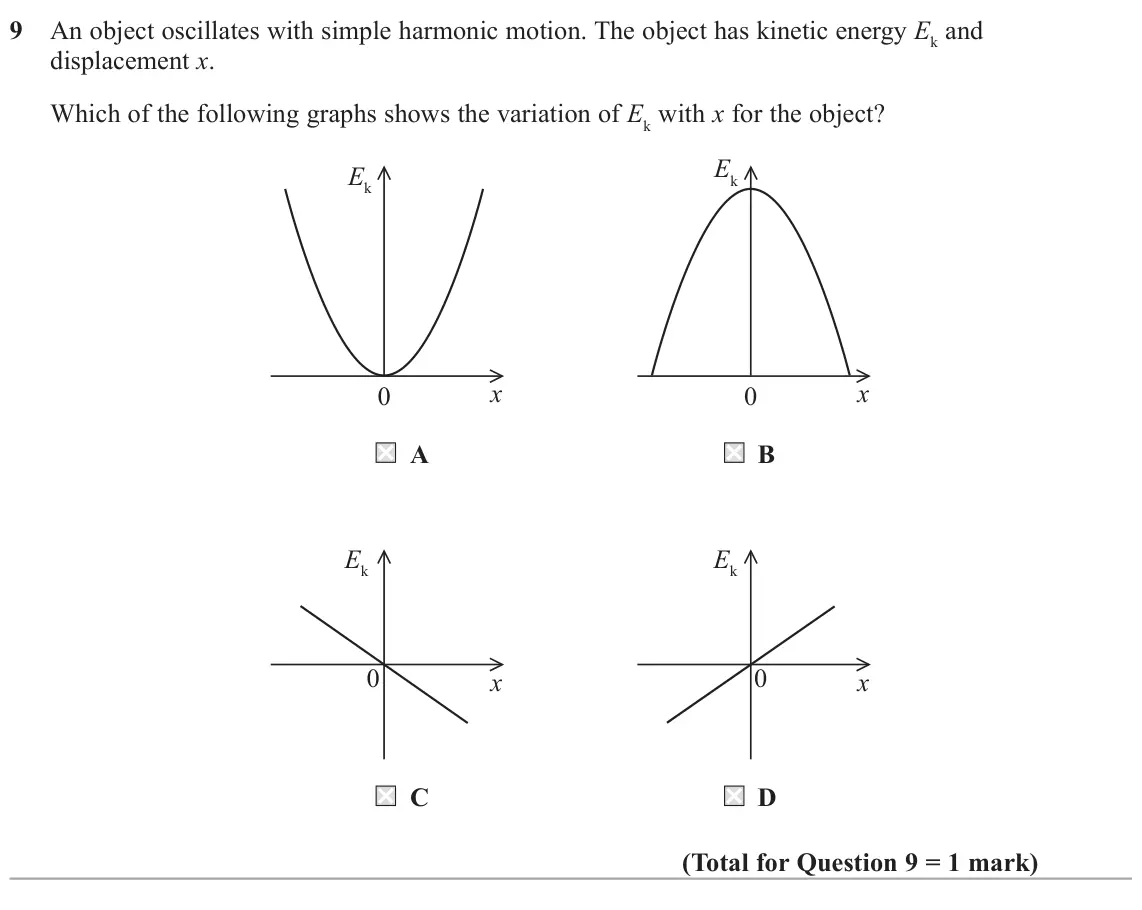
- June 2023, Paper 2, Q9 (1 mark): An object oscillates with simple harmonic motion. The object has kinetic energy Ek and displacement x. Which of the following graphs shows the variation of Ek w
- June 2023, Paper 2, Q16(b)(ii) (3 marks): A force is applied to the car which results in a further small compression of each spring. The force is then removed, and the body of the car oscillates with si
- June 2023, Paper 2, Q16(c) (2 marks): State the conditions for simple harmonic motion. (2)
- June 2023, Paper 3, Q6(a) (4 marks): Describe how the method used by the student could be improved to determine a more accurate value of the time period. (4)
- June 2023, Paper 3, Q6(b) (5 marks): The student displaced the trolley 6.0 cm from the equilibrium position. She recorded the velocity of the oscillating trolley using a sensor connected to a data
- June 2023, Paper 3, Q6(c)(ii) (2 marks): Determine the effective spring constant k of the oscillating trolley system. mass of trolley = 0.87 kg (2) k =
- June 2023, Paper 3, Q10(a)(i) (2 marks): The student displaced the pendulum through a small angle so that it oscillated. She determined the time period T as 2.50 s. Calculate the length of the pendulum
- June 2022, Paper 2, Q20(a) (5 marks): The mass of the flamingo is 65 g. When the flamingo is suspended vertically the spring extends by 8.5 cm. The flamingo is pulled downwards by a small extra disp
- June 2022, Paper 2, Q20(c)(i) (2 marks): Show that the period of oscillation of the flamingo pendulum is about 2.2 s. pendulum length = 1.25 m (2)
- June 2022, Paper 2, Q20(c)(ii) (3 marks): The amplitude of oscillation of the flamingo pendulum is 7.5 cm. Calculate the maximum velocity of the flamingo pendulum. (3) Maximum velocity =
- June 2022, Paper 3, Q4 (5 marks): The diagram shows a metronome, which includes an inverted pendulum, used by musicians to set a tempo. The pendulum oscillates with simple harmonic motion and ma
- June 2022, Paper 3, Q12(c) (5 marks): Buildings in nearby Tohoku University suffered structural damage during the 2011 earthquake. The graph shows how the acceleration of one of the buildings, measu
- November 2021, Paper 2, Q9 (1 mark): A mass is suspended from a spring and allowed to come to equilibrium. The mass is displaced vertically and moves with simple harmonic motion. The graph shows ho
- November 2021, Paper 2, Q11 (4 marks): A simple pendulum consisting of a thread and a bob is set up next to a horizontal rod. The bob is displaced to the left and released. When the bob reaches the e
- November 2021, Paper 3, Q10(b)(i) (1 mark): Give an example of another possible systematic error in this experiment. (1)
- November 2021, Paper 3, Q10(b)(ii) (3 marks): Another student suggests that to reduce the uncertainty in the value for the period, a data logger connected to a light gate could be used to measure time. Comm
- November 2021, Paper 3, Q10(b)(iii) (3 marks): Determine a value for the stiffness of the spring. (3) Stiffness of spring =
- November 2021, Paper 3, Q10(c) (3 marks): When determining the period of oscillation for each mass, the student measured the time for 20 oscillations. He repeated this measurement to obtain a mean time
- October 2020, Paper 2, Q7 (1 mark): A pendulum of length l with a bob of mass m oscillates with frequency f. What is the frequency of a pendulum of length 4l with a bob of mass 2m? A 4 f B 2 f C f
- October 2020, Paper 2, Q13(a) (2 marks): State why the mass will oscillate with simple harmonic motion when it is displaced slightly from its equilibrium position and released. (2)
- October 2020, Paper 2, Q13(b) (5 marks): The student then investigated the oscillations of the mass on the metal strip. The student fixed different numbers of 10 g masses to the end of the metal strip.
- October 2020, Paper 3, Q3(a) (2 marks): To determine the period T of the pendulum, the student used the following method: • release the bob from its highest position and start a stopwatch • stop the s
- October 2020, Paper 3, Q3(b) (5 marks): The student used her data to plot a graph of T 2 against d as shown below. 14.0 13.0 12.0 11.0 T 2 / s2 10.0 9.0 8.0 0.00 0.10 0.20 0.30 0.40 0.50 0.60 0.70 d /
- June 2019, Paper 2, Q10 (1 mark): A mass at the end of a spring is set into small amplitude simple harmonic motion. Which of the following graphs correctly shows the variation of velocity v of t
- June 2019, Paper 2, Q16(a) (4 marks): The pendulum makes 8 complete oscillations in 52.2 s. Show that the length of the wire supporting the sphere is about 10m. diameter of sphere = 60.0cm (4)
- June 2019, Paper 3, Q7(a)(i) (6 marks): Explain the procedure that the student should follow to make an accurate determination of the time period T of the trolley. (6)
- June 2019, Paper 3, Q7(a)(ii) (3 marks): Describe how the student should use her value of T to determine the maximum speed of the trolley. (3)
- June 2019, Paper 3, Q7(b) (1 mark): Another student suggests that a more accurate value for T could be obtained by using a position sensor and data logger. Comment on this suggestion. (1)
- June 2019, Paper 3, Q7(c) (3 marks): The student displaces the trolley a greater distance from the equilibrium position, so the amplitude of oscillation is doubled. The trolley still moves with sim
- June 2018, Paper 2, Q8 (1 mark): The graph shows how the displacement of a simple harmonic oscillator varies with time. Time Which of the following graphs shows how velocity varies with time fo
- June 2018, Paper 2, Q16(b)(i) (1 mark): State the phase relationship between the two pendulums. (1)
- June 2018, Paper 2, Q16(b)(ii) (3 marks): Determine the length of pendulums A and B. (3) Length =
- June 2018, Paper 3, Q5(a)(i) (2 marks): Calculate a more accurate value for lm. (2) lm =
- June 2018, Paper 3, Q5(a)(ii) (2 marks): Determine the time period of the oscillations of this pendulum, using your calculated value for lm. (2) Time period of oscillations =
- June 2018, Paper 3, Q5(b) (4 marks): She sets the pendulum into oscillations with small amplitude and uses a stopwatch to determine the time period. A B O The student releases the pendulum at A and
- June 2018, Paper 3, Q11(b) (2 marks): State what is meant by simple harmonic motion. (2)
- June 2018, Paper 3, Q11(c)(i) (2 marks): the frequency of oscillation (2)
- June 2018, Paper 3, Q11(c)(ii) (2 marks): the maximum speed of the platform. (2)
- June 2018, Paper 3, Q11(d) (2 marks): The platform continues to move with simple harmonic motion at the same frequency, but its amplitude is doubled. Explain how the maximum kinetic energy of the pl
- June 2017, Paper 2, Q3 (1 mark): A playground swing completes 24 oscillations in 1 minute. Which of the following is the frequency of the oscillations? A 0.042 Hz B 0.40 Hz C 2.5 Hz D 24 Hz
- June 2017, Paper 3, Q4(a) (2 marks): Calculate the length L required for the pendulum to be a “seconds pendulum”. (2) L =
- June 2017, Paper 3, Q4(b) (2 marks): The student set the pendulum into oscillation. She used a stopwatch to check the accuracy of the pendulum’s period T. Describe the procedure the student should
- June 2017, Paper 3, Q4(c) (4 marks): Another student suggested that the uncertainty in the measurement of the time period of the pendulum could be reduced by using a light gate and a data logger. T
- June 2017, Paper 3, Q11(c) (4 marks): Two identical springs are joined in series and a bar magnet is hung from one end as shown. S N The bar magnet is displaced a small distance vertically from its
Questions, mark schemes and examiner’s reports are © Pearson Edexcel, from their published past papers. Plumi isn’t affiliated with any exam board. Want whole papers? Every Edexcel A-Level Physics paper.
Rather write your answers by hand on iPad? Plumi marks them against the same mark schemes.