 plumi
Gravitational fields and orbits: Edexcel A‑Level Physics questions
Every Edexcel A-Level Physics exam question on Gravitational fields and orbits (specification points 174–180), 2016–2025, with its mark scheme and examiner’s report.
Find questions1,540
Calculations
Q17(a)(ii)
The whole paper ↗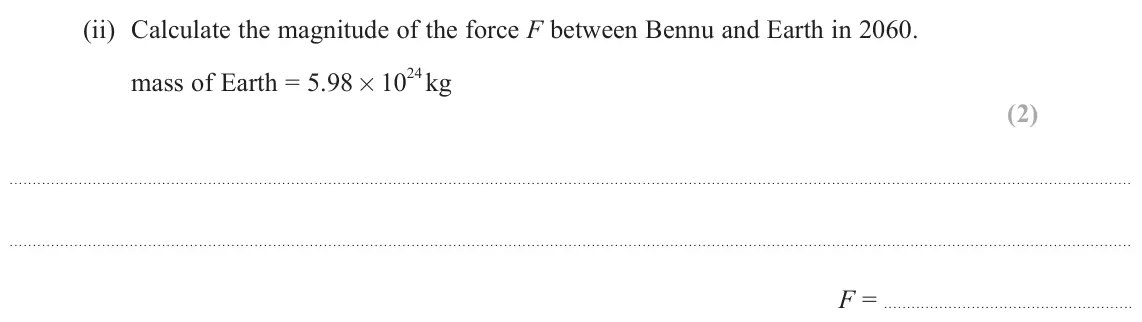
Q17(b)
The whole paper ↗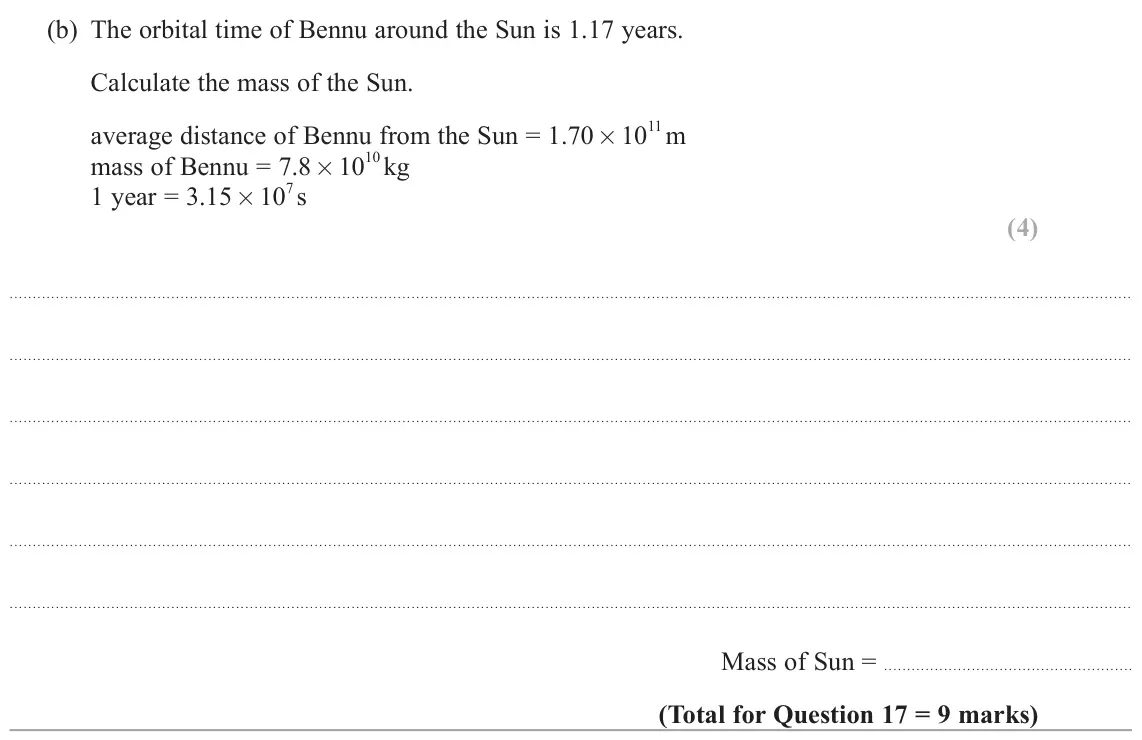
Q18(e)
The whole paper ↗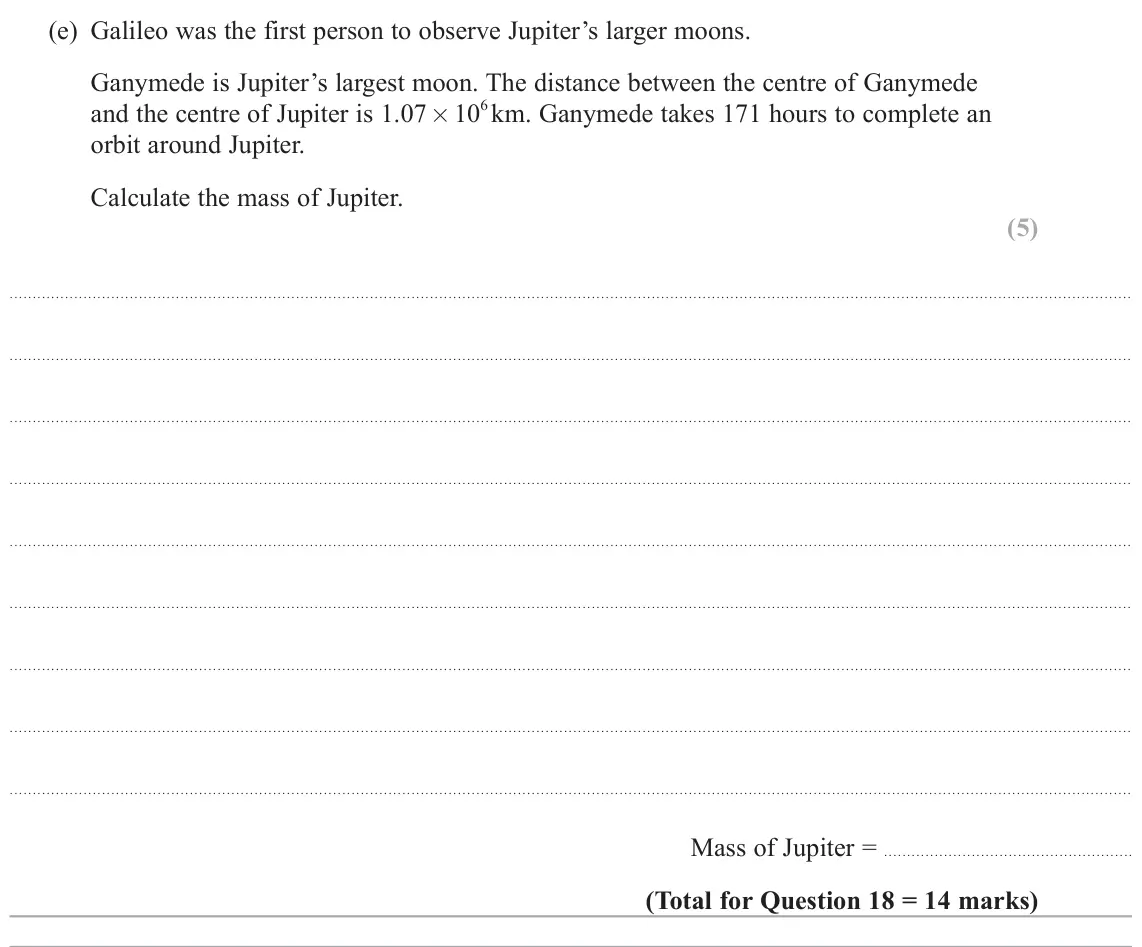
Q17(a)
The whole paper ↗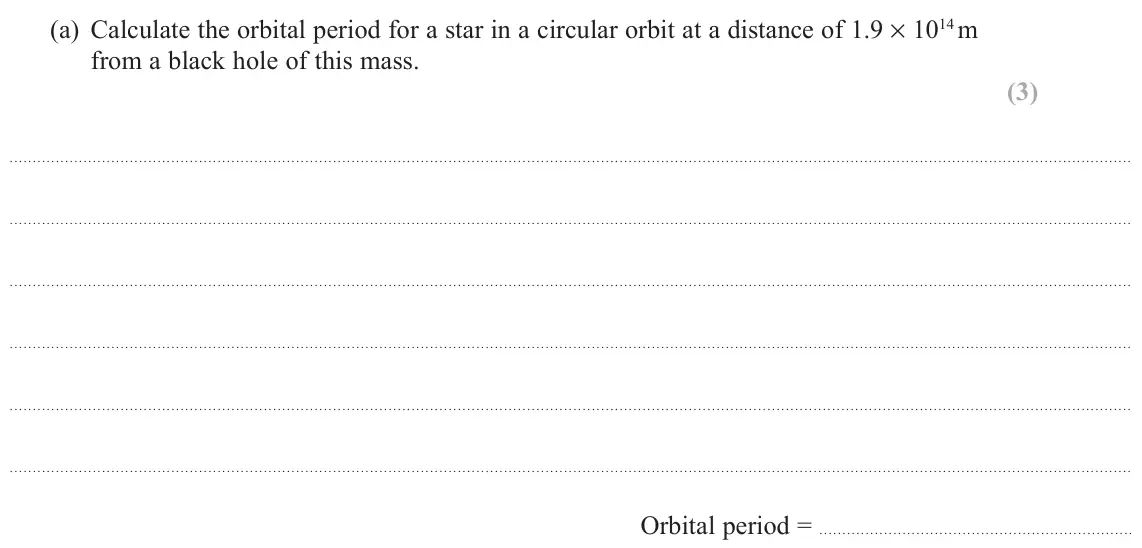
Q17(b)(i)
The whole paper ↗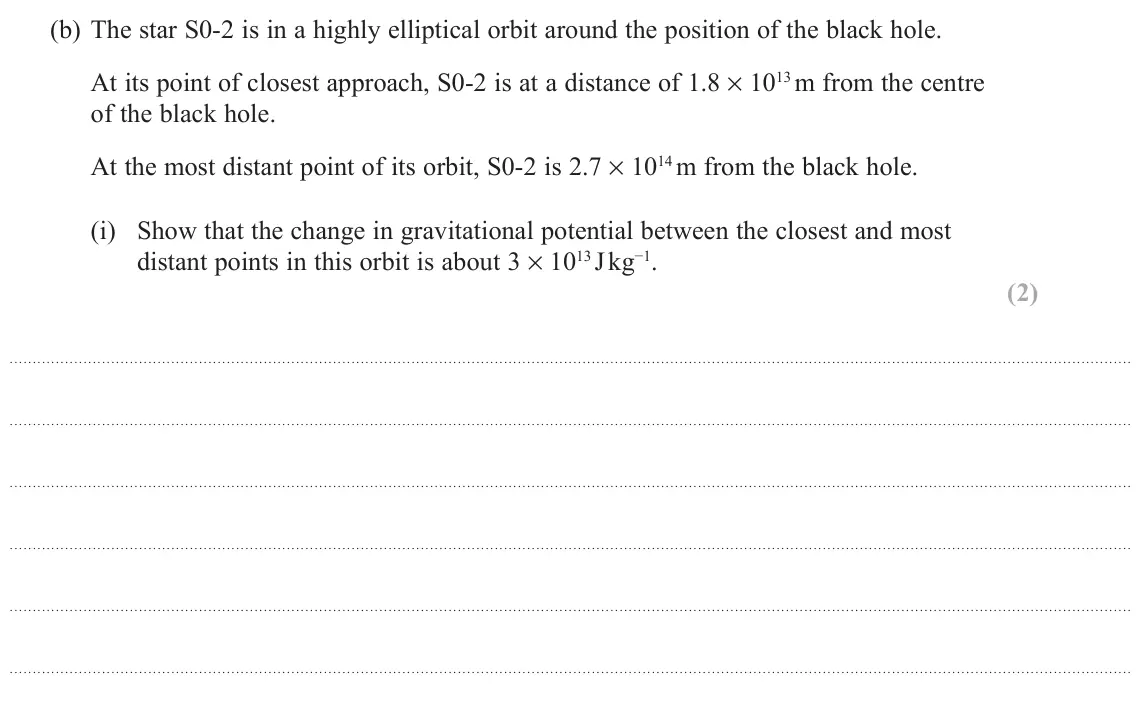
Q17(b)(ii)
The whole paper ↗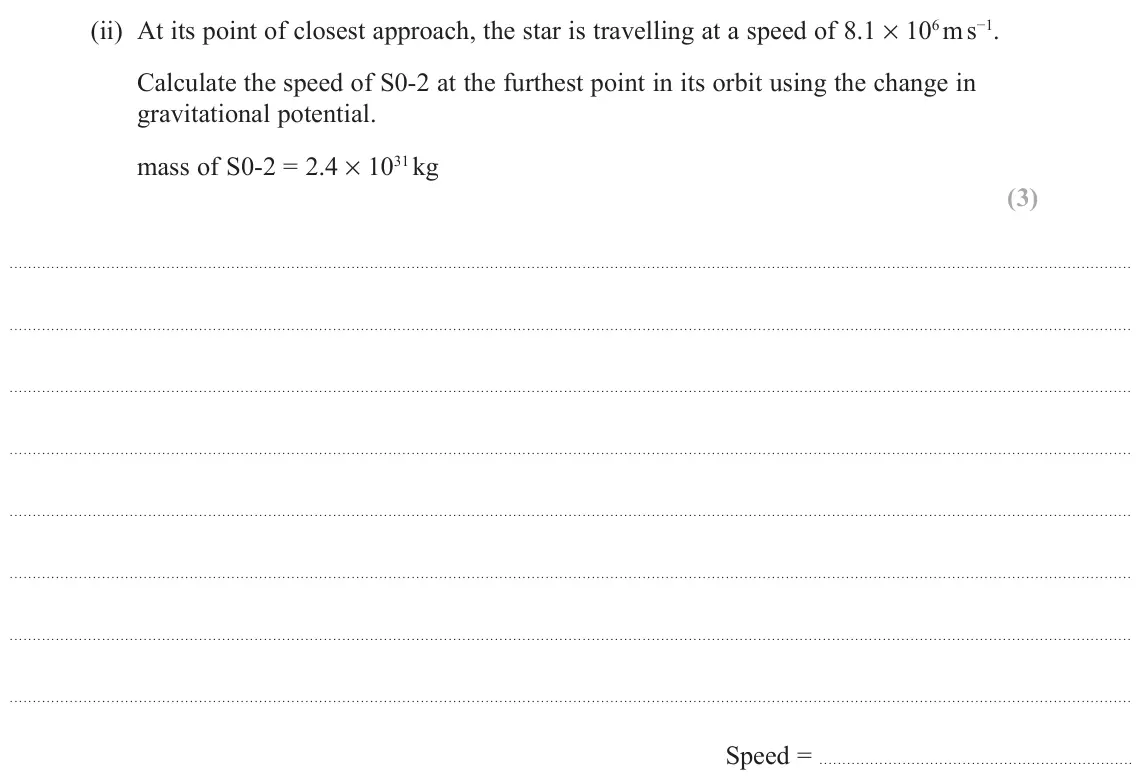
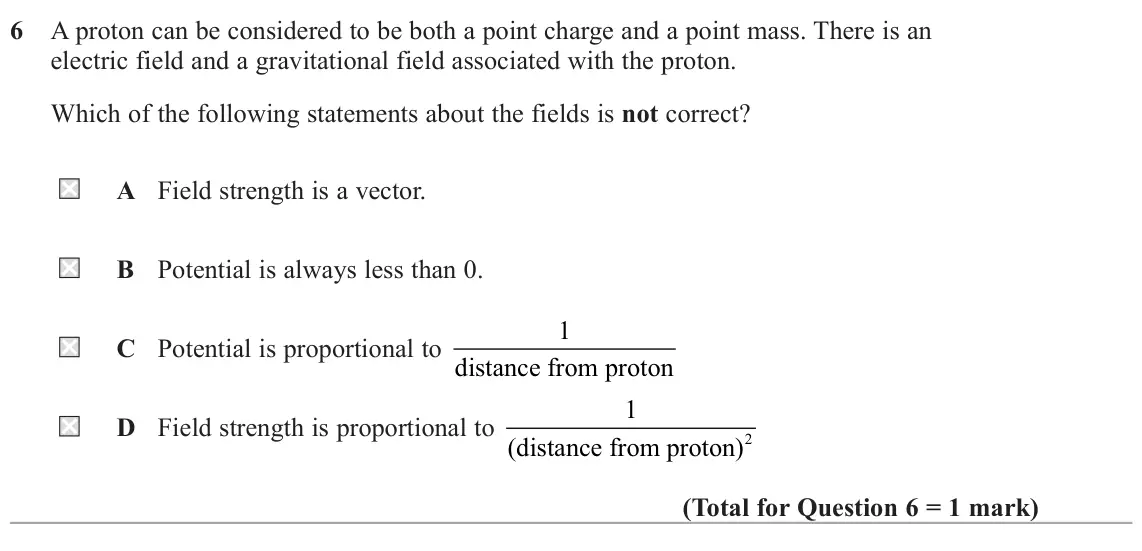
Q16(b)
The whole paper ↗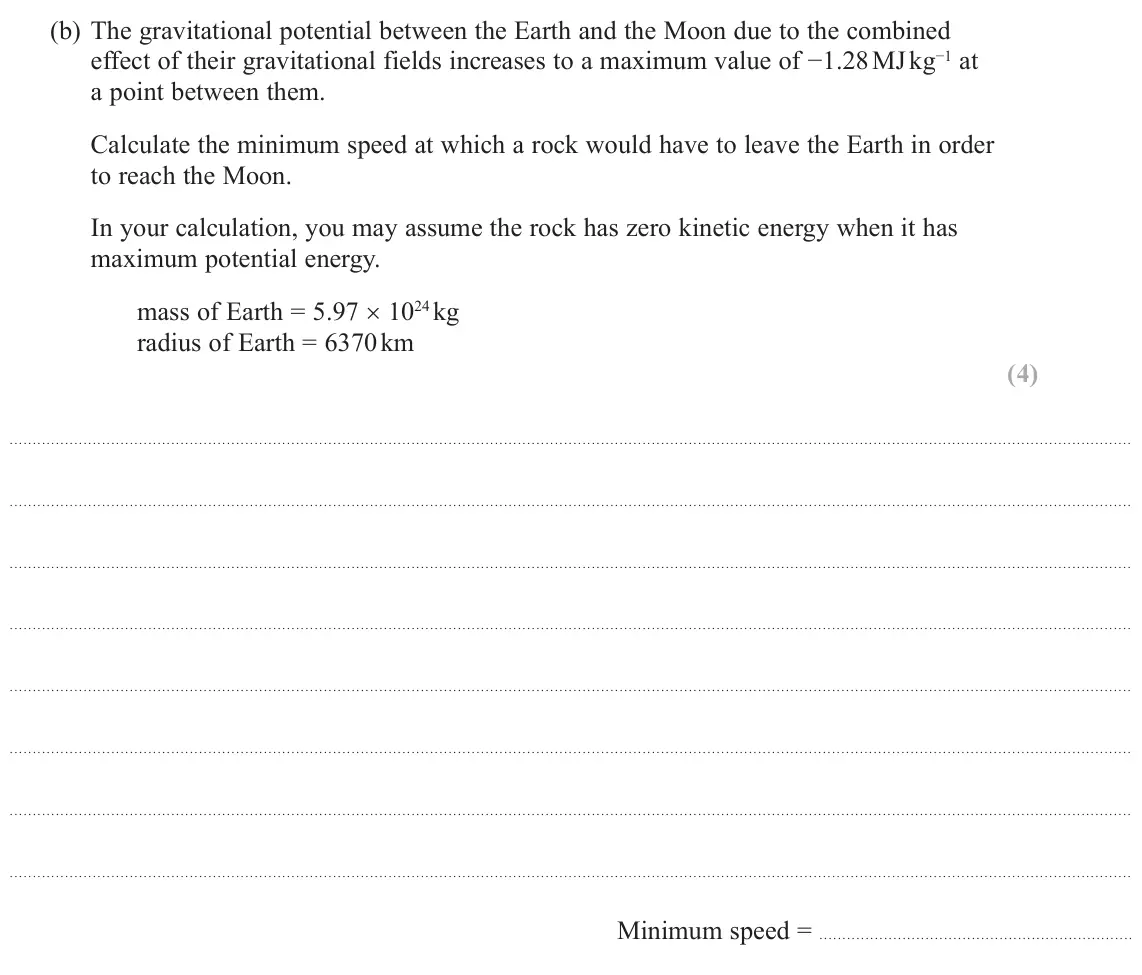
Q16(c)
The whole paper ↗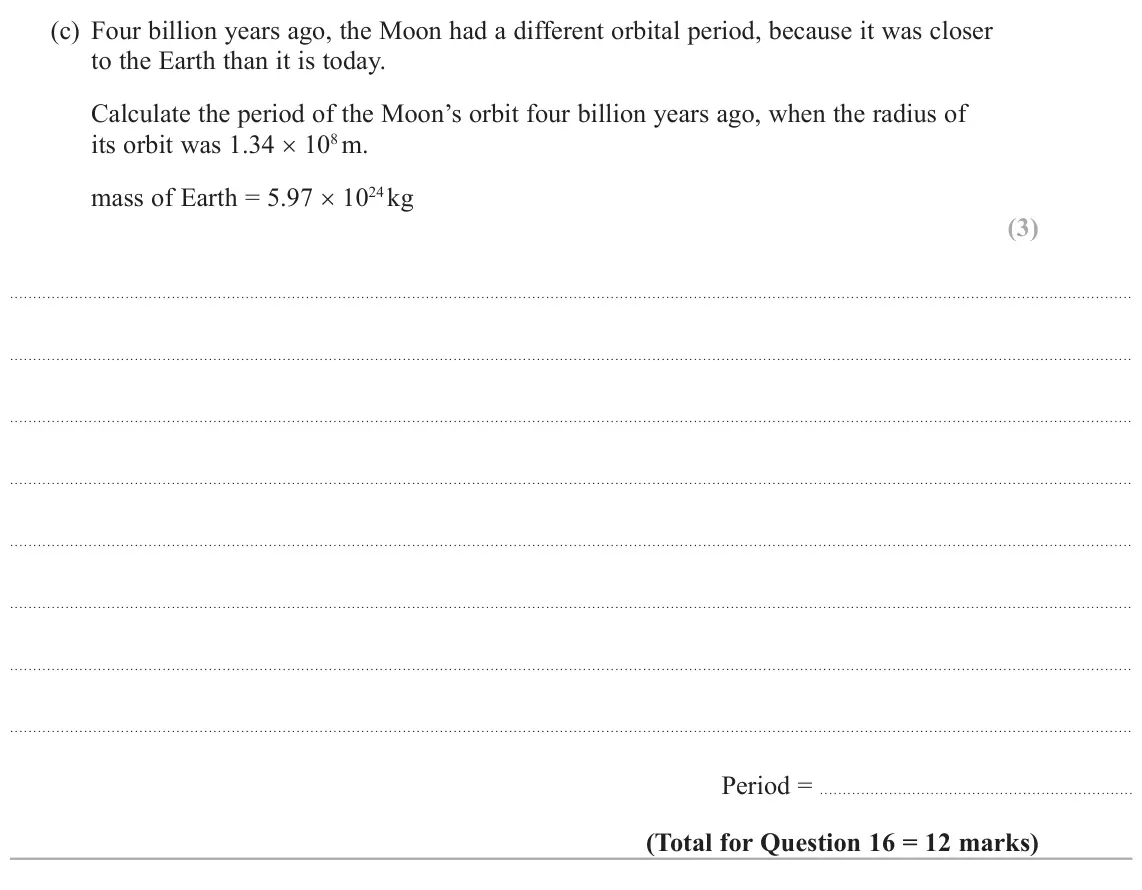
Q11(c)(i)
The whole paper ↗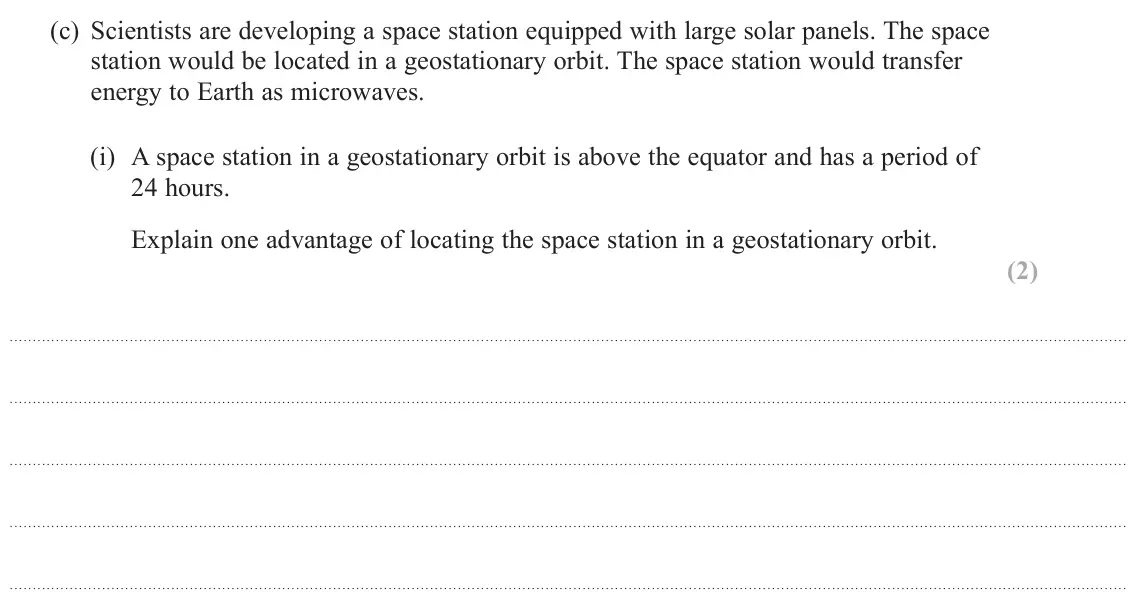
Q11(c)(ii)
The whole paper ↗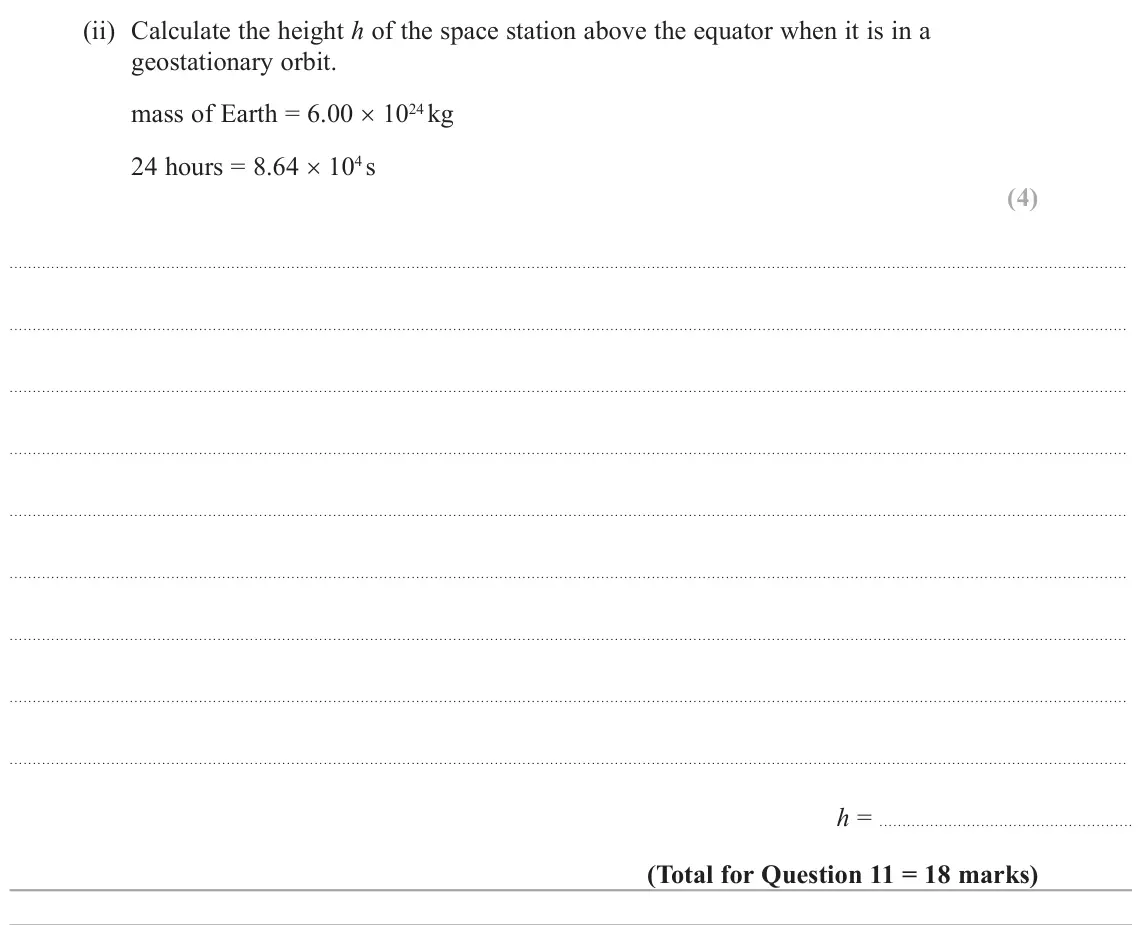
Q6(a)(i)
The whole paper ↗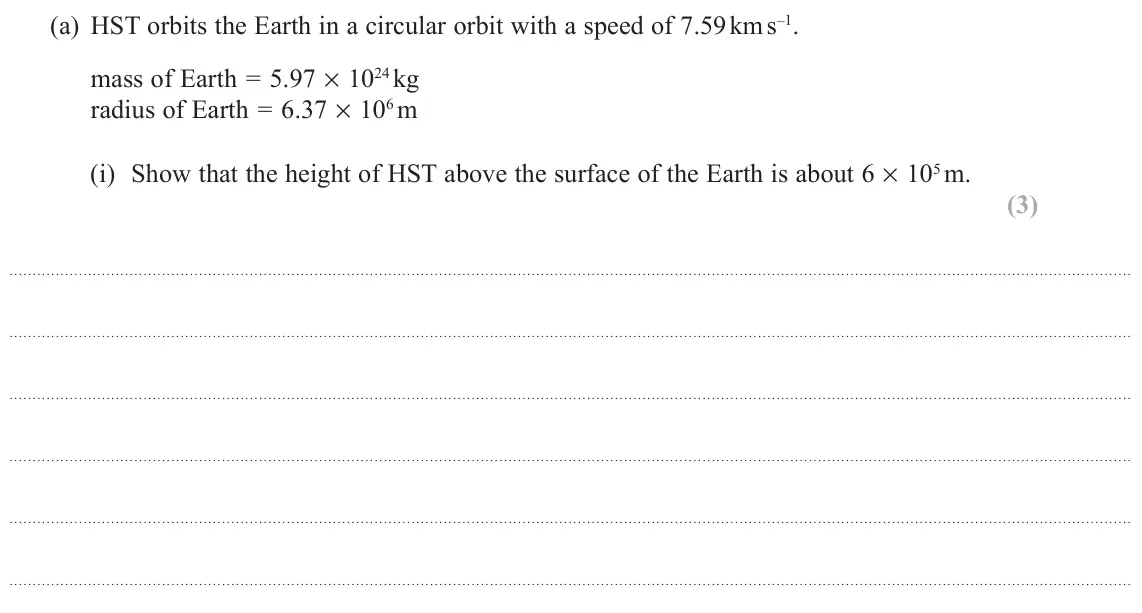
Q6(a)(ii)
The whole paper ↗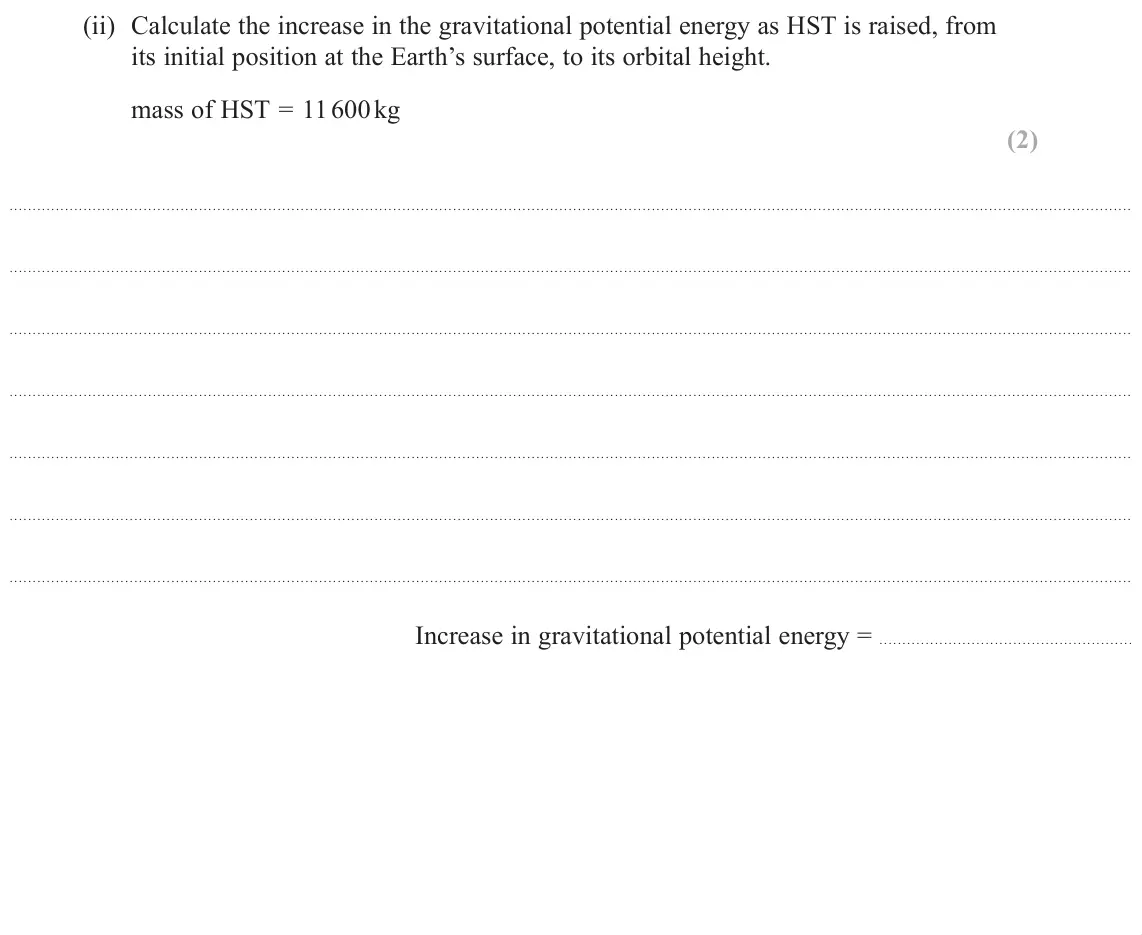
Q6(a)(iii)
The whole paper ↗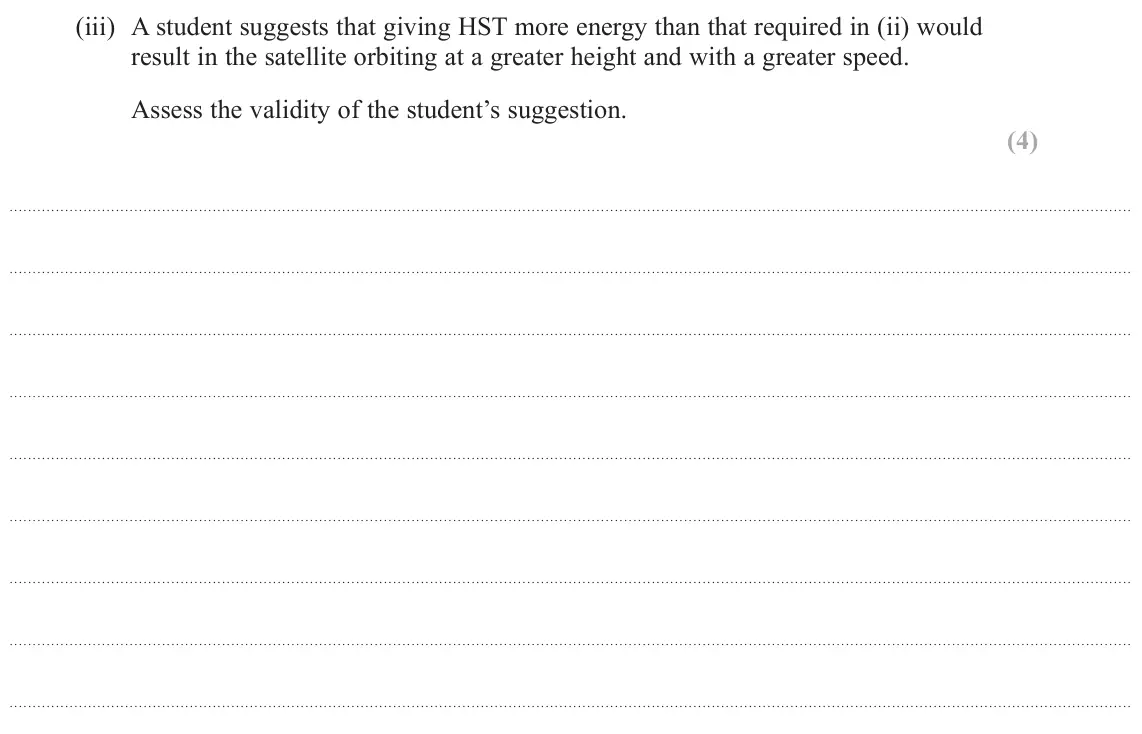
Q15(a)(i)
The whole paper ↗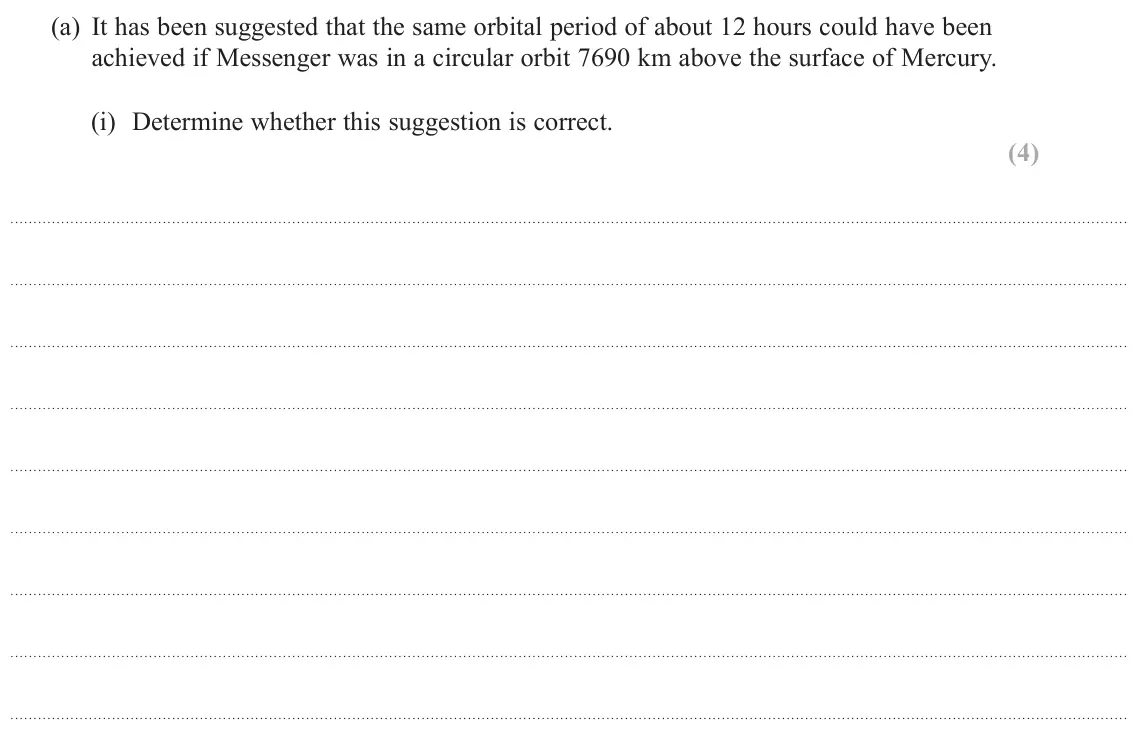
Q15(a)(ii)
The whole paper ↗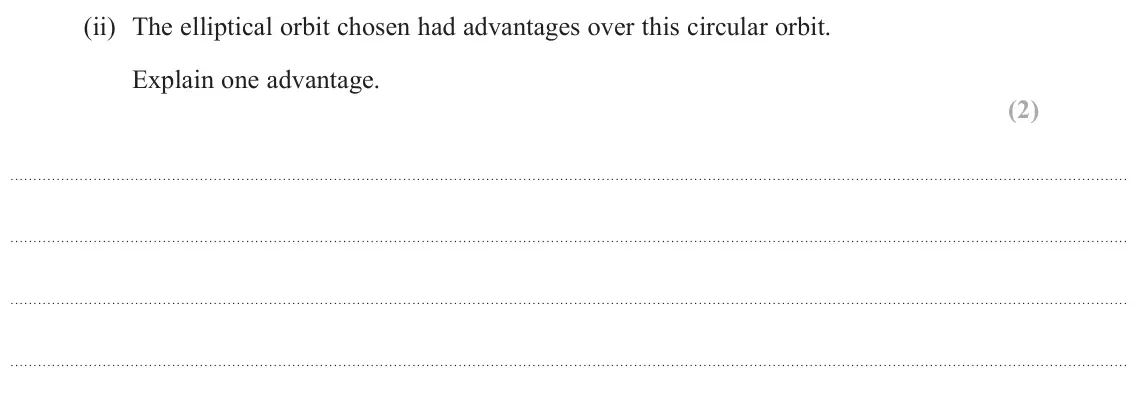
All 25 questions on Gravitational fields and orbits, as a list
- June 2025, Paper 2, Q17(a)(ii) (2 marks): Calculate the magnitude of the force F between Bennu and Earth in 2060. mass of Earth = 5.98 × 10 24 kg (2) F =
- June 2025, Paper 2, Q17(b) (4 marks): The orbital time of Bennu around the Sun is 1.17 years. Calculate the mass of the Sun. average distance of Bennu from the Sun = 1.70 × 10 11 m mass of Bennu = 7
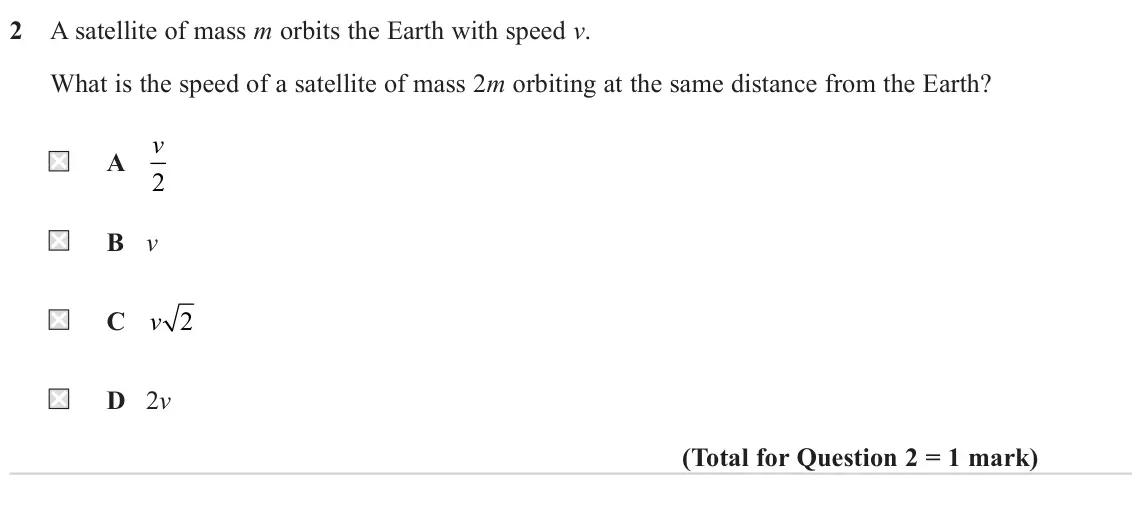
- June 2024, Paper 2, Q2 (1 mark): A satellite of mass m orbits the Earth with speed v. What is the speed of a satellite of mass 2m orbiting at the same distance from the Earth? v A 2 B v C v 2 D
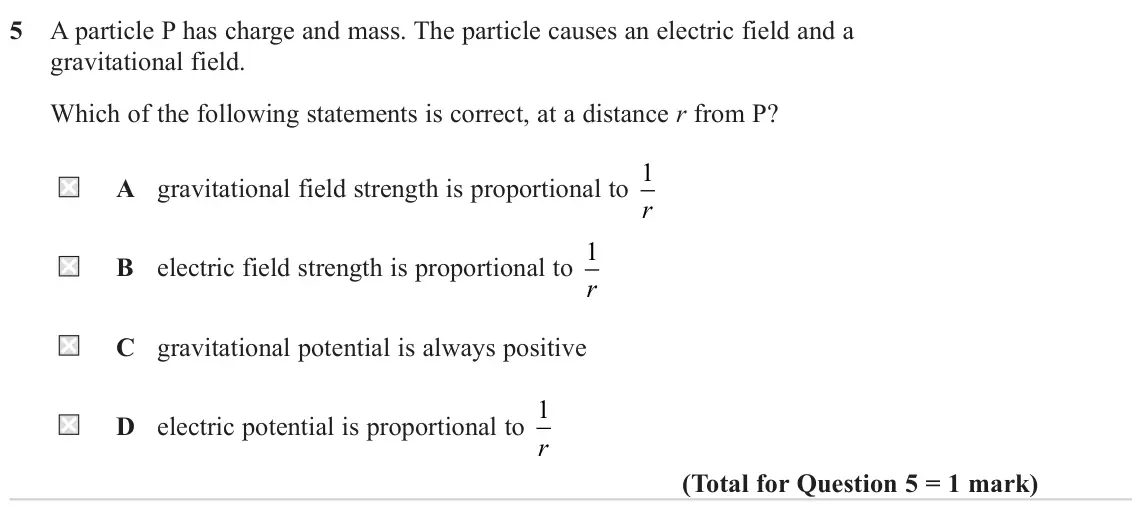
- June 2024, Paper 2, Q5 (1 mark): A particle P has charge and mass. The particle causes an electric field and a gravitational field. Which of the following statements is correct, at a distance r
- June 2023, Paper 2, Q18(e) (5 marks): Galileo was the first person to observe Jupiter’s larger moons. Ganymede is Jupiter’s largest moon. The distance between the centre of Ganymede and the centre o
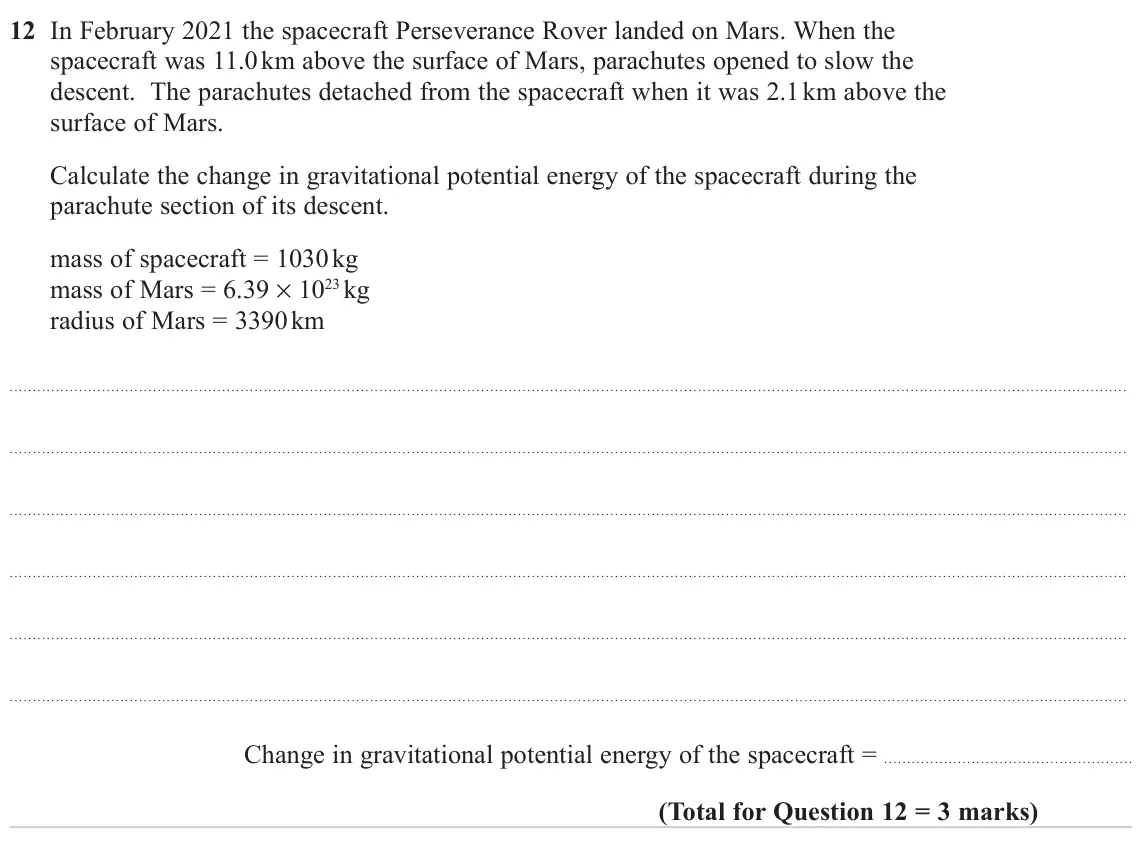
- June 2022, Paper 2, Q12 (3 marks): In February 2021 the spacecraft Perseverance Rover landed on Mars. When the spacecraft was 11.0 km above the surface of Mars, parachutes opened to slow the desc
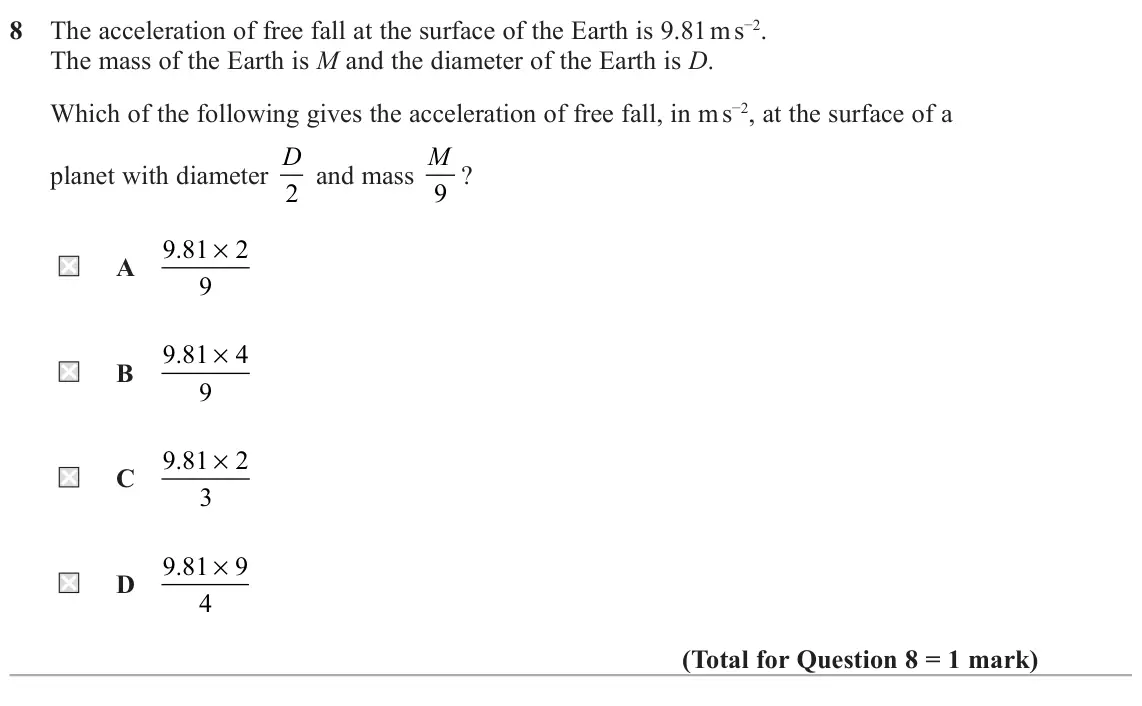
- November 2021, Paper 2, Q8 (1 mark): The acceleration of free fall at the surface of the Earth is 9.81 m s−2. The mass of the Earth is M and the diameter of the Earth is D. Which of the following g
- November 2021, Paper 2, Q17(a) (3 marks): Calculate the orbital period for a star in a circular orbit at a distance of 1.9 × 10¹⁴ m from a black hole of this mass. (3) Orbital period =
- November 2021, Paper 2, Q17(b)(i) (2 marks): Show that the change in gravitational potential between the closest and most distant points in this orbit is about 3 × 10¹³ J kg−1. (2)
- November 2021, Paper 2, Q17(b)(ii) (3 marks): At its point of closest approach, the star is travelling at a speed of 8.1 × 10⁶ m s−1. Calculate the speed of S0-2 at the furthest point in its orbit using the
- October 2020, Paper 2, Q6 (1 mark): A proton can be considered to be both a point charge and a point mass. There is an electric field and a gravitational field associated with the proton. Which of
- October 2020, Paper 2, Q16(b) (4 marks): The gravitational potential between the Earth and the Moon due to the combined effect of their gravitational fields increases to a maximum value of −1.28 MJ kg−
- October 2020, Paper 2, Q16(c) (3 marks): Four billion years ago, the Moon had a different orbital period, because it was closer to the Earth than it is today. Calculate the period of the Moon’s orbit f
- October 2020, Paper 3, Q11(c)(i) (2 marks): A space station in a geostationary orbit is above the equator and has a period of 24 hours. Explain one advantage of locating the space station in a geostationa
- October 2020, Paper 3, Q11(c)(ii) (4 marks): Calculate the height h of the space station above the equator when it is in a geostationary orbit. mass of Earth = 6.00 × 1024 kg 24 hours = 8.64 × 10⁴ s (4) h
- June 2019, Paper 3, Q6(a)(i) (3 marks): Show that the height of HST above the surface of the Earth is about 6 × 10⁵ m. (3)
- June 2019, Paper 3, Q6(a)(ii) (2 marks): Calculate the increase in the gravitational potential energy as HST is raised, from its initial position at the Earth’s surface, to its orbital height. mass of
- June 2019, Paper 3, Q6(a)(iii) (4 marks): A student suggests that giving HST more energy than that required in (ii) would result in the satellite orbiting at a greater height and with a greater speed. A
- June 2018, Paper 2, Q15(a)(i) (4 marks): Determine whether this suggestion is correct. (4)
- June 2018, Paper 2, Q15(a)(ii) (2 marks): The elliptical orbit chosen had advantages over this circular orbit. Explain one advantage. (2)
- June 2018, Paper 2, Q15(b) (4 marks): Calculate the velocity an object would have as it reached the surface of Mercury if it was released from Messenger’s maximum orbital height. Assume the object i
- June 2018, Paper 3, Q11(a) (2 marks): Explain why the astronauts in the ISS have an apparent weight of zero. (2)
- June 2017, Paper 2, Q4 (1 mark): Which of the following is not a similarity between gravitational fields and electric fields? A For a point charge or point mass, the field follows the inverse s
- June 2017, Paper 2, Q12(a) (2 marks): Calculate the force between the black holes. mass of Sun, M = 1.99 × 1030 kg mass of black hole A = 36M mass of black hole B = 29M (2) Force =
- June 2017, Paper 2, Q12(b) (3 marks): By considering the orbit of one black hole about C, determine the period of the orbit. (3) Period =
Questions, mark schemes and examiner’s reports are © Pearson Edexcel, from their published past papers. Plumi isn’t affiliated with any exam board. Want whole papers? Every Edexcel A-Level Physics paper.
Rather write your answers by hand on iPad? Plumi marks them against the same mark schemes.