 plumi
Public sector finances: Edexcel A‑Level Economics A questions
Every Edexcel A-Level Economics A exam question on 4.5.3 Public sector finances, 2016–2025, with its mark scheme and examiner’s report.
Find questions784
Calculations
Q6(c)
The whole paper ↗
Q6(c)
The whole paper ↗
Q5(a)
The whole paper ↗
Q5(b)
The whole paper ↗
Q5(c)
The whole paper ↗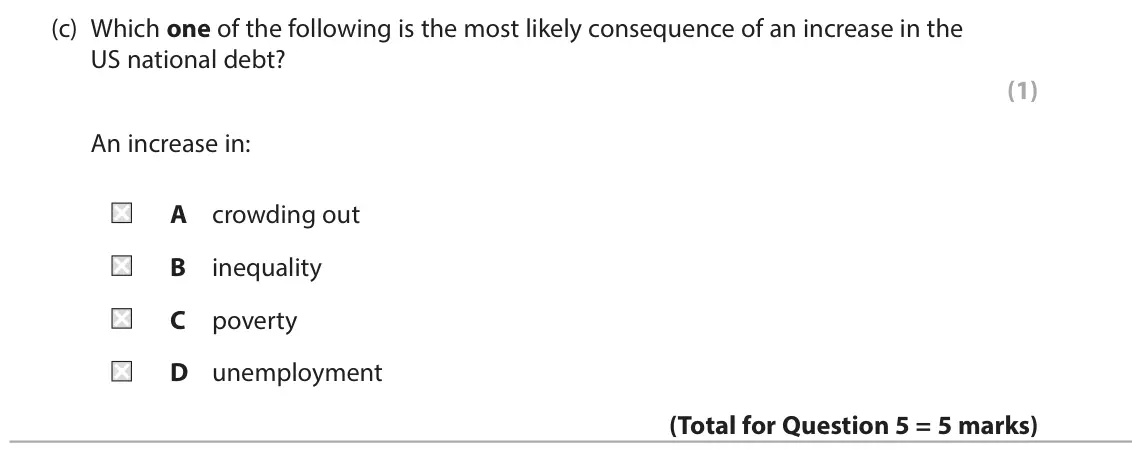
Q4(b)
The whole paper ↗
Q1(c)
The whole paper ↗
Q2(a)
The whole paper ↗

Q4(a)
The whole paper ↗
Q4(b)
The whole paper ↗
Q4(c)
The whole paper ↗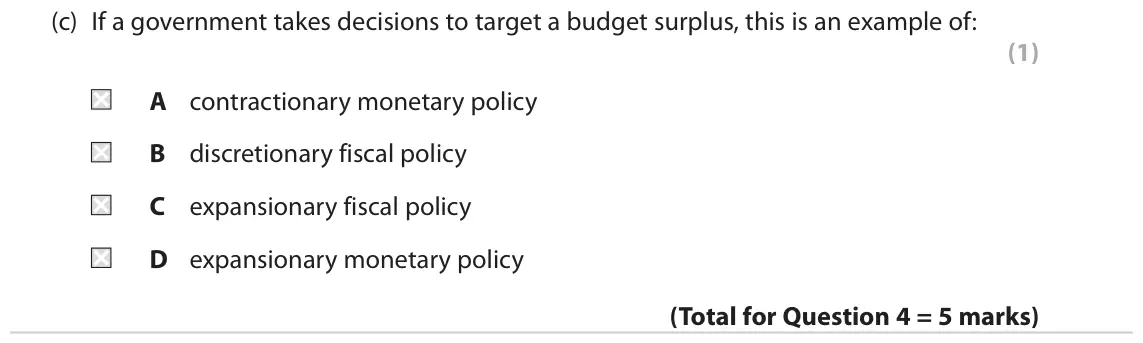
Q2(b)
The whole paper ↗
Q2(e)
The whole paper ↗
All 14 questions on Public sector finances, as a list
- June 2025, Paper 2, Q6(c) (10 marks): With reference to the information provided and your own knowledge, assess the likely macroeconomic effects of the German government’s budget deficit. (10) Read
- June 2024, Paper 2, Q6(c) (10 marks): Assess whether a fiscal deficit and national debt should be a cause for concern for the UK government. (10) Read Figures 1, 2, 3 and 4 and the following extract
- June 2023, Paper 2, Q5(a) (2 marks): Calculate the US national debt in 2021 as a percentage of GDP. (2) 5 In 2021, the US total GDP was $23 trillion and national debt was $28.4 trillion. (Source: a
- June 2023, Paper 2, Q5(b) (2 marks): Explain the relationship between a fiscal deficit and the national debt. (2) 5 In 2021, the US total GDP was $23 trillion and national debt was $28.4 trillion.
- June 2023, Paper 2, Q5(c) (1 mark): Which one of the following is the most likely consequence of an increase in the US national debt? (1) An increase in: A crowding out B inequality C poverty D un
- June 2022, Paper 2, Q4(b) (4 marks): With reference to the graph, explain the difference between automatic stabilisers and discretionary fiscal policy. (4) 4 The trade cycle Real GDP Positive outpu
- November 2021, Paper 2, Q1(c) (2 marks): Explain the impact of annual fiscal deficits on the US national debt. (2) 1 After the Global Financial Crisis of 2008, the US President introduced expansionary
- November 2021, Paper 3, Q2(a) (5 marks): Explain one reason why a country such as Germany wants to avoid an increase in the national debt relative to GDP (Figure 2). (5) Read Figures 1 to 4 and extract
- June 2019, Paper 2, Q8 (25 marks): Japan’s budget deficit for 2017/18 is expected to be 4.6% of GDP. Its national debt is forecast to increase to above 250% of GDP by 2019. Evaluate the impact of
- June 2018, Paper 2, Q4(a) (2 marks): Explain one likely reason why the 2019 budget surplus target was abandoned. (2) 4 The UK has experienced a budget deficit since 2001. The government aimed to re
- June 2018, Paper 2, Q4(b) (2 marks): Explain the likely impact of abandoning the budget surplus target on the UK national debt. (2) 4 The UK has experienced a budget deficit since 2001. The governm
- June 2018, Paper 2, Q4(c) (1 mark): If a government takes decisions to target a budget surplus, this is an example of: (1) A contractionary monetary policy B discretionary fiscal policy C expansio
- June 2017, Paper 3, Q2(b) (8 marks): With reference to Figures 4 and 5 and your own knowledge, examine the relationship between the national debt as a proportion of GDP and the fiscal deficit. (8)
- June 2017, Paper 3, Q2(e) (25 marks): With reference to the information provided and your own knowledge, evaluate the microeconomic and macroeconomic effects of a government policy of cutting public
Questions, mark schemes and examiner’s reports are © Pearson Edexcel, from their published past papers. Plumi isn’t affiliated with any exam board. Want whole papers? Full past papers.
Rather write your answers by hand on iPad? Plumi marks them against the same mark schemes.