 plumi
Stars and the Universe: CAIE IGCSE Physics questions
Every CAIE IGCSE Physics exam question on 6.2 Stars and the Universe, June 2024 and the specimen papers, with its mark scheme and examiner’s report.
Find questions355
Calculations

Q11(b)
The whole paper ↗
Q11(c)
The whole paper ↗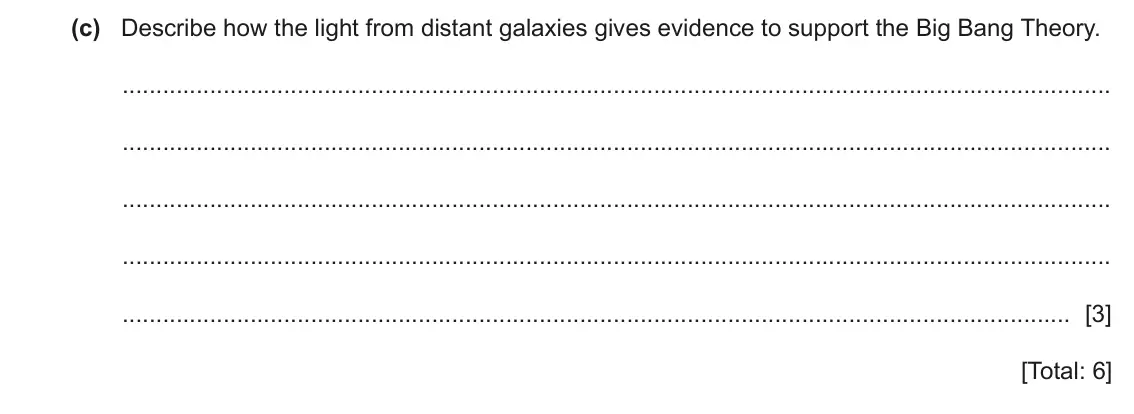
Q9(a)
The whole paper ↗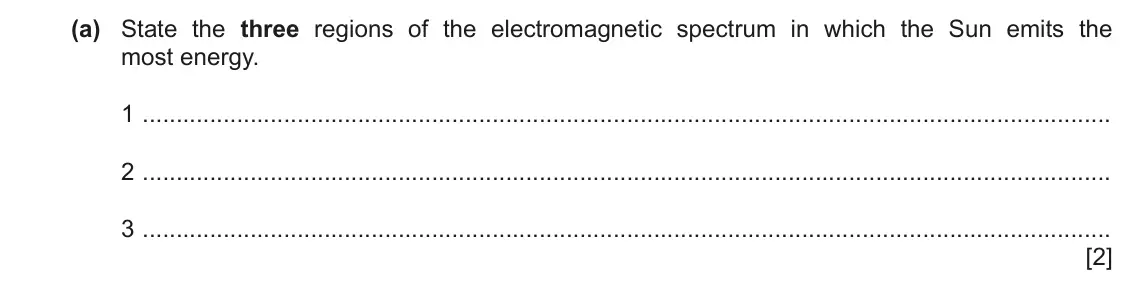
Q9(c)(i)
The whole paper ↗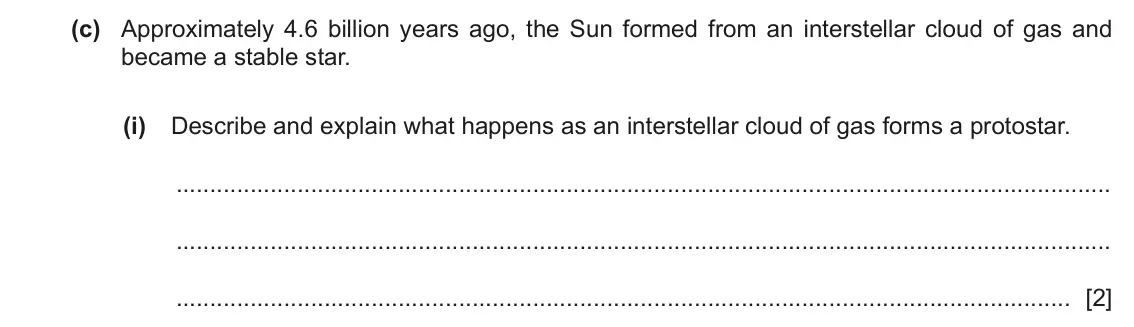
Q9(c)(ii)
The whole paper ↗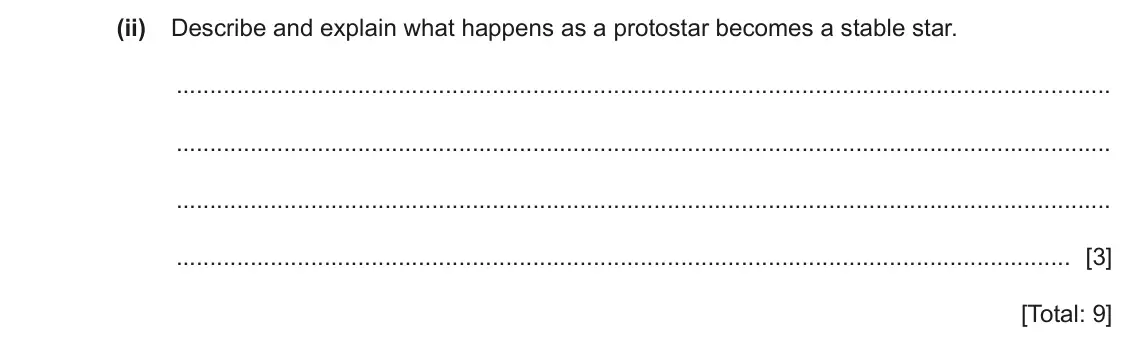
Q12(a)(i)
The whole paper ↗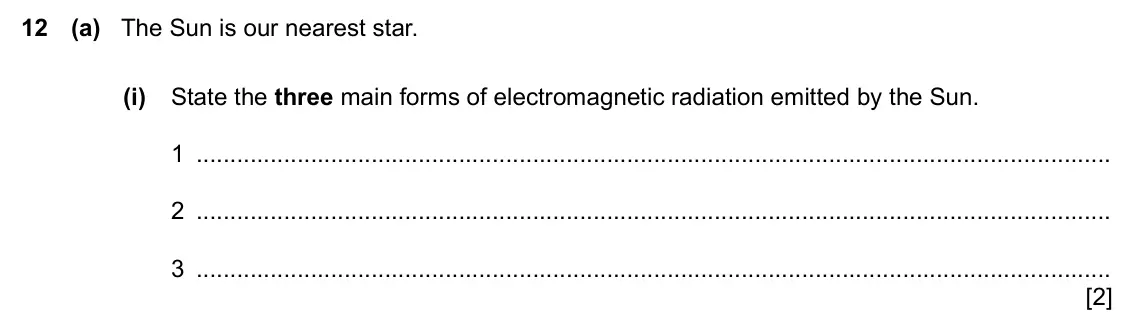
Q12(a)(ii)
The whole paper ↗
Q12(b)
The whole paper ↗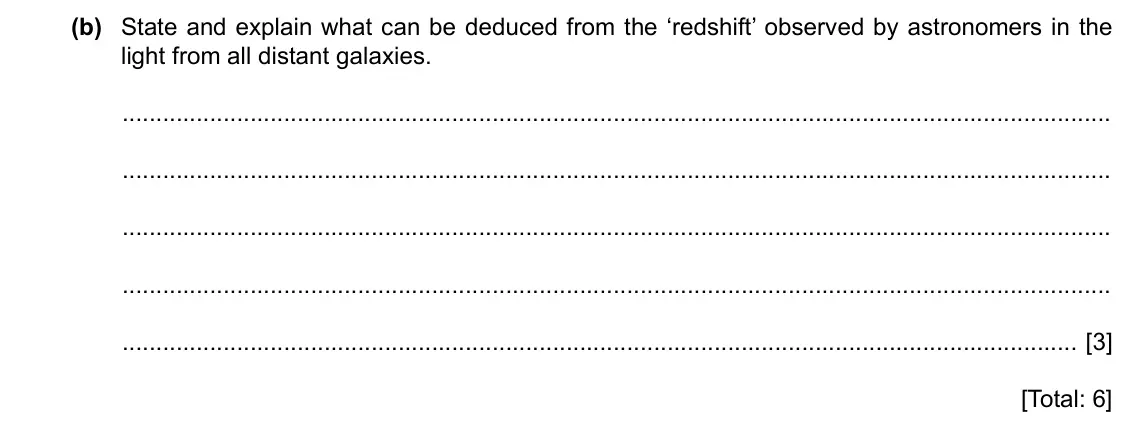
Q3(a)(i)
The whole paper ↗
Q11(a)
The whole paper ↗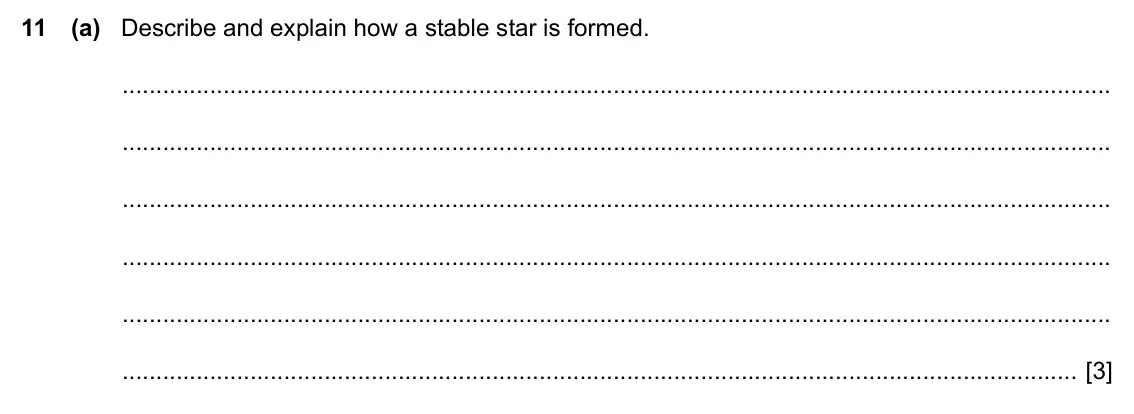
Q11(b)
The whole paper ↗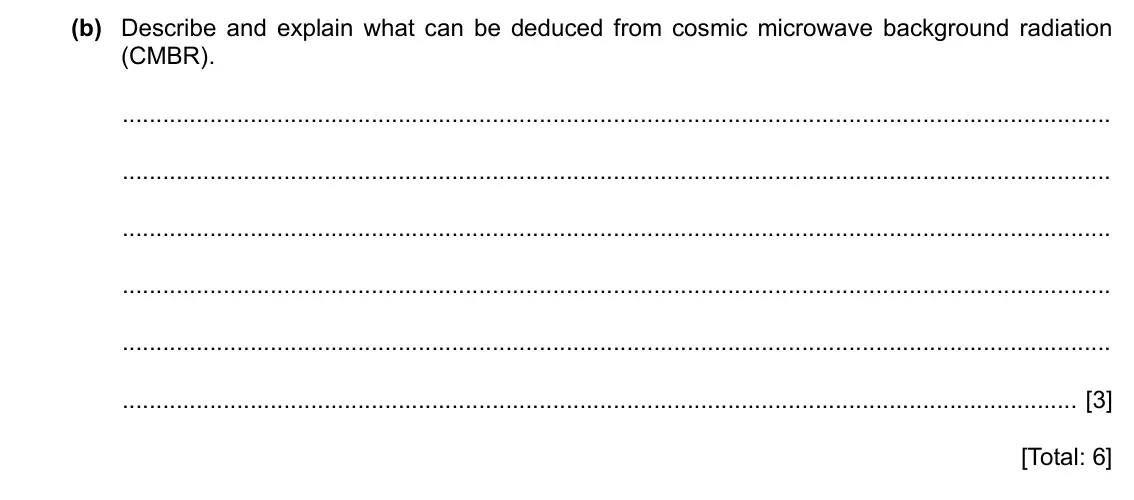
All 18 questions on Stars and the Universe, as a list
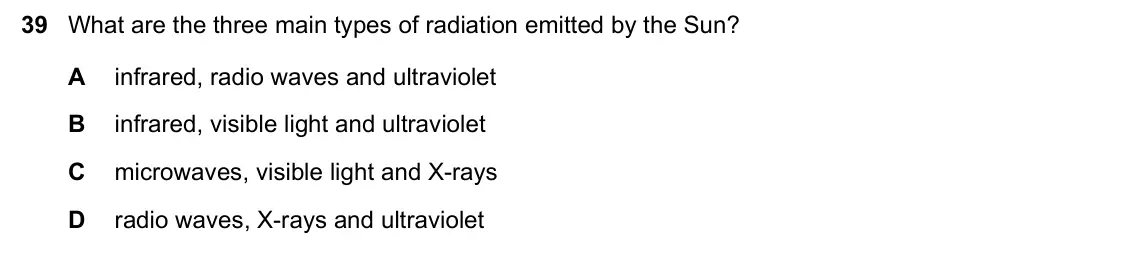
- June 2024, Paper 1, Q39 (1 mark): What are the three main types of radiation emitted by the Sun? A infrared, radio waves and ultraviolet B infrared, visible light and ultraviolet C microwaves, v
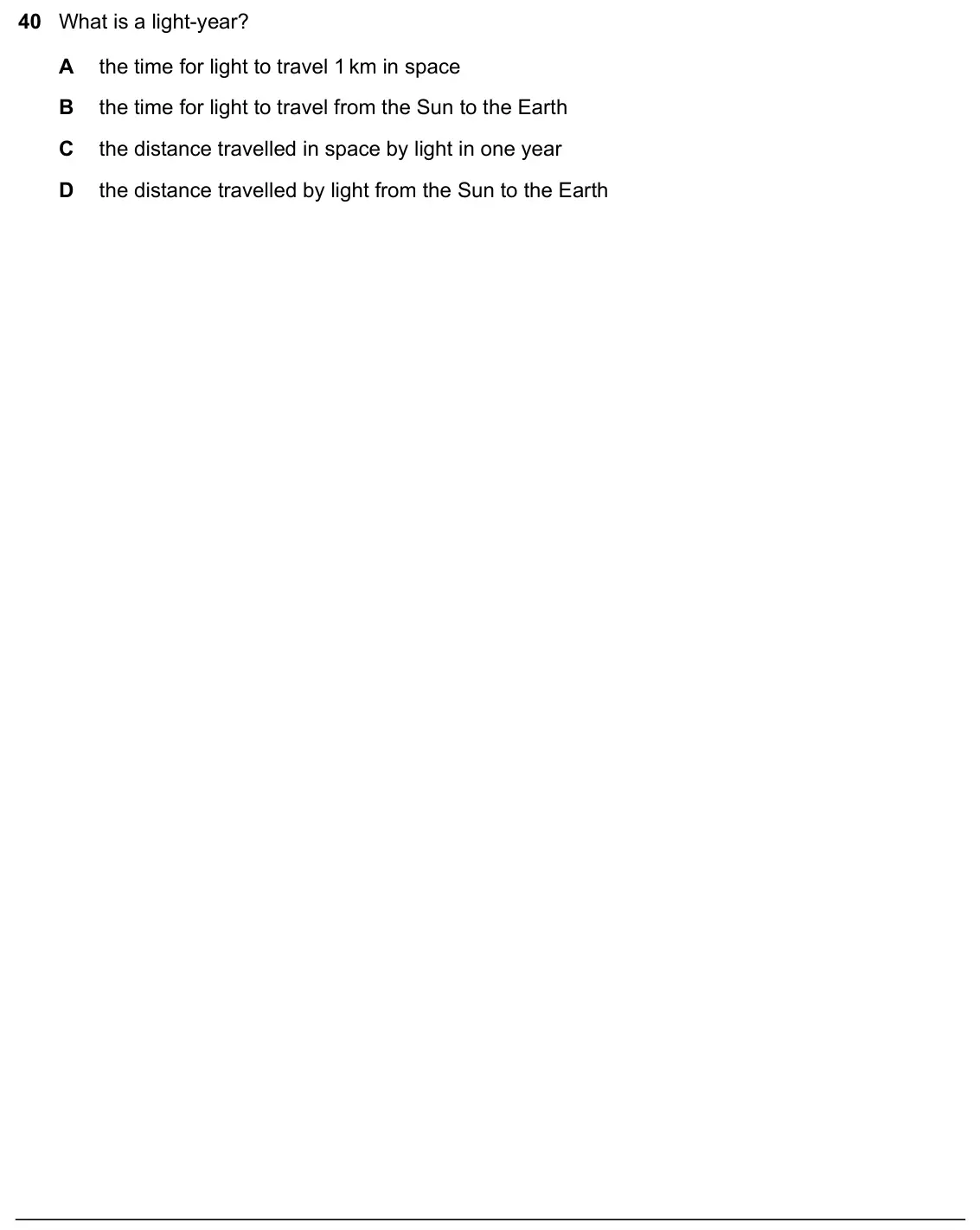
- June 2024, Paper 1, Q40 (1 mark): What is a light-year? A the time for light to travel 1 km in space B the time for light to travel from the Sun to the Earth C the distance travelled in space by
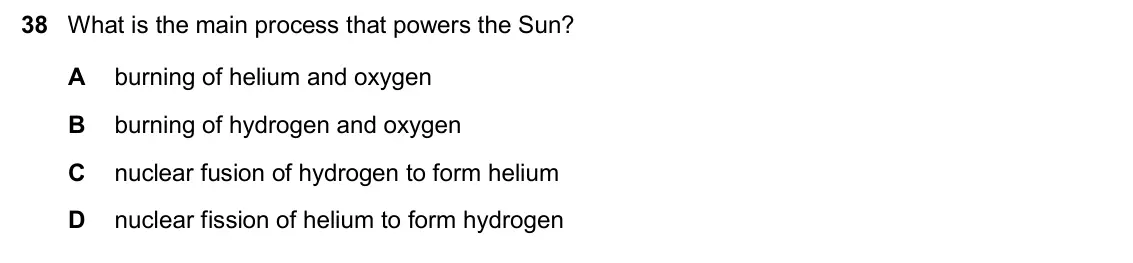
- June 2024, Paper 2, Q38 (1 mark): What is the main process that powers the Sun? A burning of helium and oxygen B burning of hydrogen and oxygen C nuclear fusion of hydrogen to form helium D nucl
- June 2024, Paper 2, Q39 (1 mark): A galaxy is 3.0 1020 km from the Earth. At which speed is the galaxy moving away from the Earth? A 660 km/ s B 6600 km/ s C 660 m/ s D 6600 m/ s
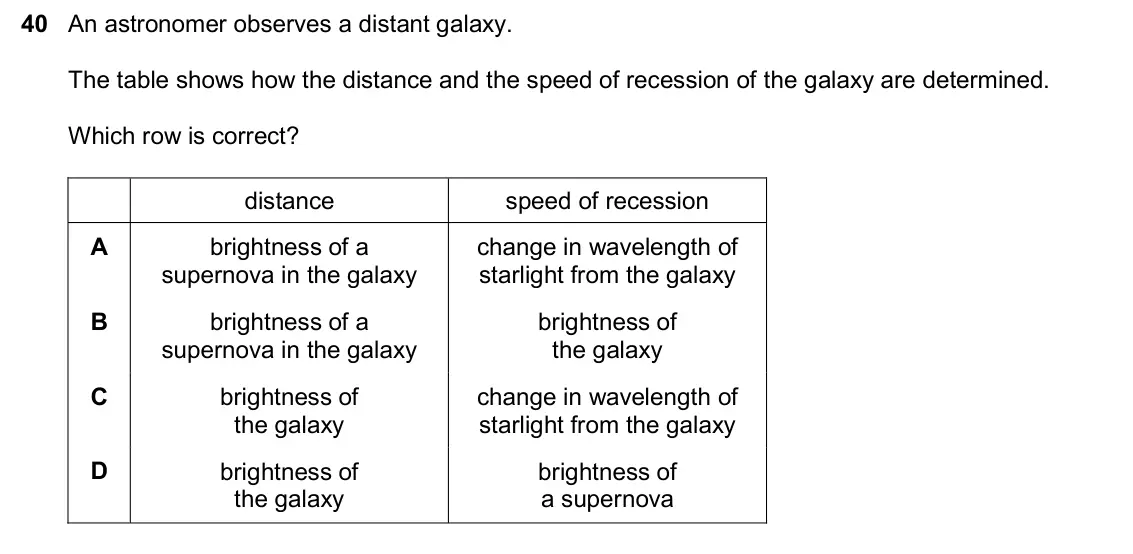
- June 2024, Paper 2, Q40 (1 mark): An astronomer observes a distant galaxy. The table shows how the distance and the speed of recession of the galaxy are determined. Which row is correct? distanc
- June 2024, Paper 3, Q11(b) (1 mark): State the name of the galaxy that includes our Solar System. [1]
- June 2024, Paper 3, Q11(c) (3 marks): Describe how the light from distant galaxies gives evidence to support the Big Bang Theory. [3] [Total: 6]
- June 2024, Paper 4, Q9(a) (2 marks): State the three regions of the electromagnetic spectrum in which the Sun emits the most energy. 1 2 3 [2]
- June 2024, Paper 4, Q9(c)(i) (2 marks): Describe and explain what happens as an interstellar cloud of gas forms a protostar. [2]
- June 2024, Paper 4, Q9(c)(ii) (3 marks): Describe and explain what happens as a protostar becomes a stable star. [3] [Total: 9]
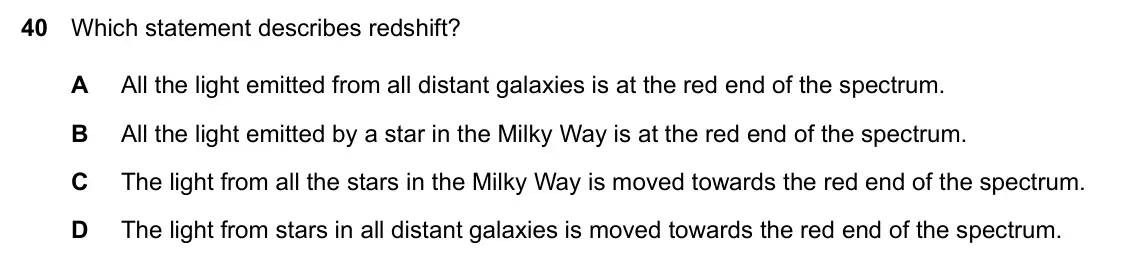
- Specimen, Paper 1, Q40 (1 mark): Which statement describes redshift? A All the light emitted from all distant galaxies is at the red end of the spectrum. B All the light emitted by a star in th
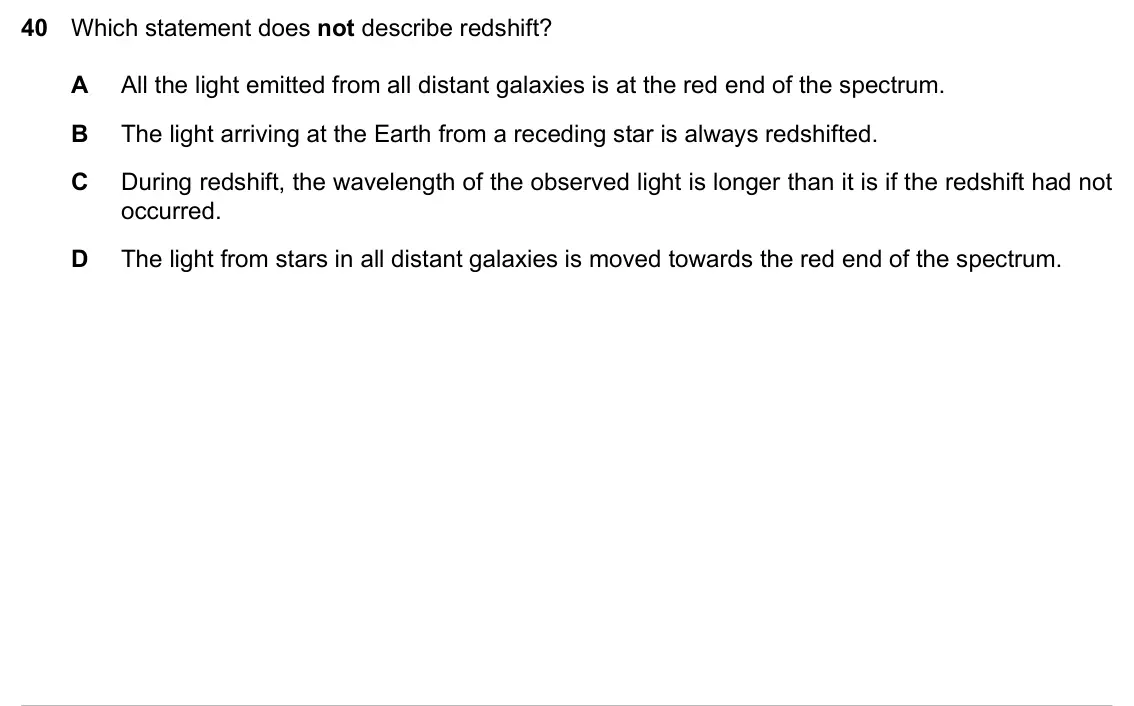
- Specimen, Paper 2, Q40 (1 mark): Which statement does not describe redshift? A All the light emitted from all distant galaxies is at the red end of the spectrum. B The light arriving at the Ear
- Specimen, Paper 3, Q12(a)(i) (2 marks): State the three main forms of electromagnetic radiation emitted by the Sun. 1 2 3 [2]
- Specimen, Paper 3, Q12(a)(ii) (1 mark): State the two main elements that are found in the Sun. 1 2 [1]
- Specimen, Paper 3, Q12(b) (3 marks): State and explain what can be deduced from the ‘redshift’ observed by astronomers in the light from all distant galaxies. [3] [Total: 6]
- Specimen, Paper 4, Q3(a)(i) (1 mark): State the name of the process which releases energy in the Sun. [1]
- Specimen, Paper 4, Q11(a) (3 marks): Describe and explain how a stable star is formed. [3]
- Specimen, Paper 4, Q11(b) (3 marks): Describe and explain what can be deduced from cosmic microwave background radiation (CMBR). [3] [Total: 6]
Questions, mark schemes and examiner’s reports are © Cambridge University Press & Assessment, from their published past papers. Plumi isn’t affiliated with any exam board. Want whole papers? Every CAIE IGCSE Physics paper.
Rather write your answers by hand on iPad? Plumi marks them against the same mark schemes.