 plumi
Quadratic functions: CAIE IGCSE Additional Maths questions
Every CAIE IGCSE Additional Maths exam question on 2 Quadratic functions, June 2024 and the specimen papers, with its mark scheme and examiner’s report.
Find questions46


All 5 questions on Quadratic functions, as a list
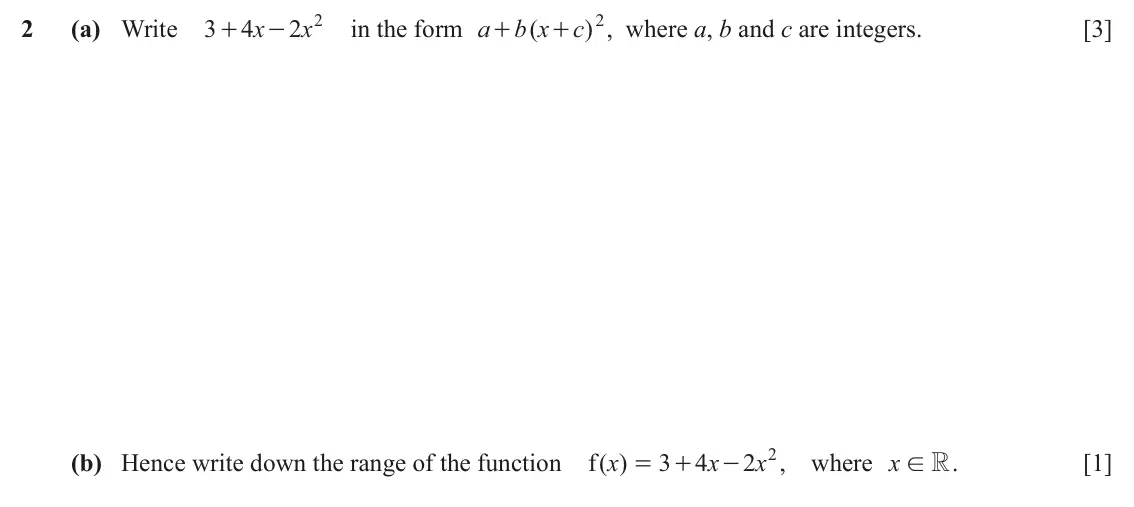
- June 2024, Paper 2, Q2 (4 marks): (a) Write 3 4 x 2 2 x in the form a b x ( c 2 ) , where a, b and c are integers. [3] + - + + (b) Hence write down the range of the function ( )x f 3 4 x 2 x 2 ,
- June 2024, Paper 2, Q3 (3 marks): Use algebra to show that the equation 5 x x ( 3 ) 5 x 26 has no real solutions. [3] - = -
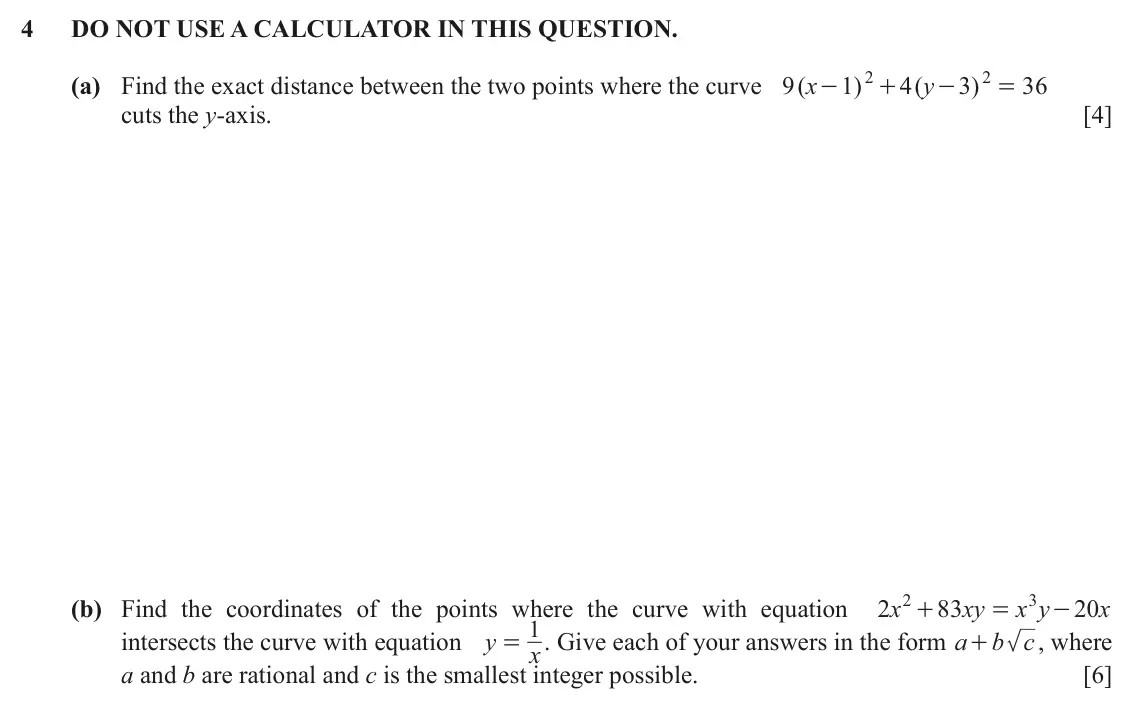
- June 2024, Paper 2, Q4 (10 marks): DO NOT USE A CALCULATOR IN THIS QUESTION. (a) Find the exact distance between the two points where the curve ( 9 x 1 ) 2 4 ( y 3 ) 2 36 - + - = cuts the y-axis.
- Specimen, Paper 2, Q3 (5 marks): Find the values of the constant k for which the equation (2k – 1)x2 + 6x + k + 1 = 0 has real roots. [5]
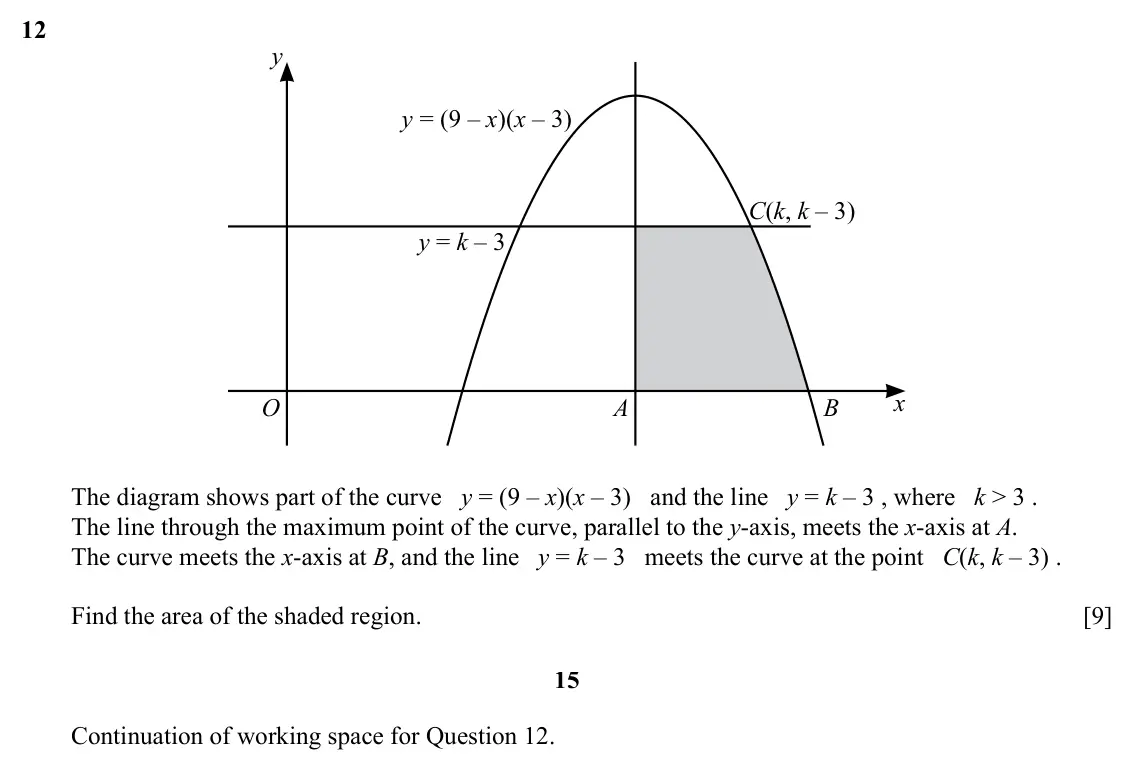
- Specimen, Paper 2, Q12 (9 marks): y y = (9 – x)(x – 3) C(k, k – 3) y = k – 3 O A B x The diagram shows part of the curve y = (9 – x)(x – 3) and the line y = k – 3 , where k > 3 . The line throug
Questions, mark schemes and examiner’s reports are © Cambridge University Press & Assessment, from their published past papers. Plumi isn’t affiliated with any exam board. Want whole papers? Every CAIE IGCSE Additional Maths paper.
Rather write your answers by hand on iPad? Plumi marks them against the same mark schemes.