Skip to content
Try on iPad

Style

Get started
Whole past papers

Processes within schools: AQA GCSE Sociology questions

AQA GCSE Sociology past-paper questions on 3.4.4 Processes within schools, 2020–2025, with mark schemes and examiner’s reports where available.

Getting your paper ready…

AQA GCSE SociologyProcesses within schools264 questions

Paper
All papers
Exam
All years

Loading the full question list…

264 questions

More options
  1. Q14June 2025 · Paper 13 marks

    3.4.4 Processes within schools

    1
    Original question 14: Describe what is meant by an anti-school subculture. [3 marks]

    Loading the question…

    The whole paper ↗
  2. 2
    Setup for original question 16

    Loading the question setup…

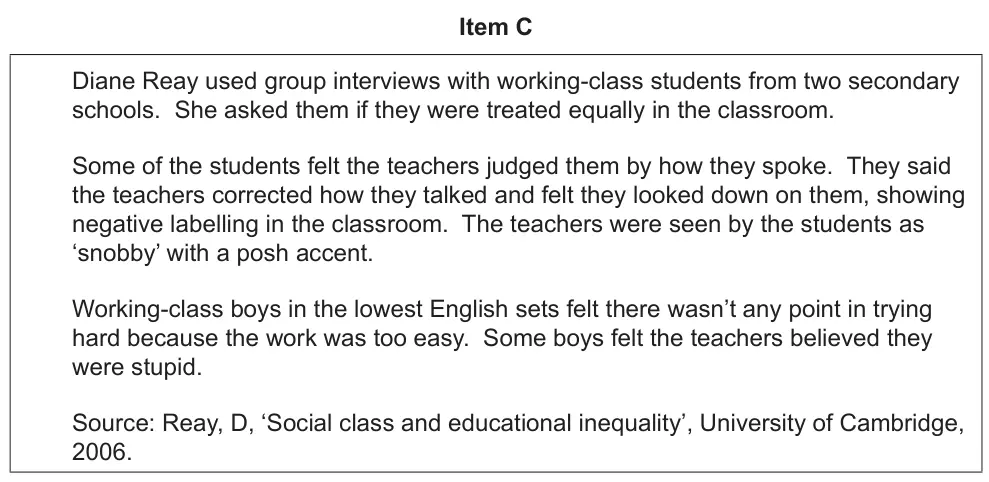
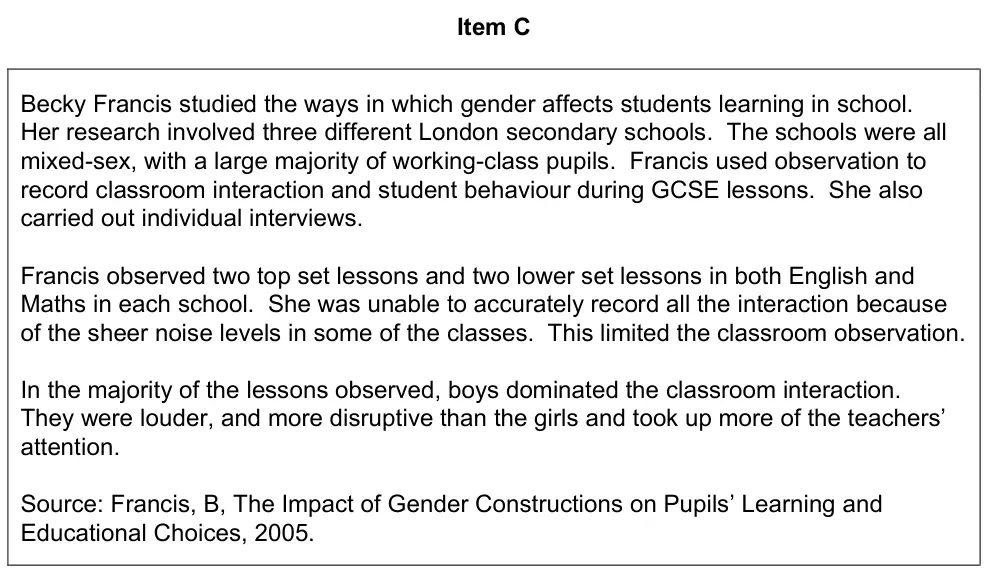
    Original question 16: From Item C, examine one weakness of the research. [2 marks]

    Loading the question…

    The whole paper ↗
  3. Q17June 2025 · Paper 14 marks

    3.4.4 Processes within schools

    3
    Setup for original question 17

    Loading the question setup…

    Original question 17: Identify and explain one in-school factor that may explain social class differences in educational achievement as shown in Item C. [4 marks]

    Loading the question…

    The whole paper ↗
  4. 4
    Original question 18: Identify and explain one advantage of using non-participant observation to investigate pupil behaviour in the classroom. [4 marks]

    Loading the question…

    The whole paper ↗
  5. 5
    Original question 21: Discuss how far sociologists would agree that gender differences in educational achievement are mainly due to factors outside of school. [12 marks]

    Loading the question…

    The whole paper ↗
  6. Q12June 2024 · Paper 11 mark

    3.4.4 Processes within schools

    6
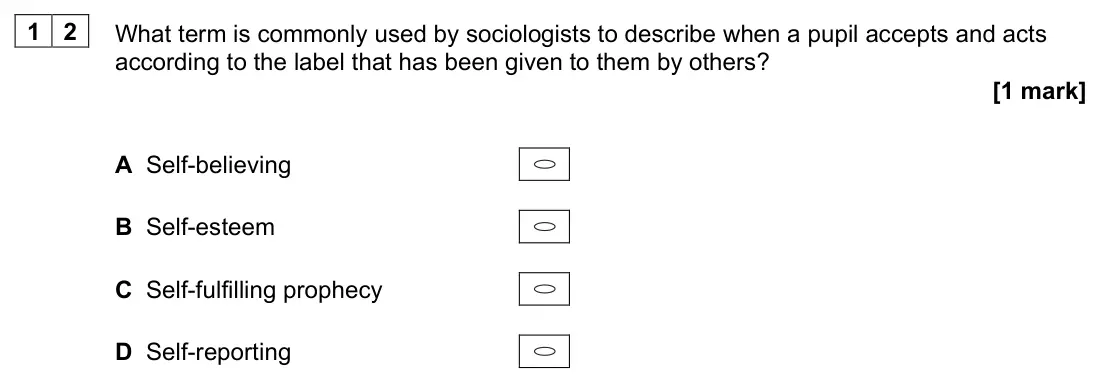
    Original question 12: What term is commonly used by sociologists to describe when a pupil accepts and acts according to the label that has been given to them by others? [1 mark] A Se

    Loading the question…

    Your answer
    The whole paper ↗
  7. Q15June 2024 · Paper 13 marks

    3.4.4 Processes within schools

    7
    Original question 15: Identify and describe one way in which the formal curriculum is different to the hidden curriculum. [3 marks]

    Loading the question…

    The whole paper ↗
  8. 8
    Setup for original question 16

    Loading the question setup…

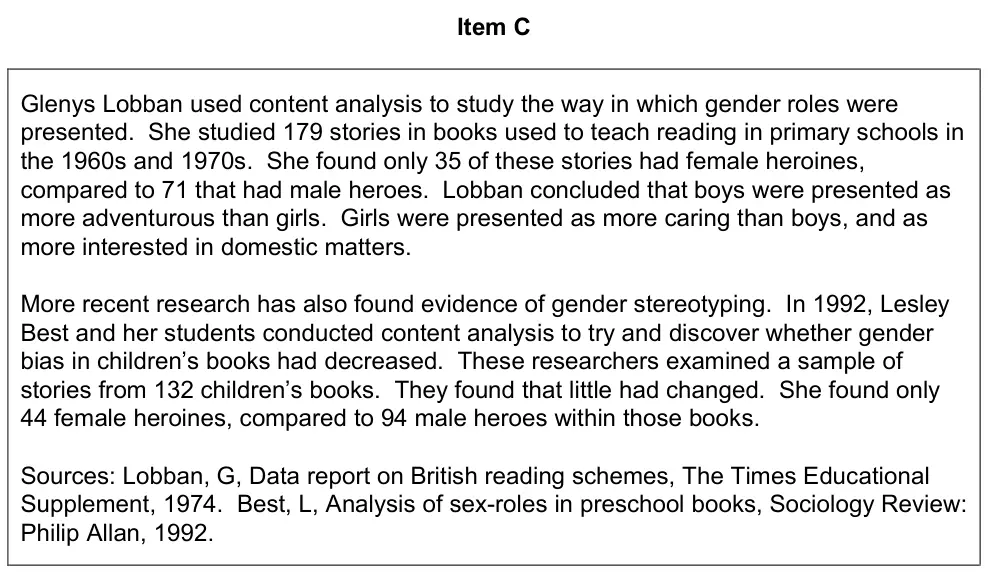
    Original question 16: From Item C, examine one strength of using content analysis to research gender stereotyping in education. [2 marks]

    Loading the question…

    The whole paper ↗
  9. Q17June 2024 · Paper 14 marks

    3.4.4 Processes within schools

    9
    Setup for original question 17

    Loading the question setup…

    Original question 17: Identify and explain one way in which gender inequalities may exist in education as shown in Item C. [4 marks]

    Loading the question…

    The whole paper ↗
  10. 10
    Original question 18: Identify and explain one disadvantage of using structured interviews to investigate gender stereotyping in schools. [4 marks]

    Loading the question…

    The whole paper ↗
  11. Q19June 2024 · Paper 14 marks

    3.4.4 Processes within schools

    11
    Setup for original question 19

    Loading the question setup…

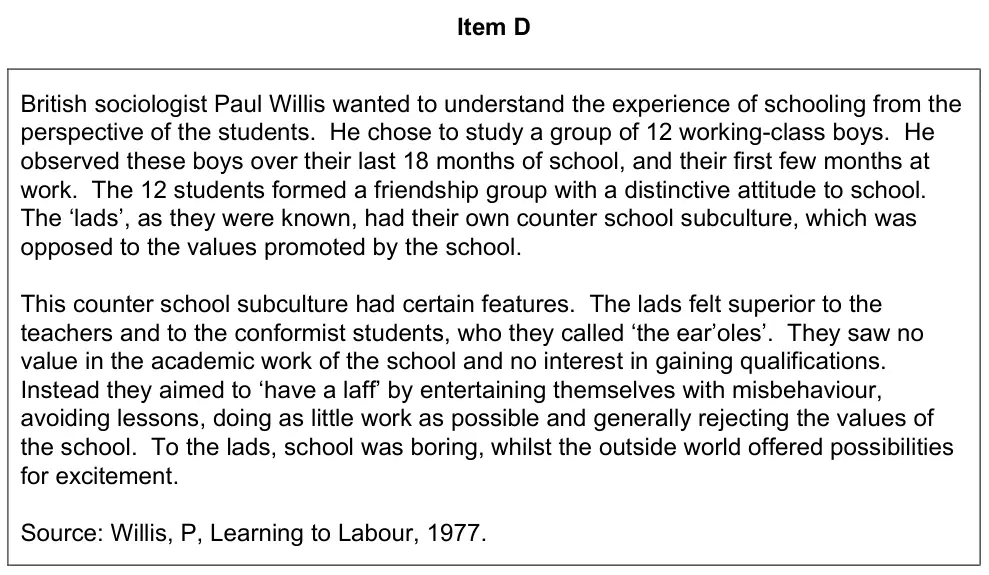
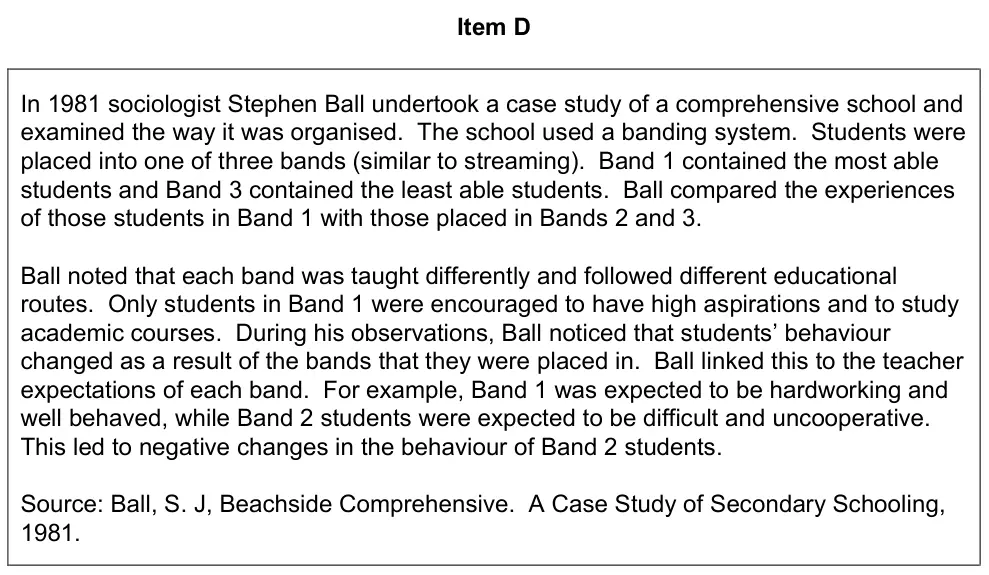
    Original question 19: From Item D, identify and describe one way in which the ‘lads’ were anti-school according to Willis, including what you know of his perspective on education. [4

    Loading the question…

    The whole paper ↗
  12. 12
    Original question 20: Identify and explain one advantage of using observations to investigate pupil subcultures. [4 marks]

    Loading the question…

    The whole paper ↗
  13. Q22June 2024 · Paper 112 marks

    3.4.4 Processes within schools

    13
    Original question 22: Discuss how far sociologists would agree that teacher expectations have a significant effect on a student’s educational performance. [12 marks]

    Loading the question…

    The whole paper ↗
  14. Q13June 2023 · Paper 11 mark

    3.4.4 Processes within schools

    14
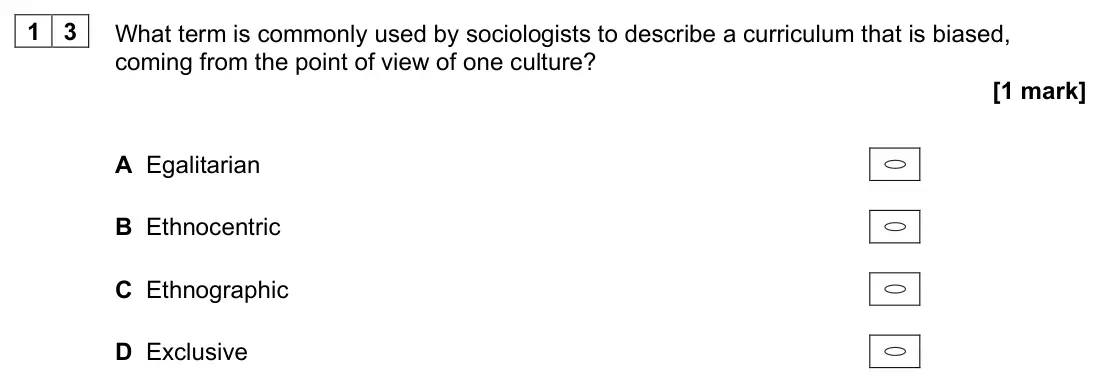
    Original question 13: What term is commonly used by sociologists to describe a curriculum that is biased, coming from the point of view of one culture? [1 mark] A Egalitarian B Ethno

    Loading the question…

    Your answer
    The whole paper ↗
  15. 15
    Setup for original question 16

    Loading the question setup…

    Original question 16: From Item C, examine one weakness of the research. [2 marks]

    Loading the question…

    The whole paper ↗
  16. 16
    Setup for original question 17

    Loading the question setup…

    Original question 17: Identify and explain one advantage of using non-participant observation to investigate classroom interactions as shown in Item C. [4 marks]

    Loading the question…

    The whole paper ↗
  17. Q19June 2023 · Paper 14 marks

    3.4.4 Processes within schools

    17
    Setup for original question 19

    Loading the question setup…

    Original question 19: From Item D, identify and describe one way in which Ball believed that the banding of students affected their approach to learning and behaviour in school, incl

    Loading the question…

    The whole paper ↗
  18. 18
    Original question 20: Identify and explain one disadvantage of using snowball sampling to investigate the effects of streaming on students’ experience of school. [4 marks]

    Loading the question…

    The whole paper ↗
  19. 19
    Original question 21: Discuss how far sociologists would agree that ethnic differences in educational achievement are mainly due to factors inside schools. [12 marks]

    Loading the question…

    The whole paper ↗
  20. Q12June 2022 · Paper 11 mark

    3.4.4 Processes within schools

    20
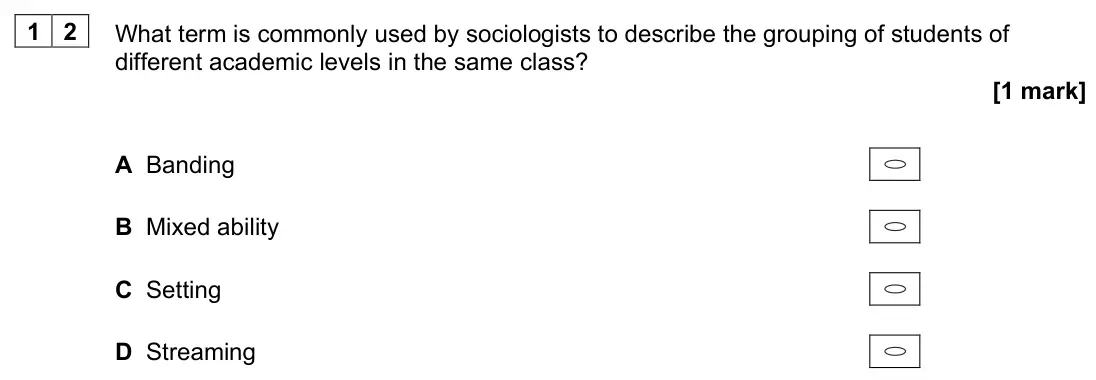
    Original question 12: What term is commonly used by sociologists to describe the grouping of students of different academic levels in the same class? [1 mark] A Banding B Mixed abili

    Loading the question…

    Your answer
    The whole paper ↗
All 30 questions on Processes within schools, as a list
  1. June 2025, Paper 1, Q14 (3 marks): Describe what is meant by an anti-school subculture. [3 marks]
  2. June 2025, Paper 1, Q16 (2 marks): From Item C, examine one weakness of the research. [2 marks]
  3. June 2025, Paper 1, Q17 (4 marks): Identify and explain one in-school factor that may explain social class differences in educational achievement as shown in Item C. [4 marks]
  4. June 2025, Paper 1, Q18 (4 marks): Identify and explain one advantage of using non-participant observation to investigate pupil behaviour in the classroom. [4 marks]
  5. June 2025, Paper 1, Q21 (12 marks): Discuss how far sociologists would agree that gender differences in educational achievement are mainly due to factors outside of school. [12 marks]
  6. June 2024, Paper 1, Q12 (1 mark): What term is commonly used by sociologists to describe when a pupil accepts and acts according to the label that has been given to them by others? [1 mark] A Se
  7. June 2024, Paper 1, Q15 (3 marks): Identify and describe one way in which the formal curriculum is different to the hidden curriculum. [3 marks]
  8. June 2024, Paper 1, Q16 (2 marks): From Item C, examine one strength of using content analysis to research gender stereotyping in education. [2 marks]
  9. June 2024, Paper 1, Q17 (4 marks): Identify and explain one way in which gender inequalities may exist in education as shown in Item C. [4 marks]
  10. June 2024, Paper 1, Q18 (4 marks): Identify and explain one disadvantage of using structured interviews to investigate gender stereotyping in schools. [4 marks]
  11. June 2024, Paper 1, Q19 (4 marks): From Item D, identify and describe one way in which the ‘lads’ were anti-school according to Willis, including what you know of his perspective on education. [4
  12. June 2024, Paper 1, Q20 (4 marks): Identify and explain one advantage of using observations to investigate pupil subcultures. [4 marks]
  13. June 2024, Paper 1, Q22 (12 marks): Discuss how far sociologists would agree that teacher expectations have a significant effect on a student’s educational performance. [12 marks]
  14. June 2023, Paper 1, Q13 (1 mark): What term is commonly used by sociologists to describe a curriculum that is biased, coming from the point of view of one culture? [1 mark] A Egalitarian B Ethno
  15. June 2023, Paper 1, Q16 (2 marks): From Item C, examine one weakness of the research. [2 marks]
  16. June 2023, Paper 1, Q17 (4 marks): Identify and explain one advantage of using non-participant observation to investigate classroom interactions as shown in Item C. [4 marks]
  17. June 2023, Paper 1, Q19 (4 marks): From Item D, identify and describe one way in which Ball believed that the banding of students affected their approach to learning and behaviour in school, incl
  18. June 2023, Paper 1, Q20 (4 marks): Identify and explain one disadvantage of using snowball sampling to investigate the effects of streaming on students’ experience of school. [4 marks]
  19. June 2023, Paper 1, Q21 (12 marks): Discuss how far sociologists would agree that ethnic differences in educational achievement are mainly due to factors inside schools. [12 marks]
  20. June 2022, Paper 1, Q12 (1 mark): What term is commonly used by sociologists to describe the grouping of students of different academic levels in the same class? [1 mark] A Banding B Mixed abili
  21. June 2022, Paper 1, Q15 (3 marks): Identify and describe one counter school subculture. [3 marks]
  22. June 2022, Paper 1, Q21 (12 marks): Discuss how far sociologists would agree that the way in which students are grouped together within the school can have a significant effect on their educationa
  23. November 2021, Paper 1, Q15 (3 marks): Identify and describe one example of how labelling may affect a student’s achievement in school. [3 marks]
  24. November 2021, Paper 1, Q20 (4 marks): Identify and explain one advantage of using unstructured interviews to investigate setting in schools. [4 marks]
  25. November 2021, Paper 1, Q22 (12 marks): Discuss how far sociologists would agree that in-school factors are the main reasons for gender-based differences in subject options and career choices. [12 mar
  26. November 2020, Paper 1, Q15 (3 marks): Identify and describe one type of pupil subculture that may be found in schools. [3 marks]
  27. November 2020, Paper 1, Q17 (4 marks): Identify and explain one in-school factor which might account for the differences in educational achievement between ethnic groups shown in Item C. [4 marks]
  28. November 2020, Paper 1, Q18 (4 marks): Identify and explain one advantage of using covert observation to investigate the extent of sexism in schools. [4 marks]
  29. November 2020, Paper 1, Q20 (4 marks): Identify and explain one advantage of using a longitudinal study to investigate the effects of streaming students in schools. [4 marks]
  30. November 2020, Paper 1, Q21 (12 marks): Discuss how far sociologists would agree that gender differences in educational achievement are mainly due to factors outside schools. [12 marks]

Questions, mark schemes and examiner’s reports are © AQA, from their published past papers. Plumi isn’t affiliated with any exam board. Want whole papers? AQA GCSE Sociology past papers.

The Plumi iPad app also offers exam-style questions with AI feedback on your handwritten working.