 plumi
Solar system; stability of orbital motions; satellites: AQA GCSE Physics questions
Every AQA GCSE Physics exam question on 4.8.1 Solar system; stability of orbital motions; satellites, 2018–2025, with its mark scheme and examiner’s report.
Find questions1,653
Calculations
Q04.7
The whole paper ↗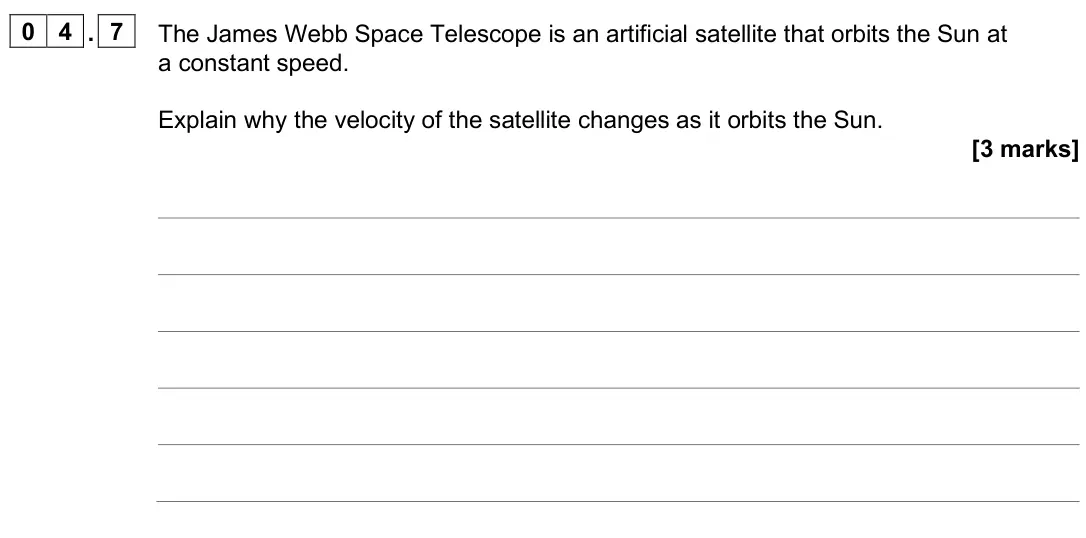
Q03.1
The whole paper ↗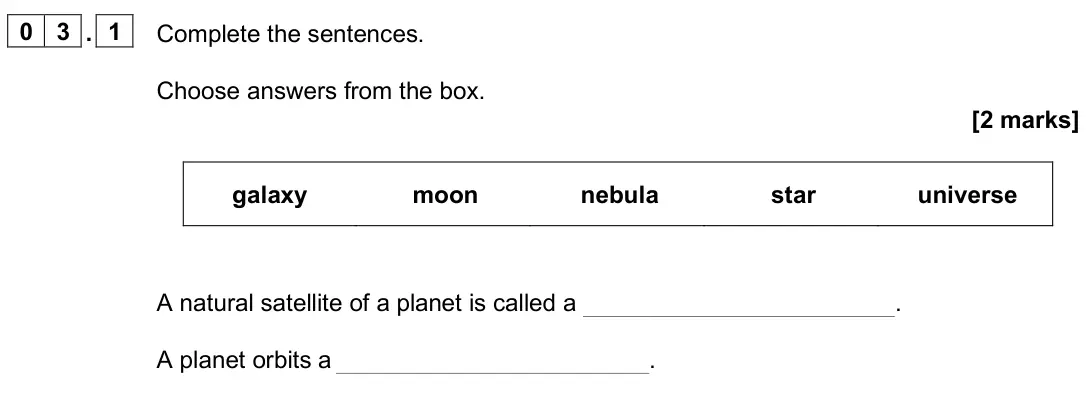
Q03.2
The whole paper ↗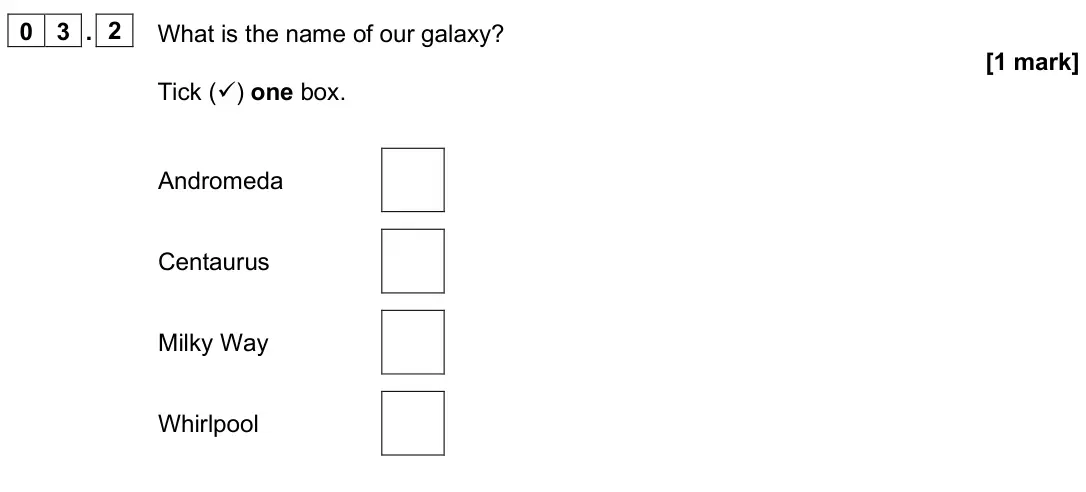
Q03.3
The whole paper ↗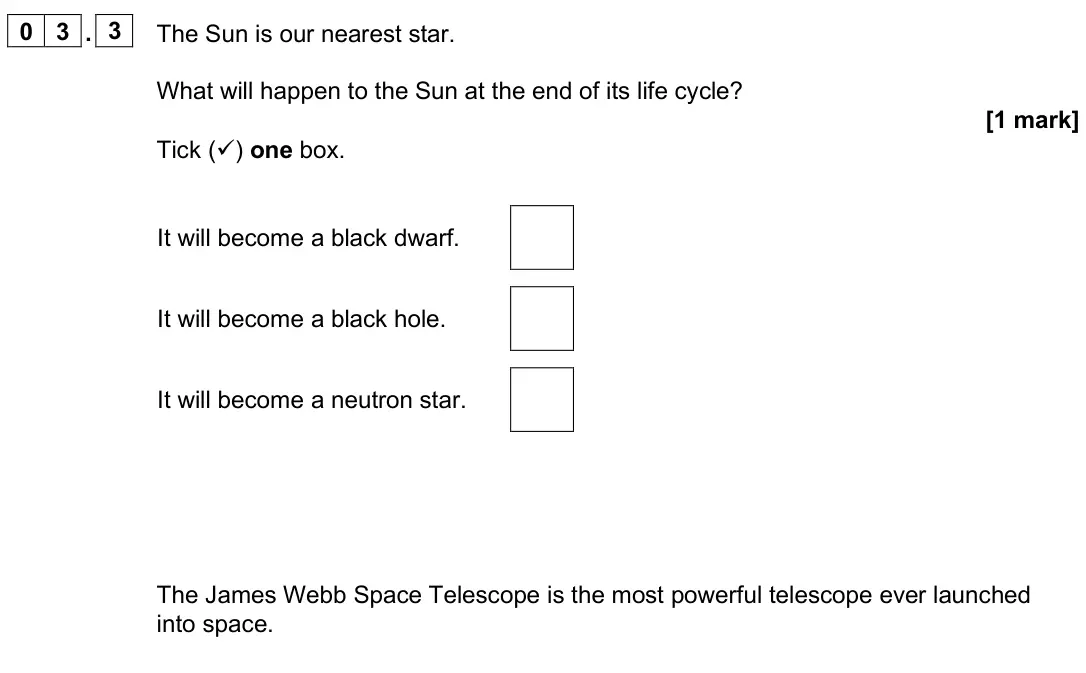
Q03.1
The whole paper ↗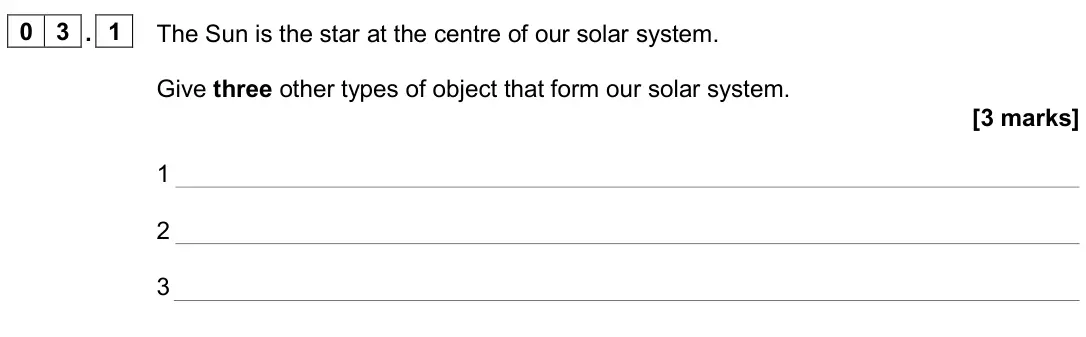
Q03.2
The whole paper ↗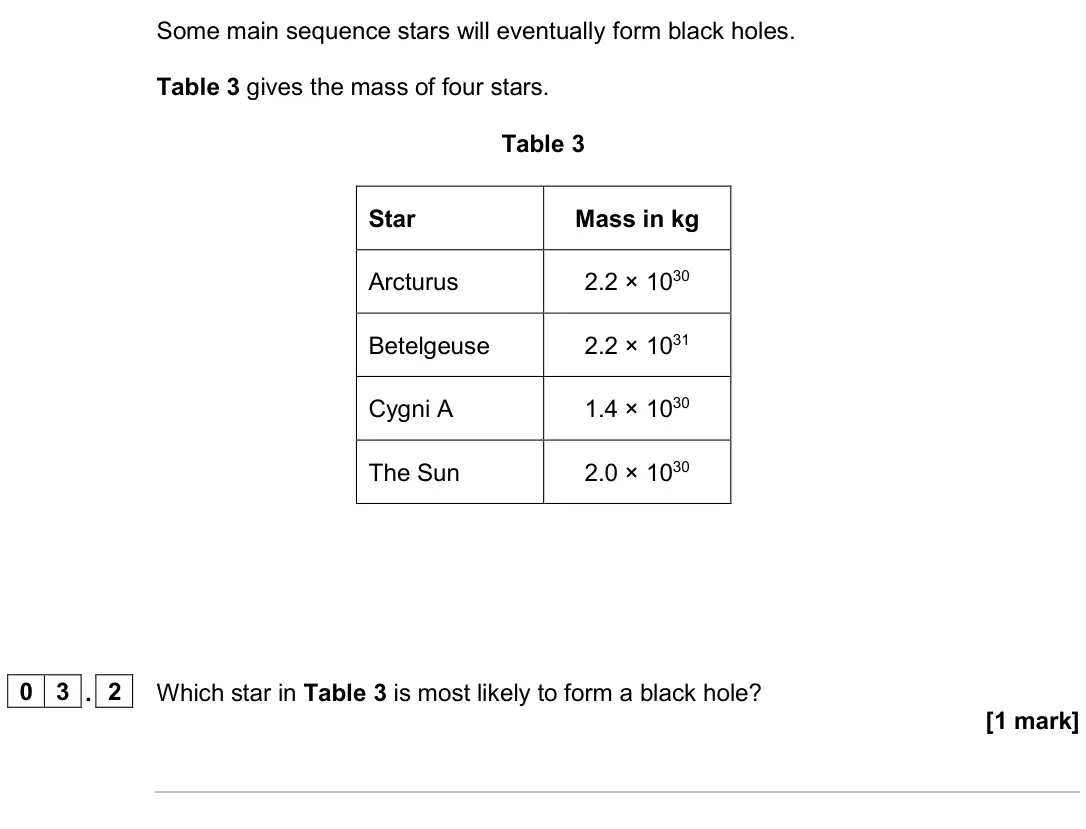
Q03.3
The whole paper ↗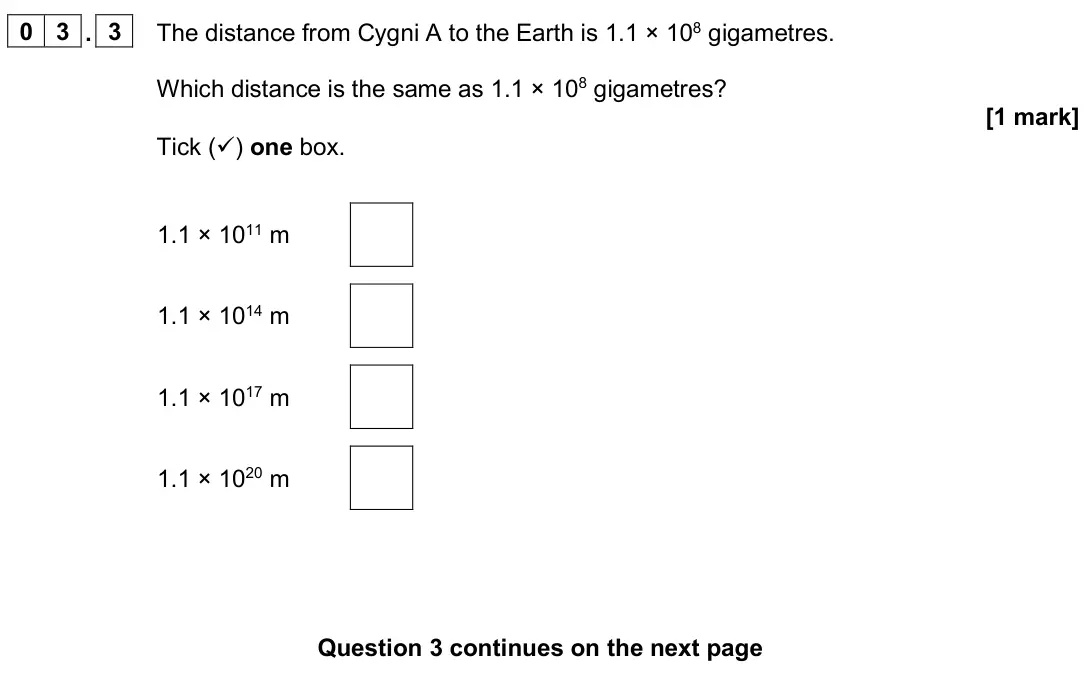
Q03.6
The whole paper ↗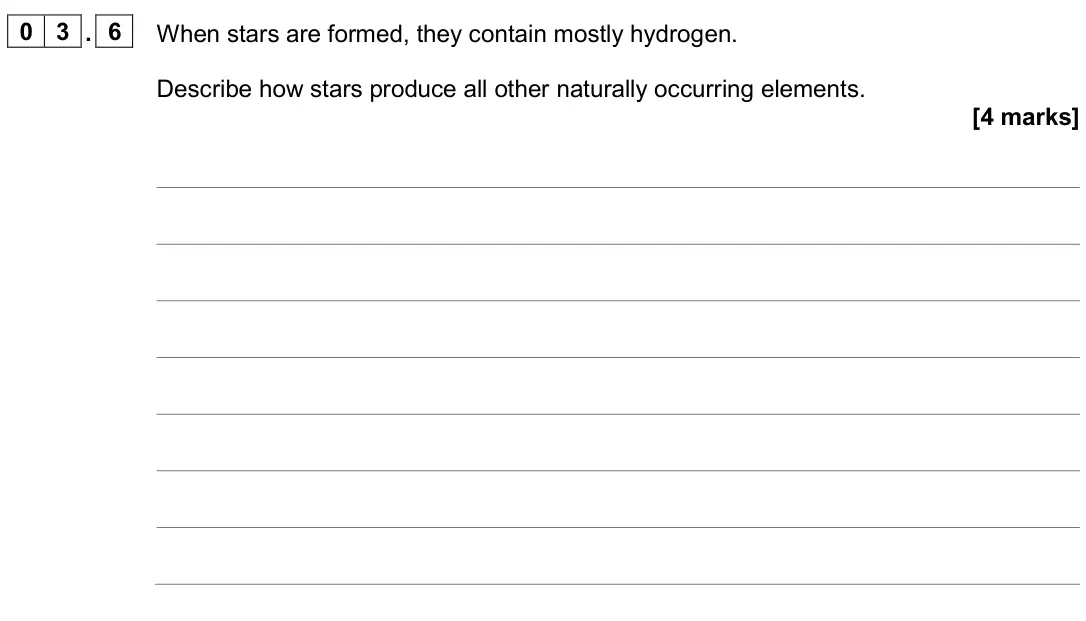
Q01.1
The whole paper ↗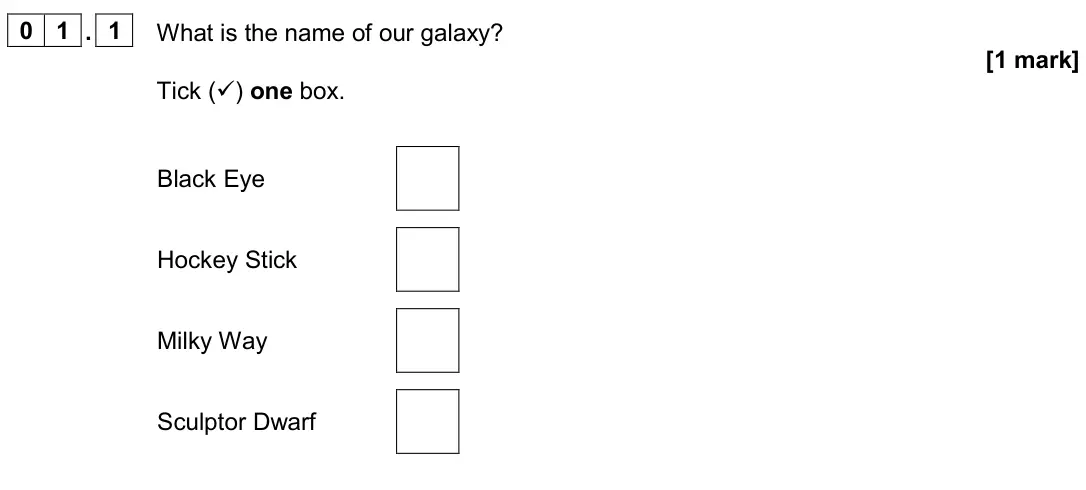
Q01.2
The whole paper ↗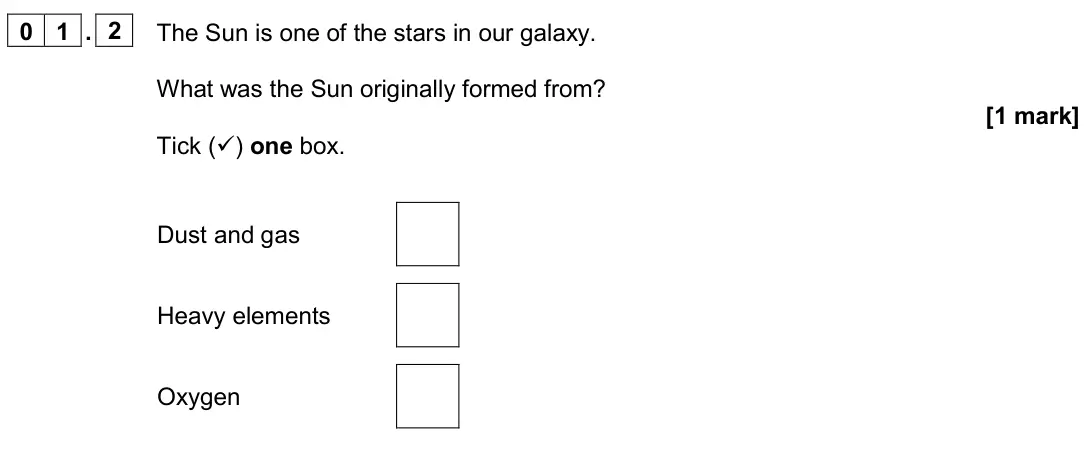
Q01.3
The whole paper ↗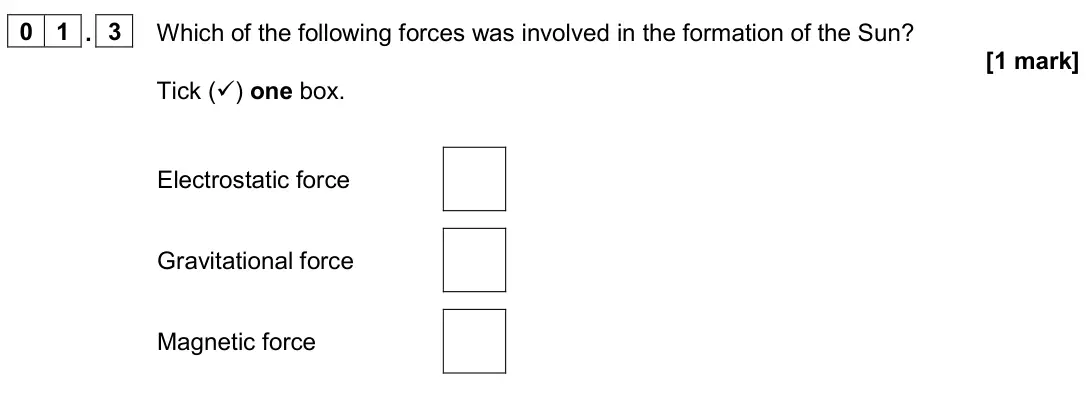
Q01.4
The whole paper ↗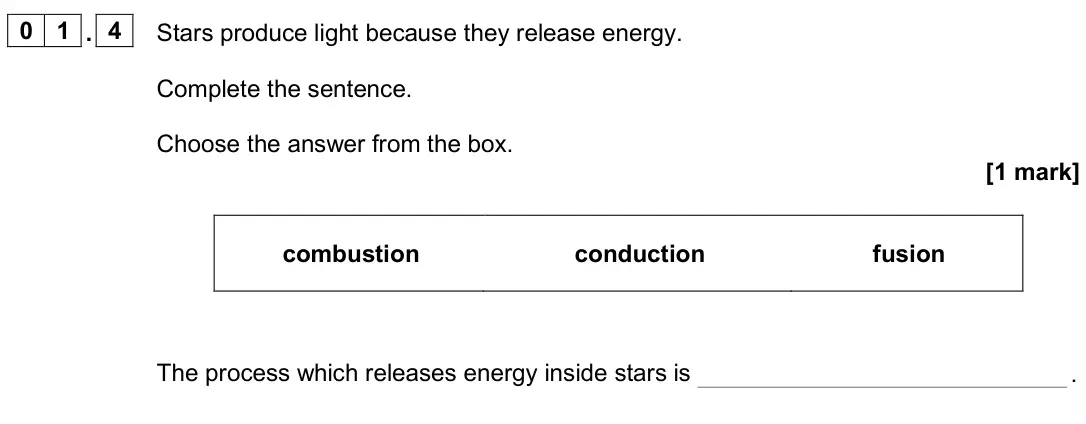
Q06.1
The whole paper ↗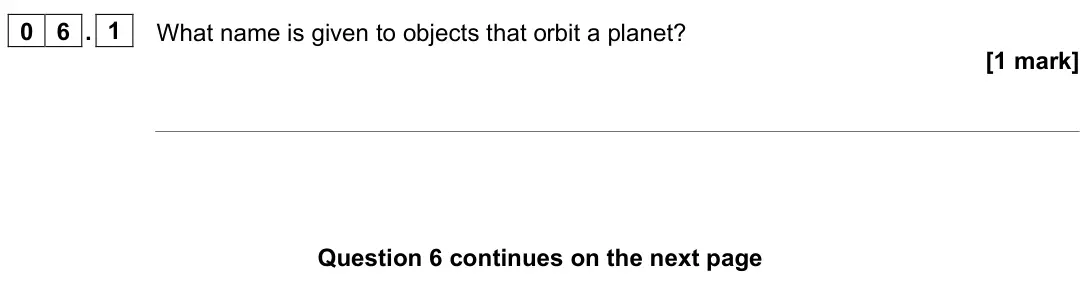
Q04.1
The whole paper ↗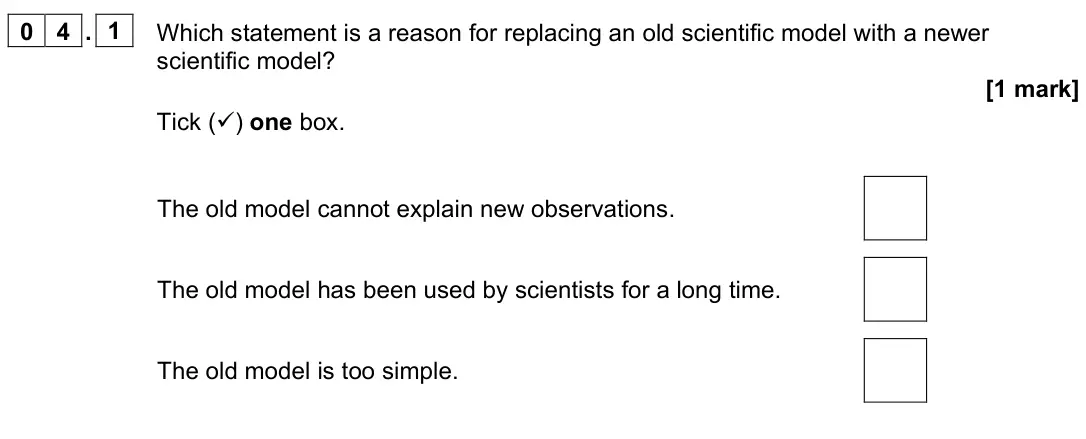
Q04.2
The whole paper ↗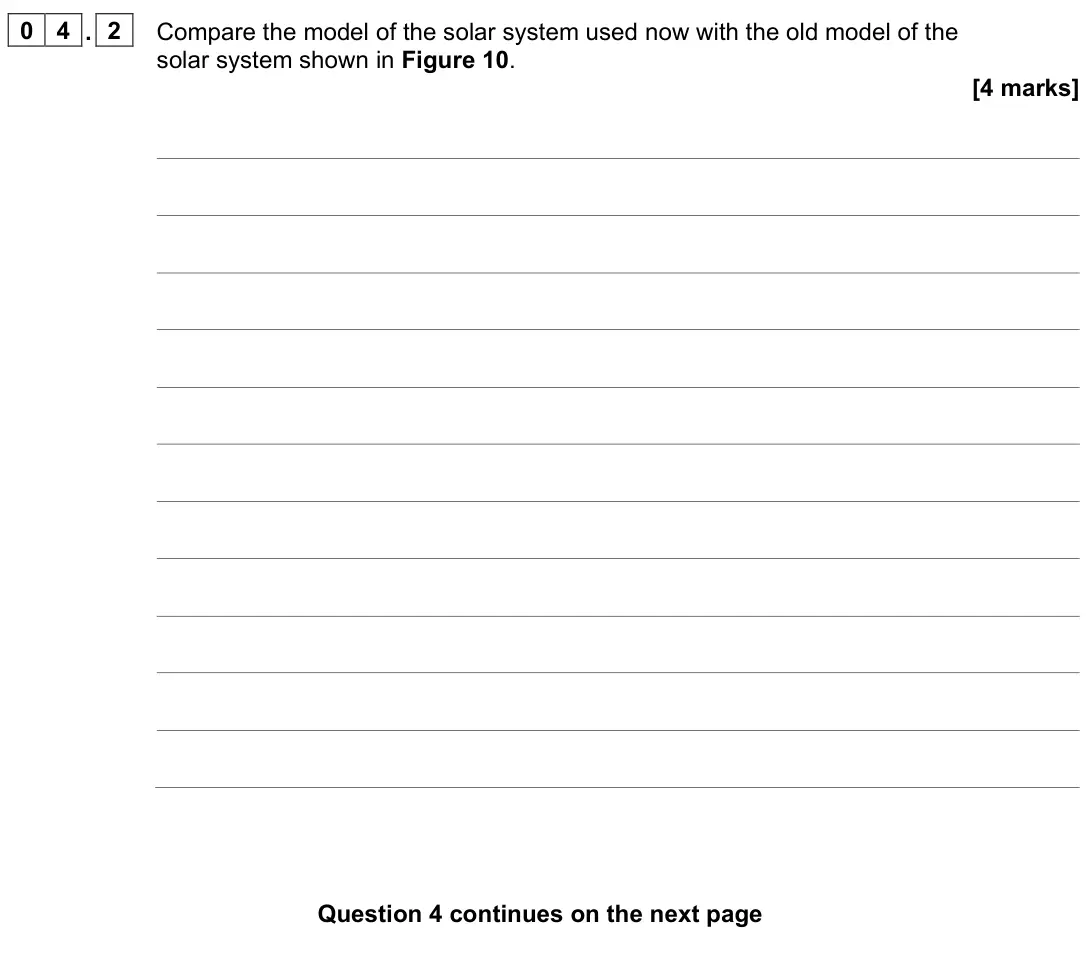
Q04.3
The whole paper ↗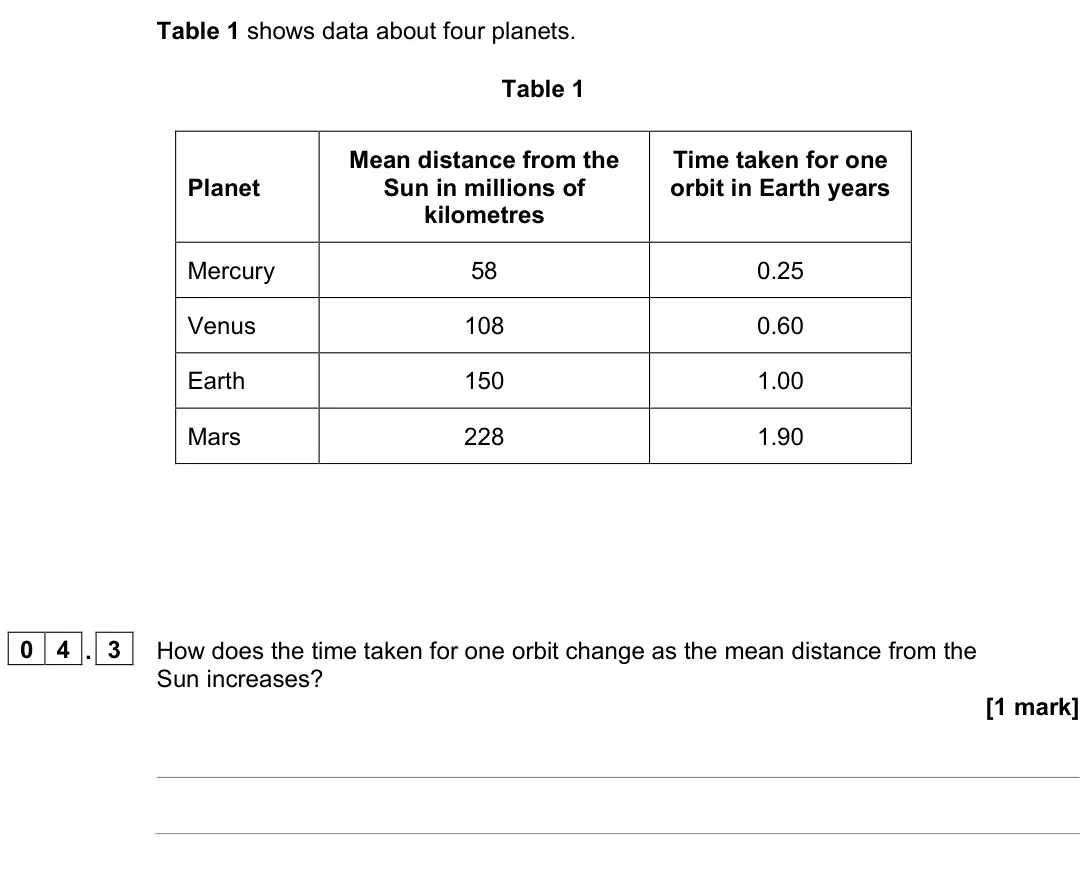
Q04.4
The whole paper ↗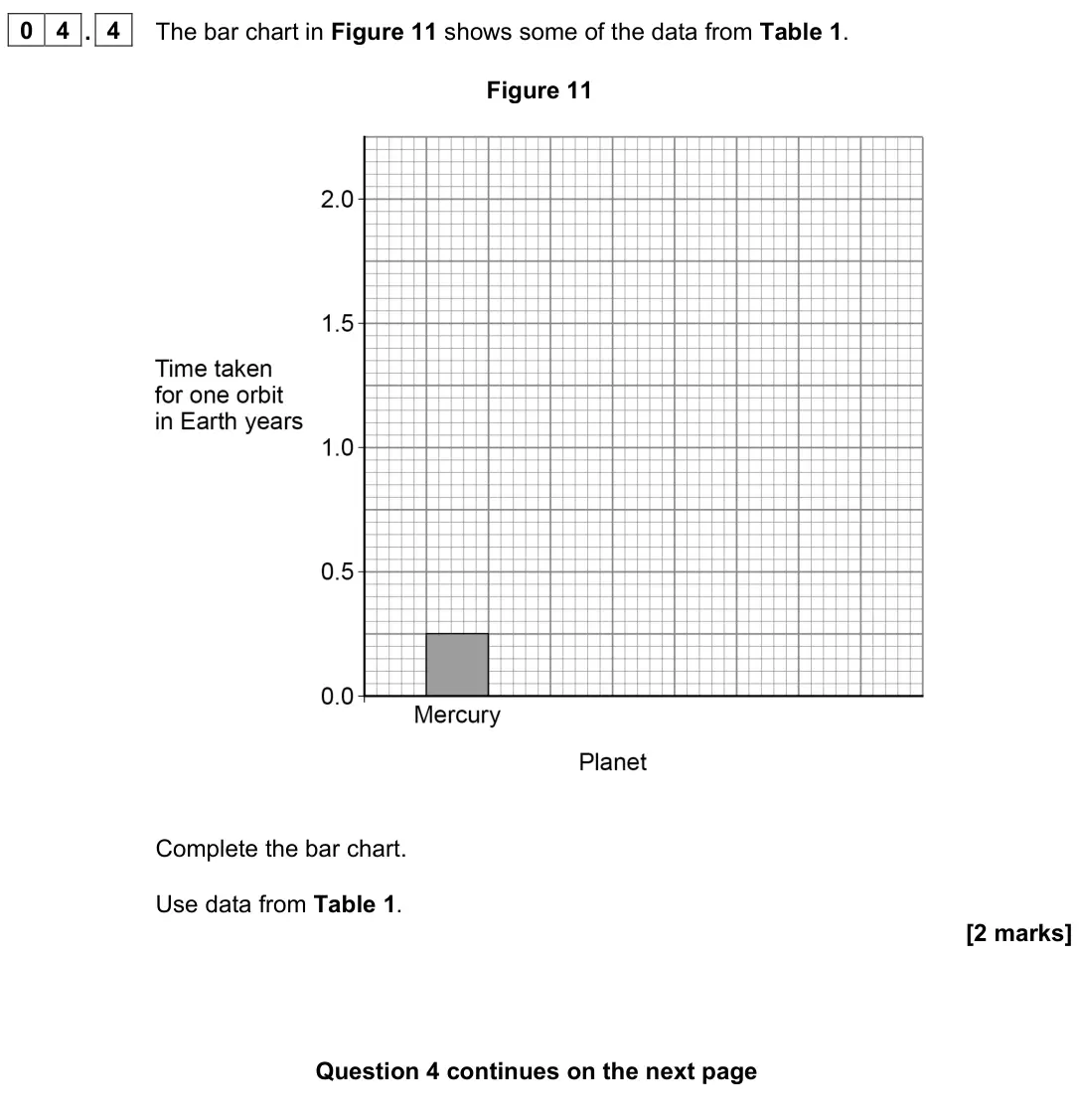
Q04.5
The whole paper ↗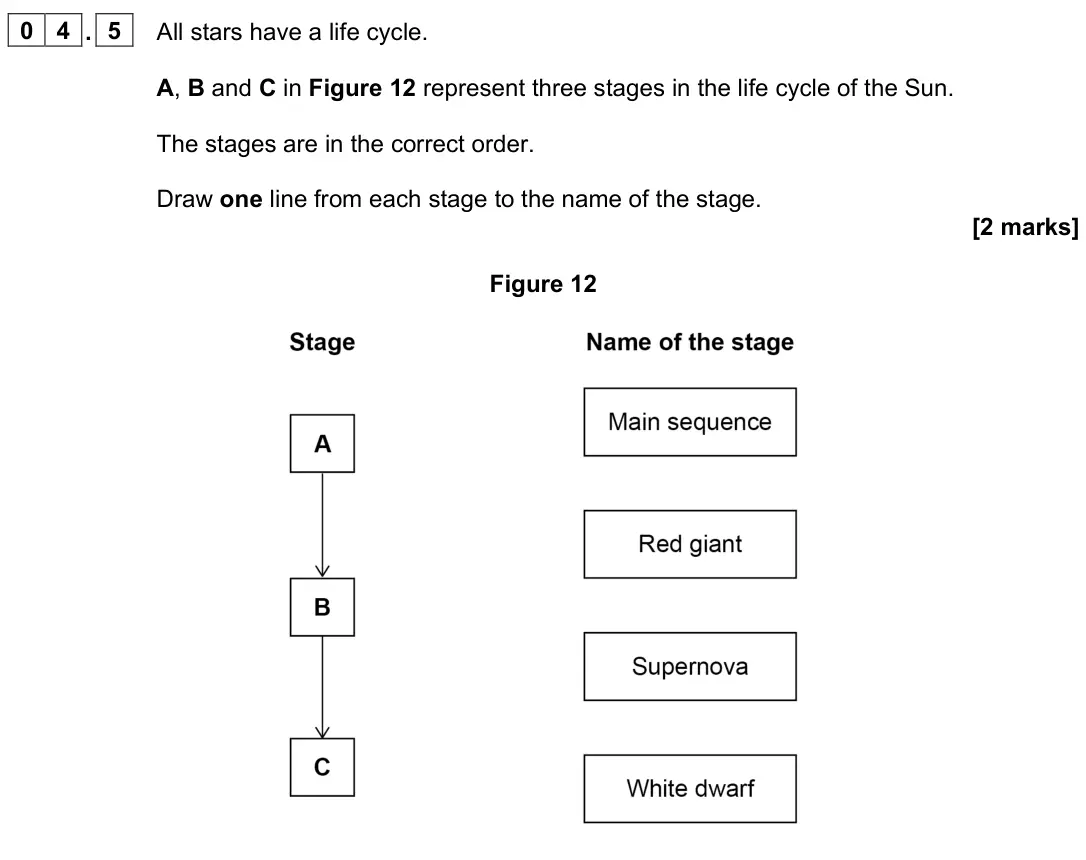
Q07.1
The whole paper ↗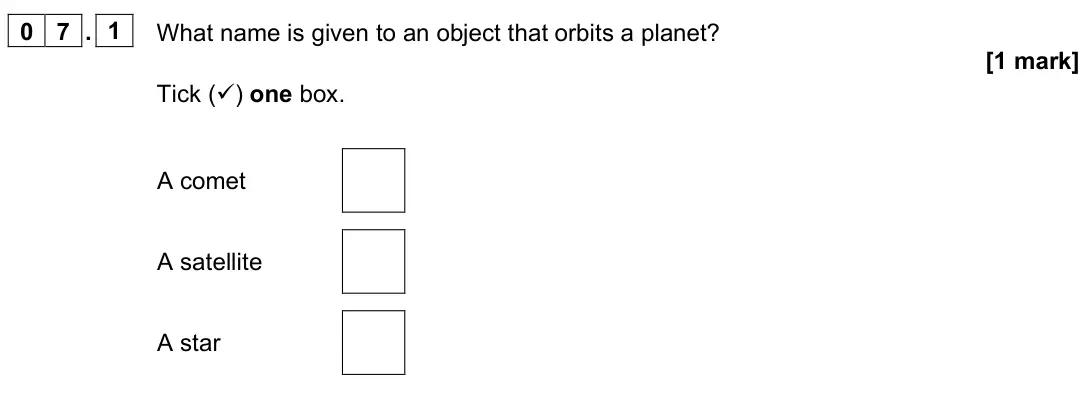
Q07.2
The whole paper ↗
All 57 questions on Solar system; stability of orbital motions; satellites, as a list
- June 2025, Paper 2 Higher, Q04.7 (3 marks): The James Webb Space Telescope is an artificial satellite that orbits the Sun at a constant speed. Explain why the velocity of the satellite changes as it orbit
- June 2025, Paper 2 Foundation, Q03.1 (2 marks): Complete the sentences. Choose answers from the box. [2 marks] galaxy moon nebula star universe A natural satellite of a planet is called a . A planet orbits a
- June 2025, Paper 2 Foundation, Q03.2 (1 mark): What is the name of our galaxy? [1 mark] Tick () one box. Andromeda Centaurus Milky Way Whirlpool
- June 2025, Paper 2 Foundation, Q03.3 (1 mark): The Sun is our nearest star. What will happen to the Sun at the end of its life cycle? [1 mark] Tick () one box. It will become a black dwarf. It will become a
- June 2024, Paper 2 Higher, Q03.1 (3 marks): The Sun is the star at the centre of our solar system. Give three other types of object that form our solar system. [3 marks] 1 2 3
- June 2024, Paper 2 Higher, Q03.2 (1 mark): Which star in Table 3 is most likely to form a black hole? [1 mark]
- June 2024, Paper 2 Higher, Q03.3 (1 mark): The distance from Cygni A to the Earth is 1.1 × 10⁸ gigametres. Which distance is the same as 1.1 × 10⁸ gigametres? [1 mark] Tick () one box. 1.1 × 10¹¹ m 1.1
- June 2024, Paper 2 Higher, Q03.6 (4 marks): When stars are formed, they contain mostly hydrogen. Describe how stars produce all other naturally occurring elements. [4 marks]
- June 2024, Paper 2 Foundation, Q01.1 (1 mark): What is the name of our galaxy? [1 mark] Tick () one box. Black Eye Hockey Stick Milky Way Sculptor Dwarf
- June 2024, Paper 2 Foundation, Q01.2 (1 mark): The Sun is one of the stars in our galaxy. What was the Sun originally formed from? [1 mark] Tick () one box. Dust and gas Heavy elements Oxygen
- June 2024, Paper 2 Foundation, Q01.3 (1 mark): Which of the following forces was involved in the formation of the Sun? [1 mark] Tick () one box. Electrostatic force Gravitational force Magnetic force
- June 2024, Paper 2 Foundation, Q01.4 (1 mark): Stars produce light because they release energy. Complete the sentence. Choose the answer from the box. [1 mark] combustion conduction fusion The process which
- June 2023, Paper 2 Higher, Q06.1 (1 mark): What name is given to objects that orbit a planet? [1 mark]
- June 2023, Paper 2 Foundation, Q04.1 (1 mark): Which statement is a reason for replacing an old scientific model with a newer scientific model? [1 mark] Tick () one box. The old model cannot explain new obs
- June 2023, Paper 2 Foundation, Q04.2 (4 marks): Compare the model of the solar system used now with the old model of the solar system shown in Figure 10. [4 marks]
- June 2023, Paper 2 Foundation, Q04.3 (1 mark): How does the time taken for one orbit change as the mean distance from the Sun increases? [1 mark]
- June 2023, Paper 2 Foundation, Q04.4 (2 marks): The bar chart in Figure 11 shows some of the data from Table 1. Figure 11 Complete the bar chart. Use data from Table 1. [2 marks]
- June 2023, Paper 2 Foundation, Q04.5 (2 marks): All stars have a life cycle. A, B and C in Figure 12 represent three stages in the life cycle of the Sun. The stages are in the correct order. Draw one line fro
- June 2023, Paper 2 Foundation, Q07.1 (1 mark): What name is given to an object that orbits a planet? [1 mark] Tick () one box. A comet A satellite A star
- June 2023, Paper 2 Foundation, Q07.2 (1 mark): The Earth exerts a gravitational force on the Hubble Space Telescope. Draw an arrow on Figure 17 to show the gravitational force. [1 mark]
- June 2022, Paper 2 Higher, Q06.1 (6 marks): Compare the formation and life cycles of stars with a similar mass to the Sun to stars with a much greater mass than the Sun. [6 marks]
- June 2022, Paper 2 Foundation, Q03.1 (1 mark): What type of object is the Sun? [1 mark]
- June 2022, Paper 2 Foundation, Q03.2 (1 mark): What is the name of the galaxy our solar system is part of? [1 mark] Tick () one box. Andromeda Milky Way Sombrero Tadpole
- June 2022, Paper 2 Foundation, Q03.3 (1 mark): What is a moon? [1 mark]
- June 2022, Paper 2 Foundation, Q03.4 (2 marks): A student researched the radius of some planets in the solar system. radius of largest dwarf planet = 1190 km radius of smallest planet = 2440 km The student ma
- June 2022, Paper 2 Foundation, Q03.5 (2 marks): Give one other similarity and one difference between the orbit of the Earth’s Moon and the orbit of the International Space Station. [2 marks] Similarity Differ
- June 2022, Paper 2 Foundation, Q03.6 (1 mark): Very few people have been to the International Space Station. Suggest one reason why very few people have been to the International Space Station. [1 mark]
- November 2021, Paper 2 Higher, Q03.1 (2 marks): Explain why the star is stable while it is in the main sequence stage of its life cycle. [2 marks]
- November 2021, Paper 2 Higher, Q03.2 (3 marks): Describe what will happen to the star between the main sequence stage and the end of the star’s life cycle. You should include the names of the stages in the li
- November 2021, Paper 2 Foundation, Q06.3 (2 marks): All stars have a life cycle. Figure 15 shows part of the life cycle of a star that becomes a black dwarf. Complete Figure 15. Choose answers from the box. [2 ma
- November 2021, Paper 2 Foundation, Q06.4 (2 marks): Which letter represents the star most likely to become a black dwarf? Give a reason for your answer. [2 marks] Tick () one box. X Y Z Reason
- November 2021, Paper 2 Foundation, Q06.5 (1 mark): In which stage of the life cycle of a star are elements heavier than iron produced? [1 mark] Tick () one box. Nebula Protostar Supernova
- November 2020, Paper 2 Higher, Q02.1 (2 marks): Complete the sentences. [2 marks] The Sun is a stable star. This is because the forces pulling inwards caused by are in equilibrium with the forces pushing outw
- November 2020, Paper 2 Higher, Q02.4 (6 marks): Some stars are much more massive than the Sun. Describe the life cycle of stars much more massive than the Sun, including the formation of new elements. [6 mark
- November 2020, Paper 2 Foundation, Q02.1 (1 mark): Complete the sentence. Choose the answer from the box. [1 mark] Andromeda Milky Way Pinwheel Whirlpool Our solar system is part of the galaxy.
- November 2020, Paper 2 Foundation, Q02.2 (1 mark): Planets orbit the Sun. What force causes planets to orbit the Sun? [1 mark]
- November 2020, Paper 2 Foundation, Q02.3 (1 mark): How does the mean surface temperature of the planets in Table 2 change as the mean distance from the Sun increases? [1 mark]
- November 2020, Paper 2 Foundation, Q02.4 (1 mark): Predict the mean surface temperature of Jupiter (X) in Table 2. [1 mark] Mean surface temperature of Jupiter = °C
- November 2020, Paper 2 Foundation, Q02.5 (1 mark): Five of the planets in the solar system are given in Table 2. How many other planets are there in the solar system? [1 mark] Tick () one box. Two Three Four Fi
- November 2020, Paper 2 Foundation, Q02.6 (1 mark): Our Moon is a natural satellite. Why is the Moon classified as a satellite? [1 mark] Tick () one box. It has no atmosphere. It has no gravitational field. It i
- November 2020, Paper 2 Foundation, Q02.7 (2 marks): How are planets and moons similar? [2 marks] Tick () two boxes. Their mass is about the same. Their orbits are circular. Their surfaces are the same colour. Th
- November 2020, Paper 2 Foundation, Q02.8 (2 marks): The diameter of the Earth is 13 000 km. The diameter of the Sun is 110 times greater than the diameter of the Earth. Calculate the diameter of the Sun. [2 marks
- November 2020, Paper 2 Foundation, Q09.1 (2 marks): Complete the sentences. [2 marks] The Sun is a stable star. This is because the forces pulling inwards caused by are in equilibrium with the forces pushing outw
- November 2020, Paper 2 Foundation, Q09.4 (6 marks): Some stars are much more massive than the Sun. Describe the life cycle of stars much more massive than the Sun, including the formation of new elements. [6 mark
- June 2018, Paper 2 Higher, Q08.1 (3 marks): Explain why the velocity of the satellite changes as it orbits the Earth. [3 marks]
- June 2018, Paper 2 Higher, Q08.2 (5 marks): Figure 15 shows how the length of a satellite orbit depends on the height of the satellite above the Earth’s surface. Figure 15 A satellite orbits 300 km above
- June 2018, Paper 2 Higher, Q08.3 (1 mark): The predicted data can be considered to be accurate. Give the reason why. [1 mark]
- June 2018, Paper 2 Higher, Q08.4 (2 marks): J Bode used his equation to predict the existence of a planet with an orbital radius of 2940 million kilometres. The planet Uranus was discovered in 1781. Uranu
- June 2018, Paper 2 Foundation, Q01.1 (1 mark): The Sun is a star. Which galaxy is the Sun in? Tick one box. [1 mark] Cartwheel Milky Way Starburst Tadpole
- June 2018, Paper 2 Foundation, Q01.3 (1 mark): There are some planets in our solar system missing from Table 1. How many planets are missing? [1 mark]
- June 2018, Paper 2 Foundation, Q01.4 (1 mark): Estimate how many years it takes Mars to orbit the Sun. [1 mark] years
- June 2018, Paper 2 Foundation, Q01.5 (2 marks): Calculate how many times Venus will orbit the Sun in 9 years. [2 marks] In 9 years Venus will orbit the Sun times.
- Specimen, Paper 2 Foundation, Q01.1: Figure 1 shows what scientists over 1000 years ago thought the solar system was like. Figure 1 0 1 Give one way that the historical model of the solar system sh
- Specimen, Paper 2 Foundation, Q01.2: Figure 1 shows what scientists over 1000 years ago thought the solar system was like. Figure 1 0 1 Give one way that the solar system shown in Figure 1 is the s
- Specimen, Paper 2 Foundation, Q01.3 (1 mark): Figure 1 shows what scientists over 1000 years ago thought the solar system was like. Figure 1 0 1 The first artificial satellite to orbit the Earth was launche
- Specimen, Paper 2 Foundation, Q01.4 (1 mark): Figure 1 shows what scientists over 1000 years ago thought the solar system was like. Figure 1 0 1 What provides the force needed to keep a satellite in its orb
- Specimen, Paper 2 Foundation, Q01.5 (1 mark): Figure 1 shows what scientists over 1000 years ago thought the solar system was like. Figure 1 0 1 All stars go through a lifecycle. The star Mira will go throu
Questions, mark schemes and examiner’s reports are © AQA, from their published past papers. Plumi isn’t affiliated with any exam board. Want whole papers? Every AQA GCSE Physics paper.
Rather write your answers by hand on iPad? Plumi marks them against the same mark schemes.