 plumi
Economies of scale: AQA GCSE Economics questions
AQA GCSE Economics past-paper questions on 3.1.4.3 Economies of scale, 2020–2025, with mark schemes and examiner’s reports where available.
Paper
All papers
Exam
All years
Calculations
- Your answer
- 0 words
- Your answer
- 0 words
- Your answer
- 0 words
- Your answer
- 0 words
 0 words
All 9 questions on Economies of scale, as a list
- June 2025, Paper 1, Q5 (1 mark): A firm is able to reduce its long-run average costs by producing a wide range of products. This is an example of [1 mark]
- June 2024, Paper 1, Q21 (9 marks): 2 1 Using Figure 2 and Table 4, assess whether the benefits of growth for a business such as Sarah’s Salads exceed the costs. [9 marks]
- June 2023, Paper 1, Q3 (1 mark): A firm can reduce its average costs in the long run by making effective use of a large machine. This is an example of [1 mark]
- June 2023, Paper 1, Q17 (2 marks): 1 7 Explain one possible disadvantage to a firm of increasing its scale of output. [2 marks]
- June 2022, Paper 1, Q5 (1 mark): Which of the following is a reason for diseconomies of scale? [1 mark]
- June 2022, Paper 1, Q12 (2 marks): 1 2 Explain one economy of scale. [2 marks]
- November 2021, Paper 1, Q8 (1 mark): A firm buys a new, efficient machine and is also able to benefit from bulk-buying discounts, leading to reduced average costs. The firm benefits from: [1 mark]
- November 2021, Paper 1, Q16 (2 marks): 1 6 State two possible diseconomies of scale to a firm when it grows in size. [2 marks]
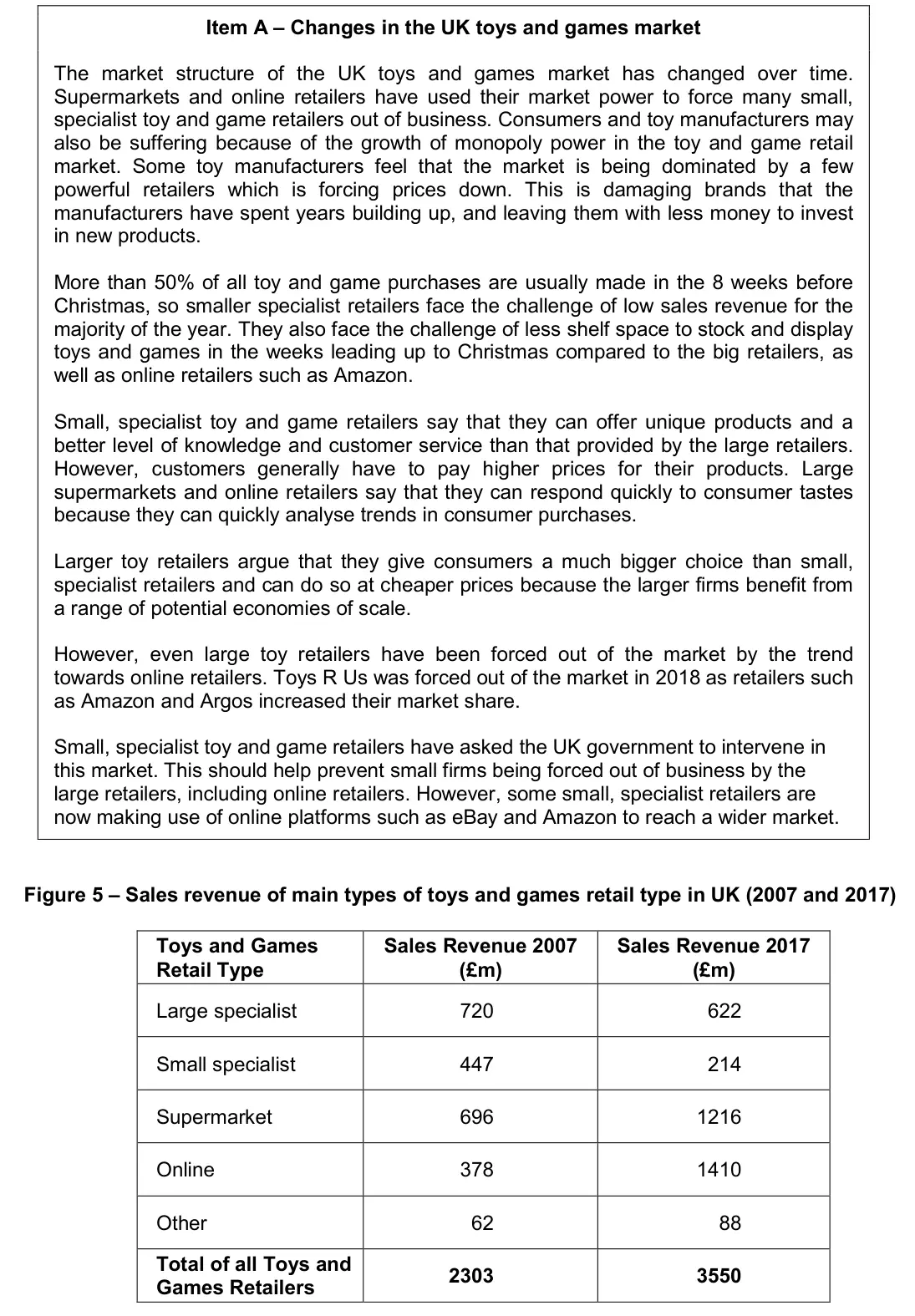
- November 2020, Paper 1, Q24 (6 marks): 2 4 Explain two possible economies of scale that a large toy retailer such as Amazon may benefit from. [6 marks]
Questions, mark schemes and examiner’s reports are © AQA, from their published past papers. Plumi isn’t affiliated with any exam board. Want whole papers? Full past papers.
The Plumi iPad app also offers exam-style questions with AI feedback on your handwritten working.