 plumi
Transport in cells: AQA GCSE Combined Science questions
Every AQA GCSE Combined Science exam question on 4.1.3 Transport in cells, 2018–2025, with its mark scheme and examiner’s report.
Find questions3,069
Calculations
Q04.1
The whole paper ↗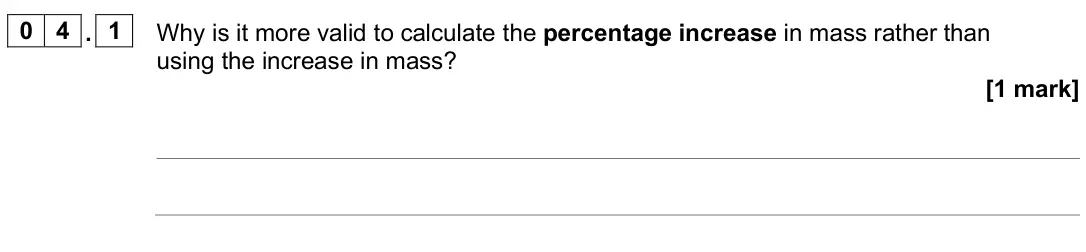
Q04.2
The whole paper ↗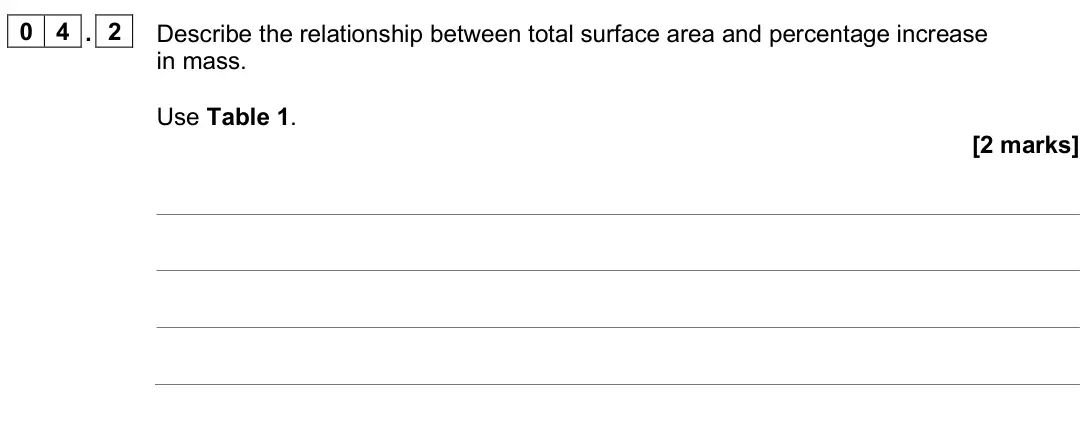
Q04.3
The whole paper ↗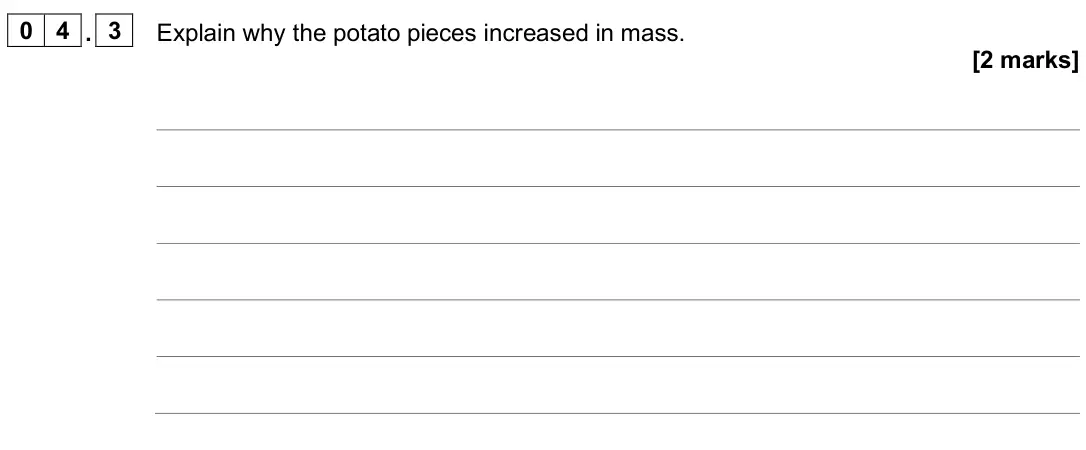
Q04.4
The whole paper ↗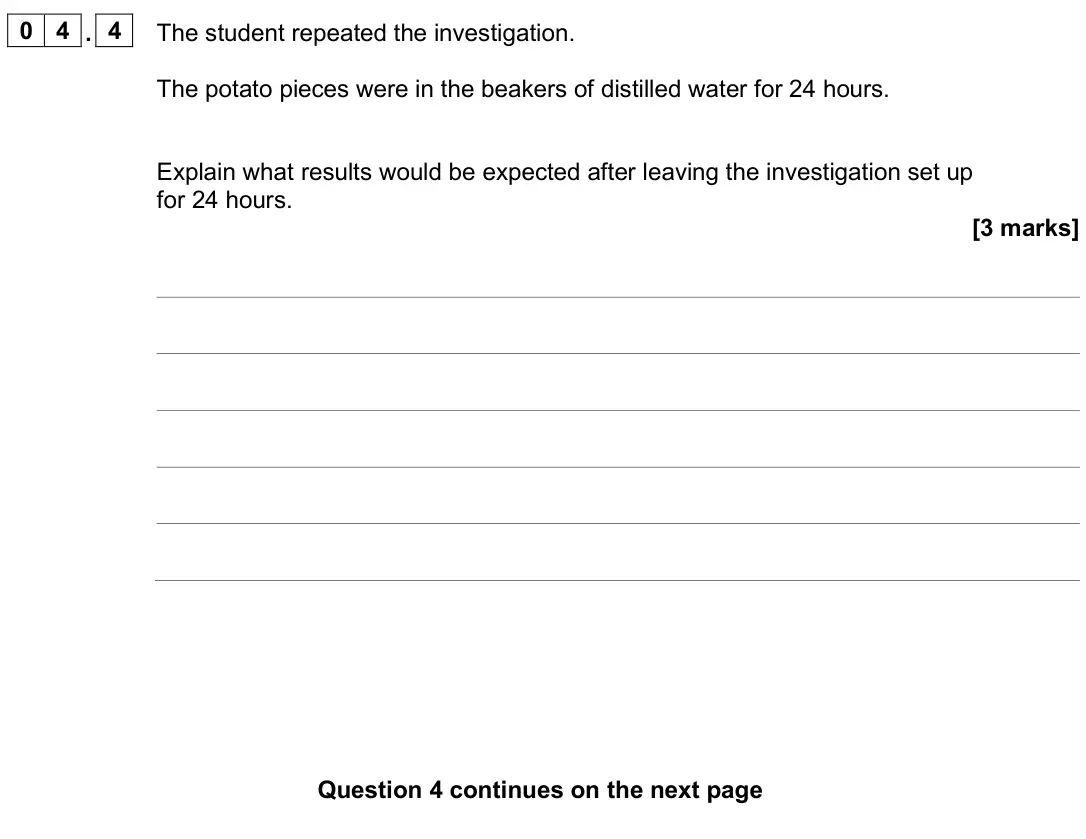
Q04.5
The whole paper ↗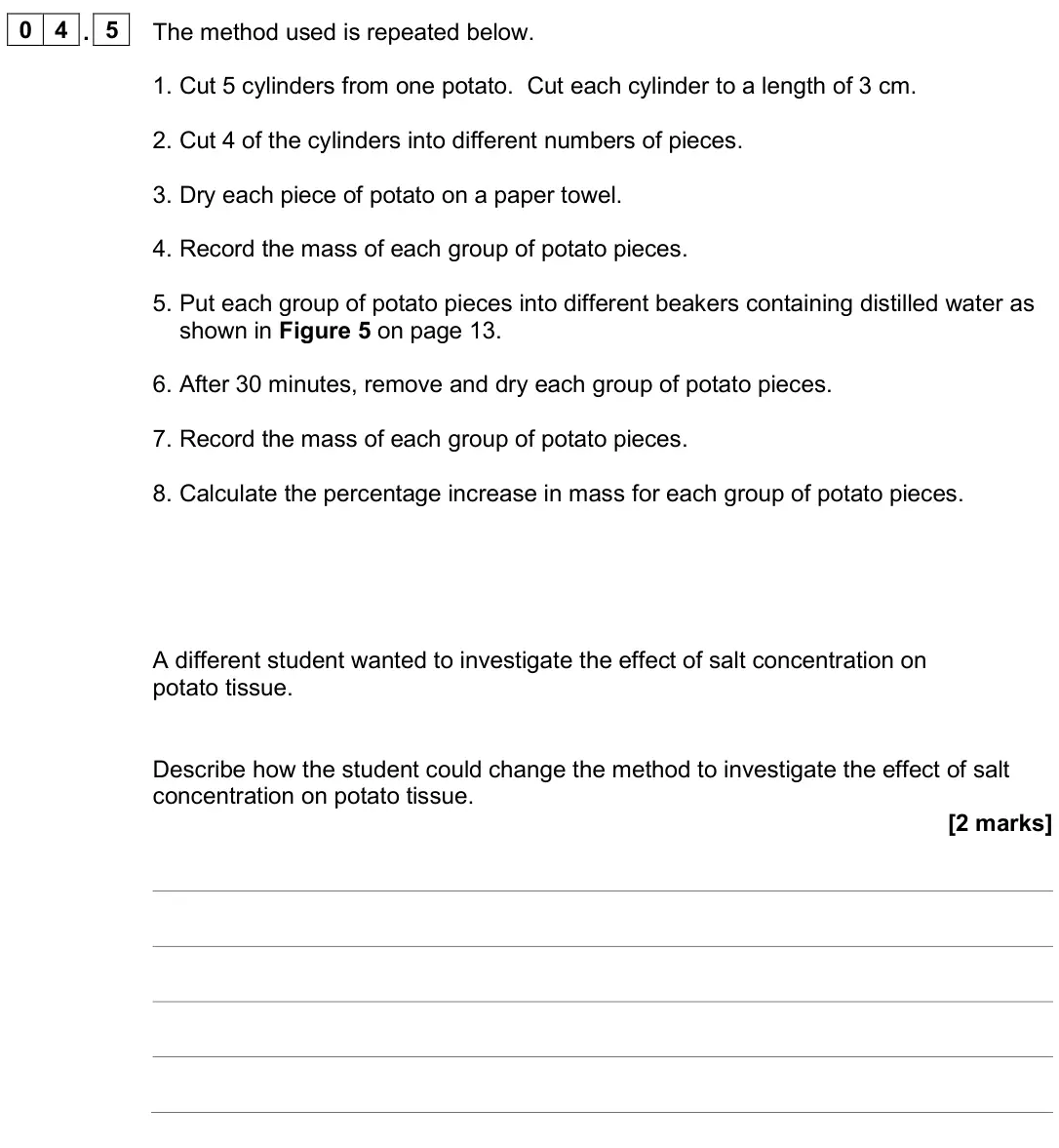
Q03.1
The whole paper ↗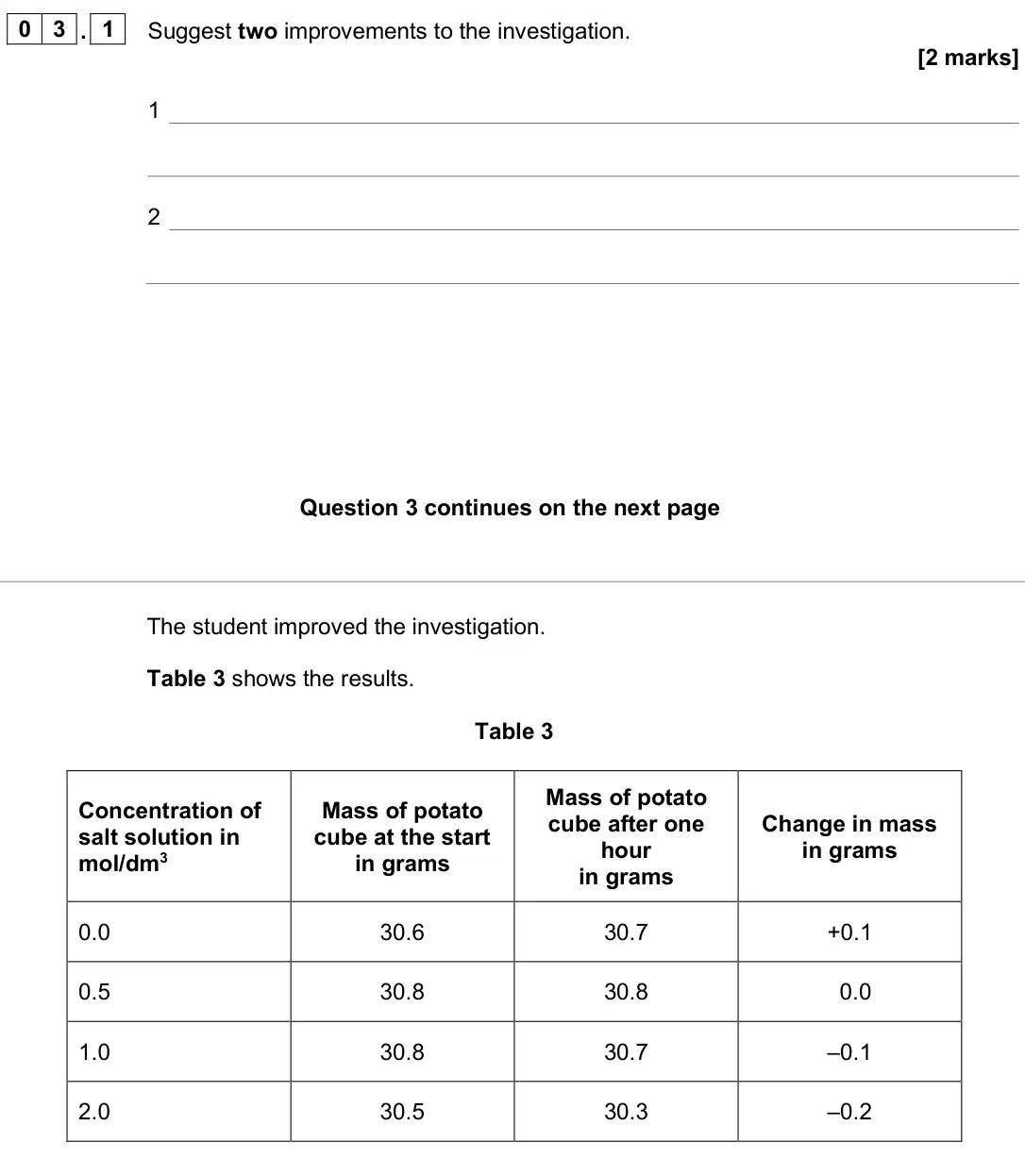
Q03.2
The whole paper ↗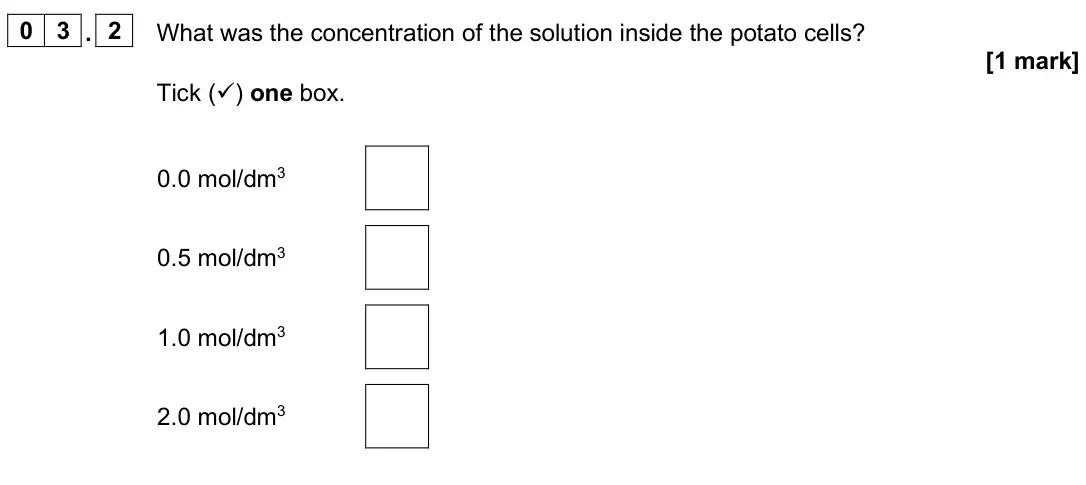
Q03.3
The whole paper ↗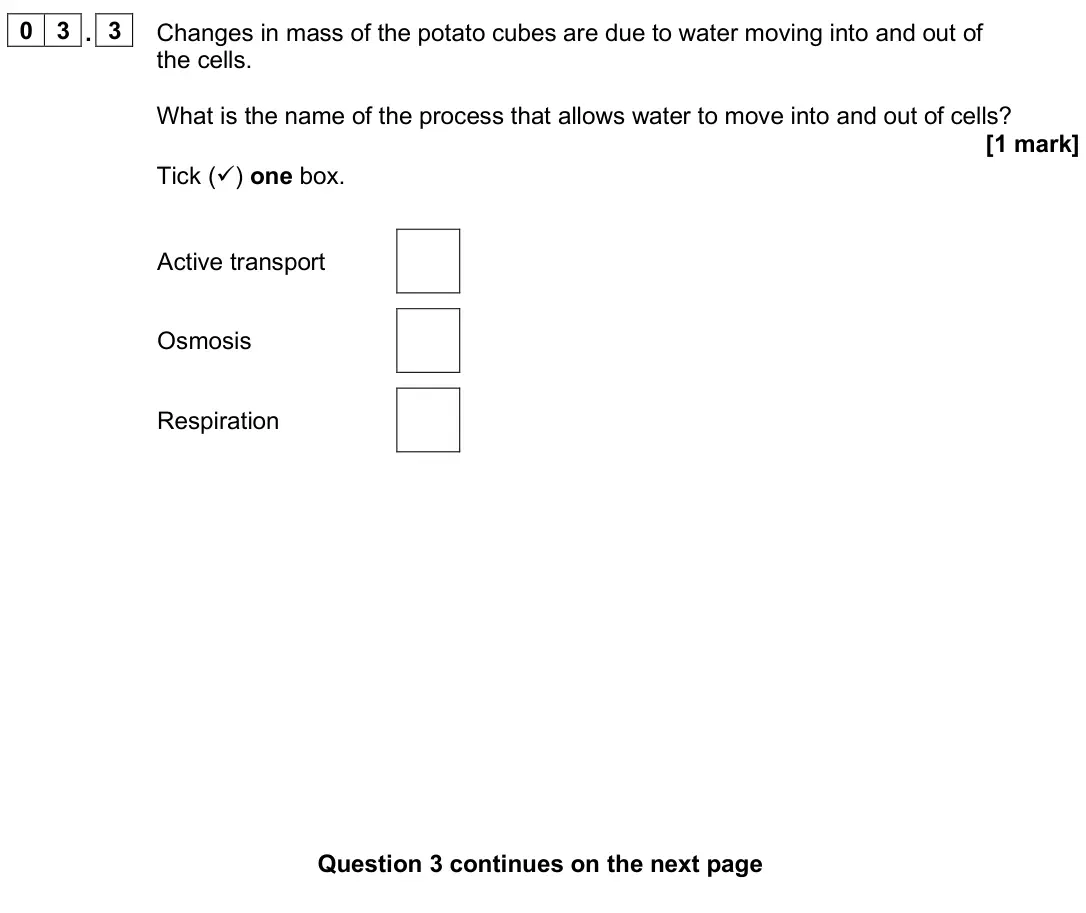
Q03.4
The whole paper ↗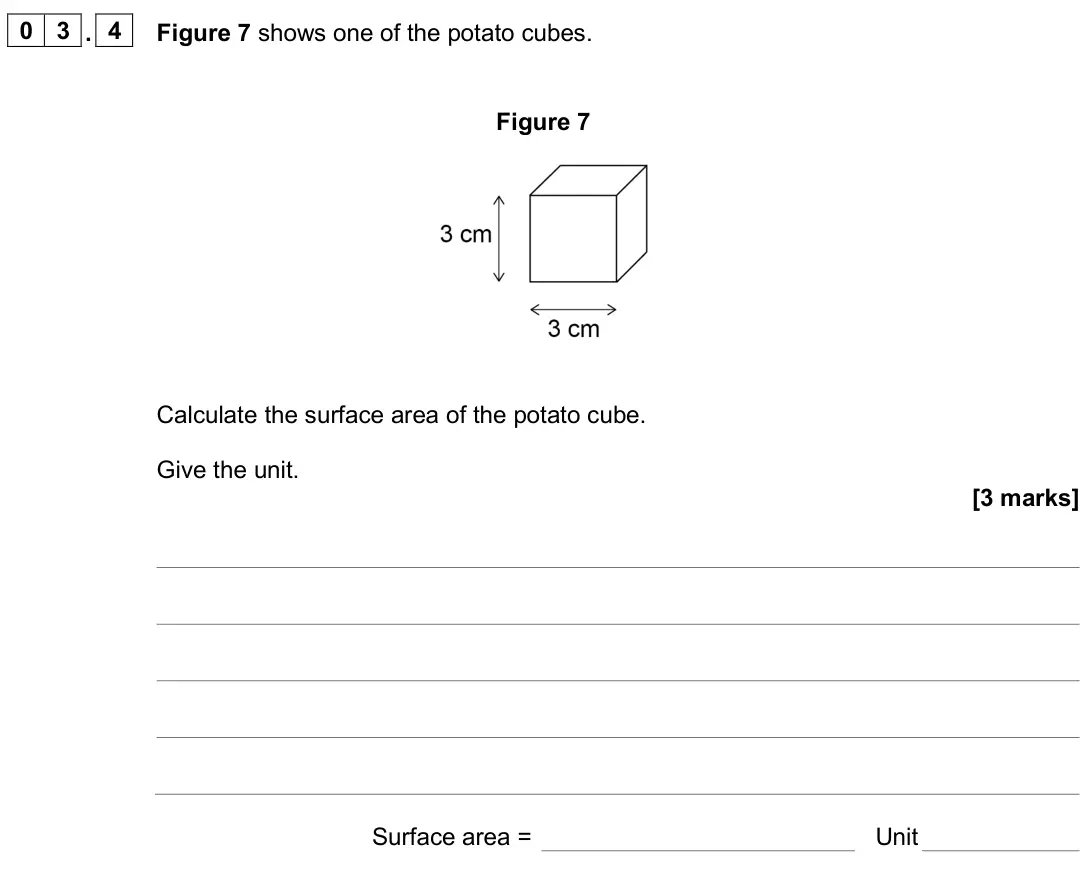
Q03.5
The whole paper ↗
Q02.1
The whole paper ↗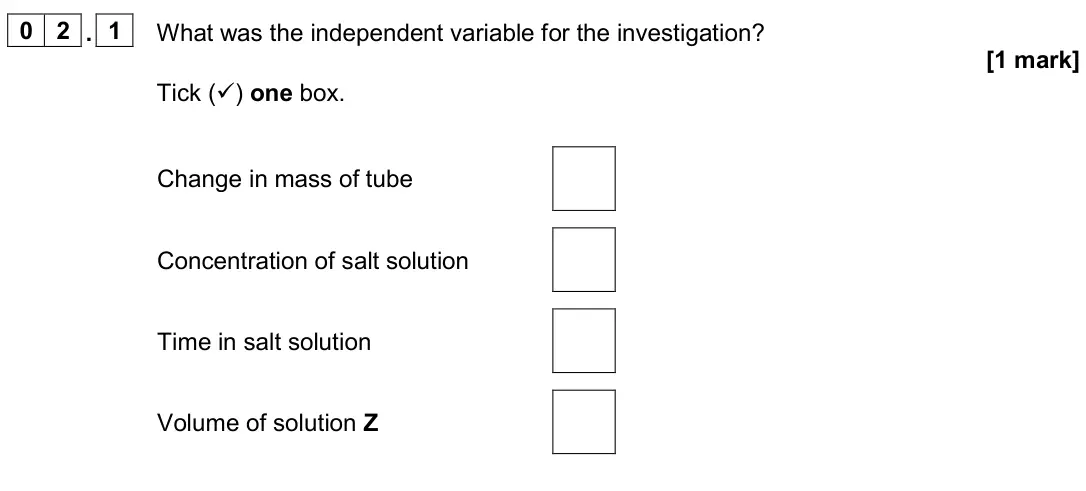
Q02.2
The whole paper ↗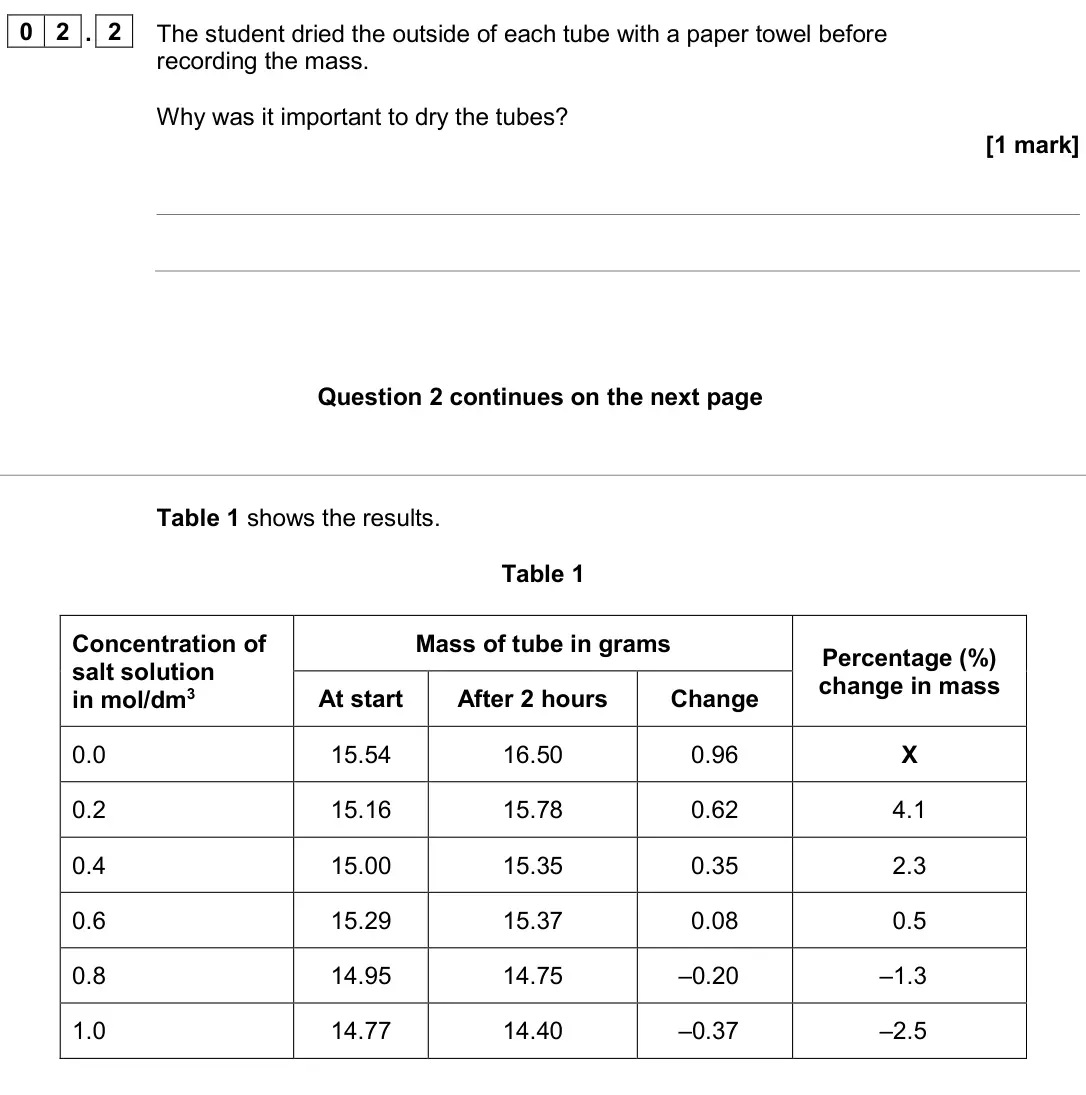
Q02.4
The whole paper ↗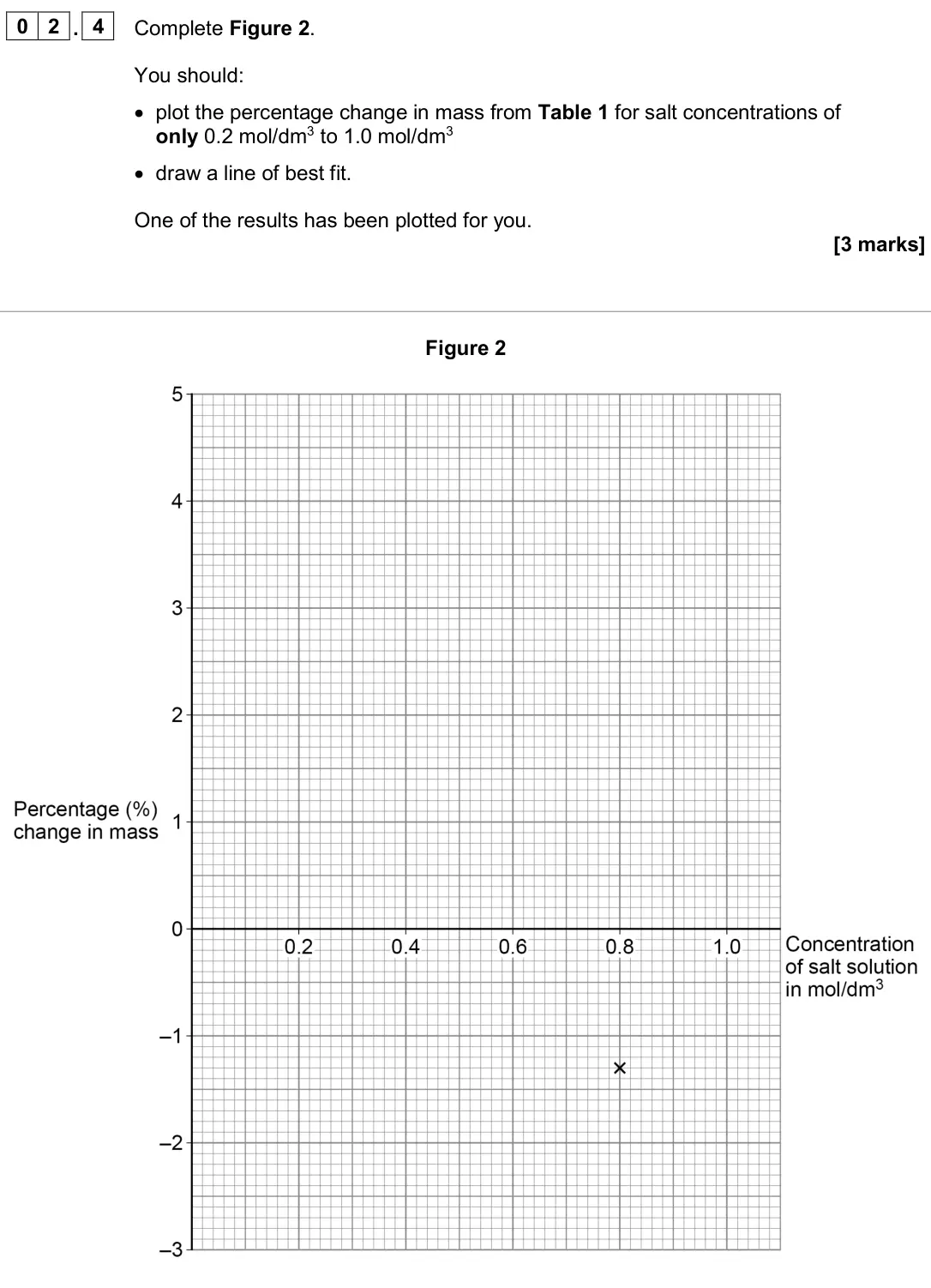
Q02.5
The whole paper ↗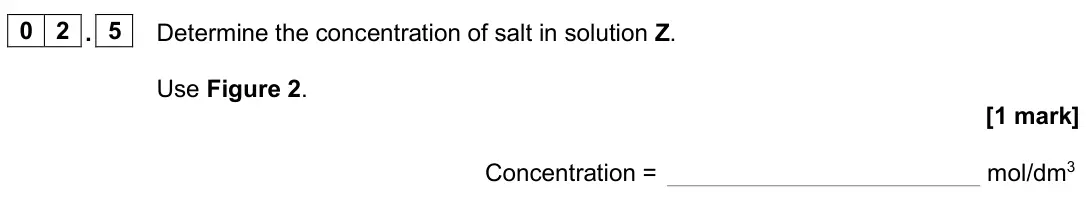
Q07.1
The whole paper ↗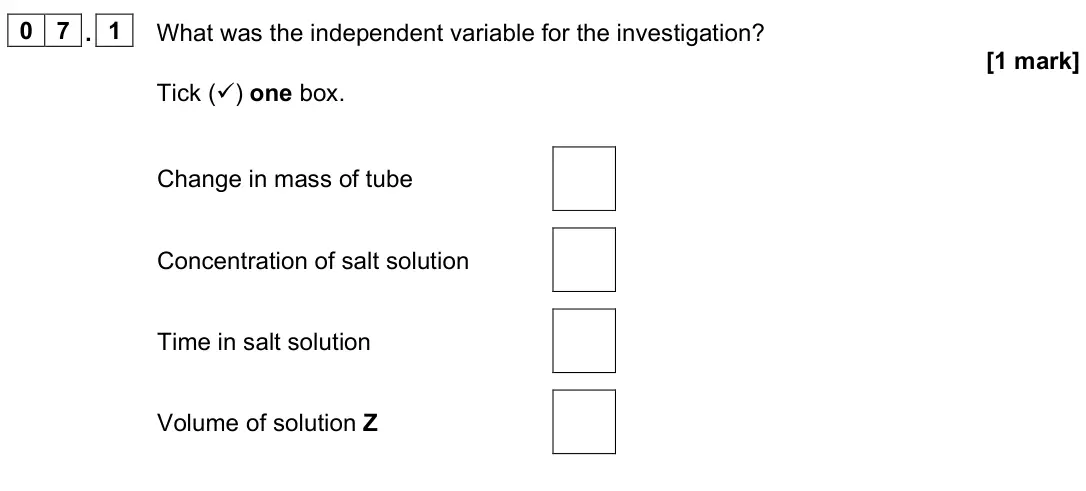
Q07.2
The whole paper ↗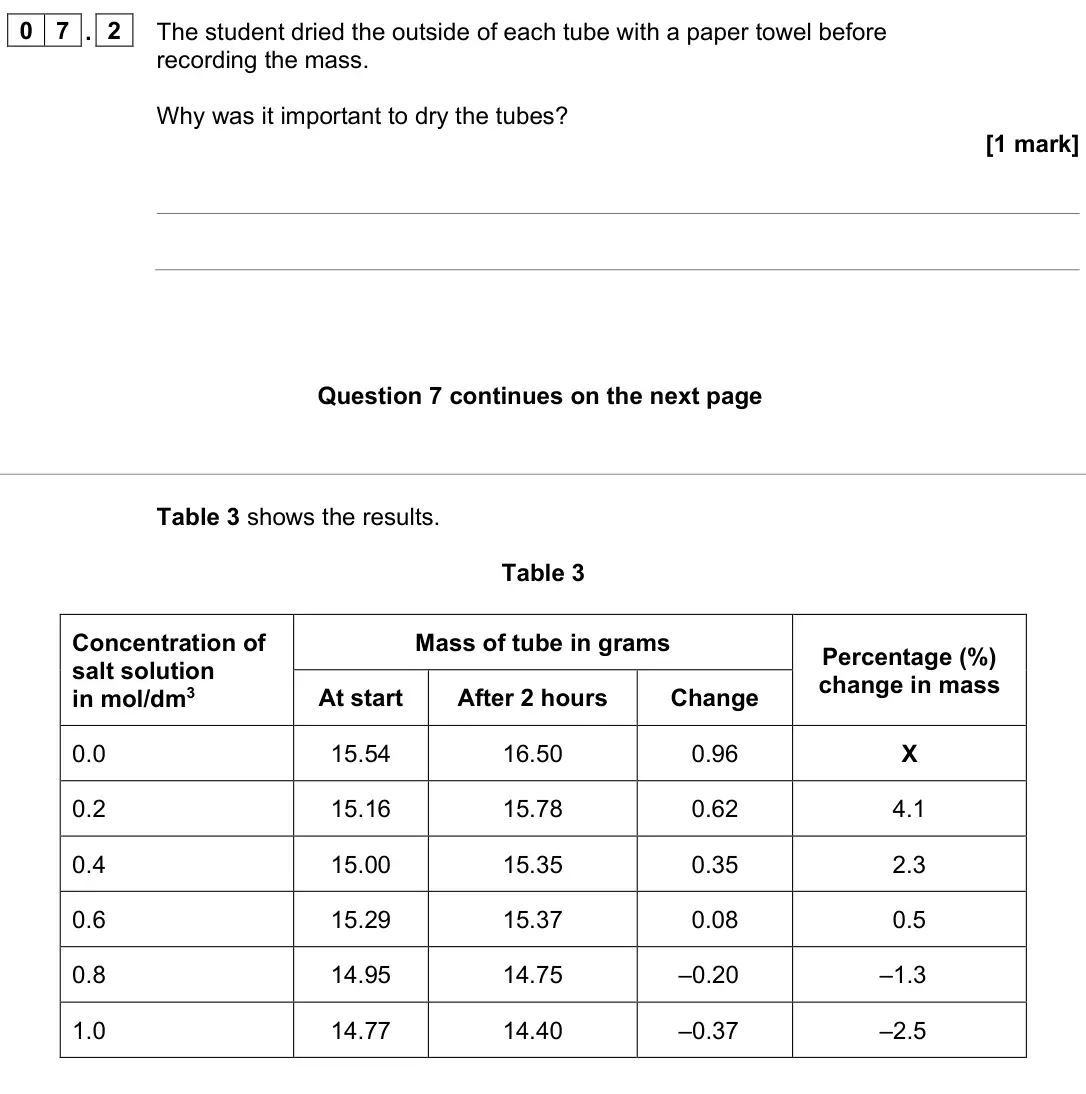
Q07.4
The whole paper ↗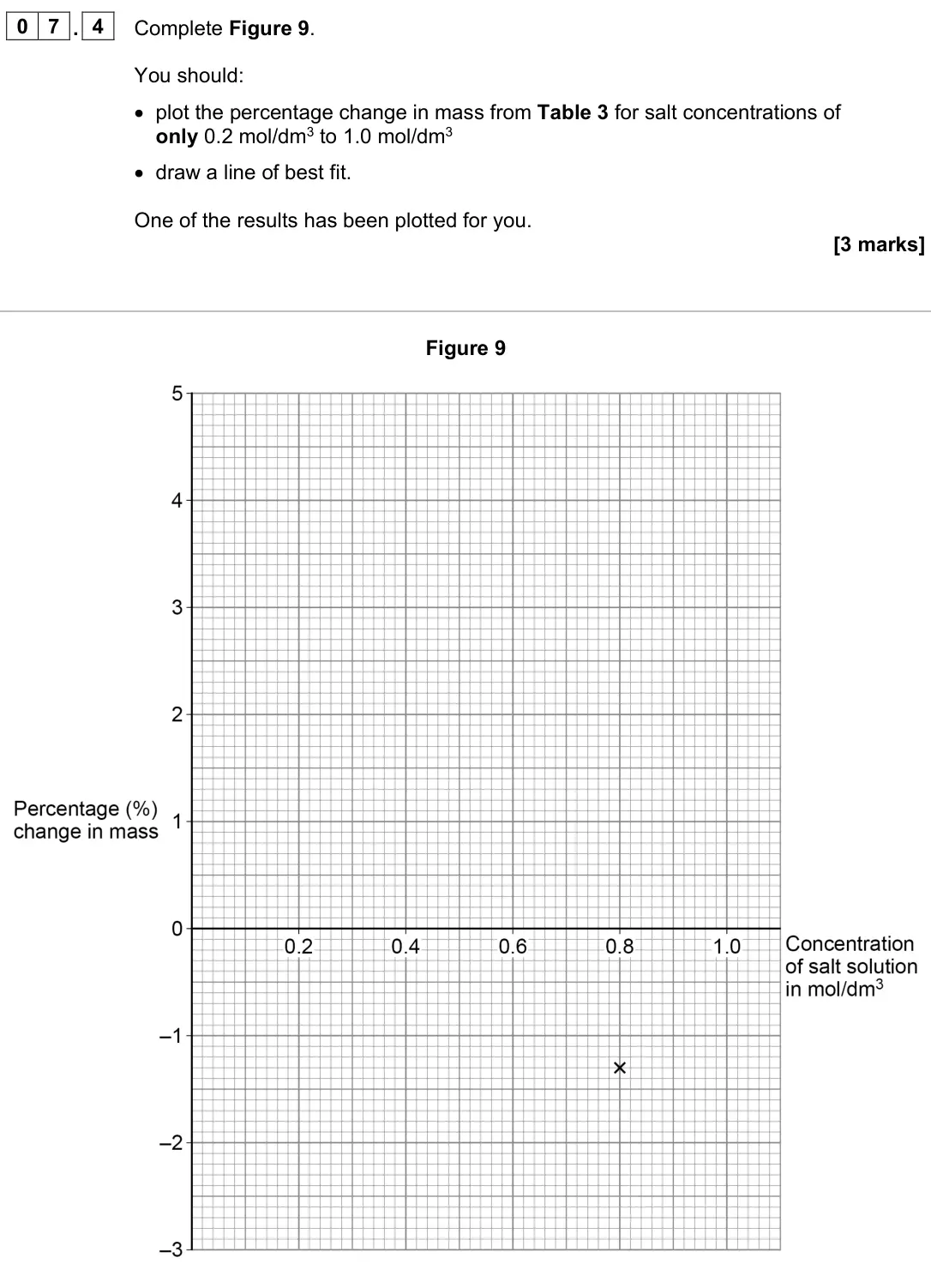
Q07.5
The whole paper ↗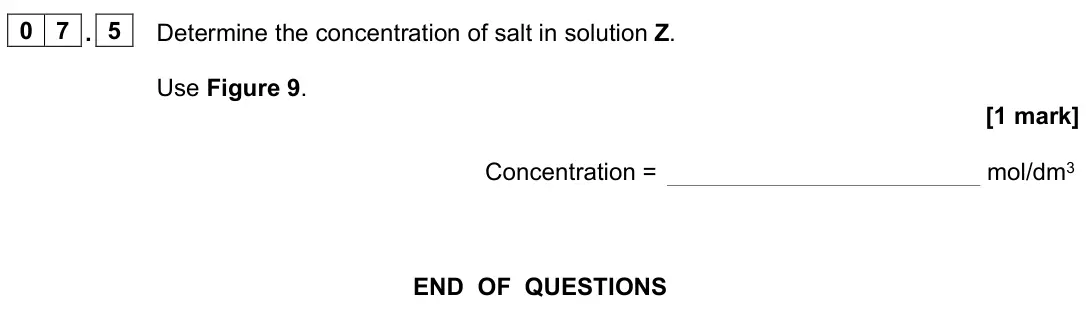
All 53 questions on Transport in cells, as a list
- June 2025, Biology Paper 1 Higher, Q04.1 (1 mark): Why is it more valid to calculate the percentage increase in mass rather than using the increase in mass? [1 mark]
- June 2025, Biology Paper 1 Higher, Q04.2 (2 marks): Describe the relationship between total surface area and percentage increase in mass. Use Table 1. [2 marks]
- June 2025, Biology Paper 1 Higher, Q04.3 (2 marks): Explain why the potato pieces increased in mass. [2 marks]
- June 2025, Biology Paper 1 Higher, Q04.4 (3 marks): The student repeated the investigation. The potato pieces were in the beakers of distilled water for 24 hours. Explain what results would be expected after leav
- June 2025, Biology Paper 1 Higher, Q04.5 (2 marks): The method used is repeated below. 1. Cut 5 cylinders from one potato. Cut each cylinder to a length of 3 cm. 2. Cut 4 of the cylinders into different numbers o
- June 2025, Biology Paper 1 Foundation, Q03.1 (2 marks): Suggest two improvements to the investigation. [2 marks] 1 2 The student improved the investigation. Table 3 shows the results. Table 3 Concentration of salt so
- June 2025, Biology Paper 1 Foundation, Q03.2 (1 mark): What was the concentration of the solution inside the potato cells? [1 mark] Tick () one box. 0.0 mol/dm3 0.5 mol/dm3 1.0 mol/dm3 2.0 mol/dm3
- June 2025, Biology Paper 1 Foundation, Q03.3 (1 mark): Changes in mass of the potato cubes are due to water moving into and out of the cells. What is the name of the process that allows water to move into and out of
- June 2025, Biology Paper 1 Foundation, Q03.4 (3 marks): Figure 7 shows one of the potato cubes. Figure 7 Calculate the surface area of the potato cube. Give the unit. [3 marks] Surface area = Unit
- June 2025, Biology Paper 1 Foundation, Q03.5 (1 mark): The student then investigated the effect of surface area on the change in mass of a piece of potato. Describe how the student could increase the surface area of
- June 2024, Biology Paper 1 Higher, Q02.1 (1 mark): What was the independent variable for the investigation? [1 mark] Tick () one box. Change in mass of tube Concentration of salt solution Time in salt solution
- June 2024, Biology Paper 1 Higher, Q02.2 (1 mark): The student dried the outside of each tube with a paper towel before recording the mass. Why was it important to dry the tubes? [1 mark] Table 1 shows the resul
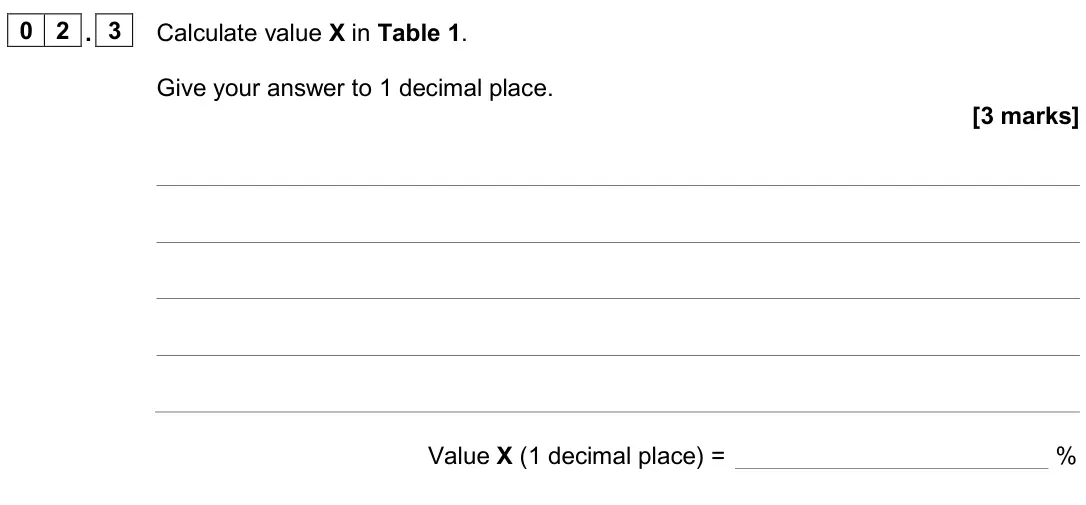
- June 2024, Biology Paper 1 Higher, Q02.3 (3 marks): Calculate value X in Table 1. Give your answer to 1 decimal place. [3 marks] Value X (1 decimal place) = %
- June 2024, Biology Paper 1 Higher, Q02.4 (3 marks): Complete Figure 2. You should: • plot the percentage change in mass from Table 1 for salt concentrations of only 0.2 mol/dm3 to 1.0 mol/dm3 • draw a line of bes
- June 2024, Biology Paper 1 Higher, Q02.5 (1 mark): Determine the concentration of salt in solution Z. Use Figure 2. [1 mark] Concentration = mol/dm3
- June 2024, Biology Paper 1 Foundation, Q07.1 (1 mark): What was the independent variable for the investigation? [1 mark] Tick () one box. Change in mass of tube Concentration of salt solution Time in salt solution
- June 2024, Biology Paper 1 Foundation, Q07.2 (1 mark): The student dried the outside of each tube with a paper towel before recording the mass. Why was it important to dry the tubes? [1 mark] Table 3 shows the resul
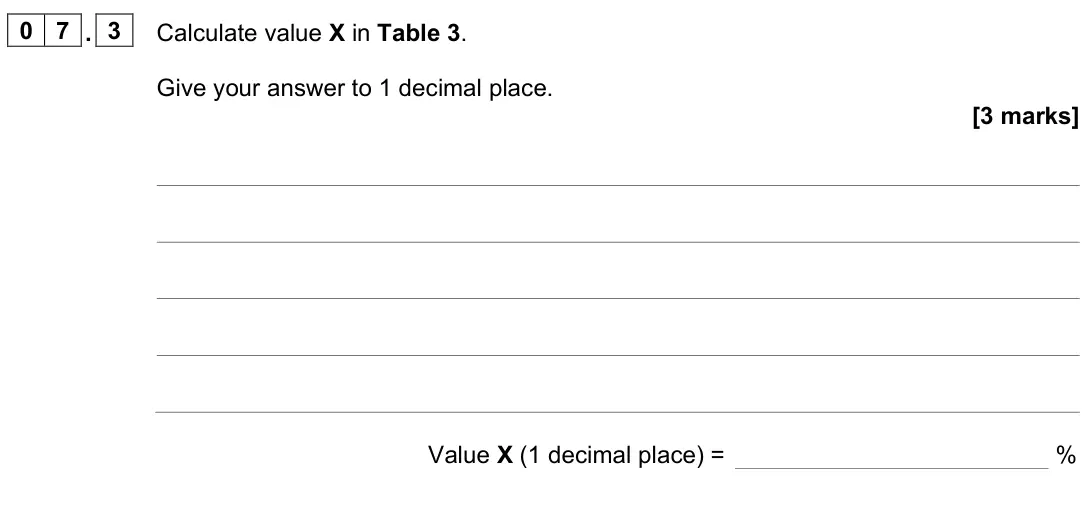
- June 2024, Biology Paper 1 Foundation, Q07.3 (3 marks): Calculate value X in Table 3. Give your answer to 1 decimal place. [3 marks] Value X (1 decimal place) = %
- June 2024, Biology Paper 1 Foundation, Q07.4 (3 marks): Complete Figure 9. You should: • plot the percentage change in mass from Table 3 for salt concentrations of only 0.2 mol/dm3 to 1.0 mol/dm3 • draw a line of bes
- June 2024, Biology Paper 1 Foundation, Q07.5 (1 mark): Determine the concentration of salt in solution Z. Use Figure 9. [1 mark] Concentration = mol/dm3
- June 2023, Biology Paper 1 Higher, Q04.4 (2 marks): Figure 5 shows a pair of guard cells around a stoma. Figure 5 During the day, glucose is made in the guard cells. Describe how an increase in glucose concentrat
- June 2023, Biology Paper 1 Foundation, Q01.5 (2 marks): What is the name of the process that moves oxygen molecules into the cell in Figure 1? Give the reason for your answer. [2 marks] Tick () one box. Active trans
- June 2023, Biology Paper 1 Foundation, Q01.6 (2 marks): Name two substances that move into most cells in the body from the blood. Do not refer to oxygen in your answer. [2 marks] 1 2
- June 2023, Biology Paper 1 Foundation, Q05.3 (2 marks): Give two ways that the lungs are adapted for efficient gas exchange. [2 marks] 1 2 Table 3 shows the percentage of gases in air breathed into the lungs and air
- June 2022, Biology Paper 1 Foundation, Q02.4 (1 mark): Carbon dioxide can move into and out of cells. What is the process by which carbon dioxide can move into and out of cells? [1 mark] Tick () one box. Active tra
- June 2022, Biology Paper 1 Foundation, Q02.5 (2 marks): Which cell will carbon dioxide move into at the fastest rate? Give a reason for your answer. [2 marks] Tick () one box. A B C D Reason
- November 2021, Biology Paper 1 Higher, Q06.1 (4 marks): Describe how water is transported from the soil to the atmosphere through a plant. [4 marks]
- November 2021, Biology Paper 1 Higher, Q06.4 (2 marks): What does the structure of the companion cells suggest about the process that moves dissolved sugars through the phloem tissue? Give a reason for your answer. U
- November 2021, Biology Paper 1 Foundation, Q04.2 (1 mark): The concentration of nitrate ions in the soil is lower than the concentration of nitrate ions inside a plant. How would the nitrate ions move from the soil into
- November 2020, Biology Paper 1 Higher, Q01.1 (1 mark): What is the independent variable? [1 mark] Tick () one box. Change in mass of the pieces of potato Concentration of the sugar solution Length of time the piece
- November 2020, Biology Paper 1 Higher, Q01.2 (2 marks): Explain why the potato in 0.0 mol/dm3 sugar solution increased in mass. [2 marks]
- November 2020, Biology Paper 1 Higher, Q01.3 (2 marks): Complete Figure 1. Some of the results have been plotted for you. You should: • plot the data from Table 1 • draw a line of best fit through all the points. [2
- November 2020, Biology Paper 1 Higher, Q01.4 (1 mark): The mass of a piece of potato does not change when: concentration of solution inside cells = concentration of solution outside cells Determine the concentration
- November 2020, Biology Paper 1 Higher, Q01.5 (3 marks): Calculate the percentage change in mass for the potato in 0.2 mol/dm3 sugar solution. Use Table 1. Use the equation: percentage change in mass = change in mass
- November 2020, Biology Paper 1 Higher, Q02.6 (1 mark): Name the process by which sugar moves into cell A. [1 mark]
- November 2020, Biology Paper 1 Higher, Q02.7 (1 mark): Name the process by which sugar moves into cell B. [1 mark]
- November 2020, Biology Paper 1 Higher, Q02.9 (4 marks): Figure 2 is repeated below. Figure 2 Explain how villi are adapted for efficient absorption of sugar molecules. [4 marks]
- November 2020, Biology Paper 1 Foundation, Q05.1 (1 mark): What is the independent variable? [1 mark] Tick () one box. Change in mass of the pieces of potato Concentration of the sugar solution Length of time the piece
- November 2020, Biology Paper 1 Foundation, Q05.2 (2 marks): Explain why the potato in 0.0 mol/dm3 sugar solution increased in mass. [2 marks]
- November 2020, Biology Paper 1 Foundation, Q05.3 (2 marks): Complete Figure 5. Some of the results have been plotted for you. You should: • plot the data from Table 3 • draw a line of best fit through all the points. [2
- November 2020, Biology Paper 1 Foundation, Q05.4 (1 mark): The mass of a piece of potato does not change when: concentration of solution inside cells = concentration of solution outside cells Determine the concentration
- November 2020, Biology Paper 1 Foundation, Q05.5 (3 marks): Calculate the percentage change in mass for the potato in 0.2 mol/dm3 sugar solution. Use Table 3. Use the equation: percentage change in mass = change in mass
- November 2020, Biology Paper 1 Foundation, Q06.6 (1 mark): Name the process by which sugar moves into cell A. [1 mark]
- November 2020, Biology Paper 1 Foundation, Q06.7 (1 mark): Name the process by which sugar moves into cell B. [1 mark]
- November 2020, Biology Paper 1 Foundation, Q06.9 (4 marks): Figure 6 is repeated below. Figure 6 Explain how villi are adapted for efficient absorption of sugar molecules. [4 marks]
- June 2019, Biology Paper 1 Higher, Q04.6 (5 marks): Figure 7 shows two cubes. Cube X represents a bacterial cell. Cube Y represents a small multicellular organism. Figure 7 A bacterial cell can absorb all the nut
- June 2019, Biology Paper 1 Higher, Q05.3 (3 marks): Describe the changes in the rate of absorption of nitrate ions for the seedling with no oxygen added. Use information from Table 5. [3 marks]
- June 2019, Biology Paper 1 Higher, Q05.4 (4 marks): Explain what the results in Table 5 show about how nitrate ions are absorbed. [4 marks]
- June 2018, Biology Paper 1 Higher, Q04.1 (1 mark): Suggest why the student calculated the percentage (%) change in mass of each piece of carrot. [1 mark]
- June 2018, Biology Paper 1 Higher, Q04.2 (4 marks): Complete Figure 7 using the results in Table 2 • Choose a suitable scale and label for the y-axis. • Plot the results. • Draw a line of best fit. [4 marks] Figu
- June 2018, Biology Paper 1 Higher, Q04.3 (1 mark): Estimate the concentration of sugar solution inside the carrot cells. Use your completed graph on Figure 7 [1 mark] Concentration = mol/dm3
- June 2018, Biology Paper 1 Higher, Q04.4 (4 marks): Explain why the mass of the carrot in the 0.6 mol/dm3 sugar solution changed. [4 marks]
- June 2018, Biology Paper 1 Higher, Q04.5 (1 mark): The student repeated the investigation using boiled pieces of carrot. The pieces of carrot did not change in mass. Suggest why. [1 mark]
Questions, mark schemes and examiner’s reports are © AQA, from their published past papers. Plumi isn’t affiliated with any exam board. Want whole papers? Full past papers.
Rather write your answers by hand on iPad? Plumi marks them against the same mark schemes.