 plumi
Organisation of an ecosystem: AQA GCSE Combined Science questions
Every AQA GCSE Combined Science exam question on 4.7.2 Organisation of an ecosystem, 2018–2025, with its mark scheme and examiner’s report.
Find questions3,069
Calculations
Q03.1
The whole paper ↗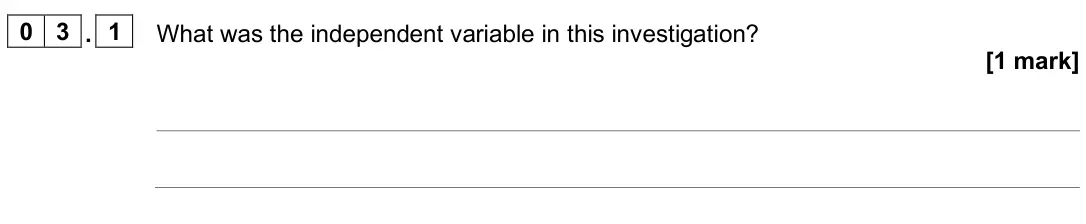
Q03.2
The whole paper ↗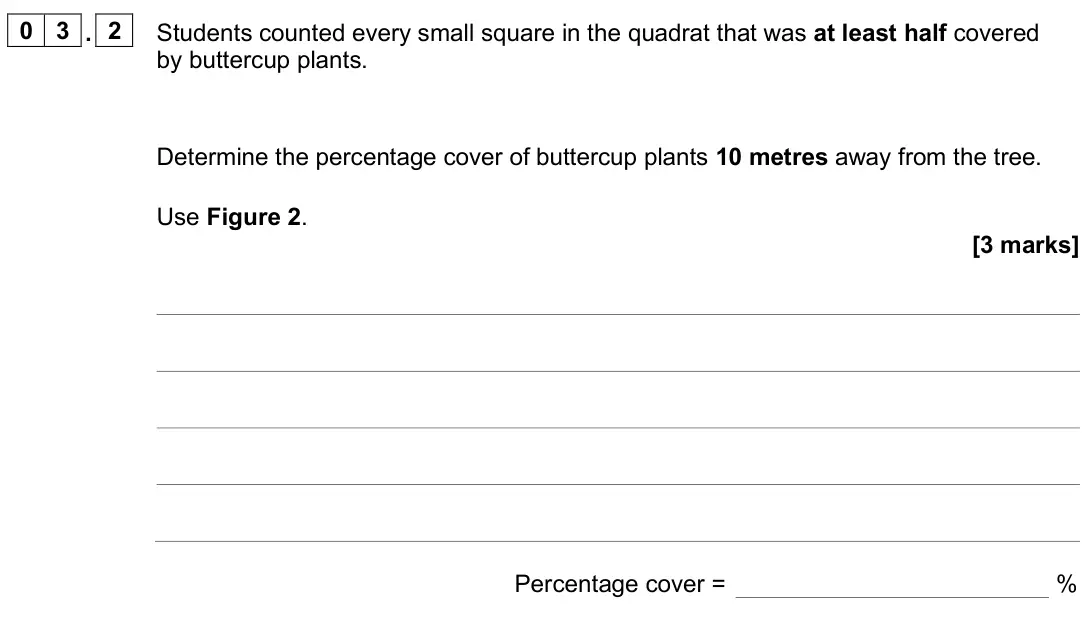
Q03.3
The whole paper ↗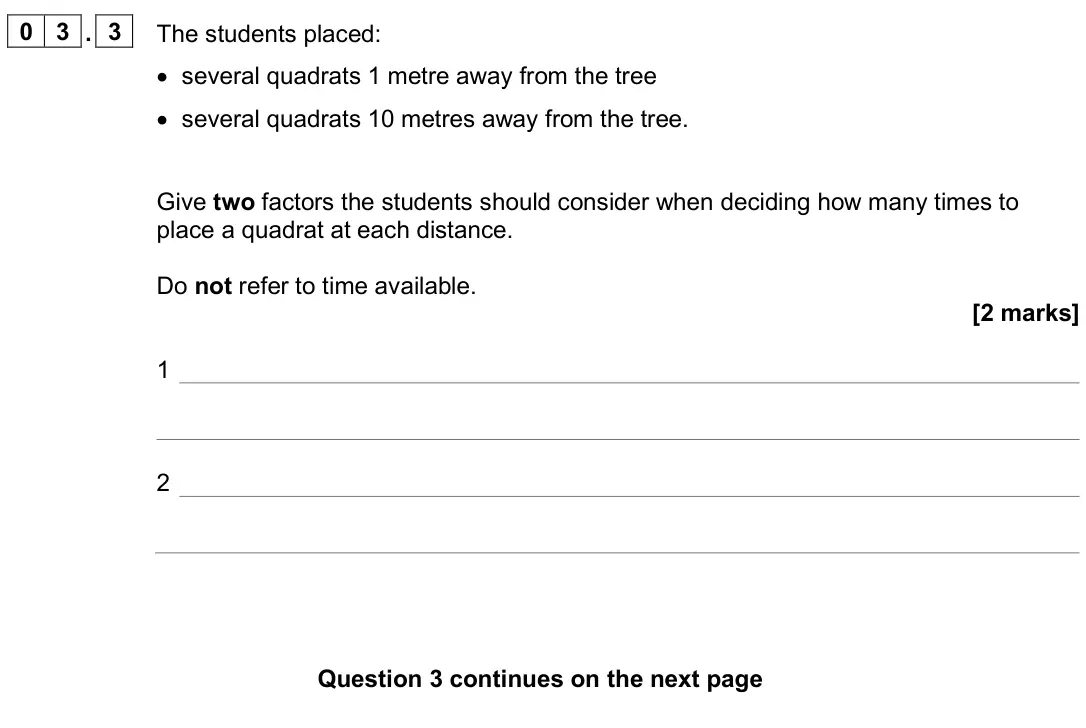
Q03.4
The whole paper ↗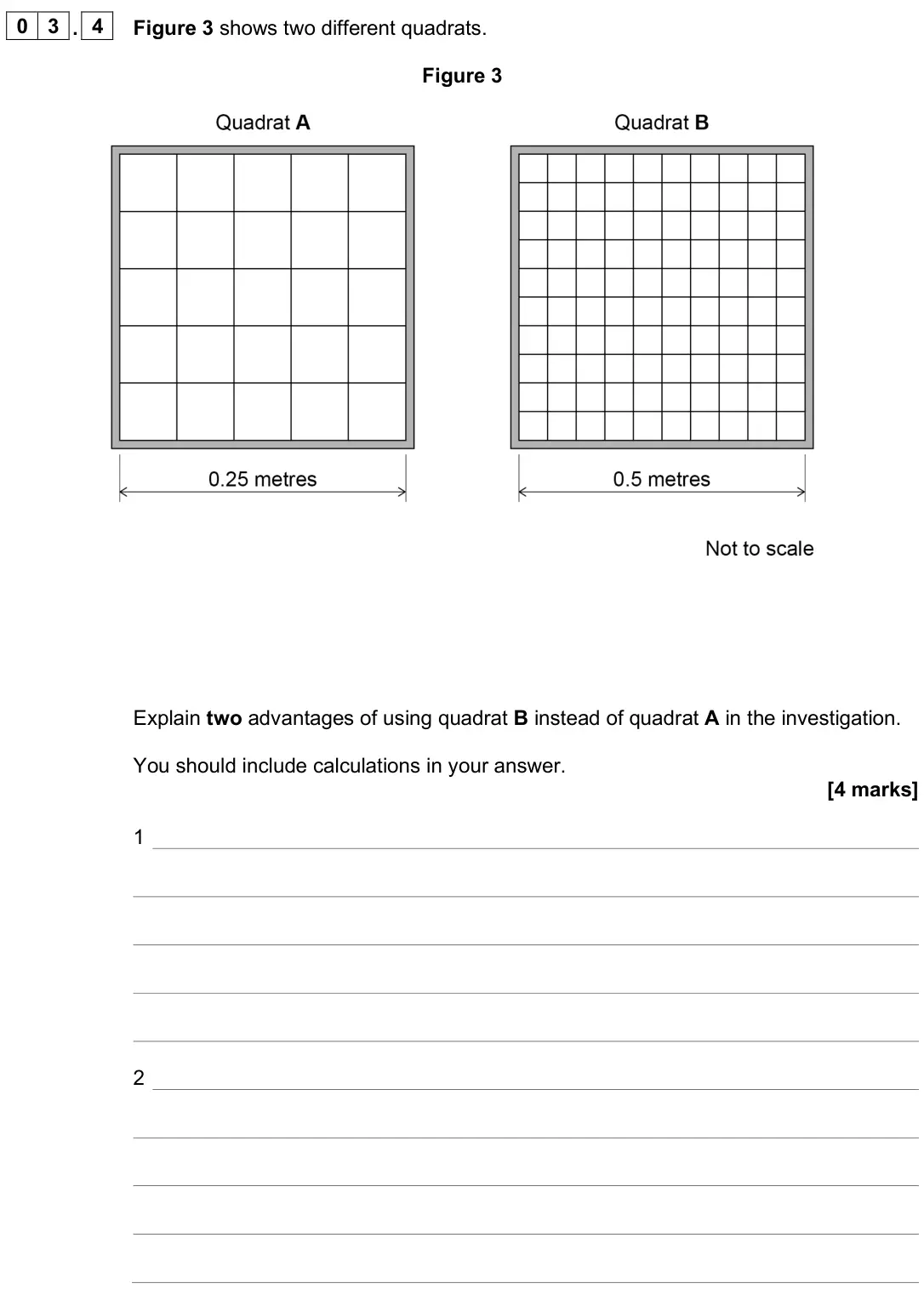
Q03.5
The whole paper ↗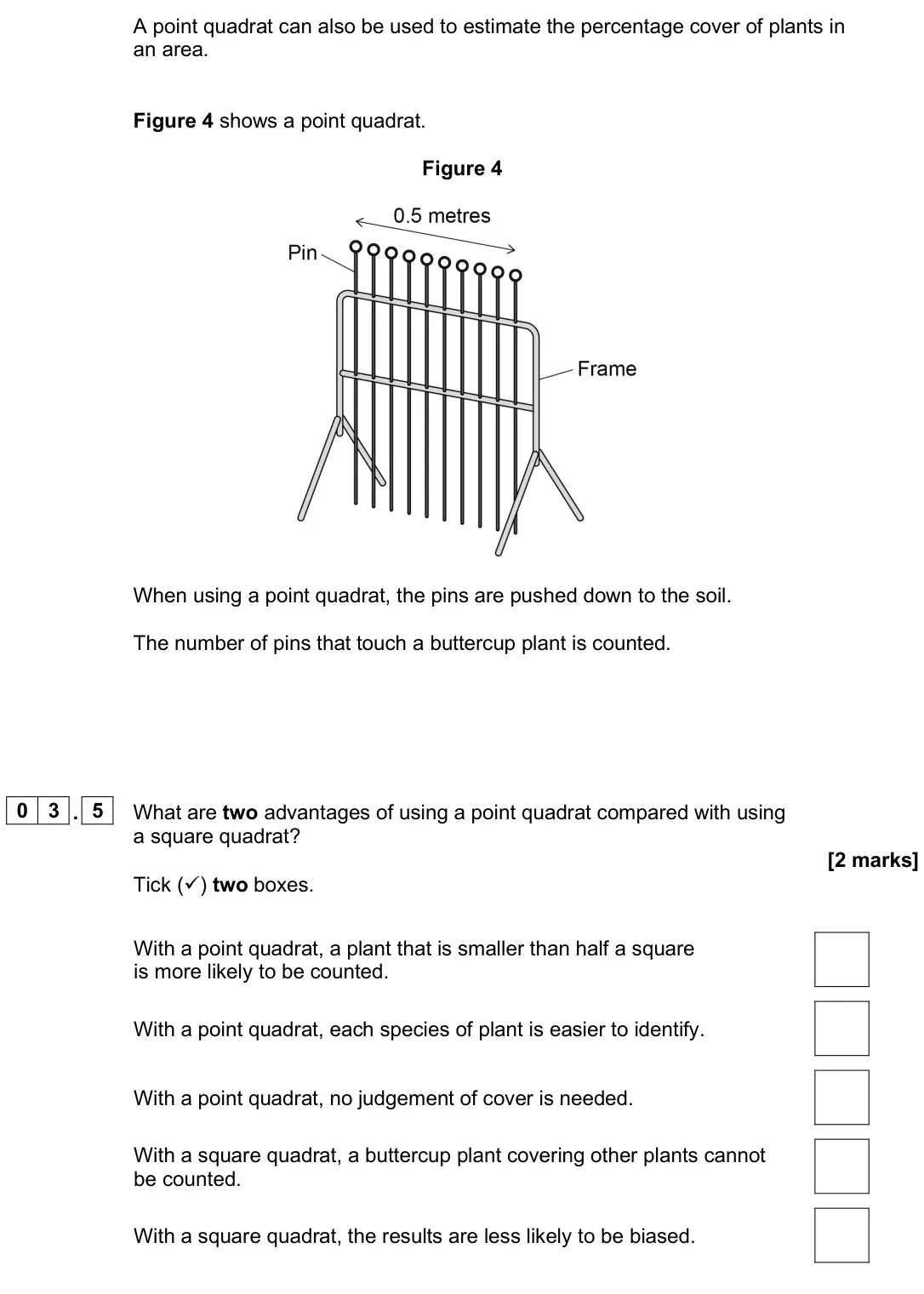
Q03.6
The whole paper ↗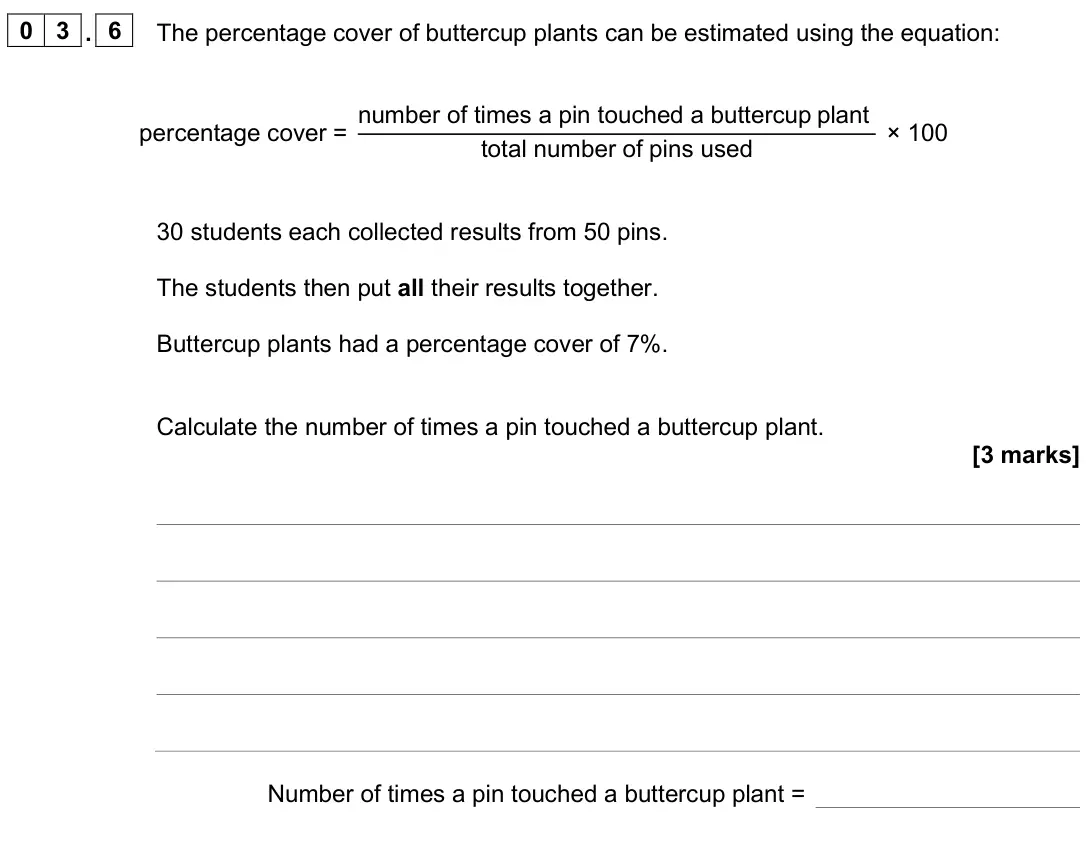
Q04.3
The whole paper ↗
Q04.5
The whole paper ↗
Q02.2
The whole paper ↗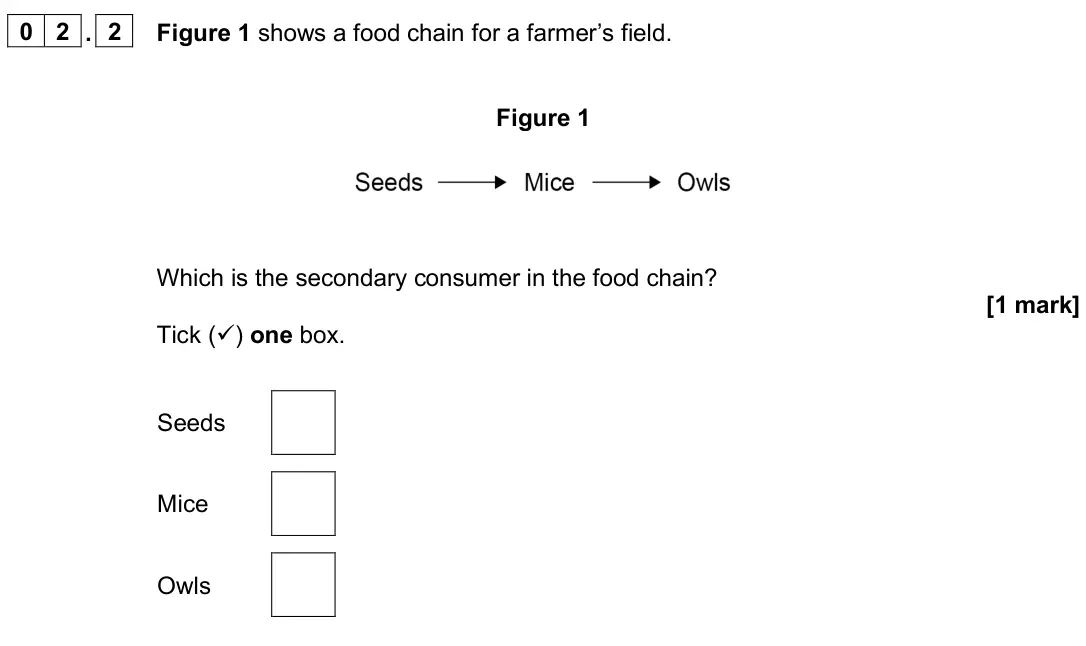
Q02.3
The whole paper ↗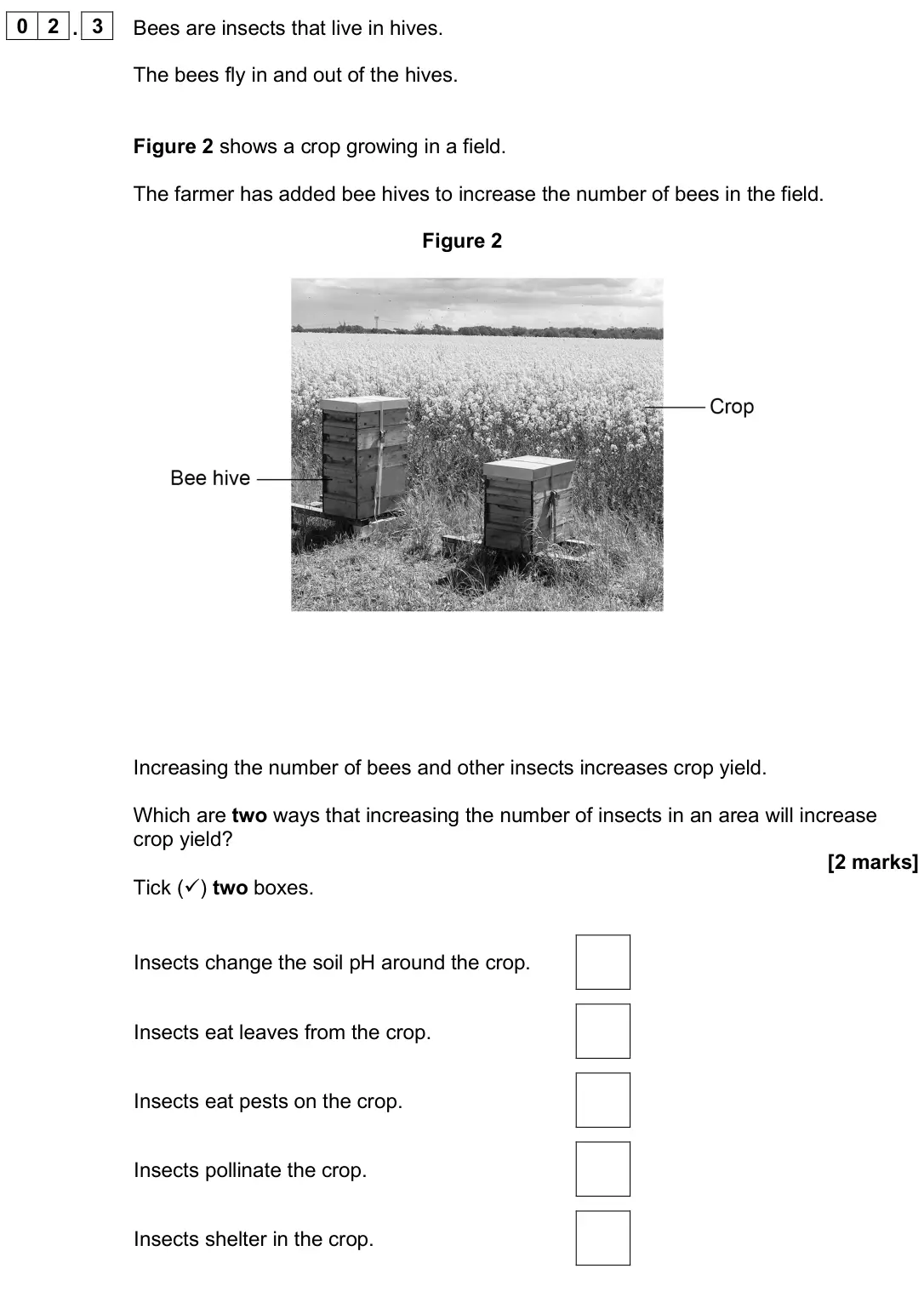
Q02.6
The whole paper ↗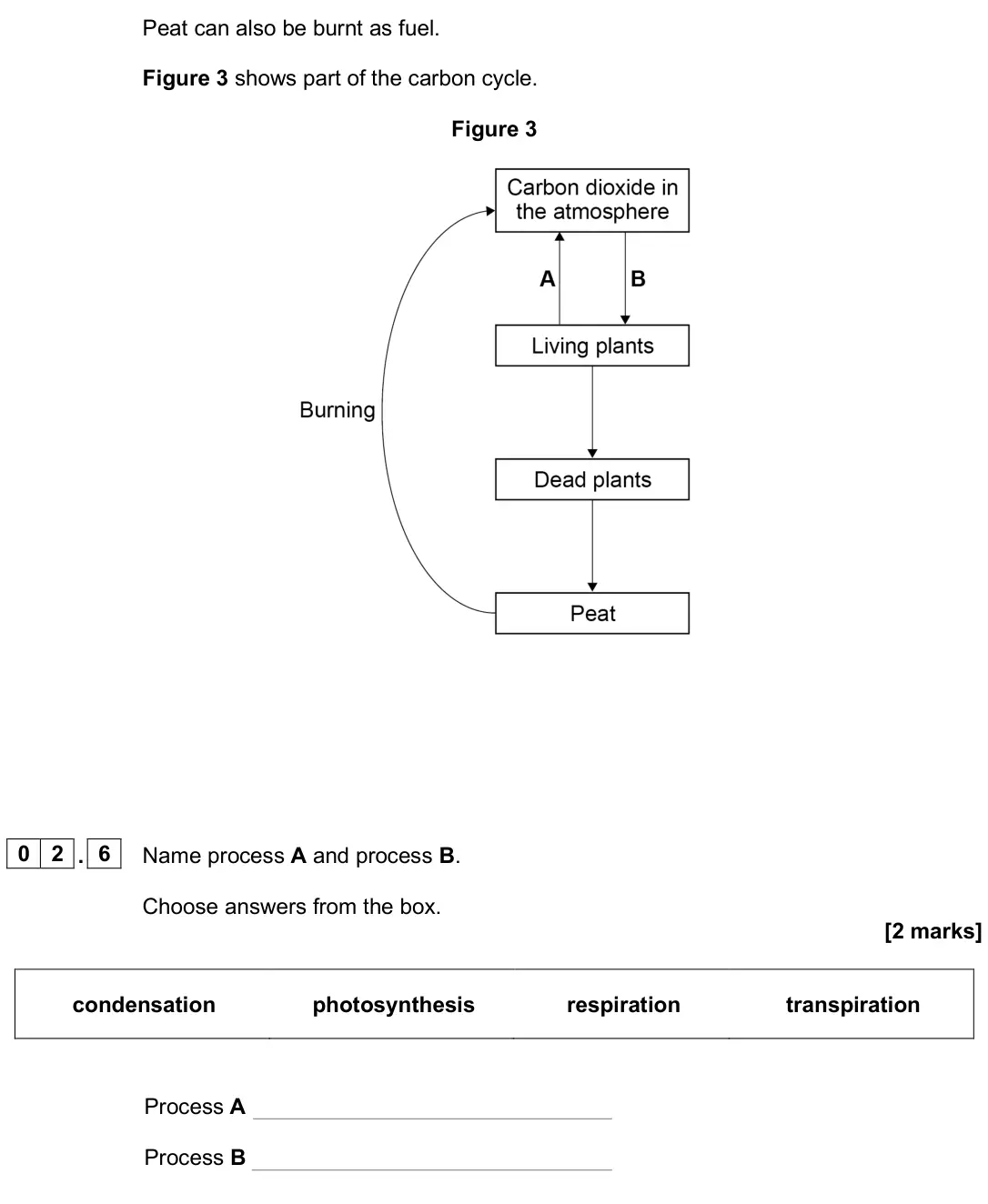
Q02.7
The whole paper ↗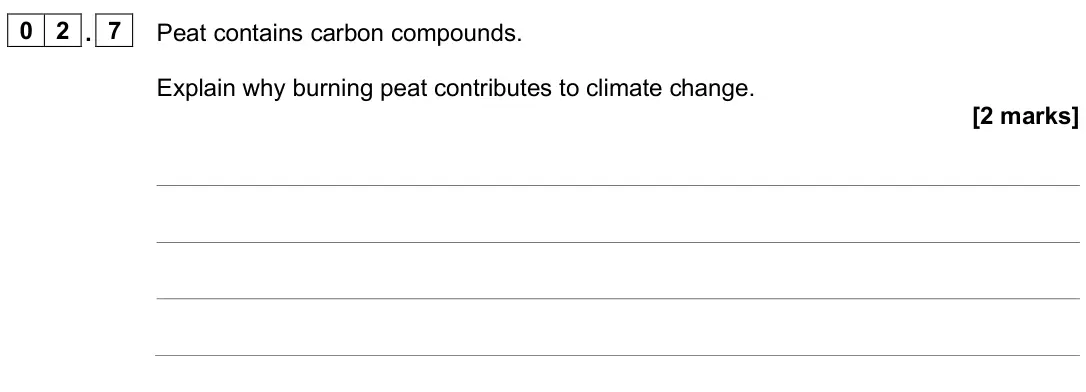
Q02.8
The whole paper ↗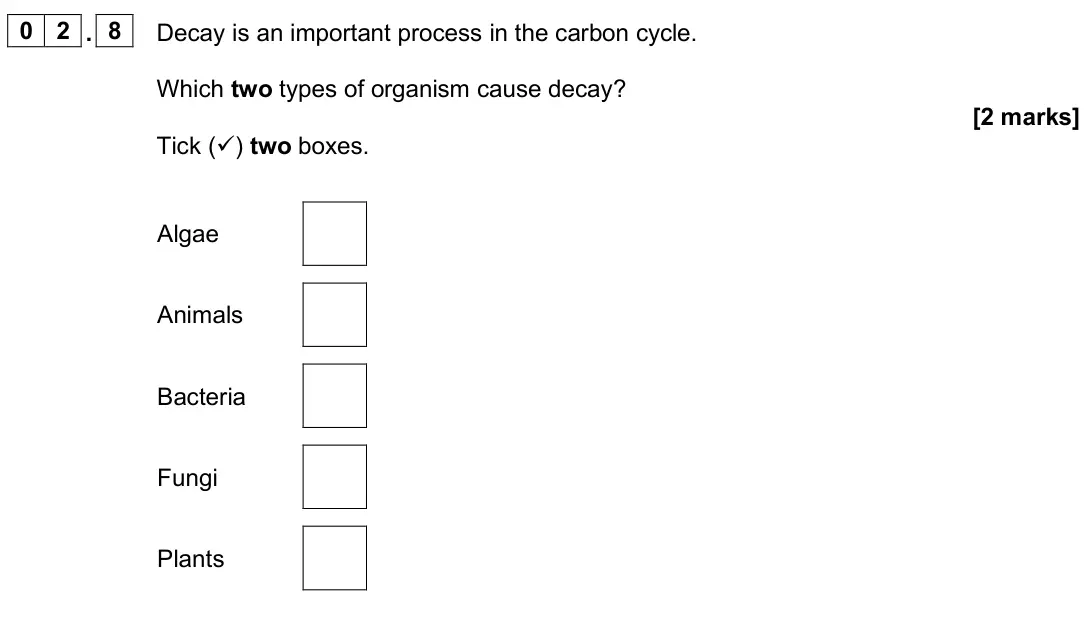
Q03.1
The whole paper ↗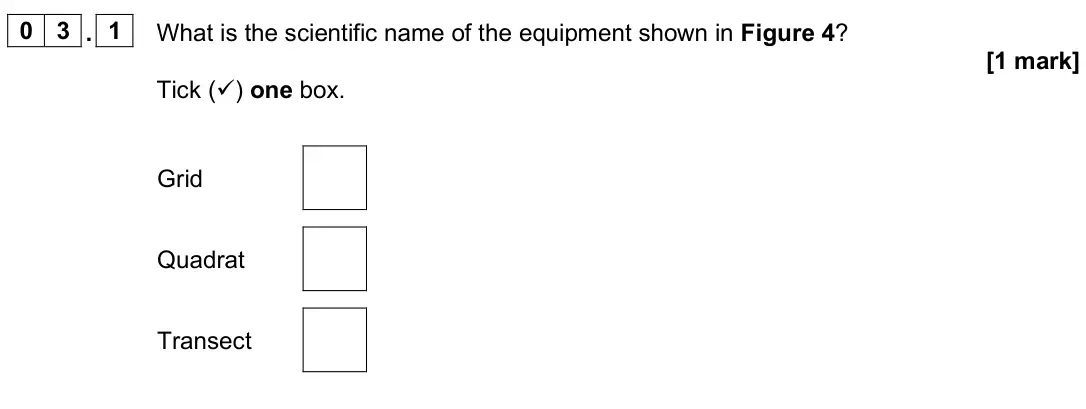
Q03.3
The whole paper ↗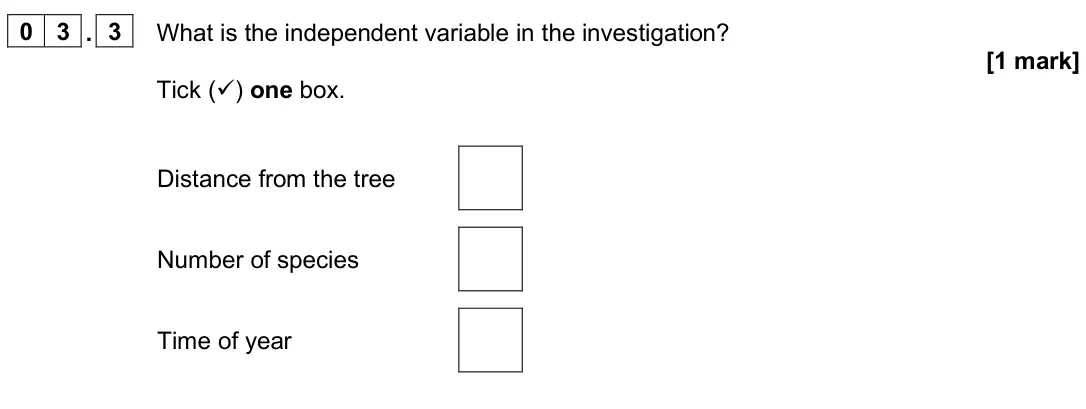
Q03.4
The whole paper ↗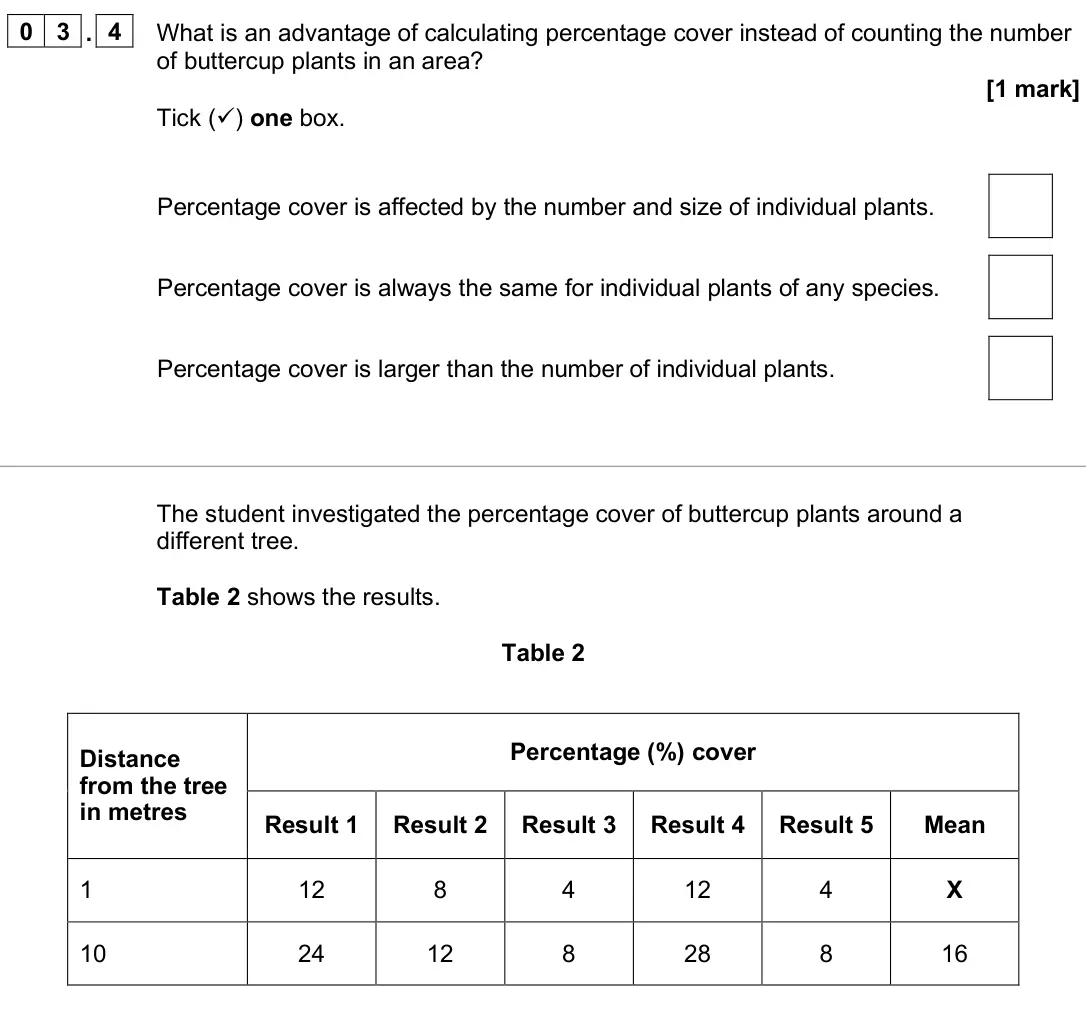
Q03.5
The whole paper ↗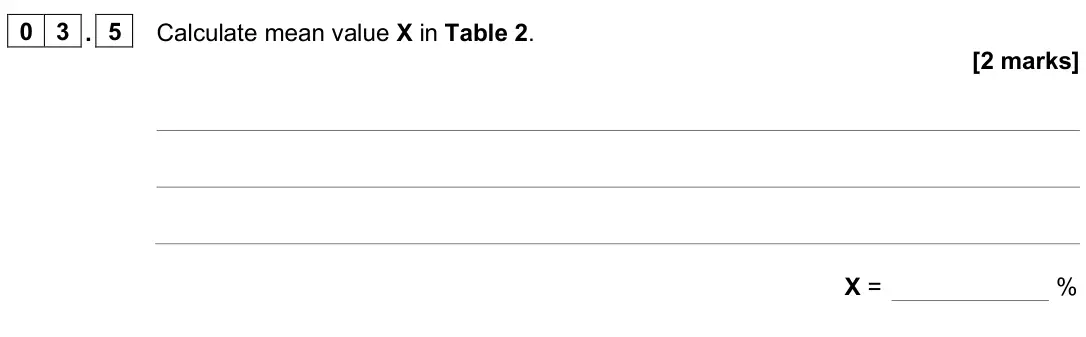
Q03.6
The whole paper ↗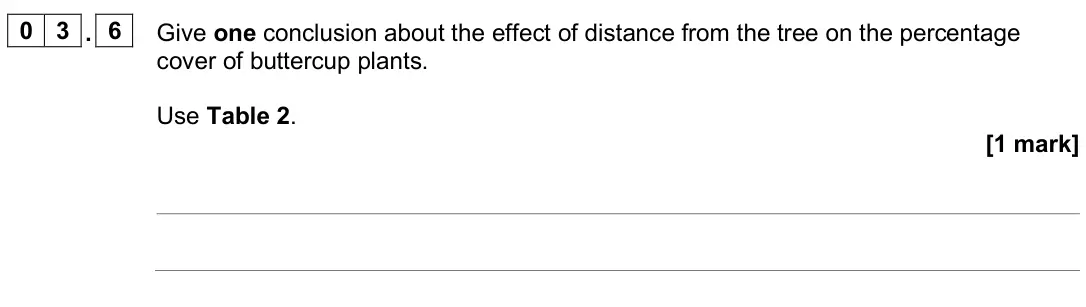
Q03.7
The whole paper ↗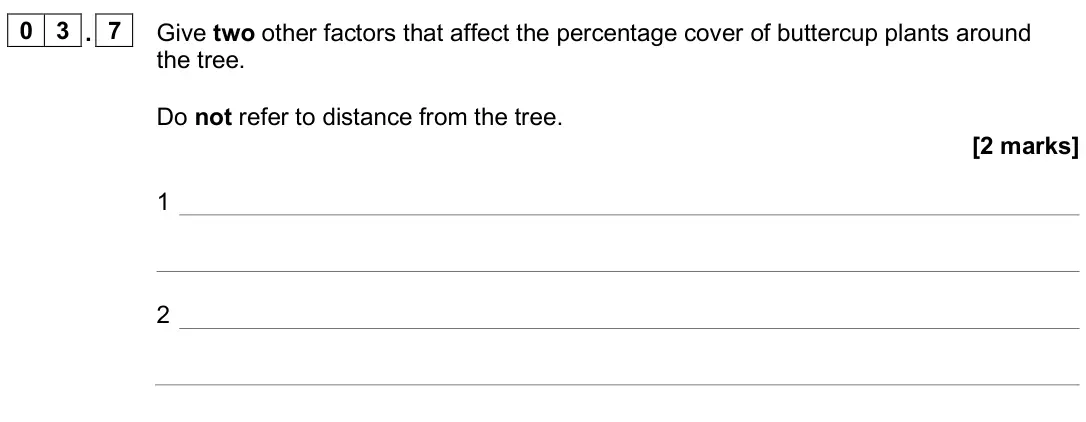
All 83 questions on Organisation of an ecosystem, as a list
- June 2025, Biology Paper 2 Higher, Q03.1 (1 mark): What was the independent variable in this investigation? [1 mark]
- June 2025, Biology Paper 2 Higher, Q03.2 (3 marks): Students counted every small square in the quadrat that was at least half covered by buttercup plants. Determine the percentage cover of buttercup plants 10 met
- June 2025, Biology Paper 2 Higher, Q03.3 (2 marks): The students placed: • several quadrats 1 metre away from the tree • several quadrats 10 metres away from the tree. Give two factors the students should conside
- June 2025, Biology Paper 2 Higher, Q03.4 (4 marks): Figure 3 shows two different quadrats. Figure 3 Explain two advantages of using quadrat B instead of quadrat A in the investigation. You should include calculat
- June 2025, Biology Paper 2 Higher, Q03.5 (2 marks): What are two advantages of using a point quadrat compared with using a square quadrat? [2 marks] Tick () two boxes. With a point quadrat, a plant that is small
- June 2025, Biology Paper 2 Higher, Q03.6 (3 marks): The percentage cover of buttercup plants can be estimated using the equation: percentage cover = number of times a pin touched a buttercup plant total number of
- June 2025, Biology Paper 2 Higher, Q04.3 (2 marks): Increasing the number of bees and other insects increases crop yield. Suggest two reasons why increasing the number of insects can increase crop yield. [2 marks
- June 2025, Biology Paper 2 Higher, Q04.5 (2 marks): Some farmland contains areas of peat. When peat is dug up: • the oxygen levels in the peat increase • the peat decays quickly. Explain why increasing the level
- June 2025, Biology Paper 2 Foundation, Q02.2 (1 mark): Figure 1 shows a food chain for a farmer’s field. Figure 1 Which is the secondary consumer in the food chain? [1 mark] Tick () one box. Seeds Mice Owls
- June 2025, Biology Paper 2 Foundation, Q02.3 (2 marks): Bees are insects that live in hives. The bees fly in and out of the hives. Figure 2 shows a crop growing in a field. The farmer has added bee hives to increase
- June 2025, Biology Paper 2 Foundation, Q02.6 (2 marks): Name process A and process B. Choose answers from the box. [2 marks] condensation photosynthesis respiration transpiration Process A Process B
- June 2025, Biology Paper 2 Foundation, Q02.7 (2 marks): Peat contains carbon compounds. Explain why burning peat contributes to climate change. [2 marks]
- June 2025, Biology Paper 2 Foundation, Q02.8 (2 marks): Decay is an important process in the carbon cycle. Which two types of organism cause decay? [2 marks] Tick () two boxes. Algae Animals Bacteria Fungi Plants
- June 2025, Biology Paper 2 Foundation, Q03.1 (1 mark): What is the scientific name of the equipment shown in Figure 4? [1 mark] Tick () one box. Grid Quadrat Transect
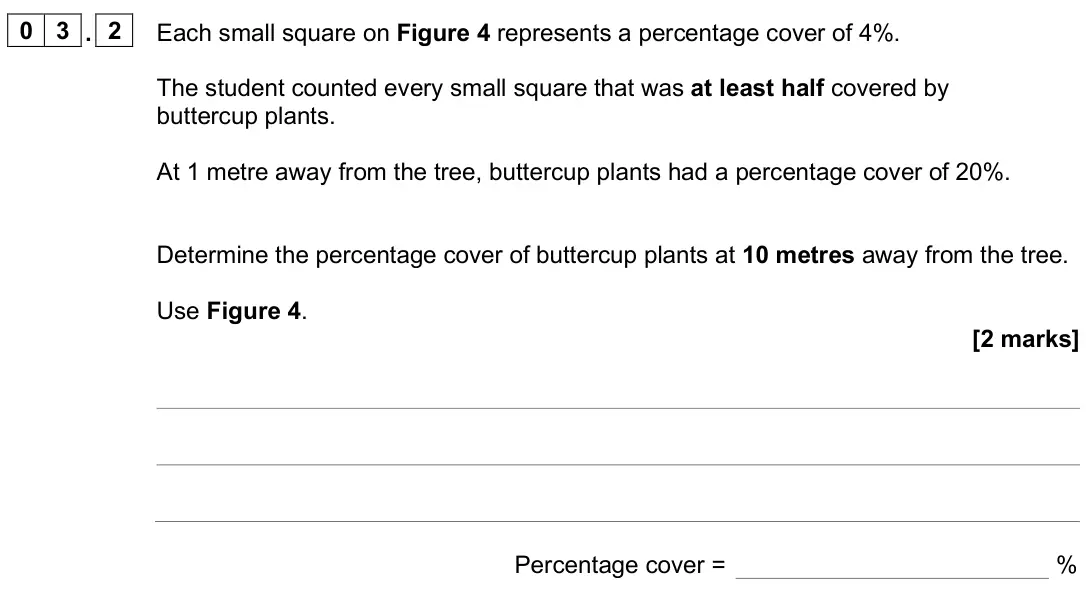
- June 2025, Biology Paper 2 Foundation, Q03.2 (2 marks): Each small square on Figure 4 represents a percentage cover of 4%. The student counted every small square that was at least half covered by buttercup plants. At
- June 2025, Biology Paper 2 Foundation, Q03.3 (1 mark): What is the independent variable in the investigation? [1 mark] Tick () one box. Distance from the tree Number of species Time of year
- June 2025, Biology Paper 2 Foundation, Q03.4 (1 mark): What is an advantage of calculating percentage cover instead of counting the number of buttercup plants in an area? [1 mark] Tick () one box. Percentage cover
- June 2025, Biology Paper 2 Foundation, Q03.5 (2 marks): Calculate mean value X in Table 2. [2 marks] X = %
- June 2025, Biology Paper 2 Foundation, Q03.6 (1 mark): Give one conclusion about the effect of distance from the tree on the percentage cover of buttercup plants. Use Table 2. [1 mark]
- June 2025, Biology Paper 2 Foundation, Q03.7 (2 marks): Give two other factors that affect the percentage cover of buttercup plants around the tree. Do not refer to distance from the tree. [2 marks] 1 2
- June 2025, Biology Paper 2 Foundation, Q03.8 (2 marks): Table 2 shows the results of the investigation. Suggest two improvements to the investigation. [2 marks] 1 2
- June 2024, Biology Paper 2 Higher, Q01.1 (1 mark): Limpets eat algae. Limpets are prey for crabs. Give the food chain for algae, crabs and limpets. [1 mark]
- June 2024, Biology Paper 2 Higher, Q01.2 (2 marks): Calculate the area of the quadrat in m2. [2 marks] Area of quadrat = m2
- June 2024, Biology Paper 2 Higher, Q01.3 (2 marks): The total area of the sea shore was 1800 m2. The students sampled 2% of the total area of the sea shore. Calculate the number of times the students needed to us
- June 2024, Biology Paper 2 Higher, Q01.4 (2 marks): Explain why throwing a quadrat is not a random method to estimate population size. Do not refer to safety in your answer. [2 marks]
- June 2024, Biology Paper 2 Higher, Q01.5 (2 marks): Describe one method the students could use to plan where the quadrat should be randomly placed each time. [2 marks]
- June 2024, Biology Paper 2 Higher, Q01.6 (1 mark): Suggest one hazard the students should be aware of when collecting data on the sea shore. Do not refer to throwing quadrats in your answer. [1 mark]
- June 2024, Biology Paper 2 Higher, Q05.2 (2 marks): Otters are an important species for the stability of the river community. Describe two ways animal species may be important for the stability of a whole communi
- June 2024, Biology Paper 2 Foundation, Q05.1 (1 mark): Limpets eat algae. Limpets are prey for crabs. Give the food chain for algae, crabs and limpets. [1 mark]
- June 2024, Biology Paper 2 Foundation, Q05.2 (2 marks): Calculate the area of the quadrat in m2. [2 marks] Area of quadrat = m2
- June 2024, Biology Paper 2 Foundation, Q05.3 (2 marks): The total area of the sea shore was 1800 m2. The students sampled 2% of the total area of the sea shore. Calculate the number of times the students needed to us
- June 2024, Biology Paper 2 Foundation, Q05.4 (2 marks): Explain why throwing a quadrat is not a random method to estimate population size. Do not refer to safety in your answer. [2 marks]
- June 2024, Biology Paper 2 Foundation, Q05.5 (2 marks): Describe one method the students could use to plan where the quadrat should be randomly placed each time. [2 marks]
- June 2024, Biology Paper 2 Foundation, Q05.6 (1 mark): Suggest one hazard the students should be aware of when collecting data on the sea shore. Do not refer to throwing quadrats in your answer. [1 mark]
- June 2023, Biology Paper 2 Higher, Q03.1 (4 marks): Describe a method to investigate how the distance from the river affects the number of different plant species in the field. You should explain how to use a tra
- June 2023, Biology Paper 2 Higher, Q03.2 (1 mark): Students used a valid method to investigate how the distance from the river affects the number of different plant species in the field. Figure 2 shows the resul
- June 2023, Biology Paper 2 Foundation, Q01.2 (1 mark): Peat can decay. Name one type of organism that causes decay. [1 mark]
- June 2023, Biology Paper 2 Foundation, Q01.3 (2 marks): Complete the sentences. Choose answers from the box. [2 marks] carbon dioxide nitrogen oxygen sulfur dioxide The organisms that cause decay respire. The gas use
- June 2023, Biology Paper 2 Foundation, Q03.1 (1 mark): A, B and C show the positions of three transects. Where should the student position another transect for this investigation? Draw the extra transect line on Fig
- June 2023, Biology Paper 2 Foundation, Q03.2 (1 mark): The student recorded the number of different plant species at 1 m intervals along each transect. Which piece of equipment should be used at 1 m intervals along
- June 2023, Biology Paper 2 Foundation, Q03.3 (1 mark): What was the mean number of different plant species 5 m from the river? [1 mark] Mean =
- June 2023, Biology Paper 2 Foundation, Q03.4 (1 mark): What is the effect of increasing distance from the river on the mean number of different plant species? [1 mark]
- June 2023, Biology Paper 2 Foundation, Q03.5 (1 mark): The minimum and maximum values on Figure 4 show the range of results at each distance from the river. Why is it useful to know the range of results? [1 mark] Ti
- June 2023, Biology Paper 2 Foundation, Q03.7 (2 marks): Explain why a decrease in the number of plants across the world increases global warming. [2 marks]
- June 2023, Biology Paper 2 Foundation, Q04.2 (1 mark): Which food chain represents the salmon, sea lice and soya plants? [1 mark] Tick () one box. salmon → sea lice → soya plants sea lice → soya plants → salmon soy
- June 2023, Biology Paper 2 Foundation, Q04.3 (1 mark): What do the arrows in a food chain represent? [1 mark] Tick () one box. The different numbers in the food chain The predators in the food chain The producers i
- June 2022, Biology Paper 2 Higher, Q01.2 (5 marks): Name the processes 1 to 5 shown on Figure 1. [5 marks] 1 2 3 4 5
- June 2022, Biology Paper 2 Higher, Q01.3 (3 marks): In 2007 the population of the world was 6 000 000 000 A study found that 4.5% of the population had severe water shortage. Calculate how many people had severe
- June 2022, Biology Paper 2 Higher, Q01.4 (2 marks): Why do more people have severe water shortage now than in 2007? [2 marks] Tick () two boxes. Climate change has increased the area of deserts. Each person drin
- June 2022, Biology Paper 2 Higher, Q01.5 (4 marks): Microorganisms in the soil recycle carbon from the leaves so that the carbon is used for new plant growth. Explain how. [4 marks]
- June 2022, Biology Paper 2 Higher, Q01.6 (1 mark): What is one benefit of fallen leaves for living plants? [1 mark] Tick () one box. Energy is released for living plants. Insect pests in the soil are killed. Ni
- June 2022, Biology Paper 2 Higher, Q03.2 (6 marks): Describe a method to investigate if the amount of water in the soil affects the number of buttercups in the field. [6 marks]
- June 2022, Biology Paper 2 Higher, Q04.1 (2 marks): Give two variables the scientists should have controlled in this investigation. [2 marks] 1 2
- June 2022, Biology Paper 2 Higher, Q04.2 (4 marks): Complete Figure 3. You should: • label the y-axis • use a suitable scale for the y-axis • plot the data from Table 1 • draw a line of best fit. [4 marks] Figure
- June 2022, Biology Paper 2 Foundation, Q02.1 (4 marks): Describe how a quadrat can be used to measure the size of the buttercup population on the wet soil area. [4 marks]
- June 2022, Biology Paper 2 Foundation, Q02.5 (1 mark): Calculate the area of the quadrat. [1 mark] Area of the quadrat = m2
- June 2022, Biology Paper 2 Foundation, Q05.2 (5 marks): Name the processes 1 to 5 shown on Figure 7. [5 marks] 1 2 3 4 5
- June 2022, Biology Paper 2 Foundation, Q05.3 (3 marks): In 2007 the population of the world was 6 000 000 000 A study found that 4.5% of the population had severe water shortage. Calculate how many people had severe
- June 2022, Biology Paper 2 Foundation, Q05.4 (2 marks): Why do more people have severe water shortage now than in 2007? [2 marks] Tick () two boxes. Climate change has increased the area of deserts. Each person drin
- June 2022, Biology Paper 2 Foundation, Q05.5 (4 marks): Microorganisms in the soil recycle carbon from the leaves so that the carbon is used for new plant growth. Explain how. [4 marks]
- June 2022, Biology Paper 2 Foundation, Q05.6 (1 mark): What is one benefit of fallen leaves for living plants? [1 mark] Tick () one box. Energy is released for living plants. Insect pests in the soil are killed. Ni
- November 2021, Biology Paper 2 Foundation, Q03.1 (2 marks): Give the food chain for the birds, cats and nuts. [2 marks]
- November 2021, Biology Paper 2 Foundation, Q03.2 (1 mark): Which organism in the food chain you gave in Question 03.1 is the primary consumer? [1 mark]
- November 2021, Biology Paper 2 Foundation, Q05.3 (2 marks): Meat is produced for humans to eat. Give two ways the production of meat releases carbon dioxide. [2 marks] 1 2
- November 2020, Biology Paper 2 Foundation, Q03.1 (1 mark): Plants take in nitrate ions dissolved in water. Which part of a plant takes in nitrate ions? [1 mark]
- November 2020, Biology Paper 2 Foundation, Q03.2 (2 marks): Name two chemicals that are cycled between plants, the soil and the air. Do not refer to nitrogen or nitrates in your answer. [2 marks] 1 2
- November 2020, Biology Paper 2 Foundation, Q03.3 (6 marks): All the chemicals in a plant are recycled when the plant dies. Describe how: • microorganisms recycle chemicals • the chemicals are used again by new plants. [6
- November 2020, Biology Paper 2 Foundation, Q05.2 (1 mark): Suggest one improvement the students could make to their method. [1 mark]
- November 2020, Biology Paper 2 Foundation, Q05.3 (2 marks): The students made this prediction: ‘There will be more invertebrate species living in the area where there are trees.’ Explain why the students’ prediction may
- November 2020, Biology Paper 2 Foundation, Q05.4 (1 mark): The students decided that one result was anomalous. Draw a ring around the anomalous result in Table 1. [1 mark]
- November 2020, Biology Paper 2 Foundation, Q05.5 (1 mark): How does removing trees affect the number of invertebrate species living among the dead leaves on the ground? Use Table 1. [1 mark]
- June 2019, Biology Paper 2 Higher, Q02.3 (6 marks): Plants take in carbon dioxide from the atmosphere. Figure 2 shows part of the carbon cycle. Figure 2 Describe how carbon from the atmosphere is cycled through l
- June 2019, Biology Paper 2 Higher, Q05.1 (2 marks): Which two improvements would increase the validity of this method? [2 marks] Tick () two boxes. Do not put any quadrats near trees. Repeat for another ten quad
- June 2019, Biology Paper 2 Higher, Q05.2 (5 marks): With an improved method the students calculated the mean number of daisy plants to be 7.65 per quadrat. The students used a quadrat measuring 50 cm × 50 cm Figu
- June 2019, Biology Paper 2 Higher, Q05.3 (6 marks): The students noticed a very uneven distribution of daisy plants in the field. Explain how different biotic factors and abiotic factors could have caused an unev
- June 2018, Biology Paper 2 Higher, Q01.2 (3 marks): Explain why the students thought their hypothesis would be correct. [3 marks]
- June 2018, Biology Paper 2 Higher, Q01.3 (2 marks): The students used two pieces of equipment. Give the scientific name of each piece of equipment. [2 marks] A square frame measuring 0.5 m × 0.5 m An electronic d
- June 2018, Biology Paper 2 Higher, Q01.4 (1 mark): Calculate the total area sampled. [1 mark] Total area sampled = m2
- June 2018, Biology Paper 2 Higher, Q01.5 (1 mark): The whole investigation was done as quickly as possible on the same day. Suggest one reason why. [1 mark]
- June 2018, Biology Paper 2 Higher, Q01.6 (1 mark): Give one way the investigation could be improved. [1 mark] Table 2 shows the results. Table 2 Distance from tree in metres 0 2 4 6 8 10 Percentage cover of gras
- June 2018, Biology Paper 2 Higher, Q01.7 (1 mark): Which plant species in Table 2 will only grow at high light intensity? [1 mark]
- June 2018, Biology Paper 2 Higher, Q01.8 (2 marks): What conclusion can be made about the relationship between light intensity and the total percentage cover of plants? Use data from Table 2 in your answer. [2 ma
- June 2018, Biology Paper 2 Higher, Q01.9 (2 marks): Light intensity might not be the cause of this pattern of plant distribution. Suggest one different factor that may cause these results. Give one reason for you
Questions, mark schemes and examiner’s reports are © AQA, from their published past papers. Plumi isn’t affiliated with any exam board. Want whole papers? Full past papers.
Rather write your answers by hand on iPad? Plumi marks them against the same mark schemes.