 plumi
Chemical measurements, conservation of mass and the quantitative interpretation of chemical equations: AQA GCSE Combined Science questions
Every AQA GCSE Combined Science exam question on 5.3.1 Chemical measurements, conservation of mass and the quantitative interpretation of chemical equations, 2018–2025, with its mark scheme and examiner’s report.
Find questions3,069
Calculations
Q02.2
The whole paper ↗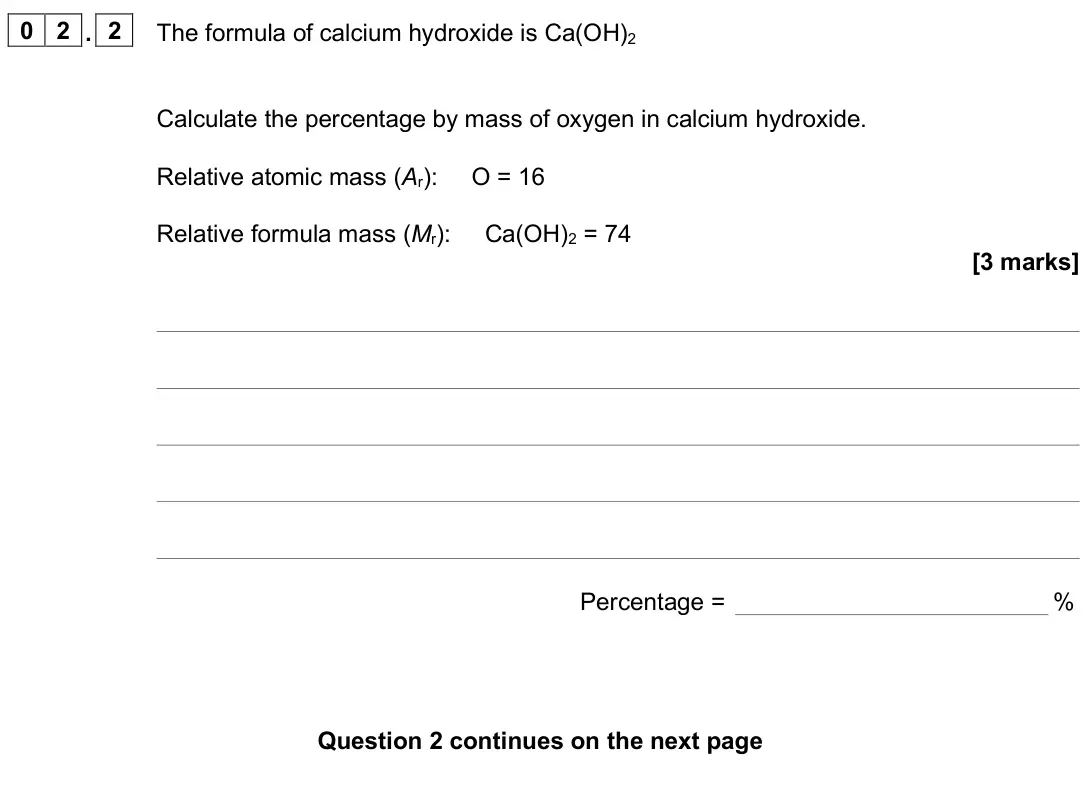
Q06.1
The whole paper ↗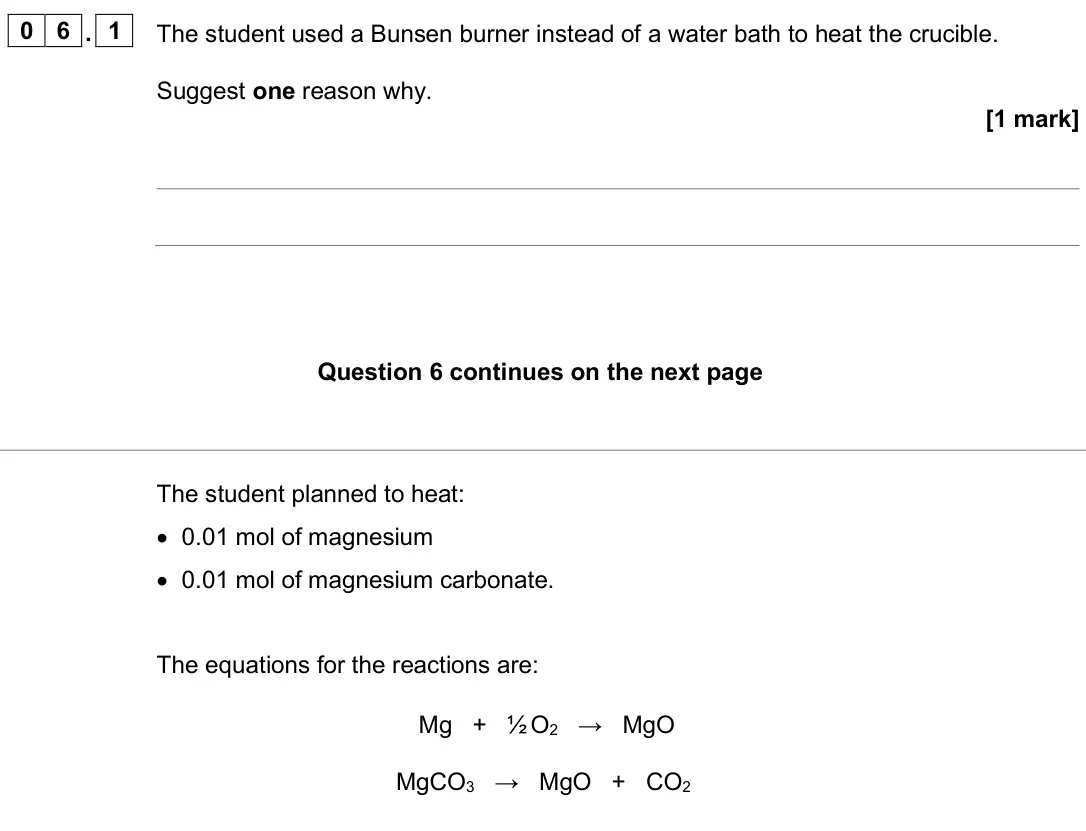
Q06.2
The whole paper ↗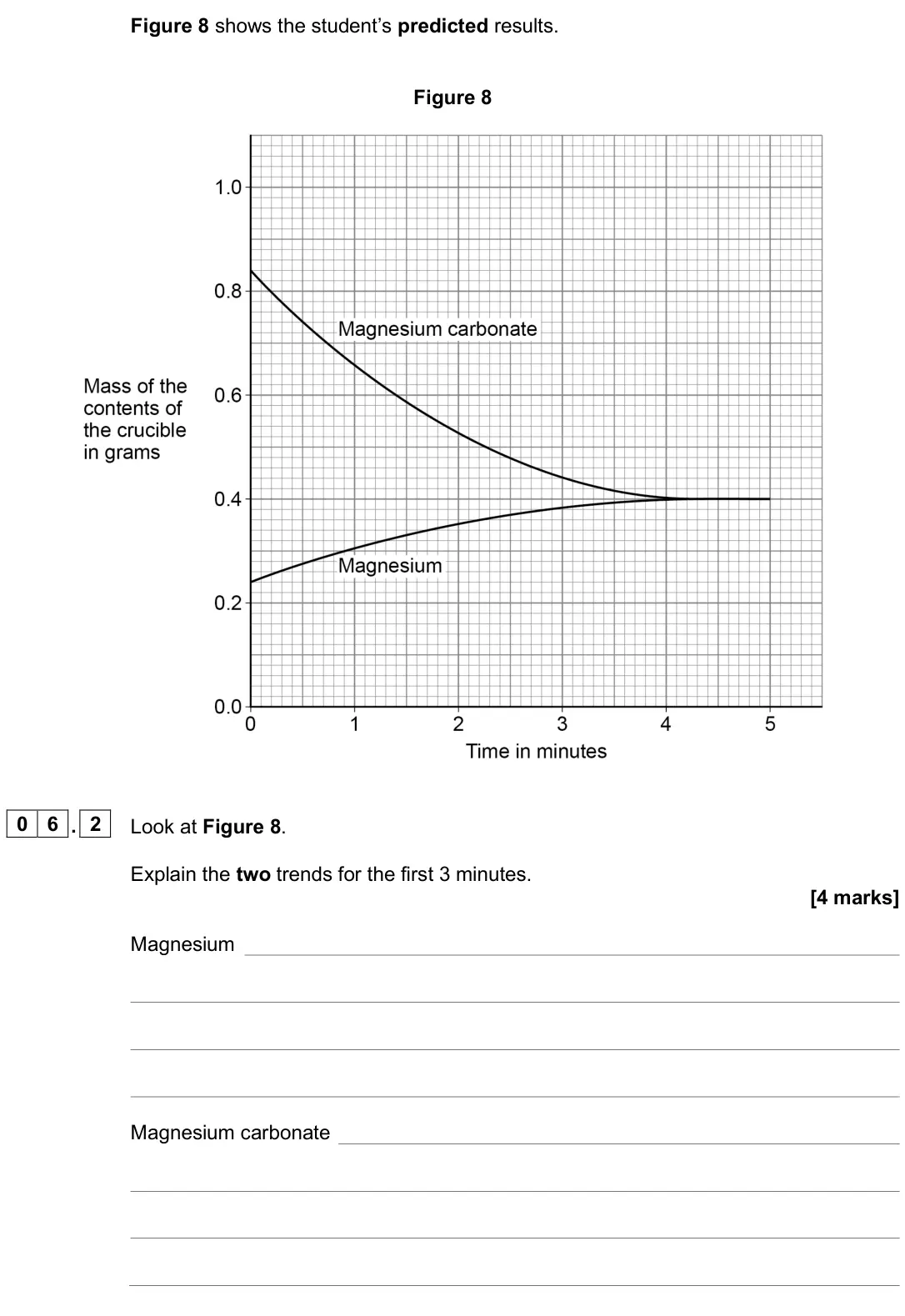
Q06.3
The whole paper ↗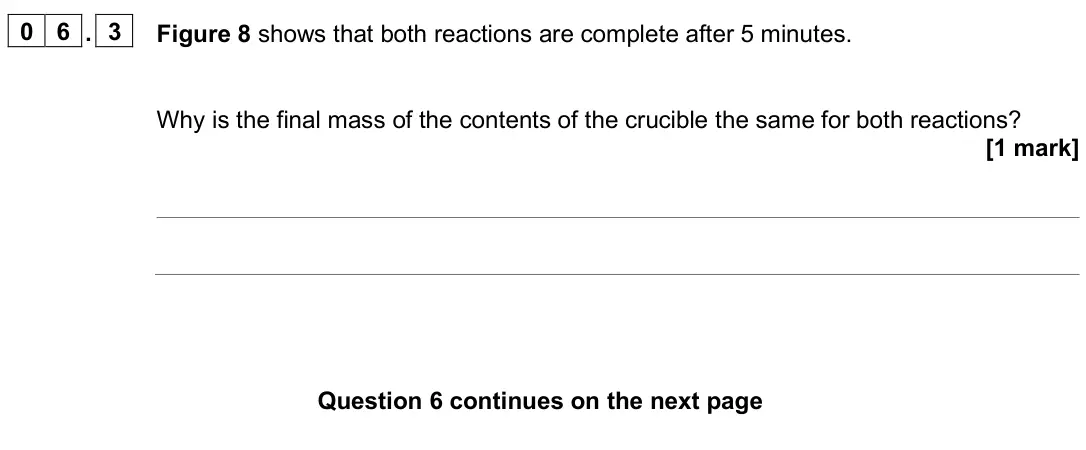
Q06.4
The whole paper ↗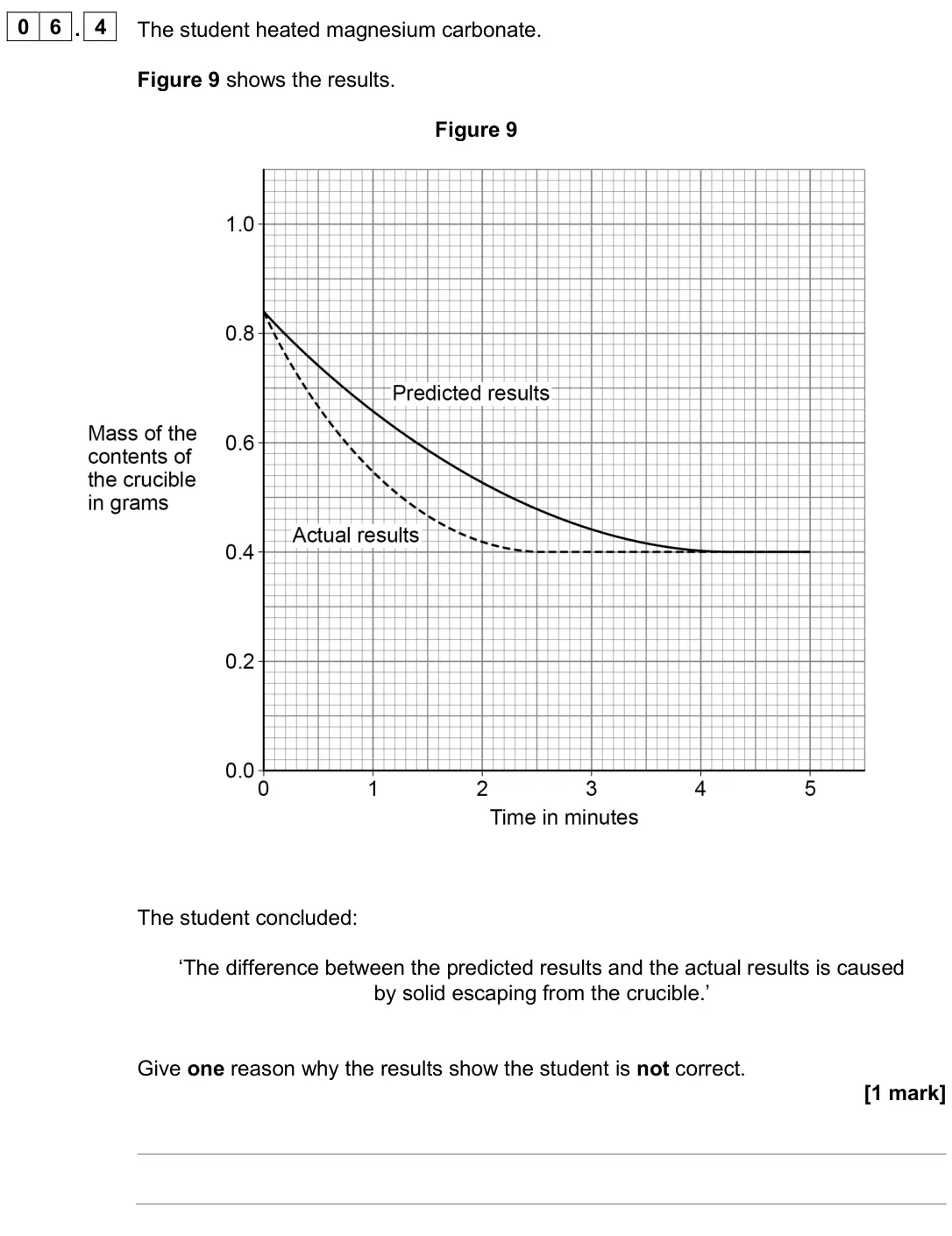
Q06.5
The whole paper ↗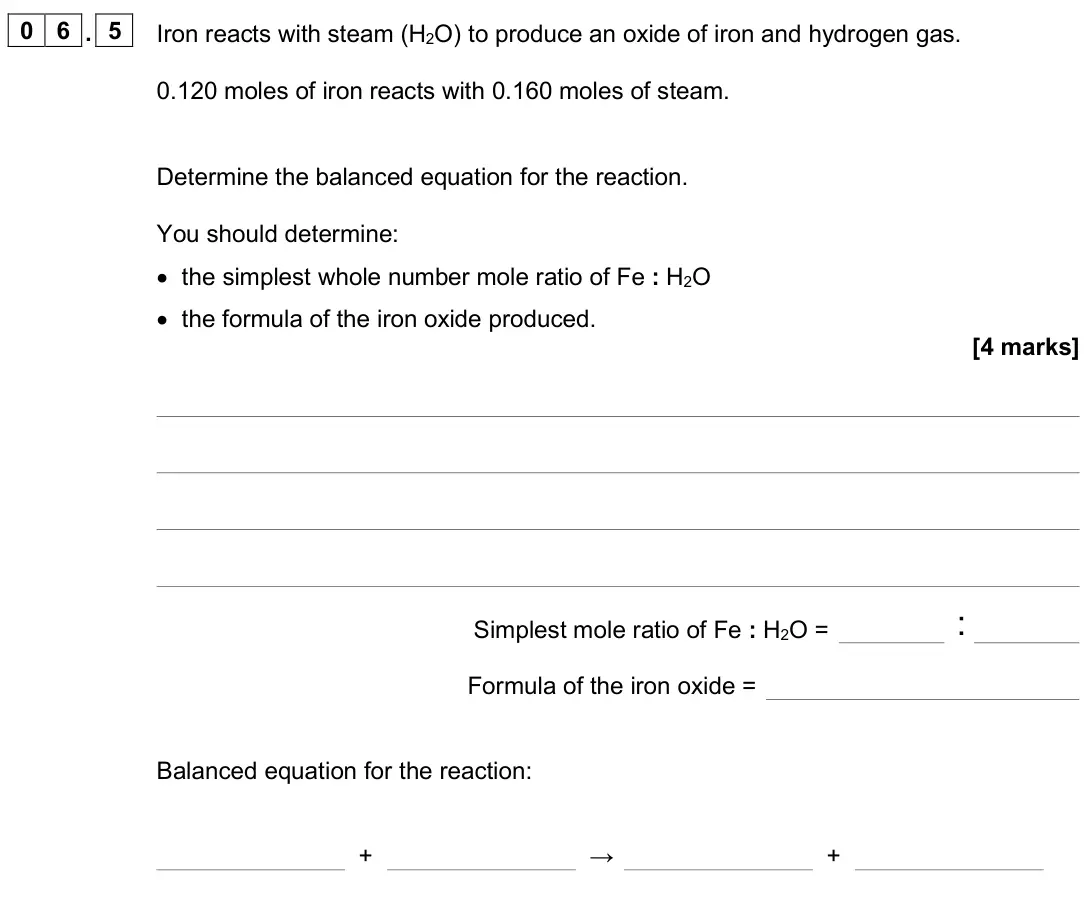
Q02.6
The whole paper ↗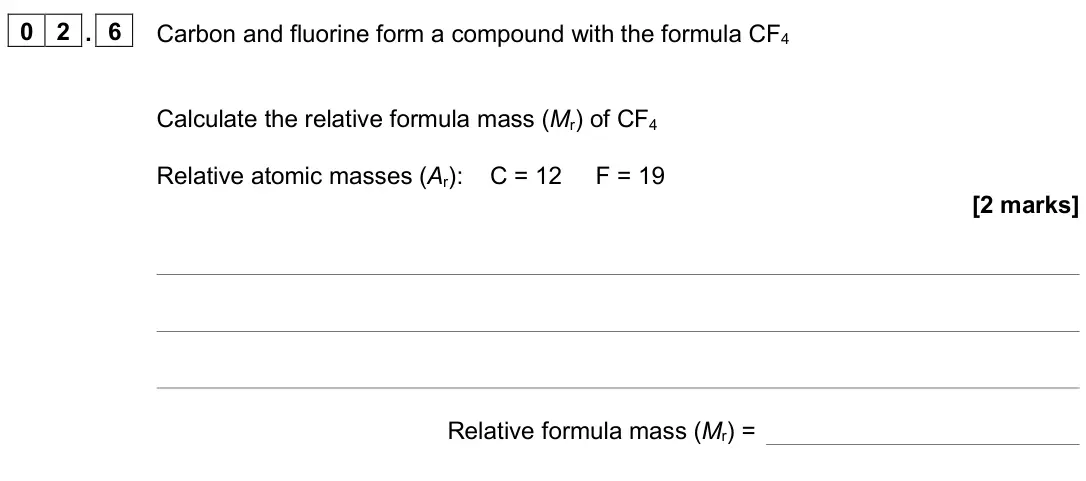
Q03.3
The whole paper ↗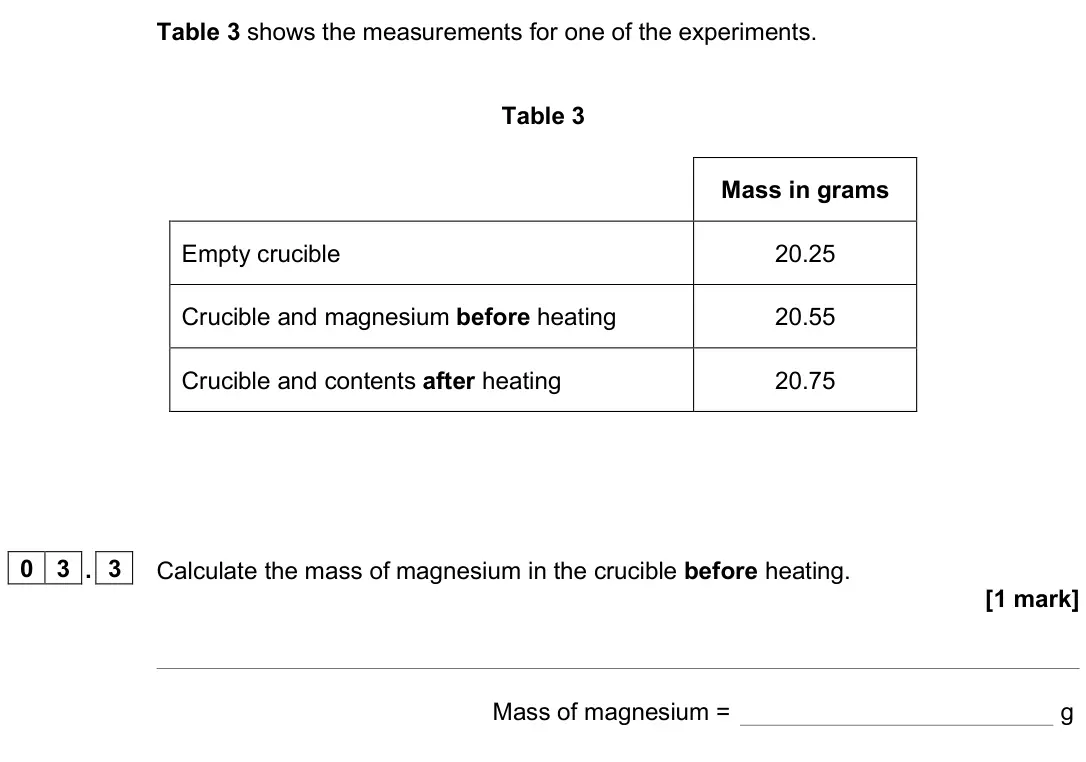
Q03.4
The whole paper ↗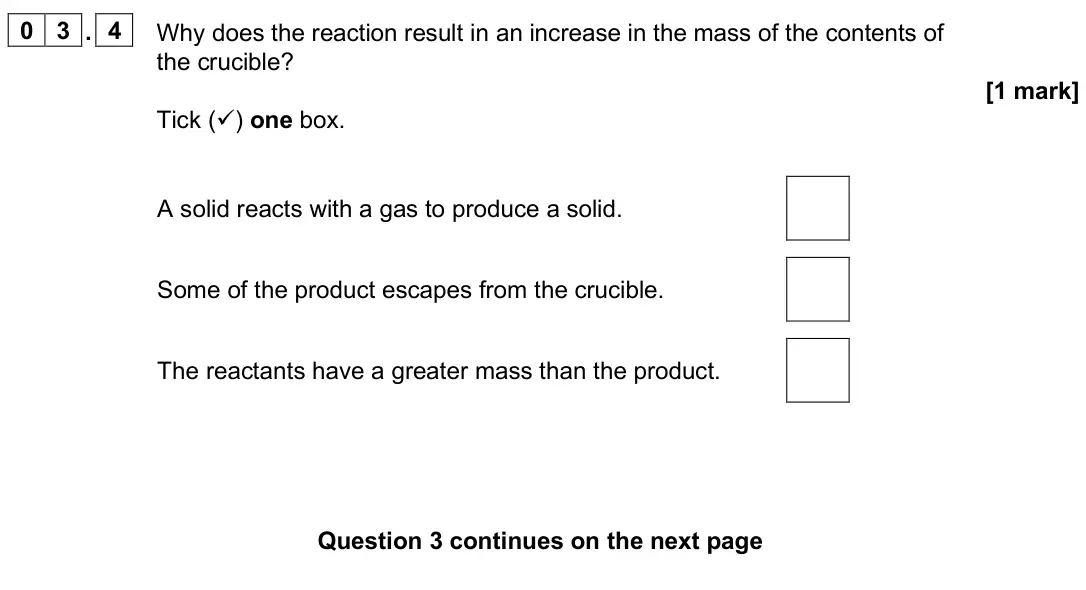
Q03.5
The whole paper ↗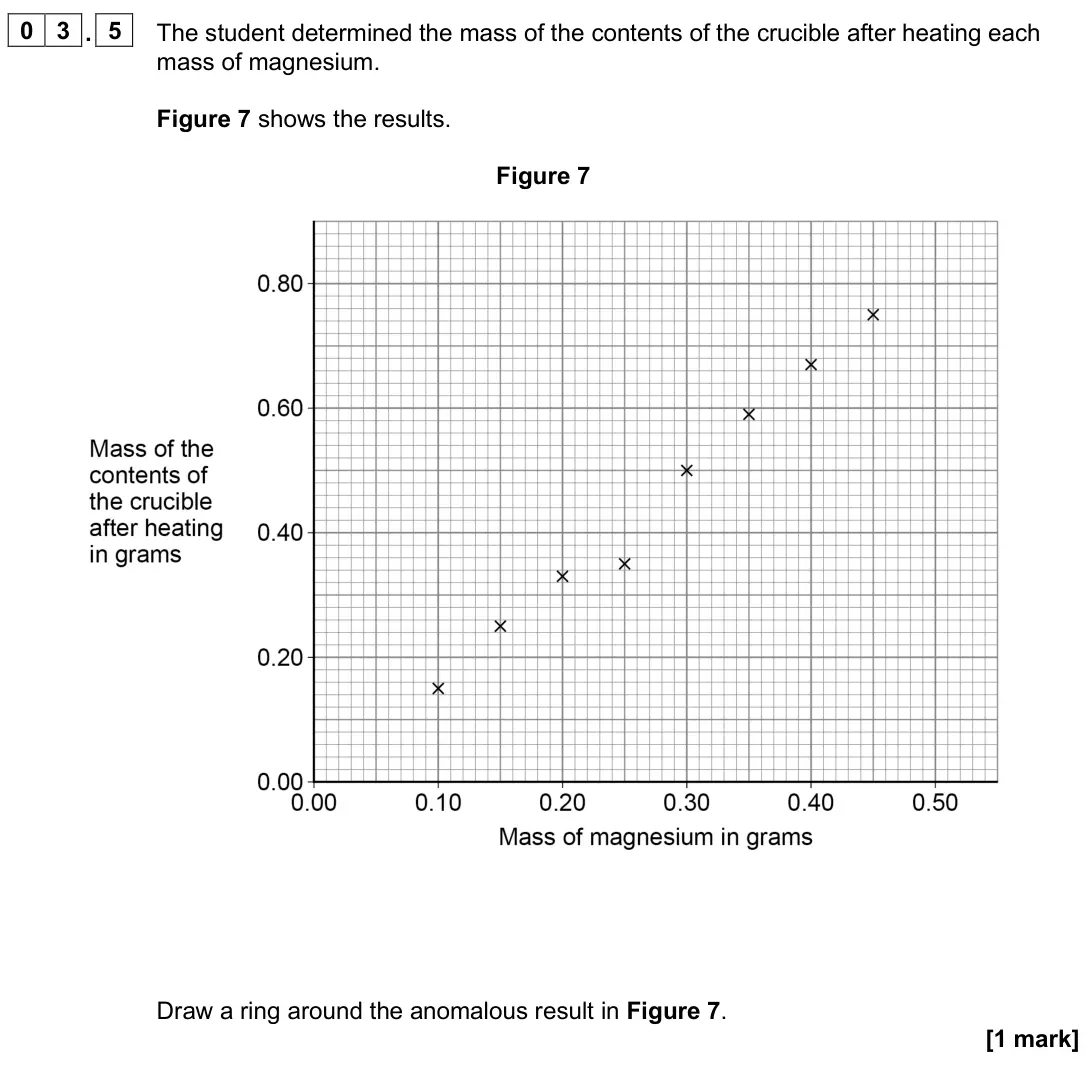
Q03.6
The whole paper ↗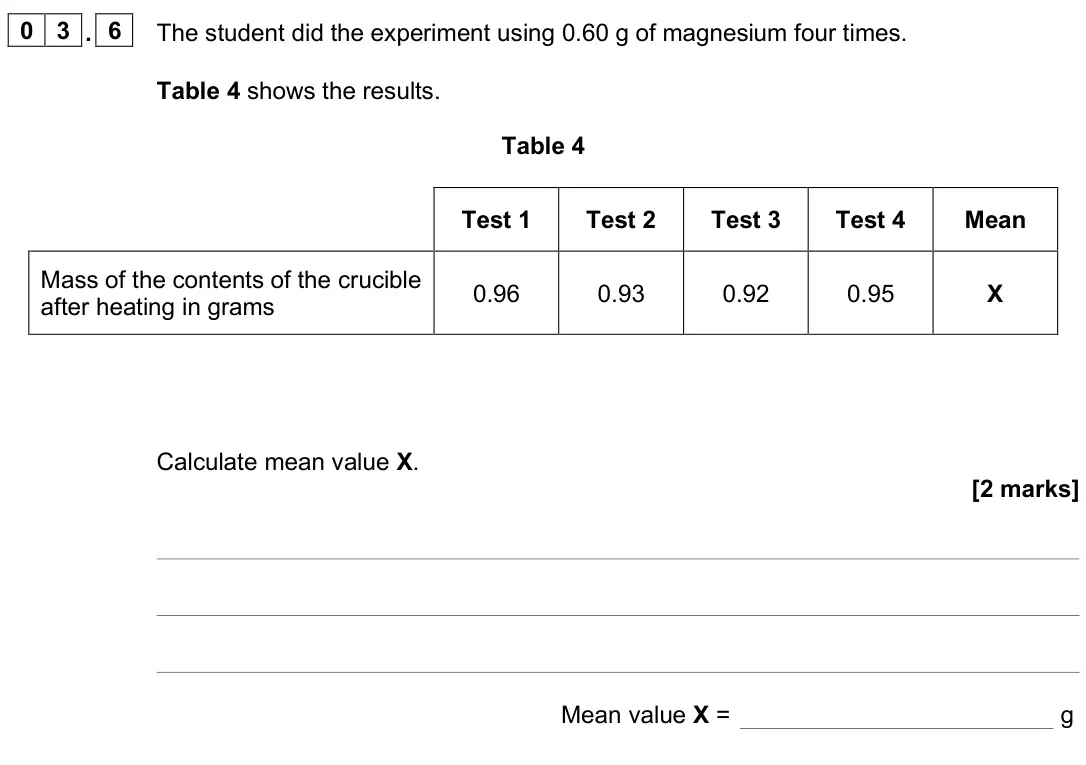
Q03.7
The whole paper ↗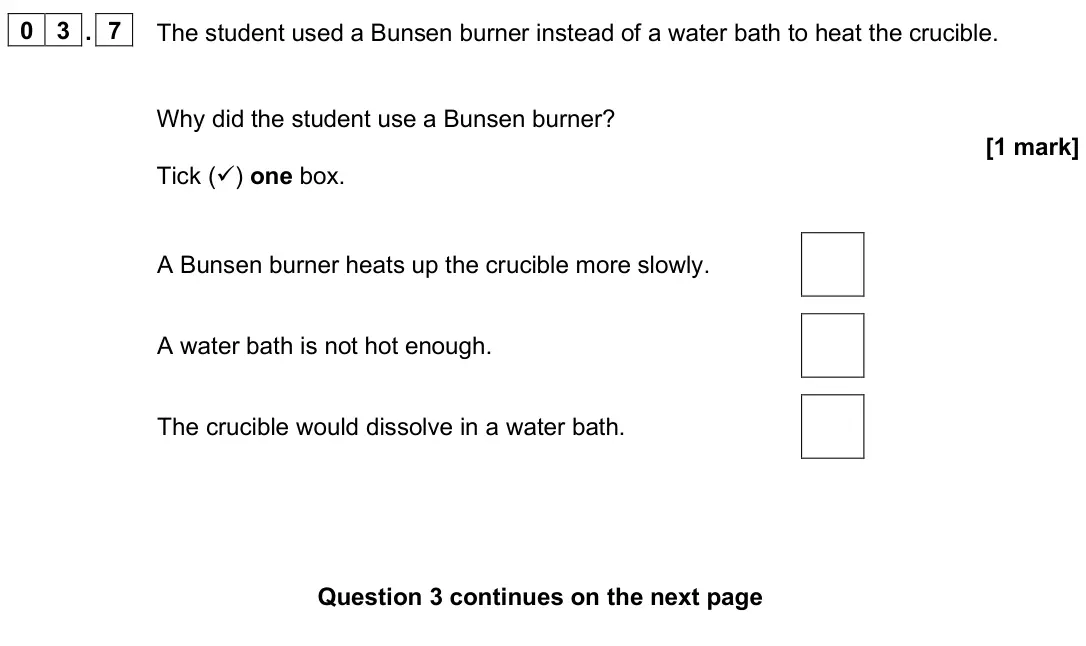
Q03.8
The whole paper ↗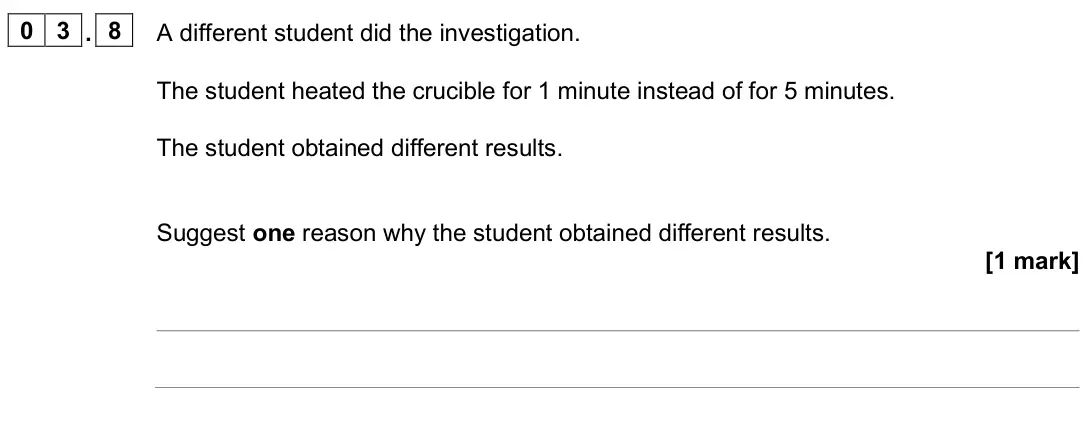
Q07.2
The whole paper ↗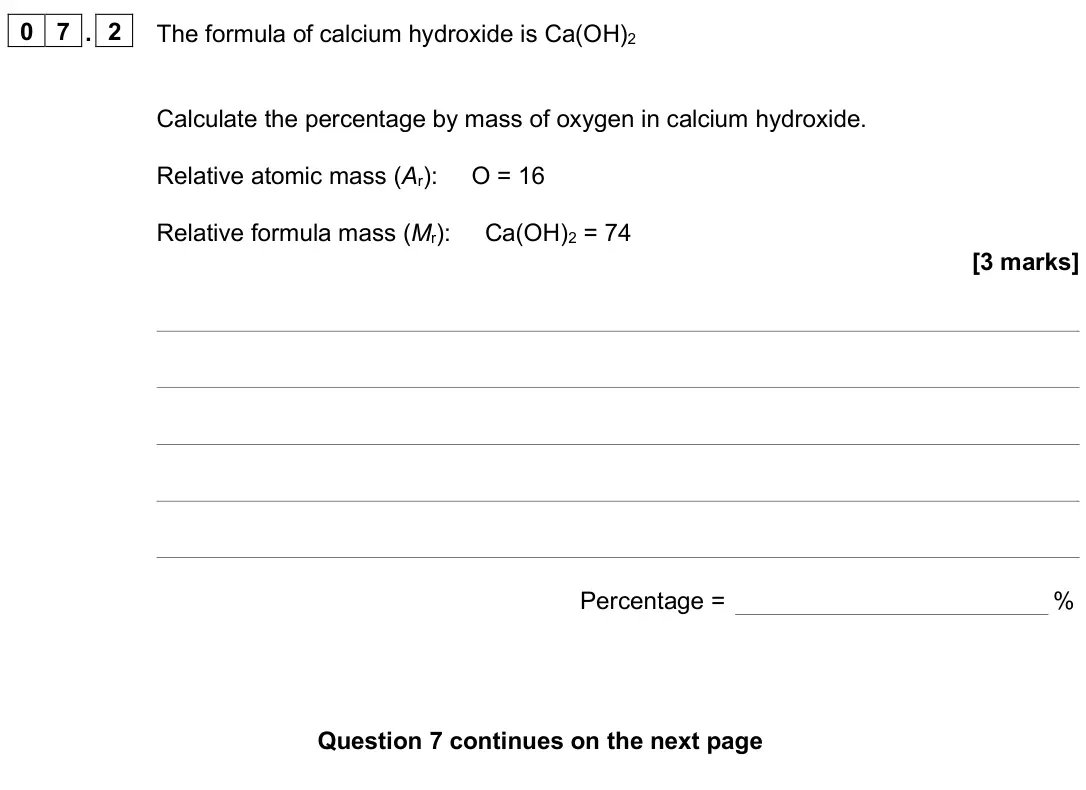
Q04.9
The whole paper ↗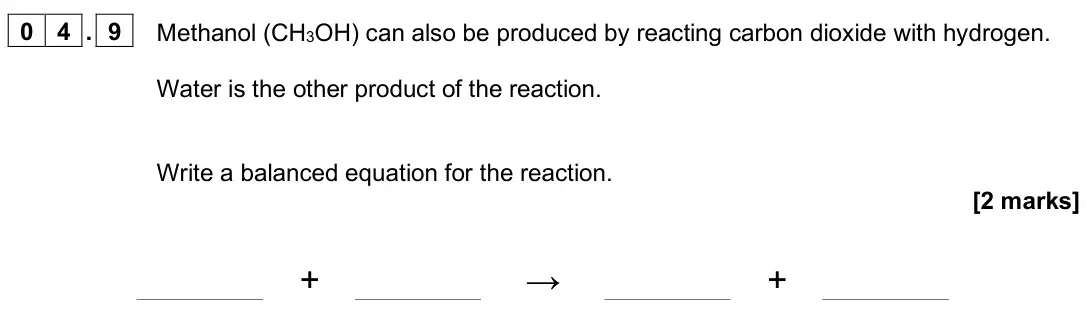
Q02.4
The whole paper ↗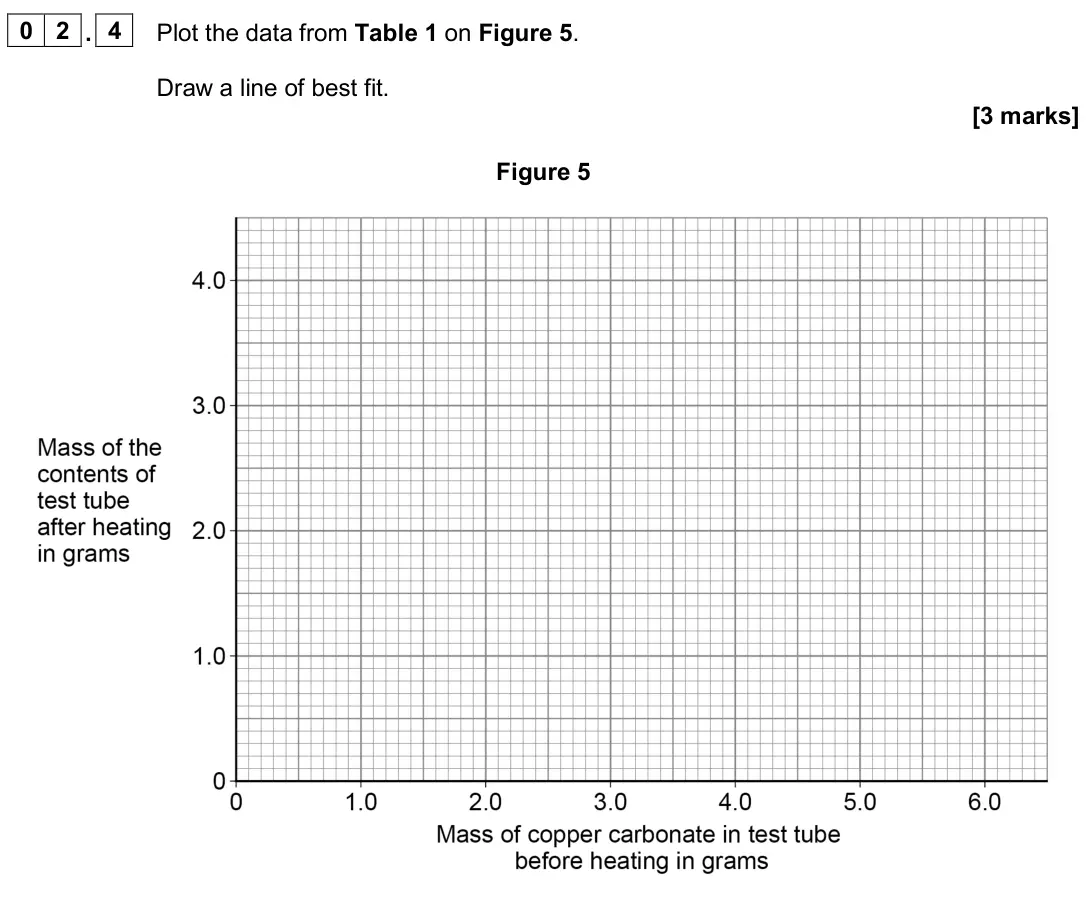
Q02.5
The whole paper ↗
Q05.2
The whole paper ↗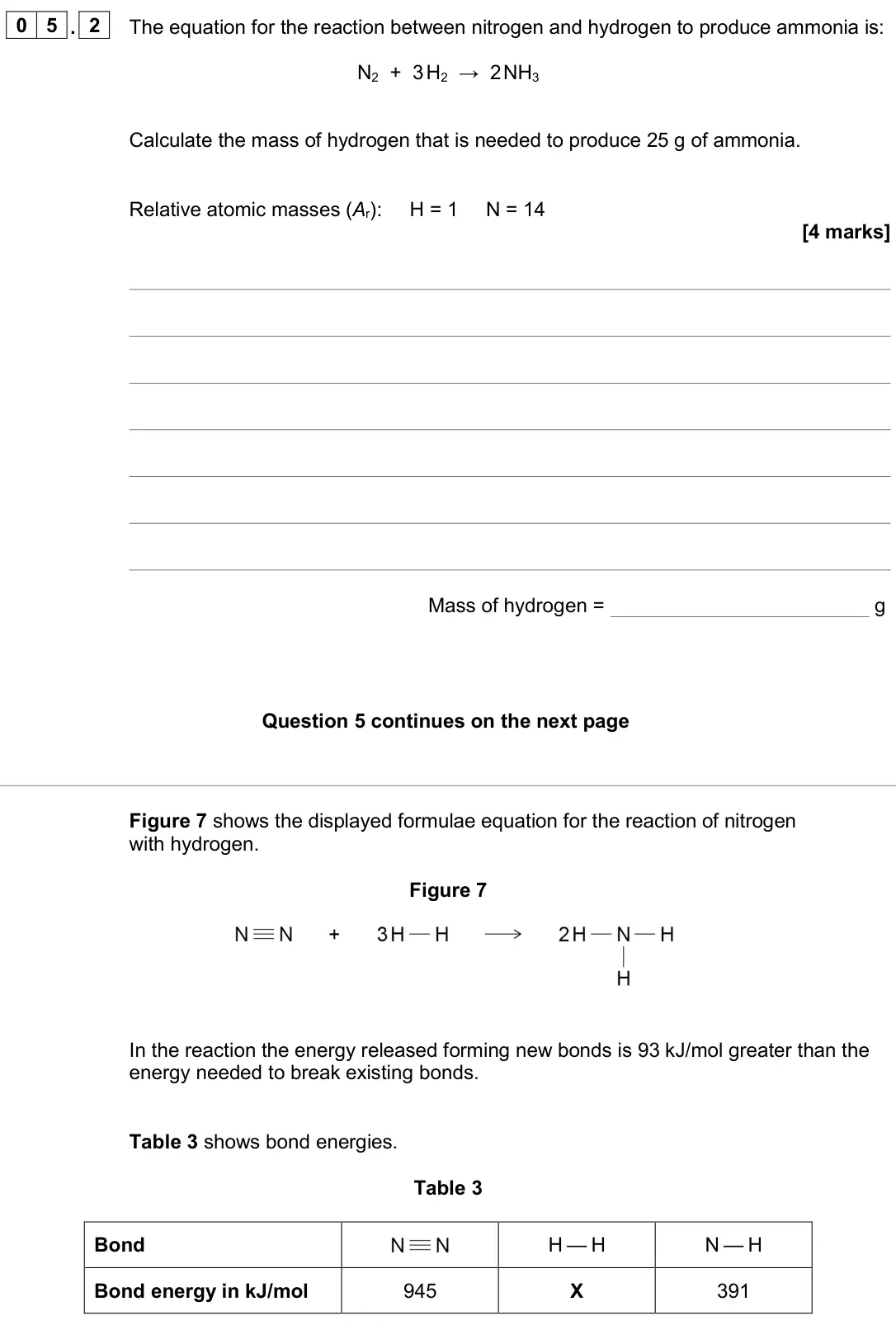
Q03.6
The whole paper ↗
All 77 questions on Chemical measurements, conservation of mass and the quantitative interpretation of chemical equations, as a list
- June 2025, Chemistry Paper 1 Higher, Q02.2 (3 marks): The formula of calcium hydroxide is Ca(OH)2 Calculate the percentage by mass of oxygen in calcium hydroxide. Relative atomic mass (Ar): O = 16 Relative formula
- June 2025, Chemistry Paper 1 Higher, Q06.1 (1 mark): The student used a Bunsen burner instead of a water bath to heat the crucible. Suggest one reason why. [1 mark] The student planned to heat: • 0.01 mol of magne
- June 2025, Chemistry Paper 1 Higher, Q06.2 (4 marks): Look at Figure 8. Explain the two trends for the first 3 minutes. [4 marks] Magnesium Magnesium carbonate
- June 2025, Chemistry Paper 1 Higher, Q06.3 (1 mark): Figure 8 shows that both reactions are complete after 5 minutes. Why is the final mass of the contents of the crucible the same for both reactions? [1 mark]
- June 2025, Chemistry Paper 1 Higher, Q06.4 (1 mark): The student heated magnesium carbonate. Figure 9 shows the results. Figure 9 The student concluded: ‘The difference between the predicted results and the actual
- June 2025, Chemistry Paper 1 Higher, Q06.5 (4 marks): Iron reacts with steam (H2O) to produce an oxide of iron and hydrogen gas. 0.120 moles of iron reacts with 0.160 moles of steam. Determine the balanced equation
- June 2025, Chemistry Paper 1 Foundation, Q02.6 (2 marks): Carbon and fluorine form a compound with the formula CF4 Calculate the relative formula mass (Mr) of CF4 Relative atomic masses (Ar): C = 12 F = 19 [2 marks] Re
- June 2025, Chemistry Paper 1 Foundation, Q03.3 (1 mark): Calculate the mass of magnesium in the crucible before heating. [1 mark] Mass of magnesium = g
- June 2025, Chemistry Paper 1 Foundation, Q03.4 (1 mark): Why does the reaction result in an increase in the mass of the contents of the crucible? [1 mark] Tick () one box. A solid reacts with a gas to produce a solid
- June 2025, Chemistry Paper 1 Foundation, Q03.5 (1 mark): The student determined the mass of the contents of the crucible after heating each mass of magnesium. Figure 7 shows the results. Figure 7 Draw a ring around th
- June 2025, Chemistry Paper 1 Foundation, Q03.6 (2 marks): The student did the experiment using 0.60 g of magnesium four times. Table 4 shows the results. Table 4 Test 1 Test 2 Test 3 Test 4 Mean Mass of the contents of
- June 2025, Chemistry Paper 1 Foundation, Q03.7 (1 mark): The student used a Bunsen burner instead of a water bath to heat the crucible. Why did the student use a Bunsen burner? [1 mark] Tick () one box. A Bunsen burn
- June 2025, Chemistry Paper 1 Foundation, Q03.8 (1 mark): A different student did the investigation. The student heated the crucible for 1 minute instead of for 5 minutes. The student obtained different results. Sugges
- June 2025, Chemistry Paper 1 Foundation, Q07.2 (3 marks): The formula of calcium hydroxide is Ca(OH)2 Calculate the percentage by mass of oxygen in calcium hydroxide. Relative atomic mass (Ar): O = 16 Relative formula
- June 2025, Chemistry Paper 2 Higher, Q04.9 (2 marks): Methanol (CH3OH) can also be produced by reacting carbon dioxide with hydrogen. Water is the other product of the reaction. Write a balanced equation for the re
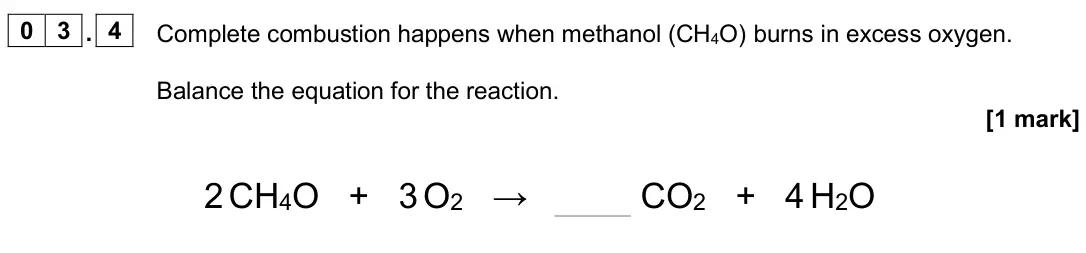
- June 2025, Chemistry Paper 2 Foundation, Q03.4 (1 mark): Complete combustion happens when methanol (CH4O) burns in excess oxygen. Balance the equation for the reaction. [1 mark] 2 CH4O + 3 O2 → CO2 + 4 H2O
- June 2024, Chemistry Paper 1 Higher, Q02.4 (3 marks): Plot the data from Table 1 on Figure 5. Draw a line of best fit. [3 marks] Figure 5
- June 2024, Chemistry Paper 1 Higher, Q02.5 (1 mark): Why does the mass of the contents of the test tube decrease in mass when copper carbonate is thermally decomposed? [1 mark]
- June 2024, Chemistry Paper 1 Higher, Q05.2 (4 marks): The equation for the reaction between nitrogen and hydrogen to produce ammonia is: N2 + 3 H2 → 2 NH3 Calculate the mass of hydrogen that is needed to produce 25
- June 2024, Chemistry Paper 1 Foundation, Q03.6 (1 mark): The range of the results is the minimum value of temperature increase to the maximum value of temperature increase. What is the range of temperature increase fo
- June 2024, Chemistry Paper 1 Foundation, Q05.5 (1 mark): When heated 0.72 g of magnesium reacts with iron oxide to produce 2.32 g of products. Calculate the mass of iron oxide that reacts with 0.72 g of magnesium. [1
- June 2024, Chemistry Paper 1 Foundation, Q07.4 (3 marks): Plot the data from Table 7 on Figure 15. Draw a line of best fit. [3 marks] Figure 15
- June 2024, Chemistry Paper 1 Foundation, Q07.5 (1 mark): Why does the mass of the contents of the test tube decrease in mass when copper carbonate is thermally decomposed? [1 mark]
- June 2024, Chemistry Paper 2 Foundation, Q01.6 (2 marks): Calculate the relative formula mass (Mr) of carbon dioxide (CO2). Relative atomic masses (Ar): C = 12 O = 16 [2 marks] Relative formula mass of carbon dioxide =
- June 2023, Chemistry Paper 1 Higher, Q01.6 (6 marks): Figure 2 shows equipment a student used for an investigation. Figure 2 The student investigated the volume of carbon dioxide produced when different masses of c
- June 2023, Chemistry Paper 1 Higher, Q02.2 (2 marks): Calculate the relative formula mass (Mr) of sulfuric acid (H2SO4). Relative atomic masses (Ar): H = 1 O = 16 S = 32 [2 marks] Relative formula mass (Mr) =
- June 2023, Chemistry Paper 1 Higher, Q02.3 (4 marks): Calculate the percentage by mass of oxygen in lithium sulfate (Li2SO4). Relative atomic mass (Ar): O = 16 Relative formula mass (Mr): Li2SO4 = 110 Give your ans
- June 2023, Chemistry Paper 1 Higher, Q03.1 (1 mark): Balance the equation for the reaction. [1 mark] Na + O2 → Na2O
- June 2023, Chemistry Paper 1 Higher, Q06.3 (6 marks): 0.72 g of magnesium is added to 100 cm3 of hydrochloric acid. The hydrochloric acid is in excess. Calculate the concentration of the magnesium chloride (MgCl2)
- June 2023, Chemistry Paper 1 Foundation, Q05.6 (1 mark): Calculate the mass of carbon dioxide produced in this experiment. [1 mark] Mass of carbon dioxide = g
- June 2023, Chemistry Paper 1 Foundation, Q05.7 (2 marks): Explain why the mass of the contents in the crucible changed during the experiment. [2 marks]
- June 2023, Chemistry Paper 1 Foundation, Q06.6 (6 marks): Figure 15 shows equipment a student used for an investigation. Figure 15 The student investigated the volume of carbon dioxide produced when different masses of
- June 2023, Chemistry Paper 1 Foundation, Q07.2 (2 marks): Calculate the relative formula mass (Mr) of sulfuric acid (H2SO4). Relative atomic masses (Ar): H = 1 O = 16 S = 32 [2 marks] Relative formula mass (Mr) =
- June 2023, Chemistry Paper 1 Foundation, Q07.3 (4 marks): Calculate the percentage by mass of oxygen in lithium sulfate (Li2SO4). Relative atomic mass (Ar): O = 16 Relative formula mass (Mr): Li2SO4 = 110 Give your ans
- June 2022, Chemistry Paper 1 Higher, Q02.4 (1 mark): The experiment is repeated 4 times. The volumes of oxygen collected in the 4 experiments are: 6 cm3 9 cm3 10 cm3 11 cm3 The mean volume of oxygen collected in t
- June 2022, Chemistry Paper 1 Higher, Q07.2 (2 marks): Complete the equation. You should balance the equation. [2 marks] Na + TiCl4 → +
- June 2022, Chemistry Paper 1 Foundation, Q02.3 (1 mark): In the reaction, 3.65 g of hydrogen chloride reacts with 4.00 g of sodium hydroxide. 1.80 g of water is produced. Calculate the mass of the other product. [1 ma
- June 2022, Chemistry Paper 1 Foundation, Q04.1 (1 mark): Magnesium and oxygen react to produce magnesium oxide. Balance the equation for the reaction. [1 mark] Mg + O2 → 2 MgO
- June 2022, Chemistry Paper 1 Foundation, Q04.3 (2 marks): Calculate the relative formula mass (Mr) of magnesium fluoride (MgF2). Relative atomic masses (Ar): F = 19 Mg = 24 [2 marks] Relative formula mass (Mr) =
- June 2022, Chemistry Paper 1 Foundation, Q06.4 (1 mark): The experiment is repeated 4 times. The volumes of oxygen collected in the 4 experiments are: 6 cm3 9 cm3 10 cm3 11 cm3 The mean volume of oxygen collected in t
- June 2022, Chemistry Paper 2 Higher, Q04.3 (2 marks): When C11H24 is cracked, three products are formed. Complete the equation for the reaction. [2 marks] C11H24 → C5H10 + 2 +
- June 2022, Chemistry Paper 2 Foundation, Q05.7 (1 mark): Balance the equation for the cracking of C6H14 [1 mark] C6H14 → C2H6 + C2H4
- November 2021, Chemistry Paper 1 Higher, Q06.1 (3 marks): 0.12 g of magnesium reacted to produce 0.20 g of magnesium oxide. Calculate the number of moles of oxygen gas (O2) that reacted. Relative atomic mass (Ar): O =
- November 2021, Chemistry Paper 1 Higher, Q06.3 (3 marks): Copper reacts with oxygen to produce copper oxide. 63.5 g of copper produces 79.5 g of copper oxide. Calculate the mass of copper oxide produced when 0.50 g of
- November 2021, Chemistry Paper 1 Higher, Q06.4 (4 marks): Iron reacts with oxygen to produce an oxide of iron. 0.015 moles of iron reacts with 0.010 moles of oxygen gas (O2). Determine: • the formula of the iron oxide
- November 2021, Chemistry Paper 1 Foundation, Q01.1 (1 mark): Which types of element react when magnesium reacted with chlorine? [1 mark] Tick () one box. A metal and a metal A metal and a non-metal A non-metal and a non-
- November 2021, Chemistry Paper 1 Foundation, Q01.3 (1 mark): What apparatus was used to measure the mass of 1.0 g of magnesium? [1 mark] Tick () one box. Balance Beaker Ruler
- November 2021, Chemistry Paper 1 Foundation, Q01.4 (1 mark): What mass of magnesium chloride was produced? [1 mark] Tick () one box. Less than 1.0 g 1.0 g More than 1.0 g
- November 2021, Chemistry Paper 1 Foundation, Q01.5 (2 marks): Magnesium reacts with oxygen to produce magnesium oxide. Calculate the percentage mass of magnesium in magnesium oxide (MgO). Relative atomic mass (Ar): Mg = 24
- November 2021, Chemistry Paper 1 Foundation, Q01.6 (1 mark): What is the most likely reason for Student 3’s anomalous result? [1 mark] Tick () one box. The student heated more than 2.00 g of magnesium carbonate. The stud
- November 2021, Chemistry Paper 1 Foundation, Q01.7 (3 marks): Calculate value X in Table 1. Do not use the anomalous result. Give your answer to 2 significant figures. [3 marks] X (2 significant figures) = g
- November 2021, Chemistry Paper 1 Foundation, Q04.3 (1 mark): Sodium reacts with water to produce sodium hydroxide and hydrogen. Balance the equation for the reaction. [1 mark] Na + 2 H2O → 2 NaOH + H2
- November 2021, Chemistry Paper 1 Foundation, Q04.4 (2 marks): Calculate the relative formula mass (Mr) of sodium hydroxide (NaOH). Relative atomic masses (Ar): H = 1 O = 16 Na = 23 [2 marks] Relative formula mass (Mr) =
- November 2021, Chemistry Paper 2 Higher, Q02.4 (1 mark): Decane (C10H22) is cracked to produce two products. Complete the equation for the reaction. [1 mark] C10H22 → + C2H4
- November 2021, Chemistry Paper 2 Foundation, Q02.2 (1 mark): Which column of data has the greatest range? [1 mark] Tick () one box. City centre Countryside Motorway
- November 2021, Chemistry Paper 2 Foundation, Q07.4 (1 mark): Decane (C10H22) is cracked to produce two products. Complete the equation for the reaction. [1 mark] C10H22 → + C2H4
- November 2020, Chemistry Paper 1 Higher, Q03 (6 marks): Some students investigated the thermal decomposition of metal carbonates. The word equation for the reaction is: metal carbonate → metal oxide + carbon dioxide
- November 2020, Chemistry Paper 1 Higher, Q06.3 (5 marks): Gold reacts with the elements in Group 7 of the periodic table. 0.175 g of gold reacts with chlorine. The equation for the reaction is: 2 Au + 3 Cl2 → 2 AuCl3 C
- November 2020, Chemistry Paper 1 Foundation, Q03.6 (1 mark): 3.94 g of gold reacts with chlorine to produce 6.07 g of gold chloride. The word equation for the reaction is: gold + chlorine → gold chloride Calculate the mas
- November 2020, Chemistry Paper 1 Foundation, Q03.7 (2 marks): Calculate the relative formula mass (Mr) of gold chloride (AuCl3). Relative atomic masses (Ar): Cl = 35.5 Au = 197 [2 marks] Relative formula mass (Mr) =
- November 2020, Chemistry Paper 1 Foundation, Q04.3 (1 mark): Sodium reacts with chlorine to produce sodium chloride. Balance the equation for the reaction. [1 mark] Na + Cl2 → NaCl
- November 2020, Chemistry Paper 1 Foundation, Q08 (6 marks): Some students investigated the thermal decomposition of metal carbonates. The word equation for the reaction is: metal carbonate → metal oxide + carbon dioxide
- November 2020, Chemistry Paper 2 Foundation, Q03.6 (1 mark): The range is the difference between the largest value and the smallest value. Which water sample has the greatest range of results? [1 mark] Tick () one box. A
- June 2019, Chemistry Paper 1 Higher, Q02.5 (3 marks): Calculate the percentage by mass of oxygen in ammonium nitrate (NH4NO3). Relative atomic masses (Ar): H = 1 N = 14 O = 16 Relative formula mass (Mr): NH4NO3 = 8
- June 2019, Chemistry Paper 1 Foundation, Q04.2 (1 mark): 4.6 g of sodium reacts with chlorine to produce 11.7 g of sodium chloride. What mass of chlorine reacted? [1 mark] Mass of chlorine = g
- June 2019, Chemistry Paper 1 Foundation, Q05.3 (3 marks): At high temperature, sodium nitrate decomposes into sodium nitrite and oxygen. A student heats three samples of sodium nitrate. The mass of each sample was 4.50
- June 2019, Chemistry Paper 1 Foundation, Q07.5 (3 marks): Calculate the percentage by mass of oxygen in ammonium nitrate (NH4NO3). Relative atomic masses (Ar): H = 1 N = 14 O = 16 Relative formula mass (Mr): NH4NO3 = 8
- June 2019, Chemistry Paper 2 Higher, Q06.3 (4 marks): Sulfur dioxide is an atmospheric pollutant. Sulfur dioxide pollution is reduced by reacting calcium oxide with sulfur dioxide to produce calcium sulfite. CaO +
- June 2018, Chemistry Paper 1 Higher, Q06.1 (2 marks): Give the formula of each product when calcium carbonate (CaCO3) is heated. [2 marks] and
- June 2018, Chemistry Paper 1 Higher, Q06.2 (3 marks): The relative formula mass (Mr) of a Group 2 metal carbonate is 197 Relative atomic masses (Ar): C = 12 O = 16 Calculate the relative atomic mass (Ar) of the Gro
- June 2018, Chemistry Paper 1 Higher, Q06.3 (3 marks): Calculate the gradient of the line in Figure 8 Give the unit. [3 marks] Gradient Unit
- June 2018, Chemistry Paper 1 Foundation, Q02.8 (1 mark): Fluorine reacts with chlorine to produce ClF3 Balance the chemical equation for the reaction. [1 mark] Cl2 + F2 → 2 ClF3
- June 2018, Chemistry Paper 1 Foundation, Q04.2 (2 marks): Name the two products when calcium carbonate (CaCO3) is heated. [2 marks] and
- June 2018, Chemistry Paper 1 Foundation, Q04.3 (1 mark): What type of reaction happens when a compound breaks down? [1 mark] Tick one box. burning decomposition neutralisation reduction
- June 2018, Chemistry Paper 1 Foundation, Q04.5 (1 mark): Figure 10 shows the volume of gas produced when a Group 2 metal carbonate is heated. Figure 10 The student collected 5.2 dm3 of gas. What mass of the Group 2 me
- June 2018, Chemistry Paper 1 Foundation, Q04.7 (4 marks): A student heated different masses of a Group 2 carbonate. The student measured the volume of gas produced. Figure 11 shows a graph of the student’s results. The
- June 2018, Chemistry Paper 1 Foundation, Q04.8 (4 marks): A student repeated the experiment with a different Group 2 metal carbonate (XCO3). The relative formula mass (Mr) of XCO3 is 84 Relative atomic masses (Ar): C =
Questions, mark schemes and examiner’s reports are © AQA, from their published past papers. Plumi isn’t affiliated with any exam board. Want whole papers? Full past papers.
Rather write your answers by hand on iPad? Plumi marks them against the same mark schemes.