 plumi
Forming, redistribution and addition processes: AQA A‑Level Product Design questions
AQA A-Level Product Design past-paper questions on 3.1.4 Forming, redistribution and addition processes, 2020–2025, with mark schemes and examiner’s reports where available.
Getting your paper ready…
AQA A-Level Product DesignForming, redistribution and addition processes284 questions
Paper
All papers
Exam
All years
Calculations
Difficulty
Loading the full question list…
All 34 questions on Forming, redistribution and addition processes, as a list
- June 2025, Paper 1, Q07 (6 marks): _ Discuss the advantages and disadvantages of using contact adhesive to join a laminate to a large sheet of manufactured board. [6 marks]
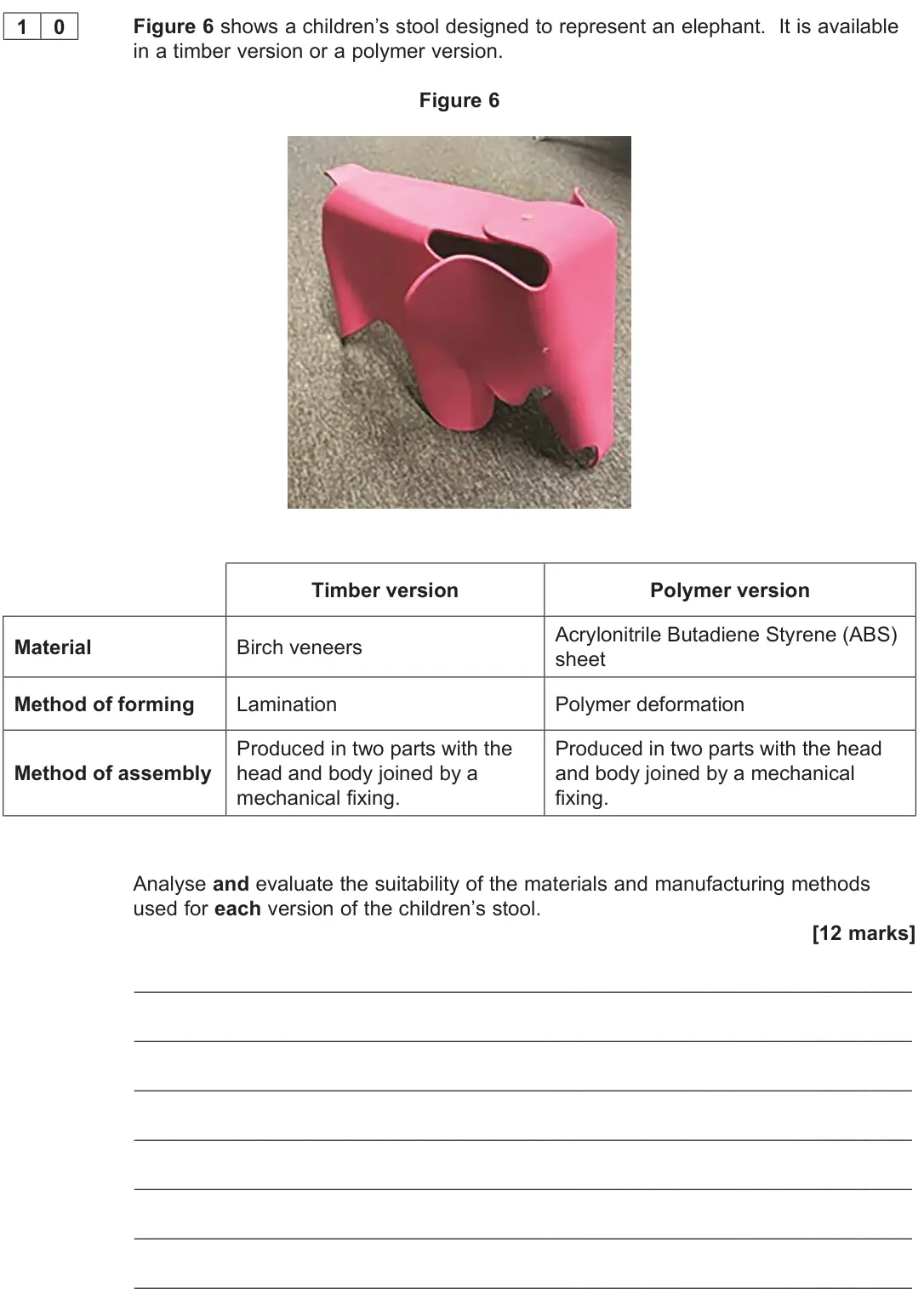
- June 2025, Paper 1, Q10 (12 marks): _ Figure 6 shows a children’s stool designed to represent an elephant. It is available in a timber version or a polymer version. Figure 6 Timber version Polymer
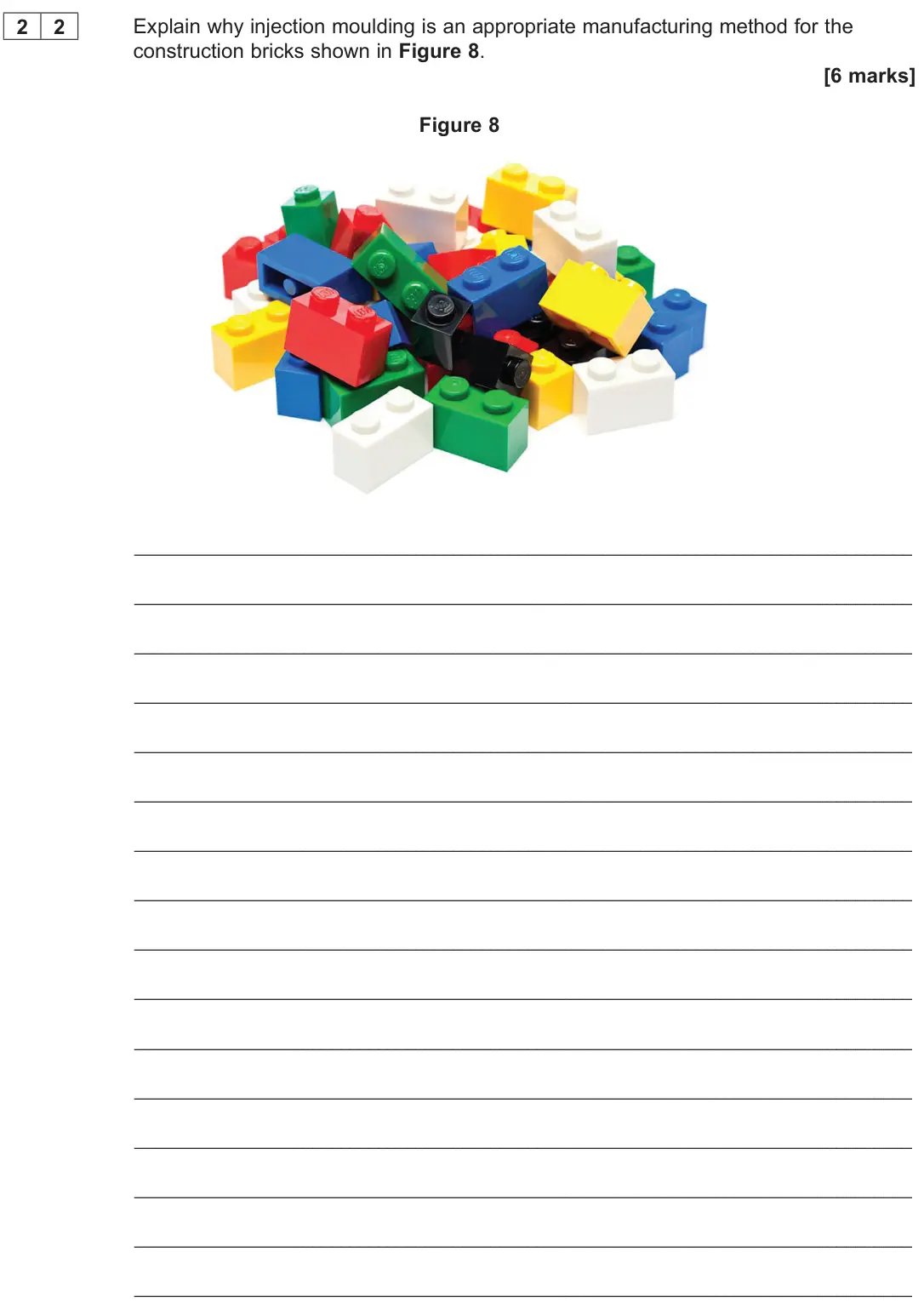
- June 2025, Paper 1, Q22 (6 marks): _ Explain why injection moulding is an appropriate manufacturing method for the construction bricks shown in Figure 8. [6 marks] Figure 8 _ ____________________
- June 2025, Paper 1, Q24 (6 marks): _ Describe the process of manufacturing an aluminium component using sand casting in a school workshop environment. You should refer to the preparation of the m
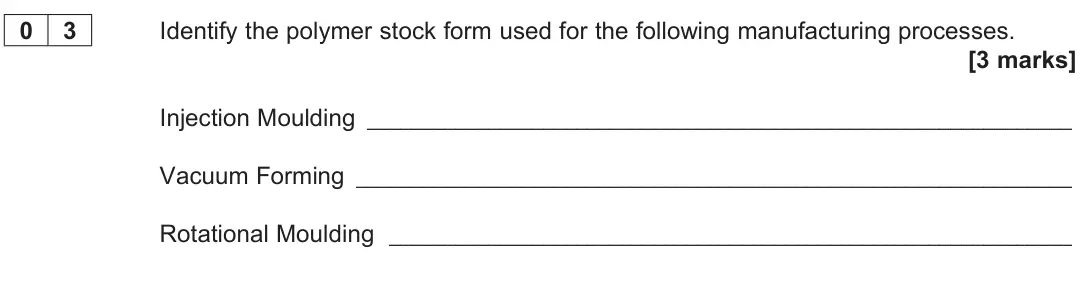
- June 2024, Paper 1, Q03 (3 marks): Identify the polymer stock form used for the following manufacturing processes. [3 marks] Injection Moulding ___________________________________________________
- June 2024, Paper 1, Q08 (6 marks): Describe why pewter is often used for casting in a school workshop. [6 marks] __________________________________________________________________________________
- June 2024, Paper 1, Q10 (6 marks): Compare the following joining methods for attaching two thin sheets of aluminium: pop rivets nuts and bolts. [6 marks] _____________________________________
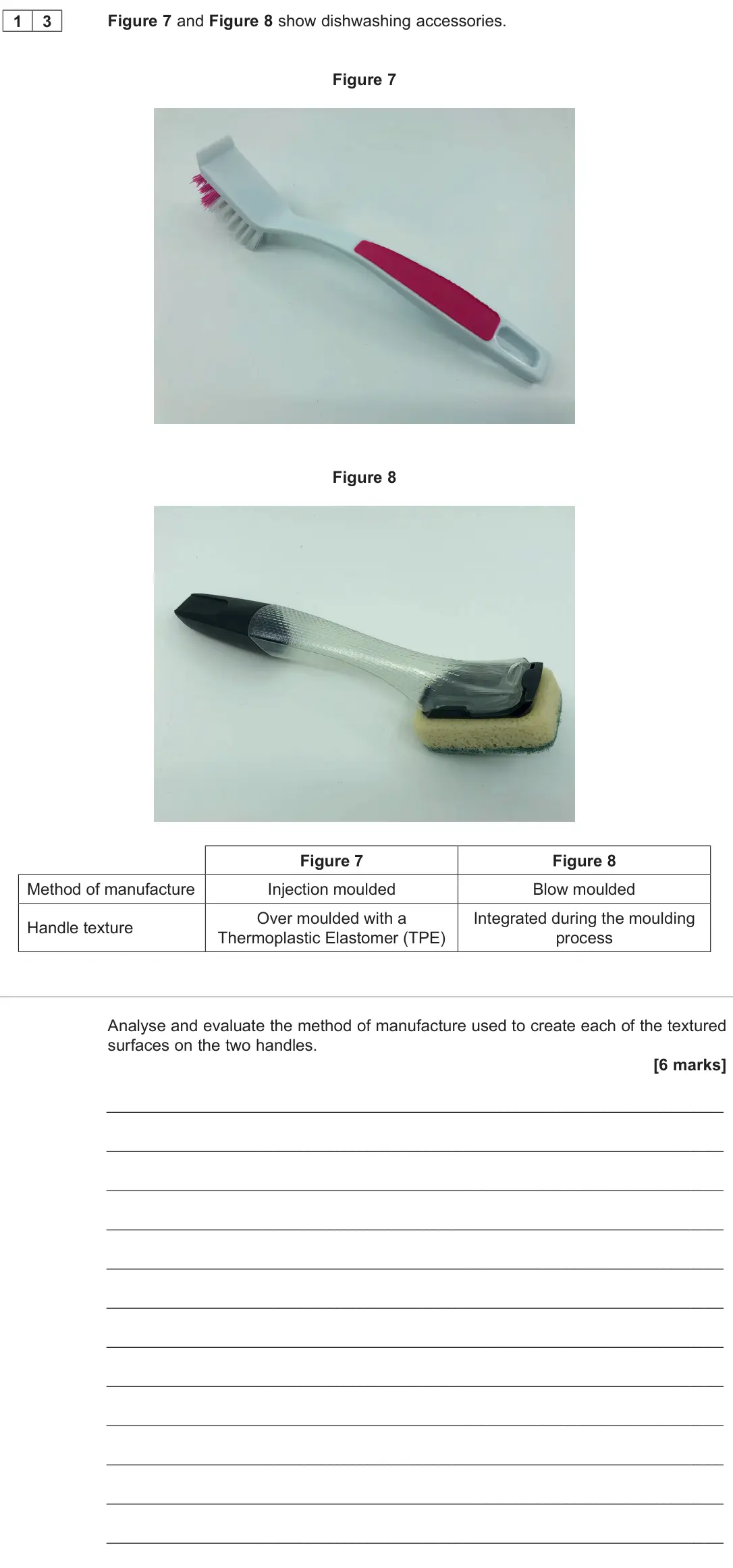
- June 2024, Paper 1, Q13 (6 marks): Figure 7 and Figure 8 show dishwashing accessories. Figure 7 Figure 8 Figure 7 Figure 8 Method of manufacture Injection moulded Blow moulded Handle texture Over
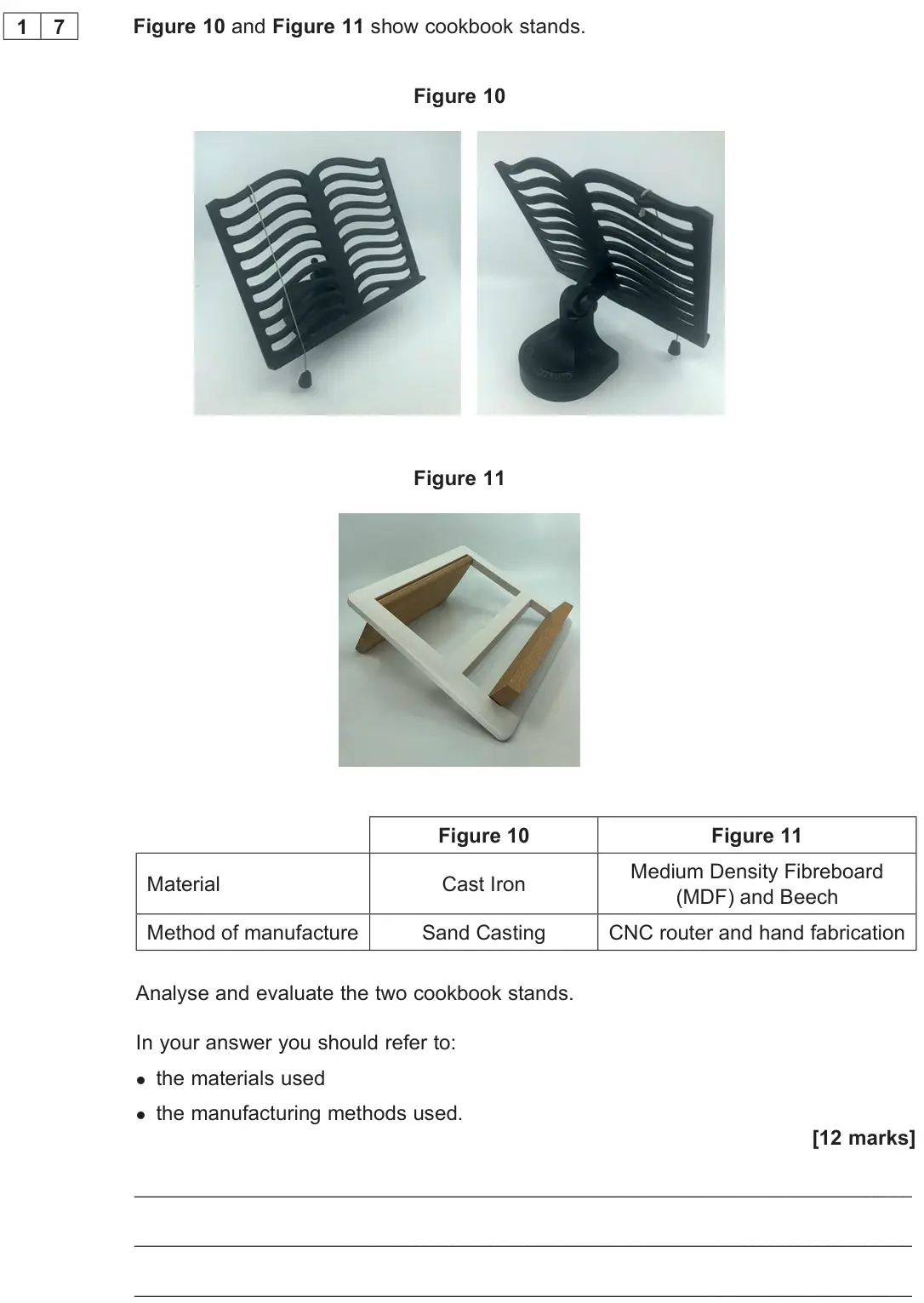
- June 2024, Paper 1, Q17 (12 marks): Figure 10 and Figure 11 show cookbook stands. Figure 10 Figure 11 Figure 10 Figure 11 Material Cast Iron Medium Density Fibreboard (MDF) and Beech Method of man
- June 2024, Paper 1, Q21 (6 marks): Explain the factors that should be considered before forming a curved piece of timber by steam bending. [6 marks] ______________________________________________
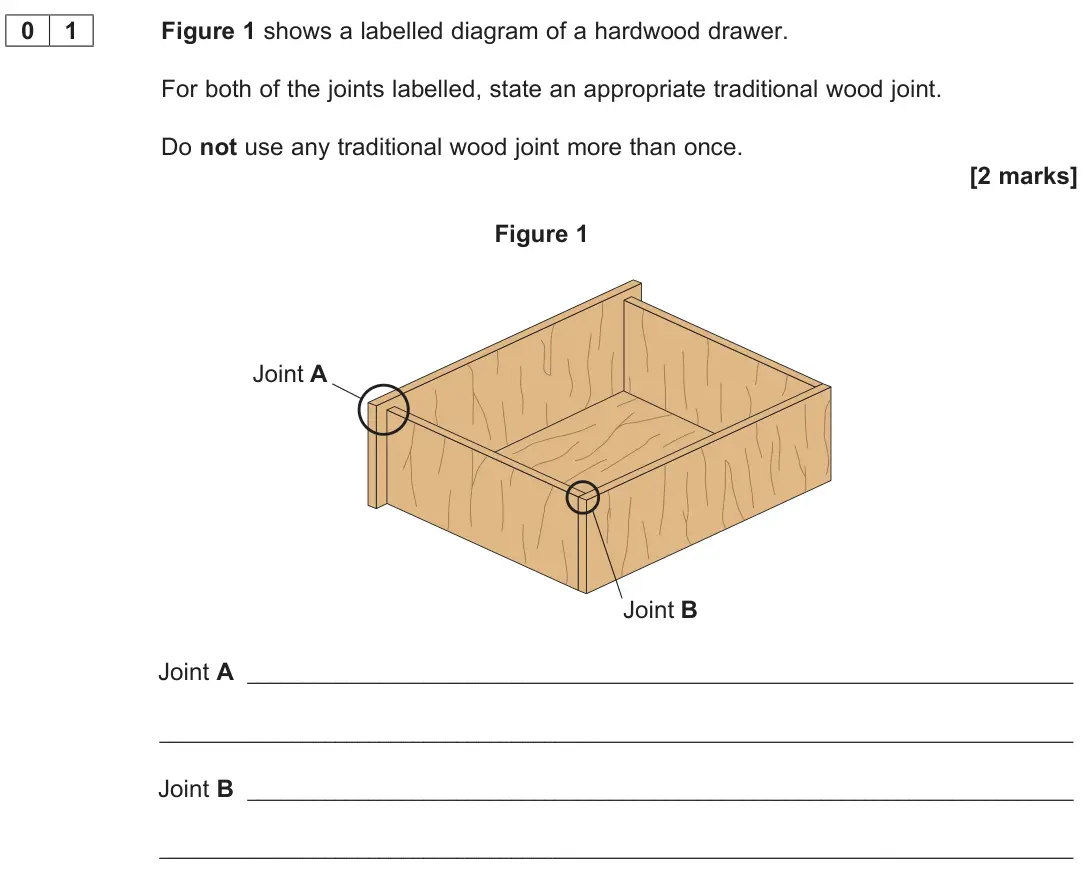
- June 2023, Paper 1, Q01 (2 marks): Figure 1 shows a labelled diagram of a hardwood drawer. For both of the joints labelled, state an appropriate traditional wood joint. Do not use any traditional
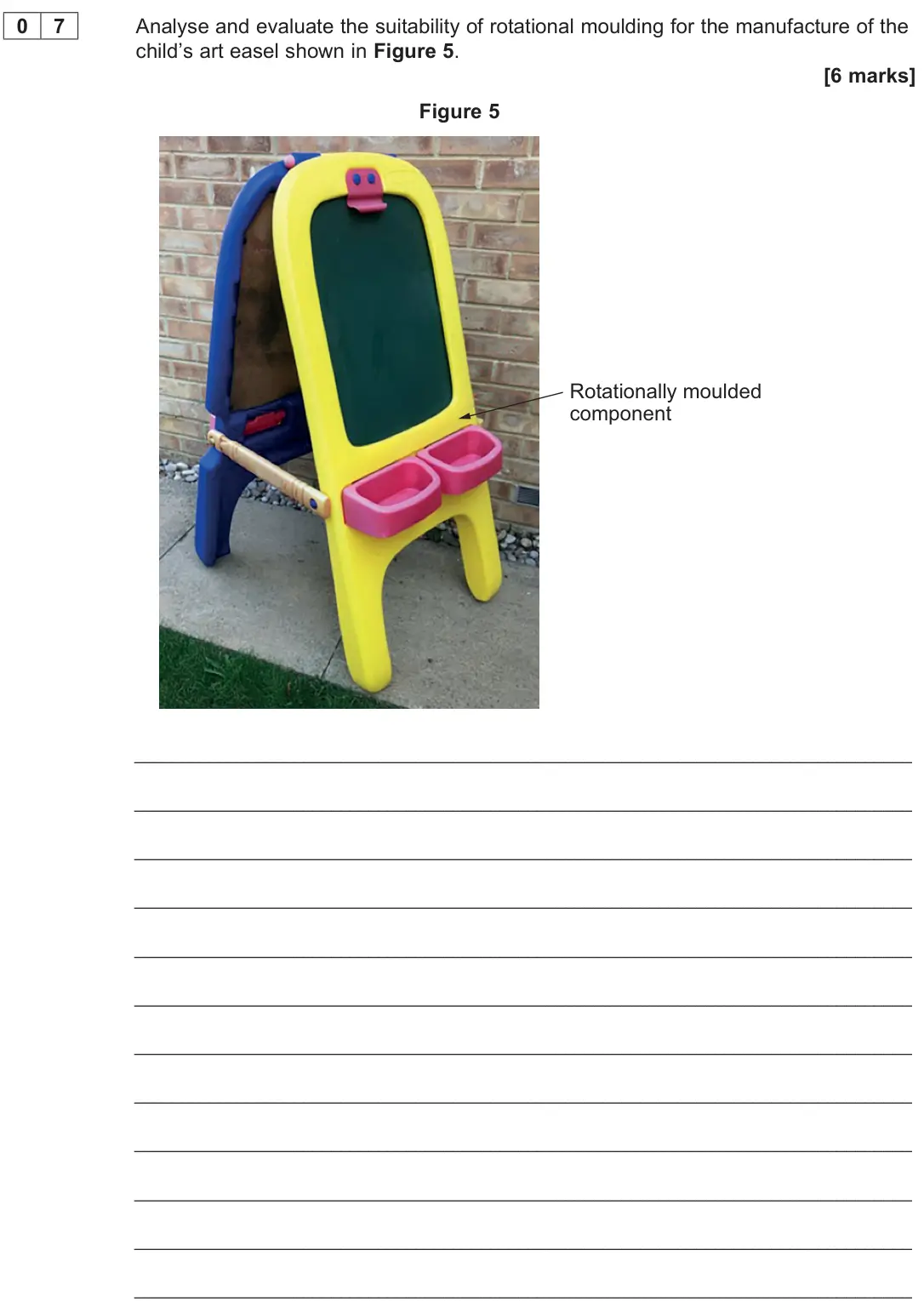
- June 2023, Paper 1, Q07 (6 marks): Analyse and evaluate the suitability of rotational moulding for the manufacture of the child’s art easel shown in Figure 5. [6 marks] Figure 5 Rotationally moul
- June 2023, Paper 1, Q17 (3 marks): Give three reasons why a gel coat is used when laminating a glass reinforced plastic (GRP) product. [3 marks] Reason 1 Reason 2 Reason 3
- June 2023, Paper 1, Q23 (6 marks): Describe the stages required to produce a vacuum formed polymer product. [6 marks] _ ___________________________________________________________________________
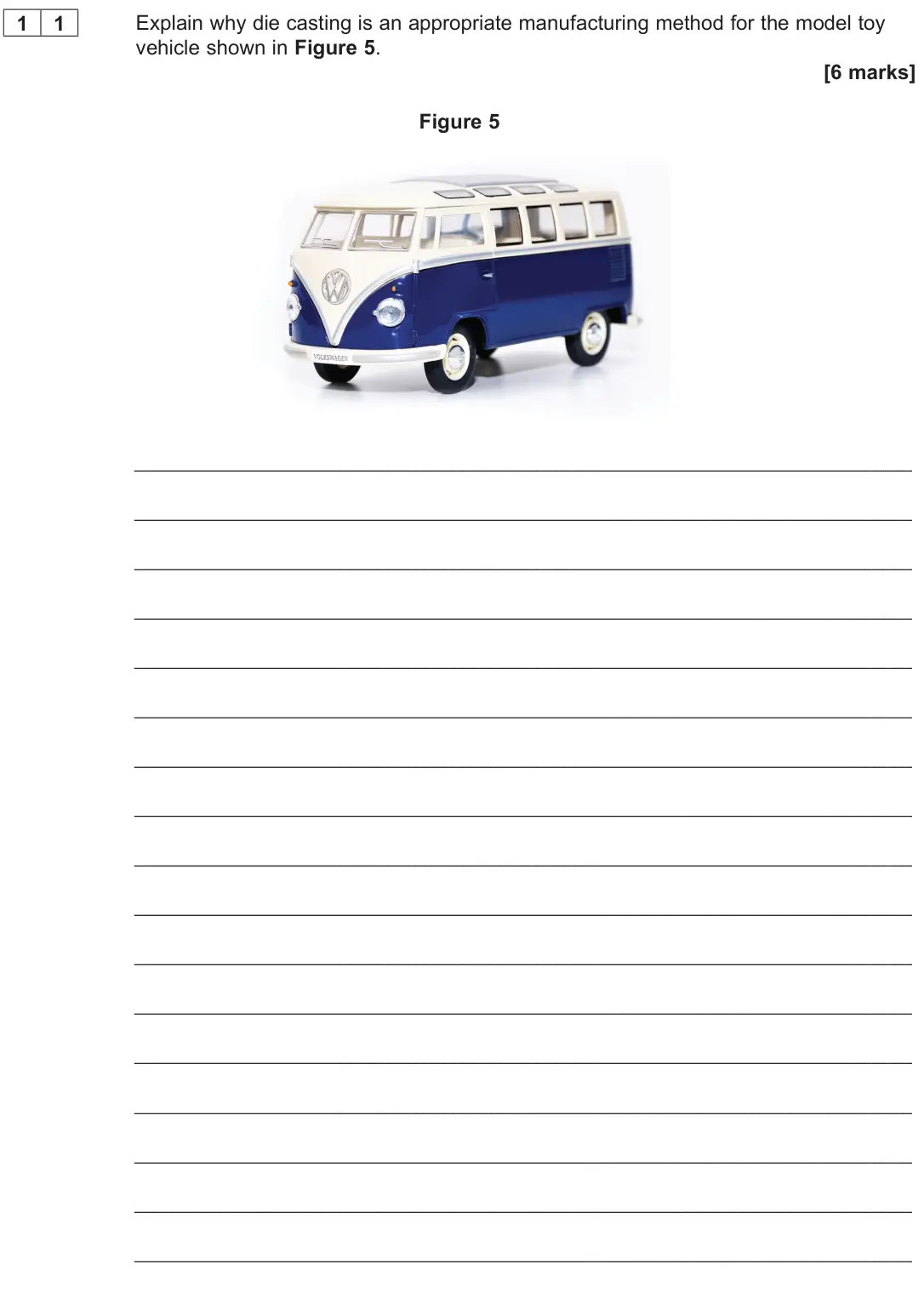
- June 2022, Paper 1, Q11 (6 marks): Explain why die casting is an appropriate manufacturing method for the model toy vehicle shown in Figure 5. [6 marks] Figure 5 _________________________________
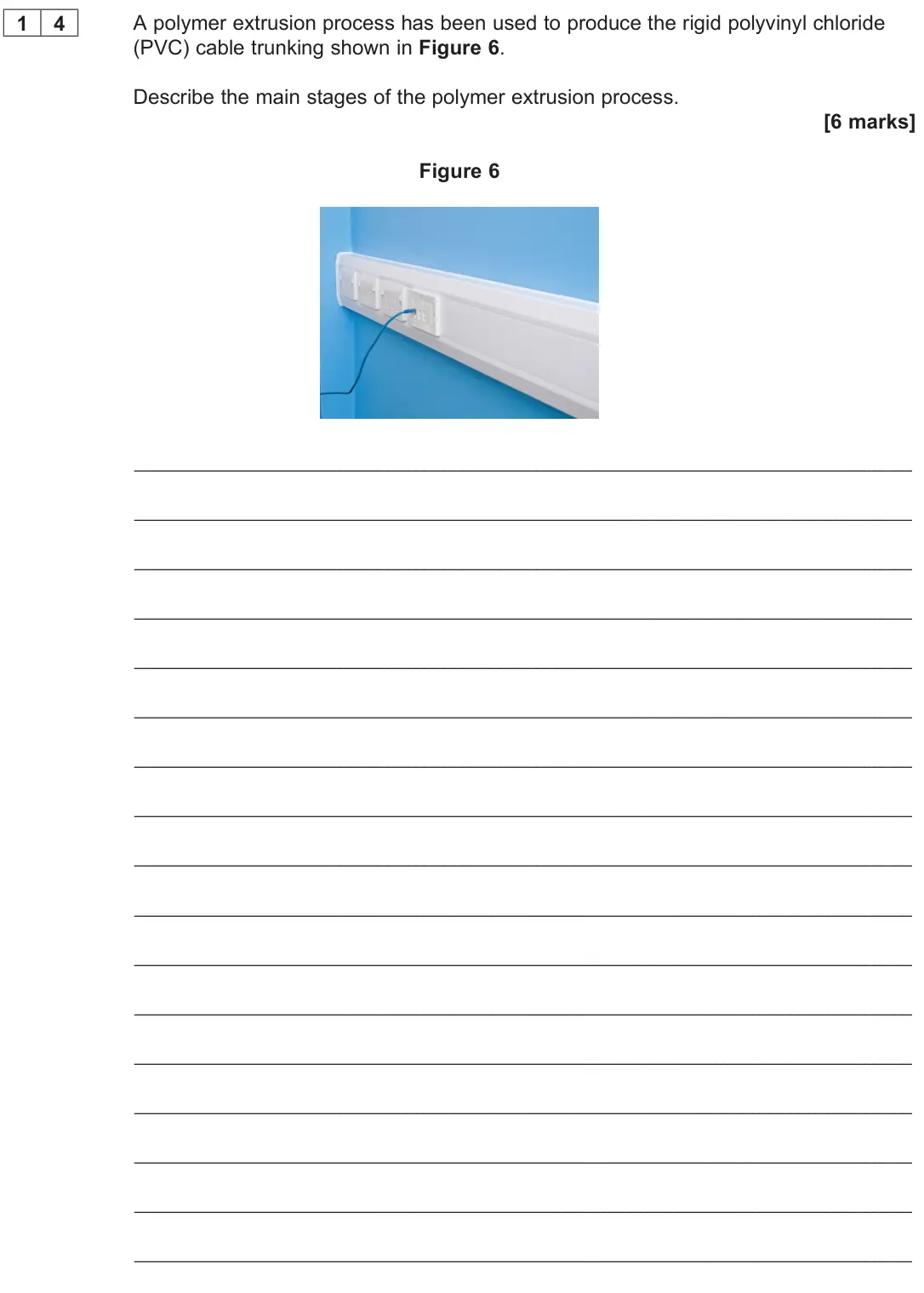
- June 2022, Paper 1, Q14 (6 marks): A polymer extrusion process has been used to produce the rigid polyvinyl chloride (PVC) cable trunking shown in Figure 6. Describe the main stages of the polyme
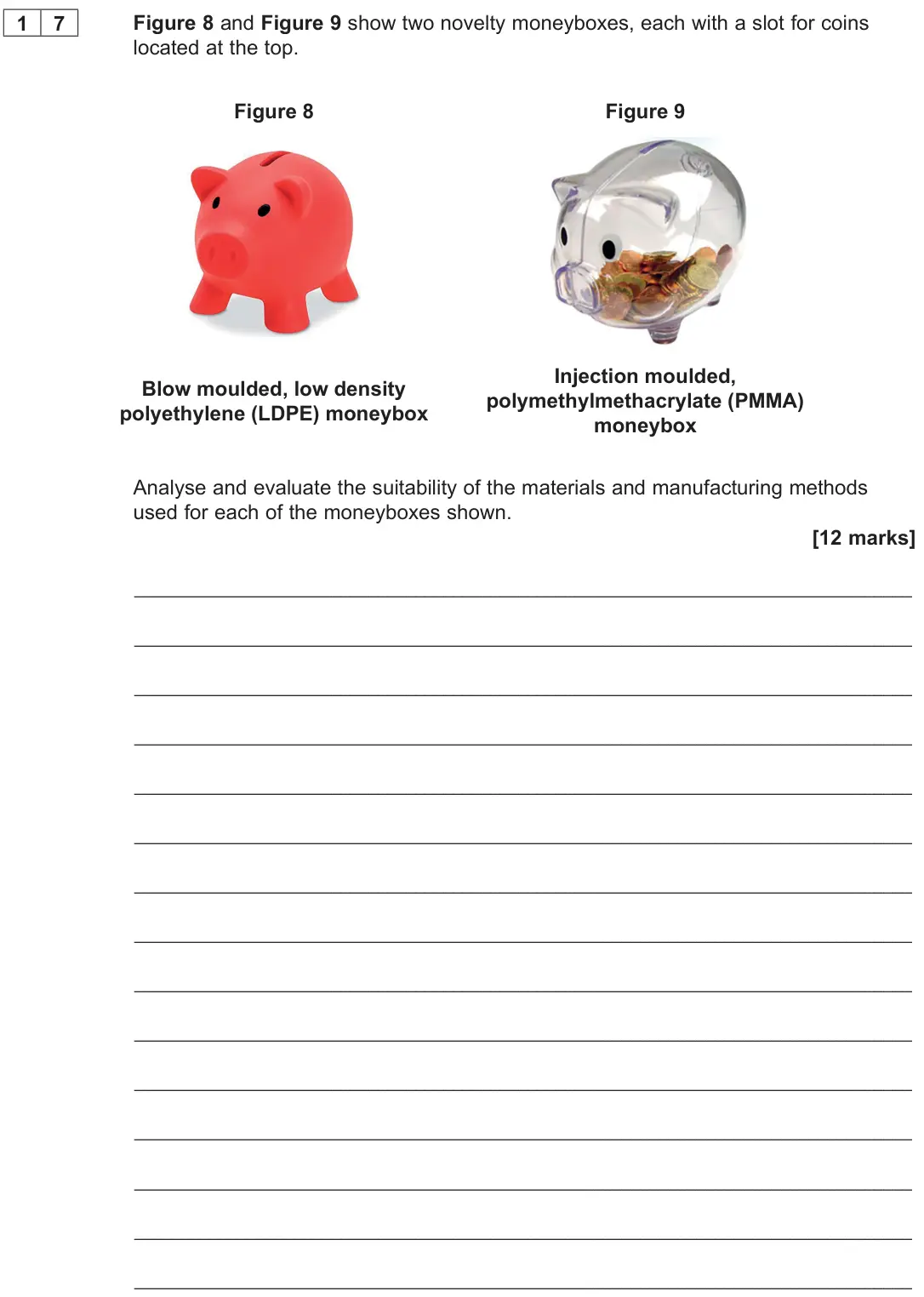
- June 2022, Paper 1, Q17 (12 marks): Figure 8 and Figure 9 show two novelty moneyboxes, each with a slot for coins located at the top. Figure 8 Figure 9 Blow moulded, low density polyethylene (LDPE
- June 2022, Paper 1, Q19 (4 marks): Describe two ways that a jig can be used to improve accuracy in manufacture. [2 x 2 marks] 1 ___________________________________________________________________
- November 2021, Paper 1, Q02 (6 marks): Describe the process of die cutting. [6 marks] ___________________________________________________________________________________ _____________________________
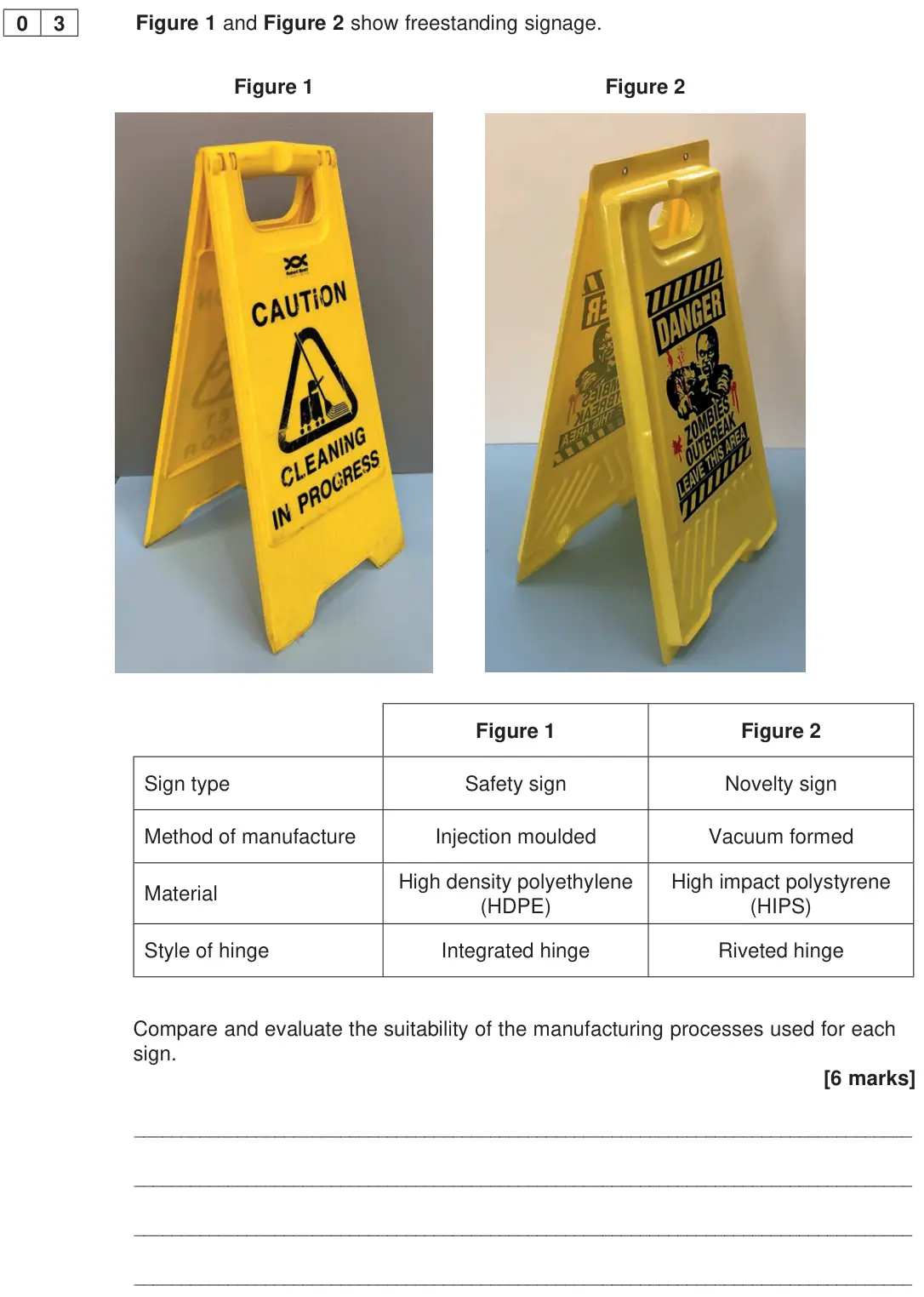
- November 2021, Paper 1, Q03 (6 marks): Figure 1 and Figure 2 show freestanding signage. Figure 1 Figure 2 Figure 1 Figure 2 Sign type Safety sign Novelty sign Method of manufacture Injection moulded
- November 2021, Paper 1, Q08 (6 marks): Explain why injection moulding is not a suitable manufacturing method for large products. [6 marks] ____________________________________________________________
- November 2021, Paper 1, Q11 (12 marks): Figure 6 and Figure 7 show mug holders. Figure 6 Figure 7 Figure 6 Figure 7 Material Beech Low-carbon steel Method of Manufacture CNC turned Cold formed Method
- November 2021, Paper 1, Q21 (6 marks): Explain the manufacturing processes that would be used to manufacture the stainless steel ruler shown in Figure 9. [6 marks] Figure 9 Stainless steel ruler ____
- November 2020, Paper 1, Q05.2 (6 marks): The product shown in Figure 3 has been laser cut and fabricated. An alternative method is to form it in one piece using injection moulding. Figure 3 Compare and
- November 2020, Paper 1, Q06 (6 marks): Describe the main stages in the process of soft soldering. [6 marks] ___________________________________________________________________________________ _______
- November 2020, Paper 1, Q16 (4 marks): A student wishes to route a symmetrical V-shaped channel in a piece of timber to the dimensions provided in Figure 7. Figure 7 Cross section of timber All dimen
- November 2020, Paper 1, Q17 (12 marks): Figure 8 and Figure 9 show children’s toys. Figure 8 Figure 9 Beech toy (hand shaped) Acrylonitrile Butadiene Styrene (ABS) toy (injection moulded) Analyse and
- Specimen, Paper 1, Q03 (2 marks): 3 Explain the meaning of the term ‘fabrication process’ and give an appropriate example. [2 marks]
- Specimen, Paper 1, Q04 (6 marks): Manufactured from thermoplastic using polymer redistribution process Figure 3 Manufactured from hardwood using fabrication process Figure 2 4 Compare the two ty
- Specimen, Paper 1, Q05 (14 marks): 5 A dining table has been manufactured from lengths of wood. Figure 4 shows a cross sectional view of two of the table legs. Figure 4 Cross sectional view of tw
- Specimen, Paper 1, Q06 (3 marks): 6 The photograph below shows a domestic bathroom shower. The shower tray is made from Acrylonitrile Butadiene Styrene (ABS) and has been manufactured using a va
- Specimen, Paper 1, Q07 (6 marks): 6 The photograph below shows a domestic bathroom shower. The shower tray is made from Acrylonitrile Butadiene Styrene (ABS) and has been manufactured using a va
- Specimen, Paper 1, Q08.2 (6 marks): 8 . 2 The stem of the lamp is bent from a single tube of mild steel with the dimensions shown in Figure 7. Describe how the tube could be formed. In your answer
- Specimen, Paper 1, Q17 (6 marks): The body of the racing car has been manufactured using a lay-up method. Name 6 stages in the manufacturing process. [6 marks] Stage 1 Stage 2 Stage 3 Stage 4 St
Questions, mark schemes and examiner’s reports are © AQA, from their published past papers. Plumi isn’t affiliated with any exam board. Want whole papers? AQA A-Level Product Design past papers.
The Plumi iPad app also offers exam-style questions with AI feedback on your handwritten working.