 plumi
Thermodynamics and engines: AQA A‑Level Physics questions
Every AQA A-Level Physics exam question on 3.11.2 Thermodynamics and engines, 2016–2025, with its mark scheme and examiner’s report.
Find questions2,714
Calculations
Q03.1
The whole paper ↗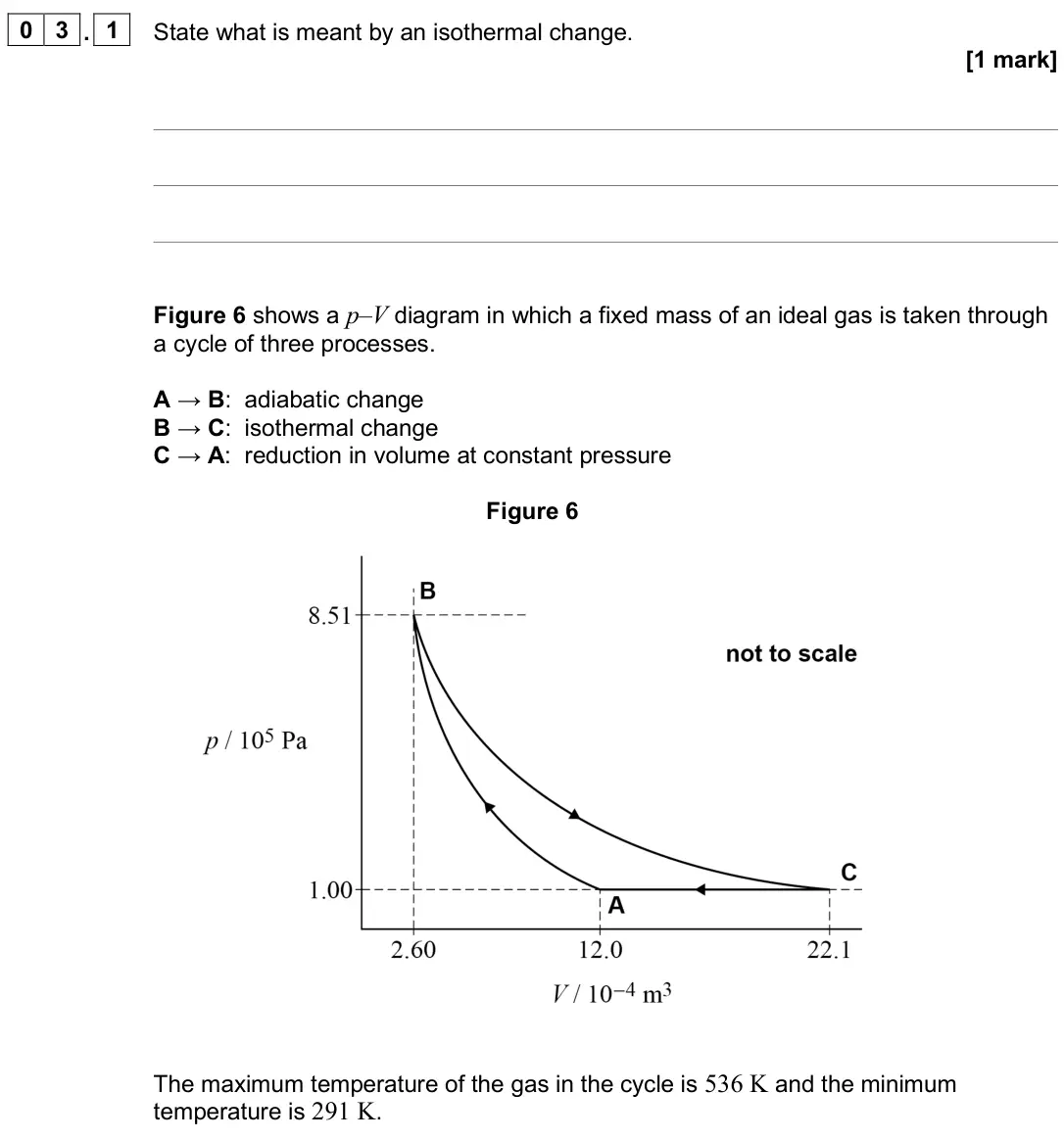
Q03.2
The whole paper ↗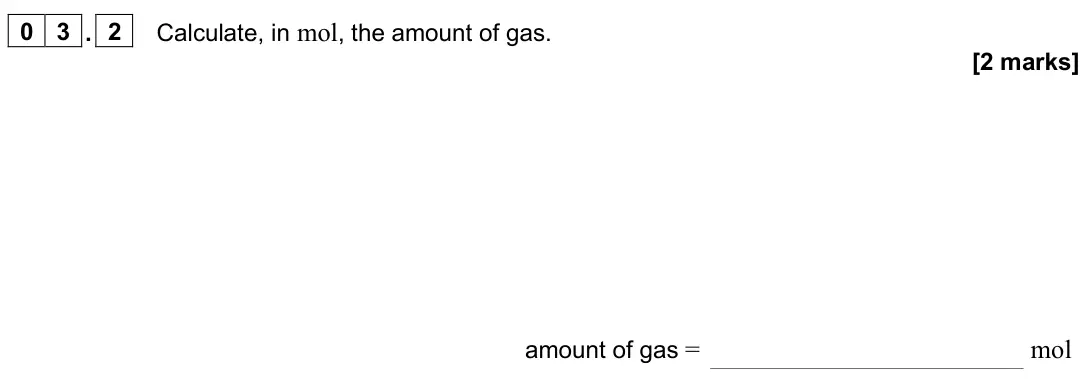
Q03.3
The whole paper ↗
Q03.4
The whole paper ↗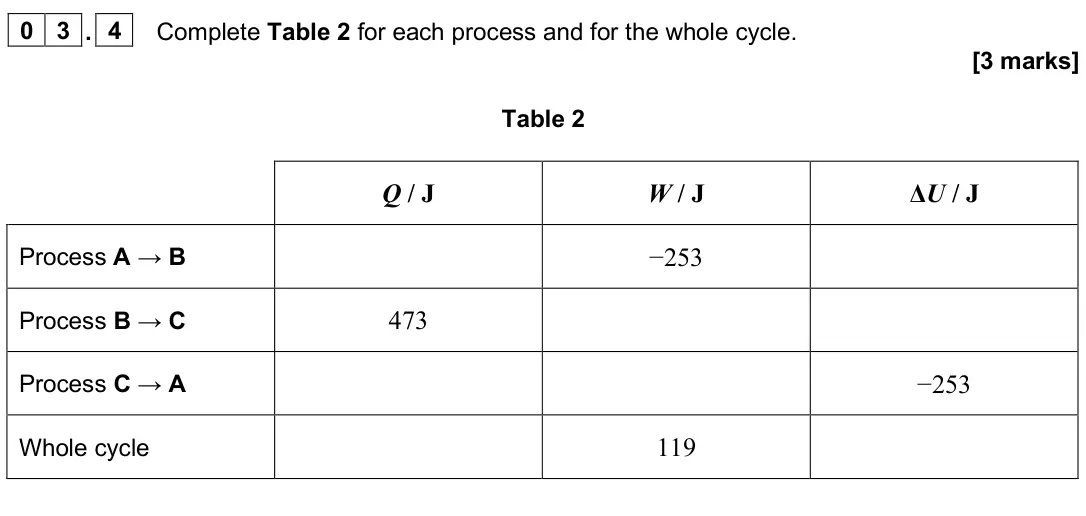
Q03.5
The whole paper ↗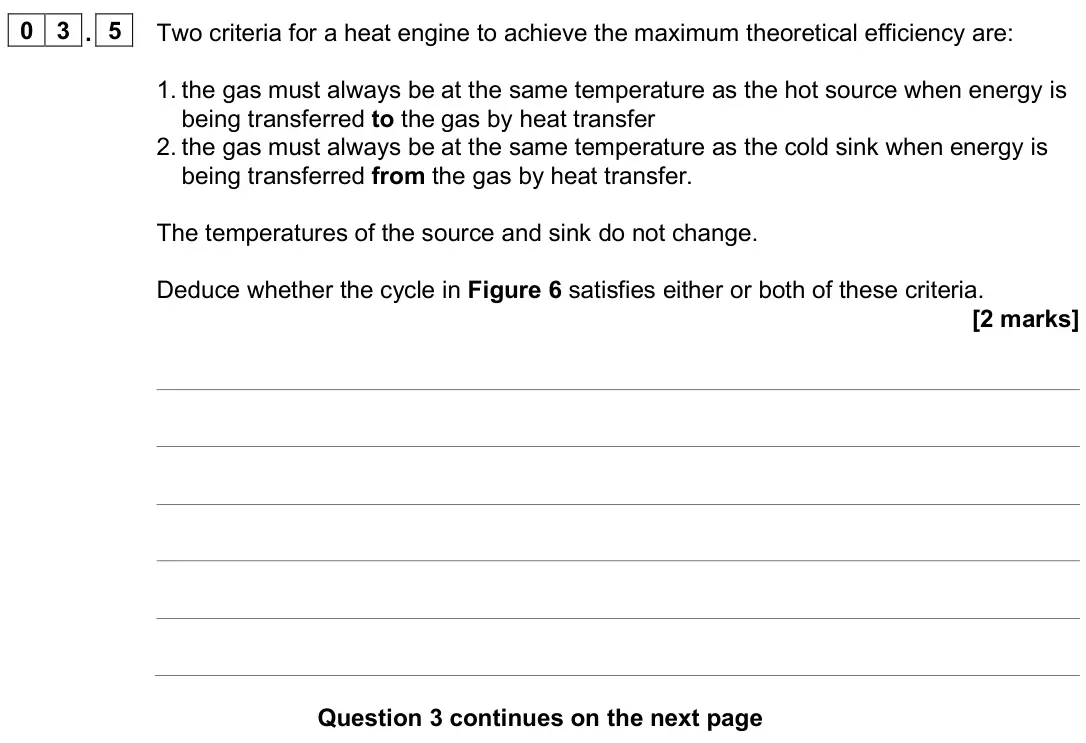
Q03.6
The whole paper ↗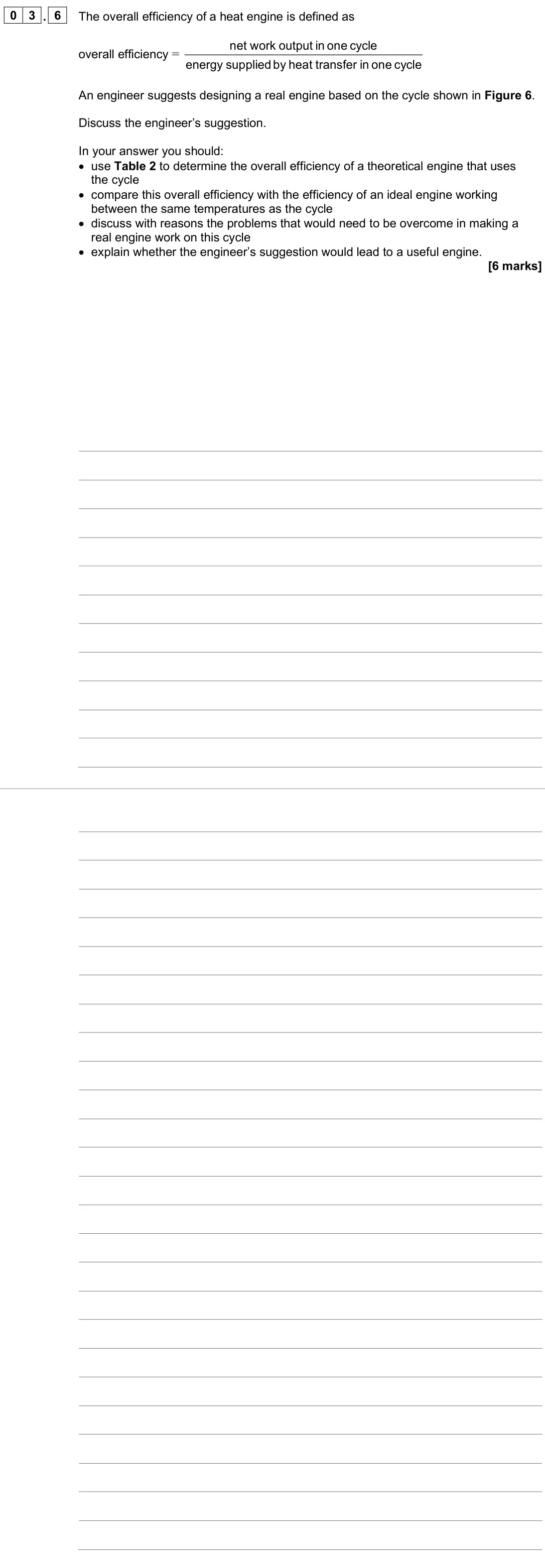
Q04.1
The whole paper ↗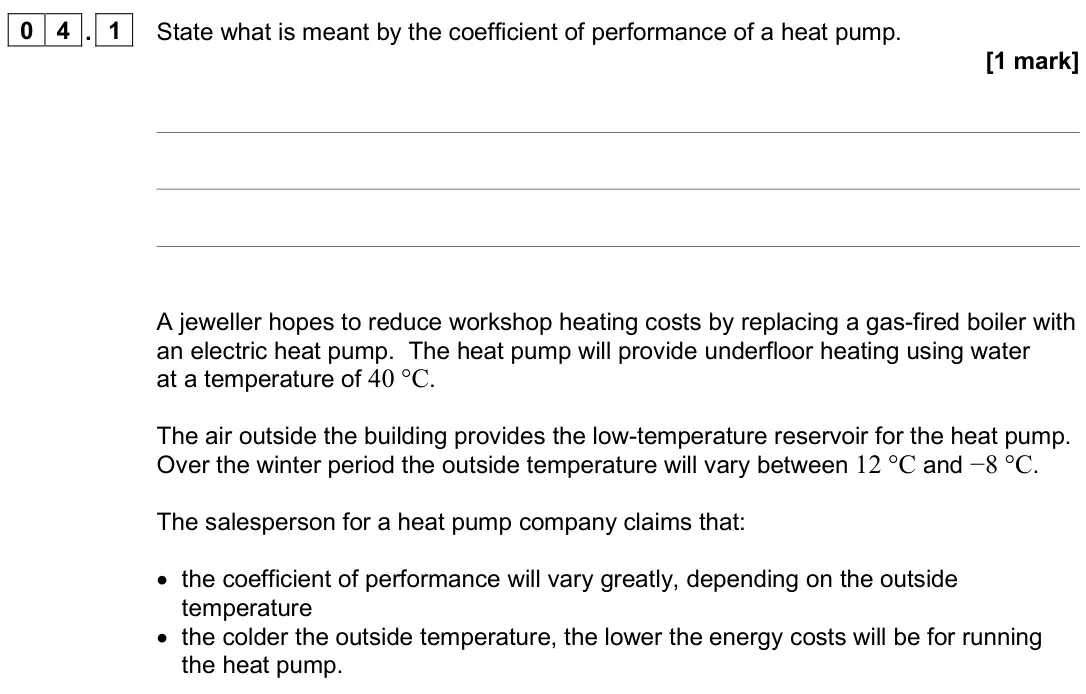
Q04.2
The whole paper ↗
Q04.3
The whole paper ↗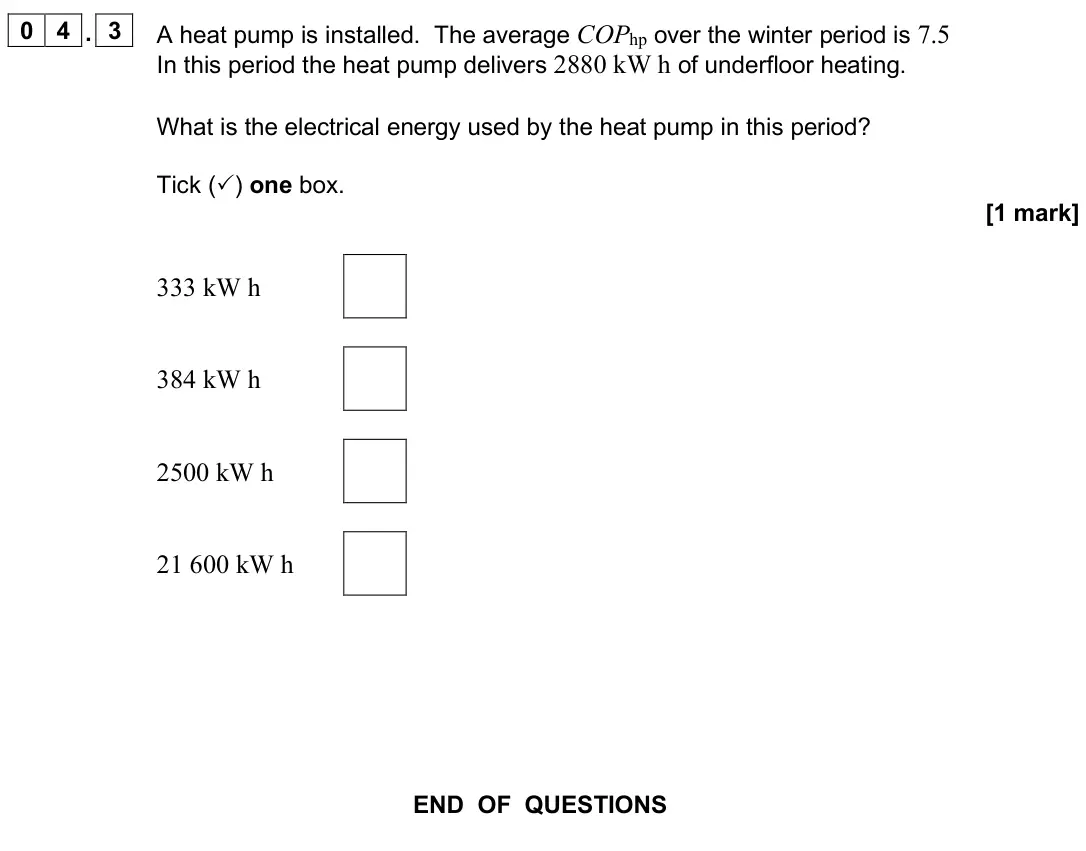
Q03.1
The whole paper ↗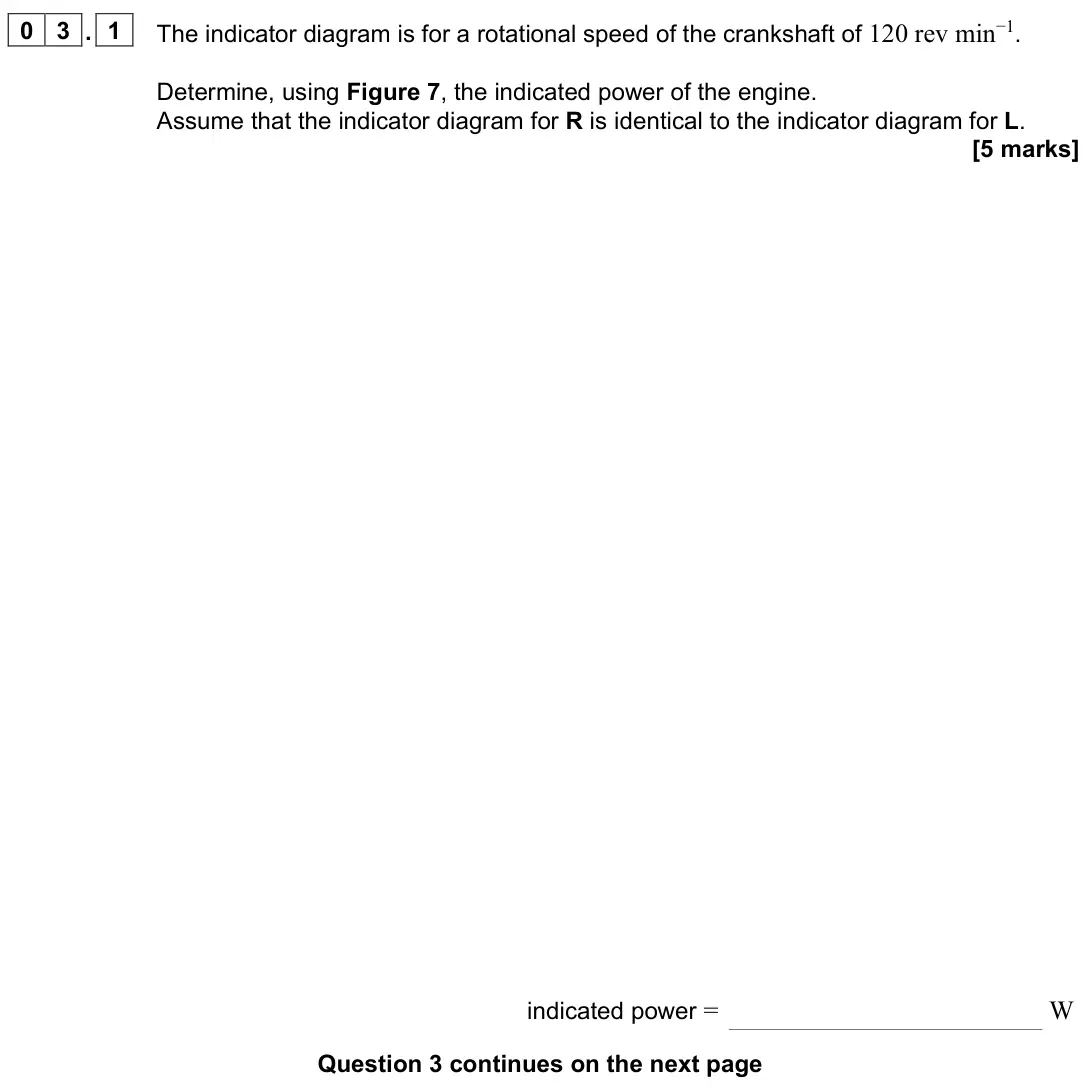
Q03.2
The whole paper ↗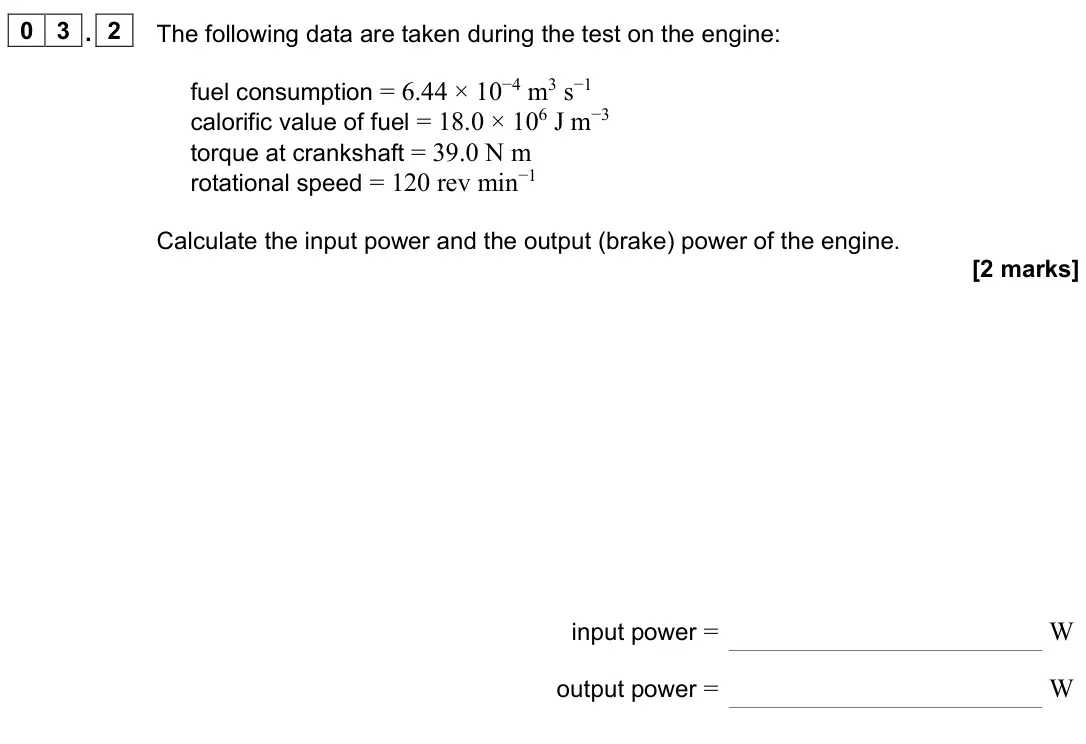
Q03.3
The whole paper ↗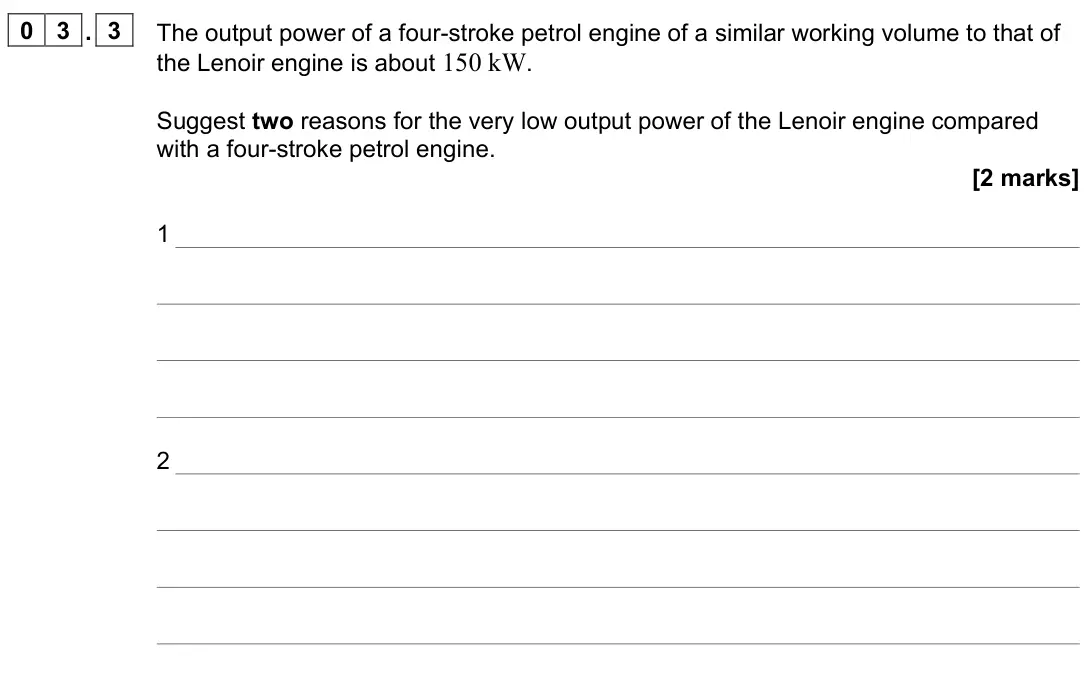
Q03.4
The whole paper ↗
Q04.1
The whole paper ↗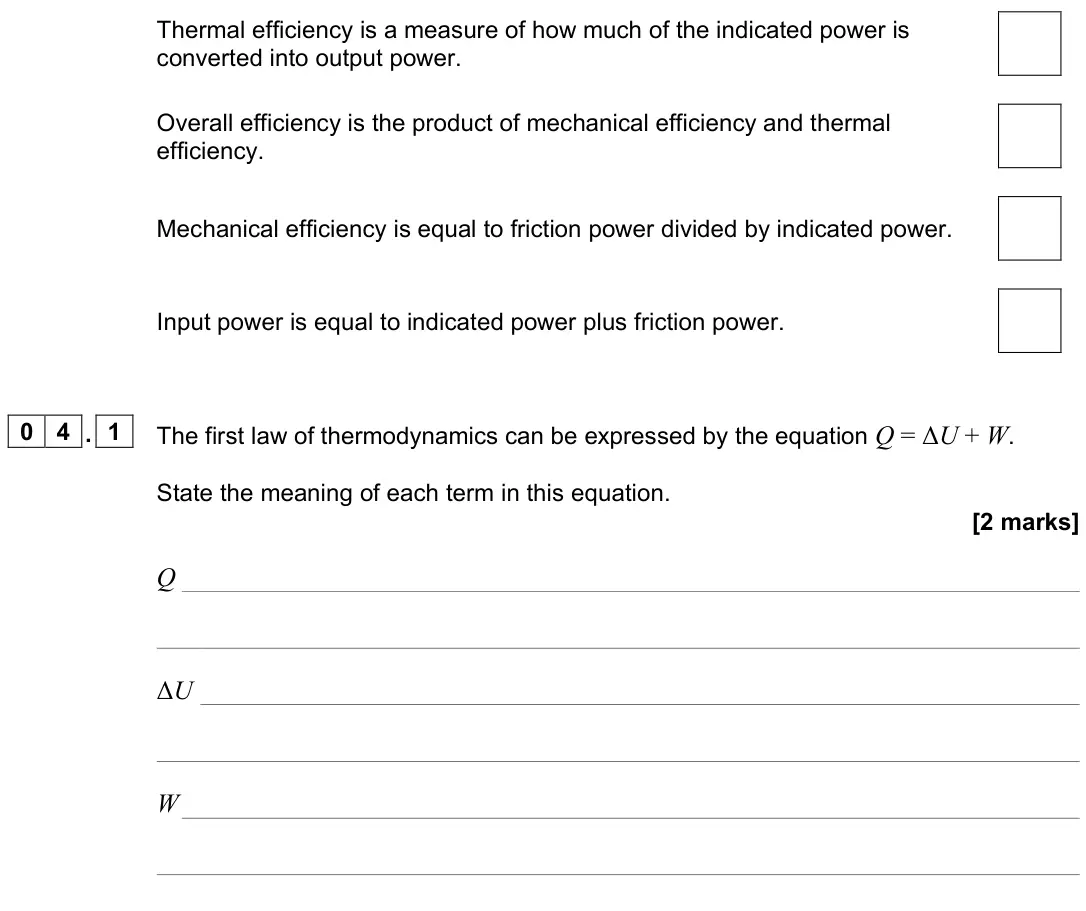
Q04.2
The whole paper ↗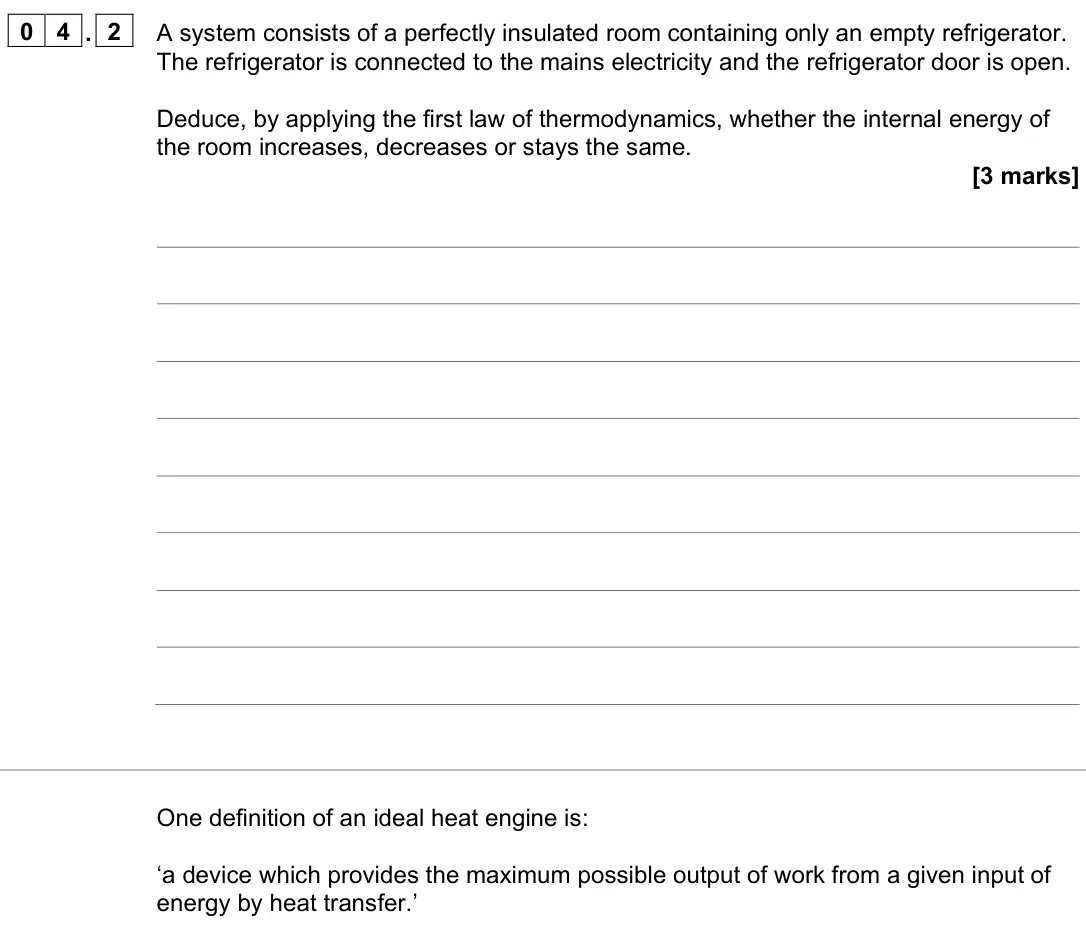
Q04.3
The whole paper ↗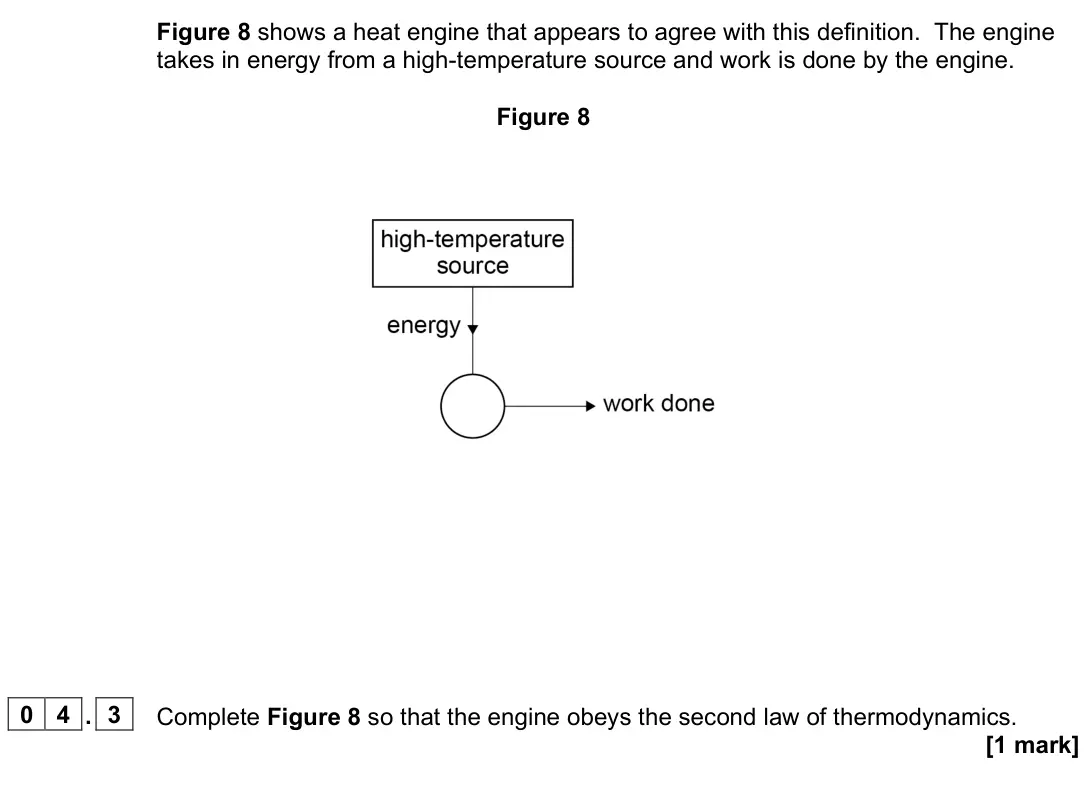
Q04.4
The whole paper ↗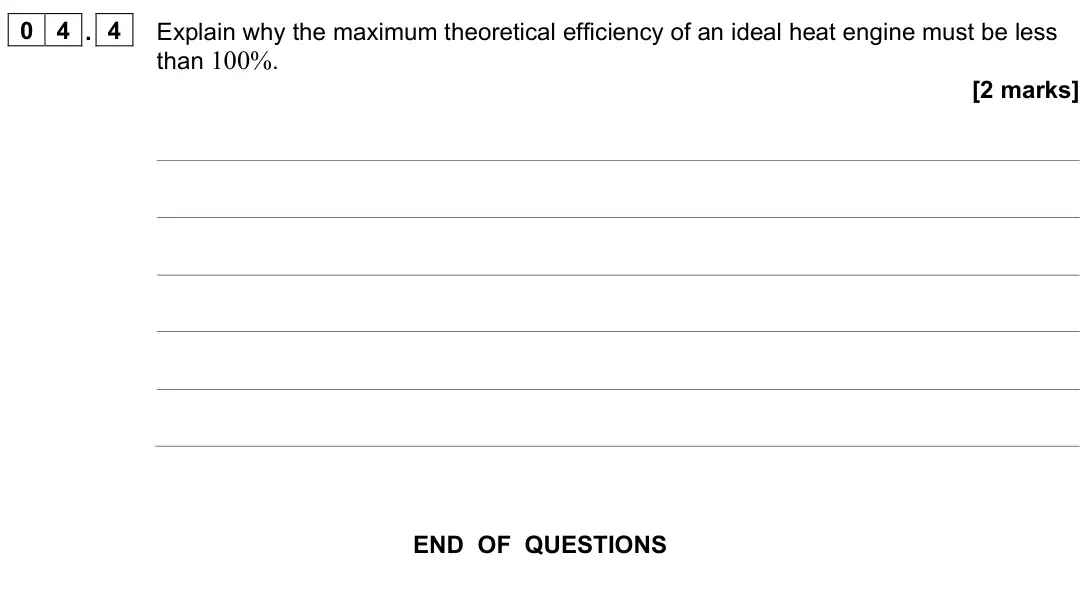
Q03.1
The whole paper ↗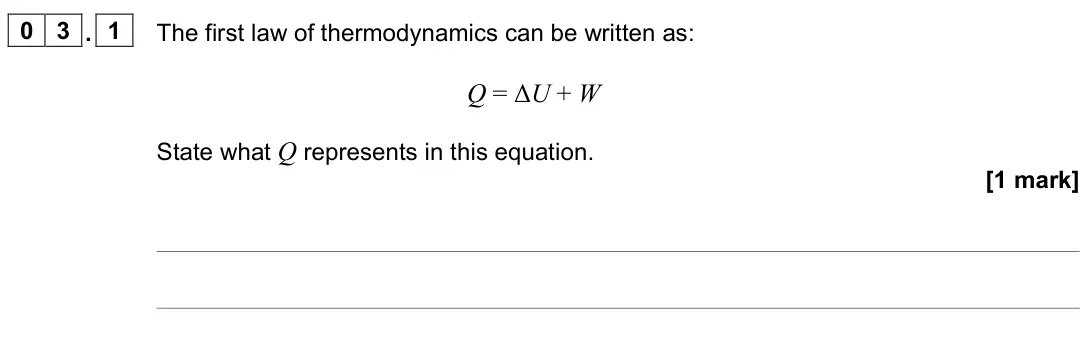
Q03.2
The whole paper ↗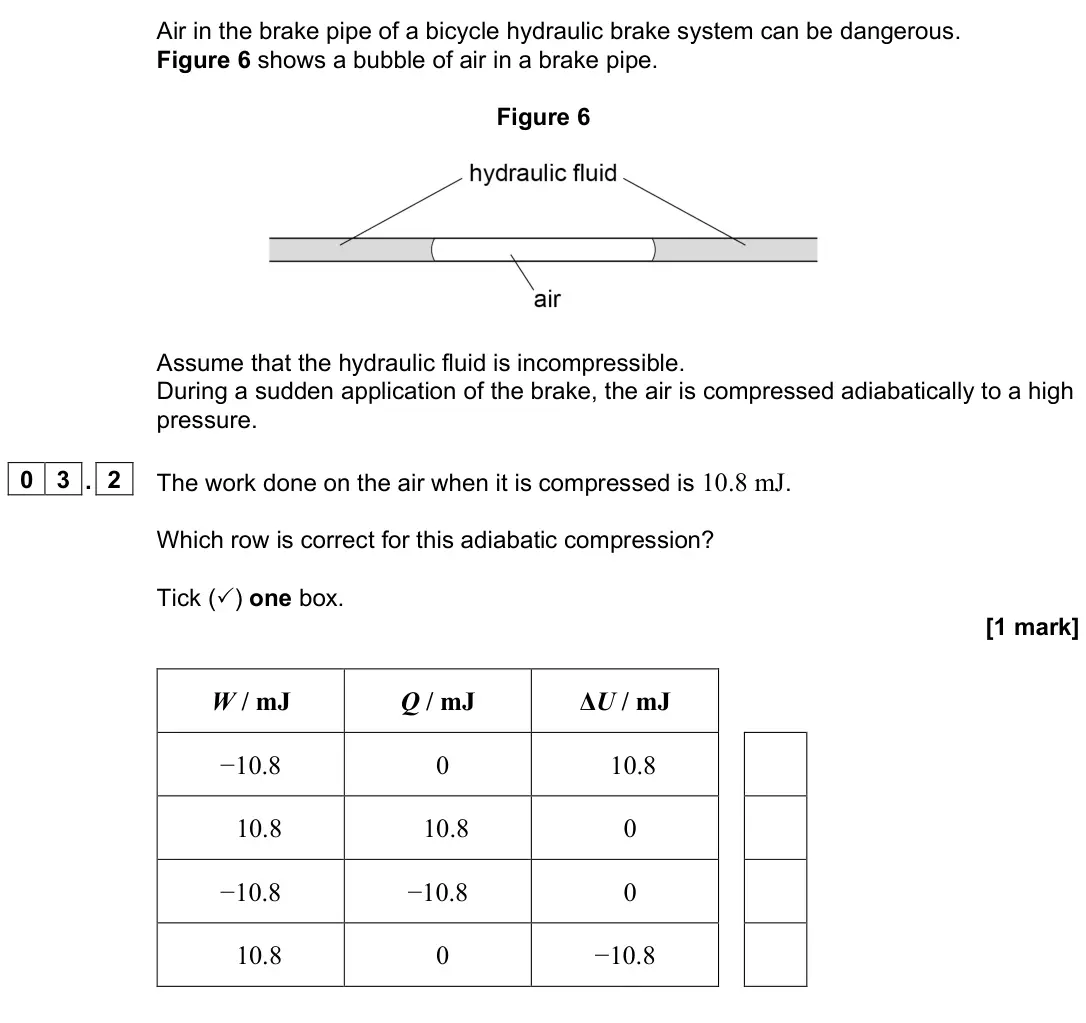
Q03.3
The whole paper ↗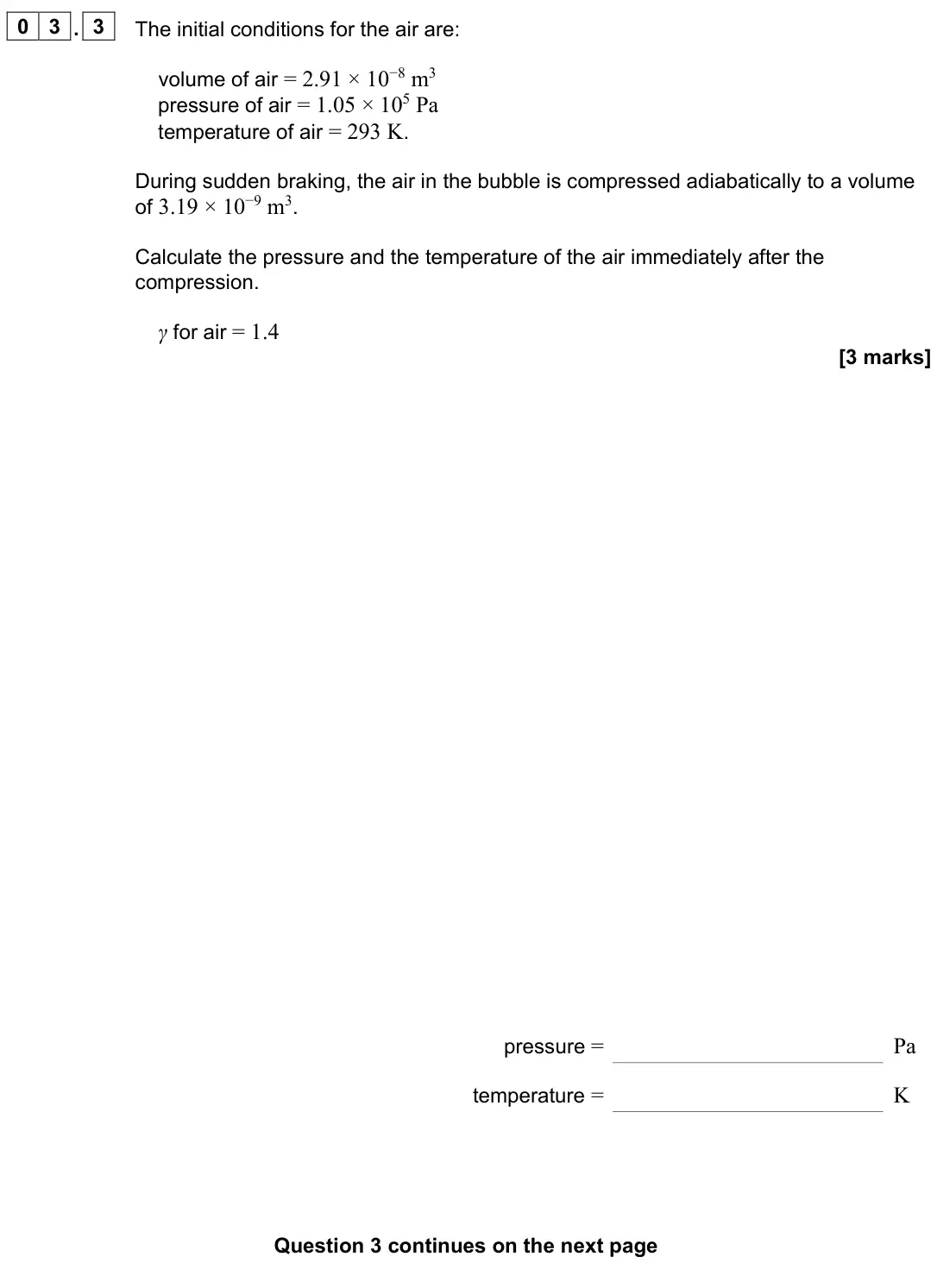
All 71 questions on Thermodynamics and engines, as a list
- June 2025, Paper 3 Engineering physics, Q03.1 (1 mark): State what is meant by an isothermal change. [1 mark] Figure 6 shows a p–V diagram in which a fixed mass of an ideal gas is taken through a cycle of three proce
- June 2025, Paper 3 Engineering physics, Q03.2 (2 marks): Calculate, in mol, the amount of gas. [2 marks] amount of gas = mol
- June 2025, Paper 3 Engineering physics, Q03.3 (1 mark): Show that the work done in process C → A is about 100 J. [1 mark]
- June 2025, Paper 3 Engineering physics, Q03.4 (3 marks): Complete Table 2 for each process and for the whole cycle. [3 marks] Table 2 Q / J W / J ΔU / J Process A → B −253 Process B → C 473 Process C → A −253 Whole cy
- June 2025, Paper 3 Engineering physics, Q03.5 (2 marks): Two criteria for a heat engine to achieve the maximum theoretical efficiency are: 1. the gas must always be at the same temperature as the hot source when energ
- June 2025, Paper 3 Engineering physics, Q03.6 (6 marks): The overall efficiency of a heat engine is defined as overall efficiency = net work output in one cycle energy supplied by heat transfer in one cycle An enginee
- June 2025, Paper 3 Engineering physics, Q04.1 (1 mark): State what is meant by the coefficient of performance of a heat pump. [1 mark] A jeweller hopes to reduce workshop heating costs by replacing a gas-fired boiler
- June 2025, Paper 3 Engineering physics, Q04.2 (3 marks): Comment on the salesperson’s claims. [3 marks]
- June 2025, Paper 3 Engineering physics, Q04.3 (1 mark): A heat pump is installed. The average COPhp over the winter period is 7.5 In this period the heat pump delivers 2880 kW h of underfloor heating. What is the ele
- June 2024, Paper 3 Engineering physics, Q03.1 (5 marks): The indicator diagram is for a rotational speed of the crankshaft of 120 rev min−1. Determine, using Figure 7, the indicated power of the engine. Assume that th
- June 2024, Paper 3 Engineering physics, Q03.2 (2 marks): The following data are taken during the test on the engine: fuel consumption = 6.44 × 10⁻⁴ m3 s−1 calorific value of fuel = 18.0 × 10⁶ J m−3 torque at crankshaf
- June 2024, Paper 3 Engineering physics, Q03.3 (2 marks): The output power of a four-stroke petrol engine of a similar working volume to that of the Lenoir engine is about 150 kW. Suggest two reasons for the very low o
- June 2024, Paper 3 Engineering physics, Q03.4 (1 mark): Which statement is correct? Tick () one box. [1 mark]
- June 2024, Paper 3 Engineering physics, Q04.1 (2 marks): The first law of thermodynamics can be expressed by the equation Q = ΔU + W. State the meaning of each term in this equation. [2 marks] Q ΔU W
- June 2024, Paper 3 Engineering physics, Q04.2 (3 marks): A system consists of a perfectly insulated room containing only an empty refrigerator. The refrigerator is connected to the mains electricity and the refrigerat
- June 2024, Paper 3 Engineering physics, Q04.3 (1 mark): Complete Figure 8 so that the engine obeys the second law of thermodynamics. [1 mark]
- June 2024, Paper 3 Engineering physics, Q04.4 (2 marks): Explain why the maximum theoretical efficiency of an ideal heat engine must be less than 100%. [2 marks]
- June 2023, Paper 3 Engineering physics, Q03.1 (1 mark): The first law of thermodynamics can be written as: Q = ΔU + W State what Q represents in this equation. [1 mark]
- June 2023, Paper 3 Engineering physics, Q03.2 (1 mark): The work done on the air when it is compressed is 10.8 mJ. Which row is correct for this adiabatic compression? Tick () one box. [1 mark] W / mJ Q / mJ ΔU / mJ
- June 2023, Paper 3 Engineering physics, Q03.3 (3 marks): The initial conditions for the air are: volume of air = 2.91 × 10⁻⁸ m3 pressure of air = 1.05 × 10⁵ Pa temperature of air = 293 K. During sudden braking, the ai
- June 2023, Paper 3 Engineering physics, Q03.4 (2 marks): To produce the adiabatic change, the brake lever is pulled very quickly. The cyclist thinks that by applying the brake slowly, the work done to compress the bub
- June 2023, Paper 3 Engineering physics, Q04 (6 marks): Figure 7 shows the p–V diagram for a theoretical diesel engine cycle. Figure 8 shows the indicator diagram for a real four-stroke diesel engine working between
- June 2023, Paper 3 Engineering physics, Q05.1 (1 mark): Calculate the efficiency of this engine. [1 mark] efficiency =
- June 2023, Paper 3 Engineering physics, Q05.2 (3 marks): Figure 10 shows another system operating between the same overall temperatures and with the same input power as the engine in Figure 9. This system consists of
- June 2022, Paper 3 Engineering physics, Q03.1 (1 mark): Explain what is meant by an adiabatic change. [1 mark]
- June 2022, Paper 3 Engineering physics, Q03.2 (2 marks): Figure 4 shows the p–V diagram for an ideal diesel engine cycle. Figure 4 In this cycle, air is compressed adiabatically from a pressure of 1.0 × 10⁵ Pa and vol
- June 2022, Paper 3 Engineering physics, Q03.3 (2 marks): Explain why the compression ratio for a diesel engine must be greater than the compression ratio for a petrol engine. [2 marks]
- June 2022, Paper 3 Engineering physics, Q03.4 (2 marks): Draw, on Figure 5, a typical indicator diagram for a real four-stroke diesel engine with the same values of V1 and V2. [2 marks] Figure 5
- June 2022, Paper 3 Engineering physics, Q03.5 (1 mark): Mark with an X on your diagram the point where the injection of fuel starts. [1 mark]
- June 2022, Paper 3 Engineering physics, Q03.6 (2 marks): Explain two differences between the ideal cycle and the indicator diagram for the real engine. [2 marks] 1 2
- June 2022, Paper 3 Engineering physics, Q04.1 (4 marks): It is claimed that the coefficient of performance (COP) of a thermoelectric refrigerator is much less than the COP of an ideal refrigerator. Discuss whether the
- June 2022, Paper 3 Engineering physics, Q04.2 (2 marks): Suggest why a small value of the COP might be acceptable for this particular application of a thermoelectric cooling element. [2 marks]
- November 2021, Paper 3 Engineering physics, Q03.1 (6 marks): Figure 4 can be used to analyse the performance of the engine. Determine, for the speed at which the engine develops its maximum brake power: • the overall effi
- November 2021, Paper 3 Engineering physics, Q03.2 (2 marks): Explain why it is not advisable to run this engine at speeds above 7000 rev min−1. Refer to Figure 4 in your answer. [2 marks]
- November 2021, Paper 3 Engineering physics, Q04.1 (5 marks): Figure 6 shows the variation of pressure p with volume V as the gas expands on the right-hand side of the piston when the correct nail is used. Figure 6 The com
- November 2021, Paper 3 Engineering physics, Q04.2 (3 marks): After a nail has been used, another nail takes its place automatically. The tool can drive up to 180 nails per minute. Discuss why the expansion cannot be isoth
- November 2021, Paper 3 Engineering physics, Q05.1 (1 mark): Which is a correct statement about an ideal heat engine? Tick () one box. [1 mark]
- November 2021, Paper 3 Engineering physics, Q05.2 (2 marks): An ideal heat engine has an efficiency of 0.33 The same engine works in reverse as an ideal refrigerator between the same hot and cold spaces. Determine the coe
- November 2020, Paper 3 Engineering physics, Q03 (6 marks): Figure 4 shows some of the equipment used to investigate the thermal and mechanical efficiencies of a single-cylinder four-stroke petrol engine. Figure 4 • Petr
- November 2020, Paper 3 Engineering physics, Q04.1 (1 mark): Which row in Table 3 shows • Process 1 in which work done is zero, and • Process 2 in which the change in internal energy is zero? Tick () one box. [1 mark] Ta
- November 2020, Paper 3 Engineering physics, Q04.2 (3 marks): When irregular particles are packed, air gaps are left between the particles. The true volume of a quantity of irregular particles must be determined using a me
- November 2020, Paper 3 Engineering physics, Q04.3 (2 marks): Sketch on Figure 6 the variation of pressure with volume when the plunger is pushed in fully very quickly and then left for several seconds. Assume no leakage p
- November 2020, Paper 3 Engineering physics, Q04.4 (2 marks): Explain why the compression of a gas can be considered to be an isothermal change when the gas is compressed very slowly. [2 marks]
- November 2020, Paper 3 Engineering physics, Q05.1 (2 marks): Explain how the second law of thermodynamics predicts that a heat engine can never be 100% efficient. [2 marks]
- November 2020, Paper 3 Engineering physics, Q05.2 (4 marks): A company plans to build a geothermal power station in a region where there is hot rock deep below the surface. The scheme is shown in Figure 7. Figure 7 In the
- June 2019, Paper 3 Engineering physics, Q03.1 (1 mark): Show, by calculation, that the volume at B is 4.1 × 10⁻² m3. [1 mark]
- June 2019, Paper 3 Engineering physics, Q03.2 (2 marks): The temperature of the air between A and B is 295 K. Show that the temperature of the air at C is about 420 K. [2 marks]
- June 2019, Paper 3 Engineering physics, Q03.3 (2 marks): An ideal engine based on this cycle uses a device called an economiser. The economiser stores all the energy transferred in the cooling process D → A and gives
- June 2019, Paper 3 Engineering physics, Q03.4 (2 marks): Explain why W is equal to Q in process A → B and in process C → D. [2 marks]
- June 2019, Paper 3 Engineering physics, Q03.5 (3 marks): It is claimed that the efficiency of this engine cycle is the same as the maximum theoretical efficiency of a heat engine operating between the same temperature
- June 2019, Paper 3 Engineering physics, Q03.6 (2 marks): Discuss one problem that would be faced by an engineer designing a real engine based on this cycle. [2 marks]
- June 2019, Paper 3 Engineering physics, Q04.1 (2 marks): A typical conventional tumble-dryer uses about 0.6 kW h per kg of clothes. A heat pump tumble-dryer uses about 0.25 kW h per kg. Explain why the heat pump tumbl
- June 2019, Paper 3 Engineering physics, Q04.2 (3 marks): The cold space of the heat pump is the room in which the tumble-dryer is placed. The hot space is the air in the tumble-dryer and is at a temperature of 160 °C.
- June 2018, Paper 3 Engineering physics, Q03.1 (1 mark): Which statement about this cycle is true? Tick () the correct answer. [1 mark]
- June 2018, Paper 3 Engineering physics, Q03.2 (5 marks): The cycle in Figure 3 may be modified by allowing the air to continue to expand adiabatically from state 4 until it is at atmospheric pressure at state 5. Figur
- June 2018, Paper 3 Engineering physics, Q03.3 (2 marks): The first law of thermodynamics can be written as Q = ΔU + W State the meaning of the terms Q and ΔU in this equation. [2 marks] Q ΔU
- June 2018, Paper 3 Engineering physics, Q03.4 (2 marks): For the air in process 5 → 1 in Figure 4, ΔU = –374 J Calculate the energy that must be removed by cooling for process 5 → 1. [2 marks] energy removed by coolin
- June 2018, Paper 3 Engineering physics, Q03.5 (3 marks): 0.060 mol of air is taken through the cycle. Determine the maximum temperature in the cycle. [3 marks] maximum temperature = K
- June 2018, Paper 3 Engineering physics, Q04 (6 marks): The National Grid is supplied mainly from power stations which have overall efficiencies of up to about 40% Table 1 shows the average power requirements of a la
- June 2017, Paper 3 Engineering physics, Q03.1 (4 marks): The gas is initially at a pressure of 1.2 × 10⁶ Pa, a volume of 9.0 × 10⁻⁵ m3 and a temperature of 290 K. When the lid is closed quickly the gas is compressed r
- June 2017, Paper 3 Engineering physics, Q03.2 (2 marks): Explain why the rapid compression of the gas can be assumed to be an adiabatic process. [2 marks]
- June 2017, Paper 3 Engineering physics, Q03.3 (3 marks): When the lid is closed slowly, the compression can be assumed to be isothermal. The gas can be compressed either isothermally or adiabatically from the same ini
- June 2017, Paper 3 Engineering physics, Q04 (6 marks): Figure 5 shows the p—V diagram for a theoretical petrol engine cycle compared to the indicator diagram for a real four-stroke petrol engine with the same maximu
- June 2017, Paper 3 Engineering physics, Q05.1 (1 mark): An ideal heat pump and an ideal refrigerator operate between the same hot and cold spaces. Which statement relating to the coefficient of performance (COP) is c
- June 2017, Paper 3 Engineering physics, Q05.2 (3 marks): An ideal refrigerator operates between a cold space at a temperature of ̶ 1 °C and a hot space at a temperature of 70 °C. Calculate the input power to the refri
- Specimen, Paper 3 Engineering physics, Q03.1 (3 marks): A single-cylinder air motor running on compressed air has the theoretical indicator diagram shown in Figure 4. • From B to C the high-pressure air pushes a pist
- Specimen, Paper 3 Engineering physics, Q03.2 (6 marks): A single-cylinder air motor running on compressed air has the theoretical indicator diagram shown in Figure 4. • From B to C the high-pressure air pushes a pist
- Specimen, Paper 3 Engineering physics, Q03.3 (4 marks): A single-cylinder air motor running on compressed air has the theoretical indicator diagram shown in Figure 4. • From B to C the high-pressure air pushes a pist
- Specimen, Paper 3 Engineering physics, Q03.4 (1 mark): A single-cylinder air motor running on compressed air has the theoretical indicator diagram shown in Figure 4. • From B to C the high-pressure air pushes a pist
- Specimen, Paper 3 Engineering physics, Q04.1: A company claims to be able to provide a combined heat and power plant for a mark garden that requires both electrical power and space heating for greenhouses.
- Specimen, Paper 3 Engineering physics, Q04.2 (5 marks): A company claims to be able to provide a combined heat and power plant for a mark garden that requires both electrical power and space heating for greenhouses.
Questions, mark schemes and examiner’s reports are © AQA, from their published past papers. Plumi isn’t affiliated with any exam board. Want whole papers? Every AQA A-Level Physics paper.
Rather write your answers by hand on iPad? Plumi marks them against the same mark schemes.