 plumi
Radioactivity: AQA A‑Level Physics questions
Every AQA A-Level Physics exam question on 3.8.1 Radioactivity, 2016–2025, with its mark scheme and examiner’s report.
Find questions2,714
Calculations
Q01.1
The whole paper ↗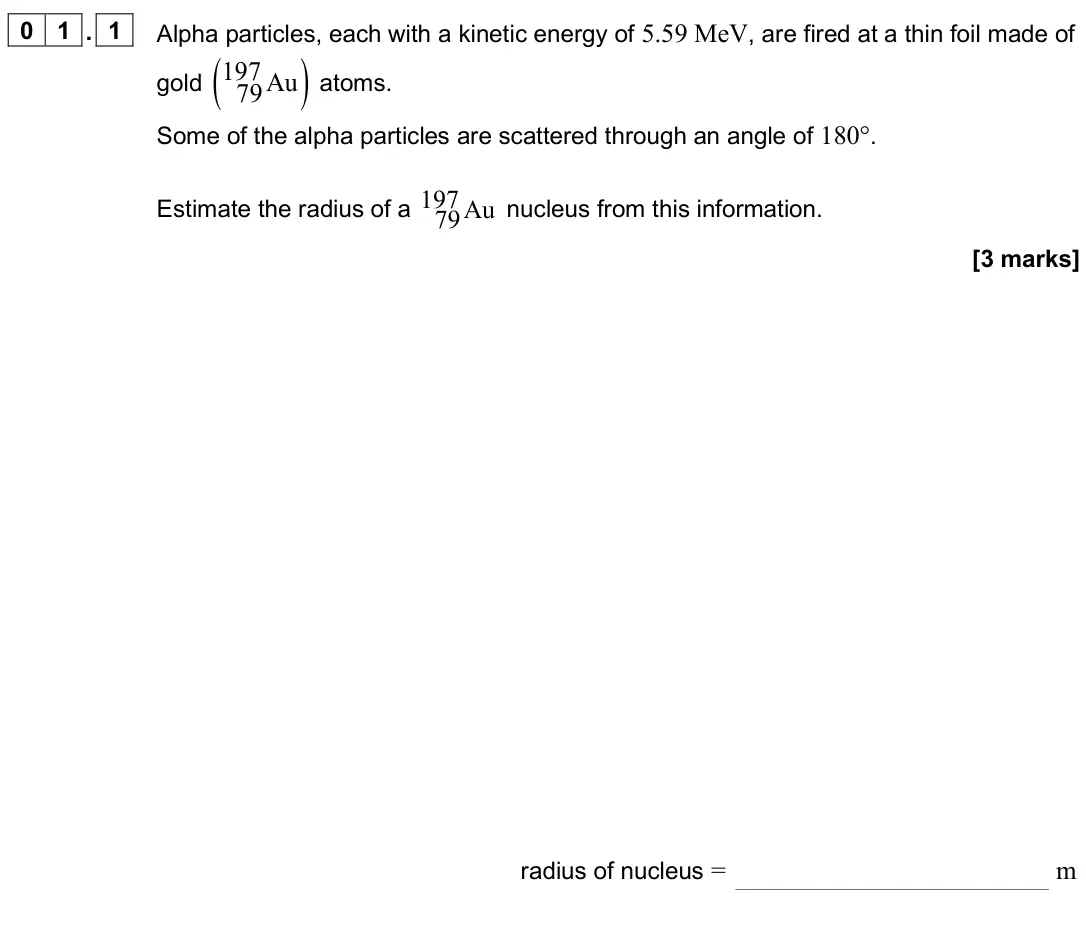
Q01.2
The whole paper ↗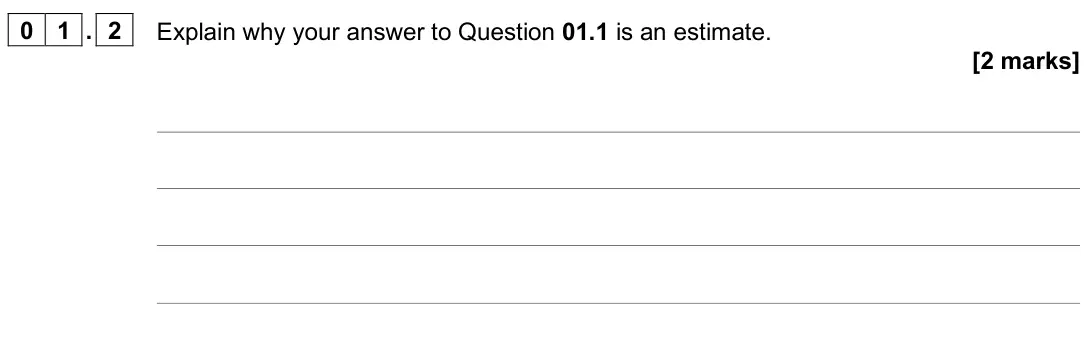
Q01.3
The whole paper ↗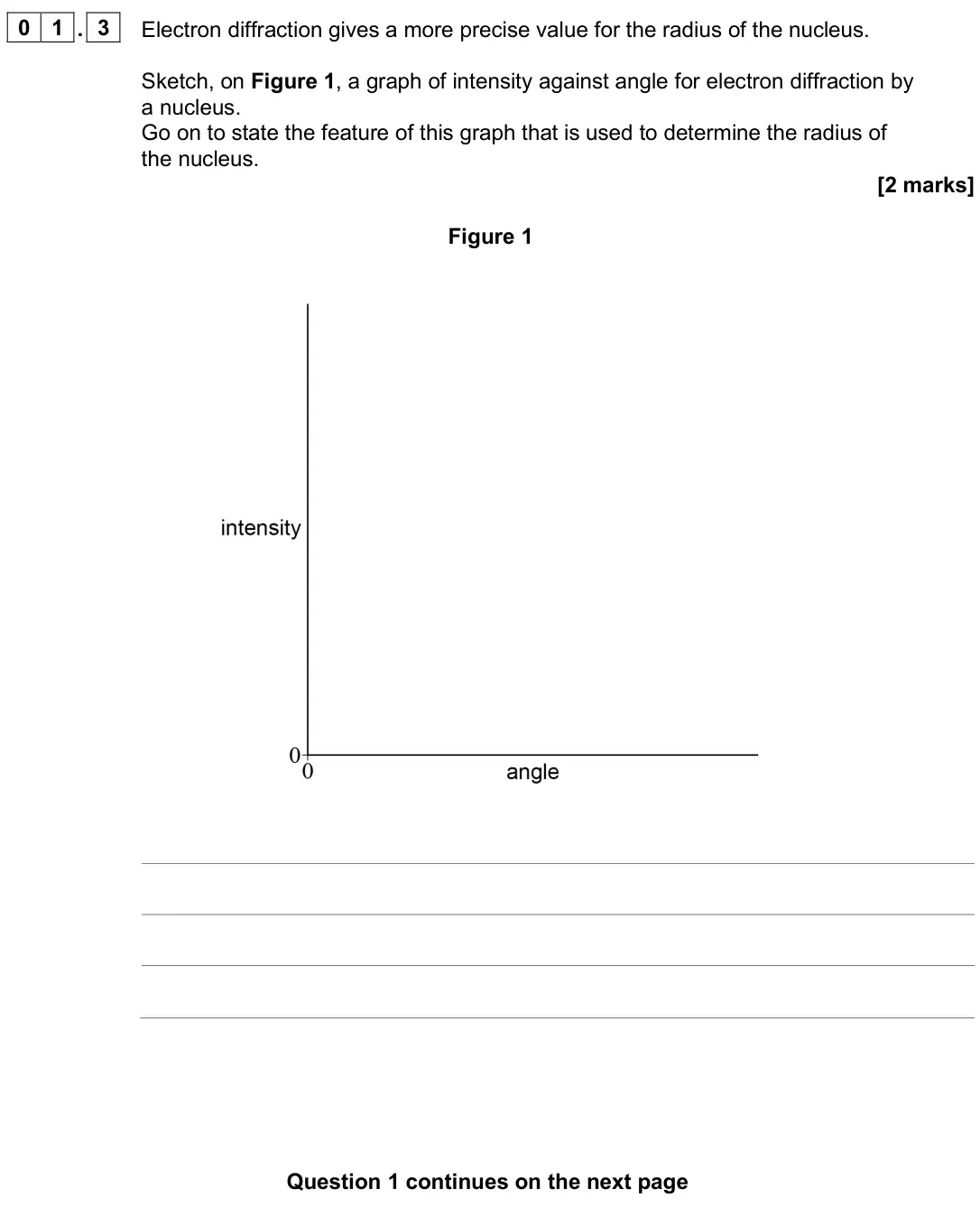
Q01.4
The whole paper ↗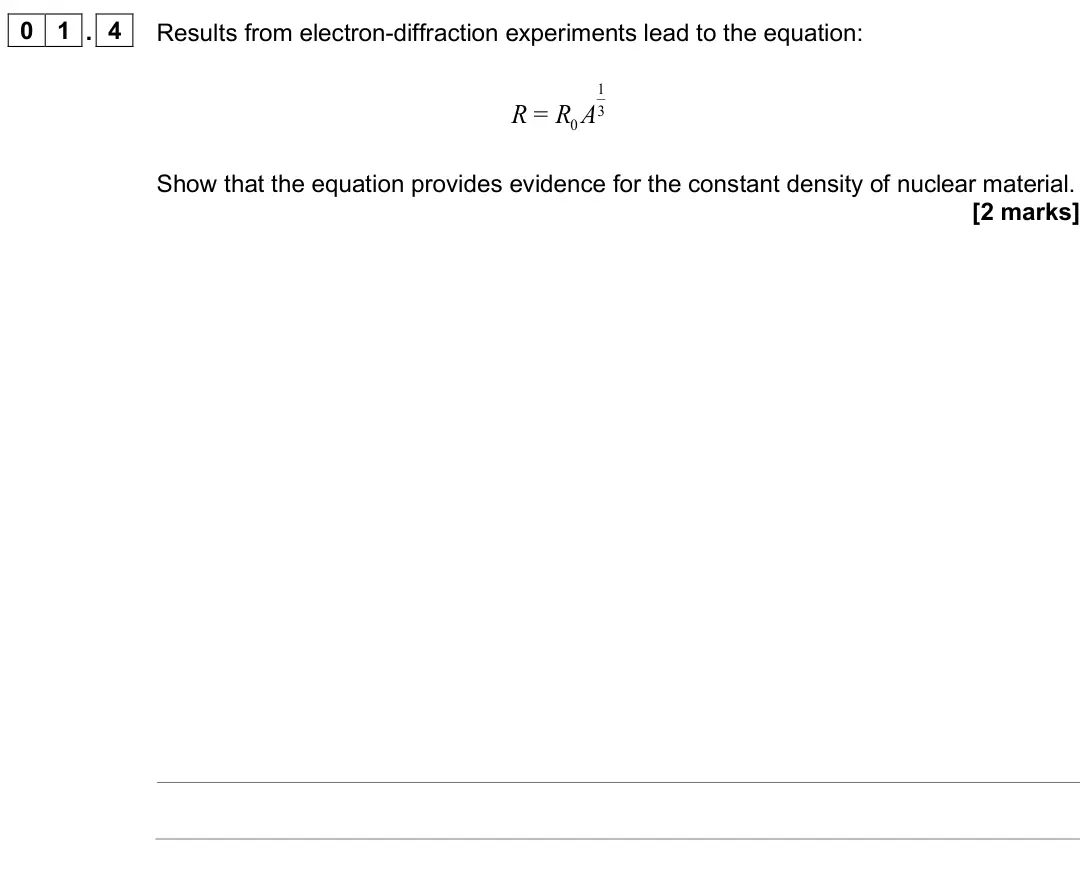
Q03.1
The whole paper ↗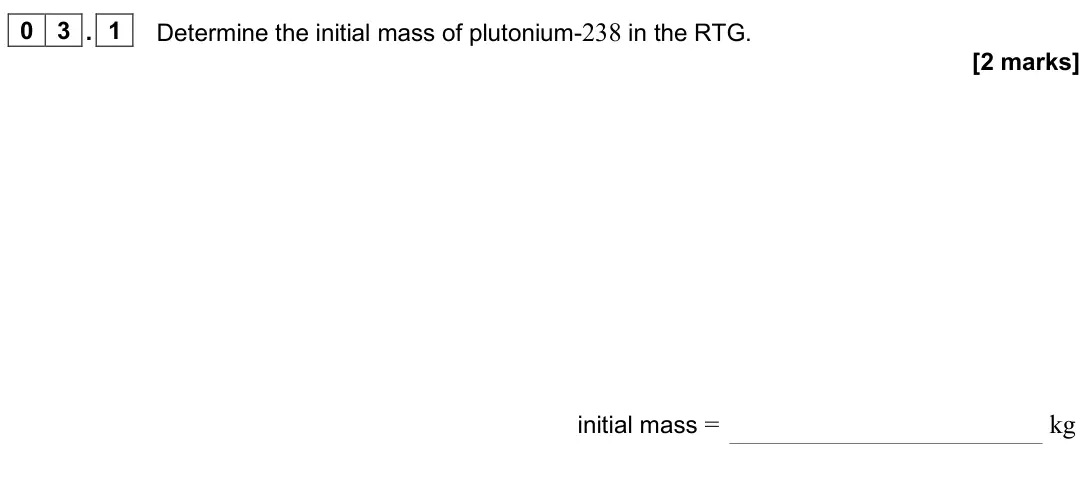
Q03.2
The whole paper ↗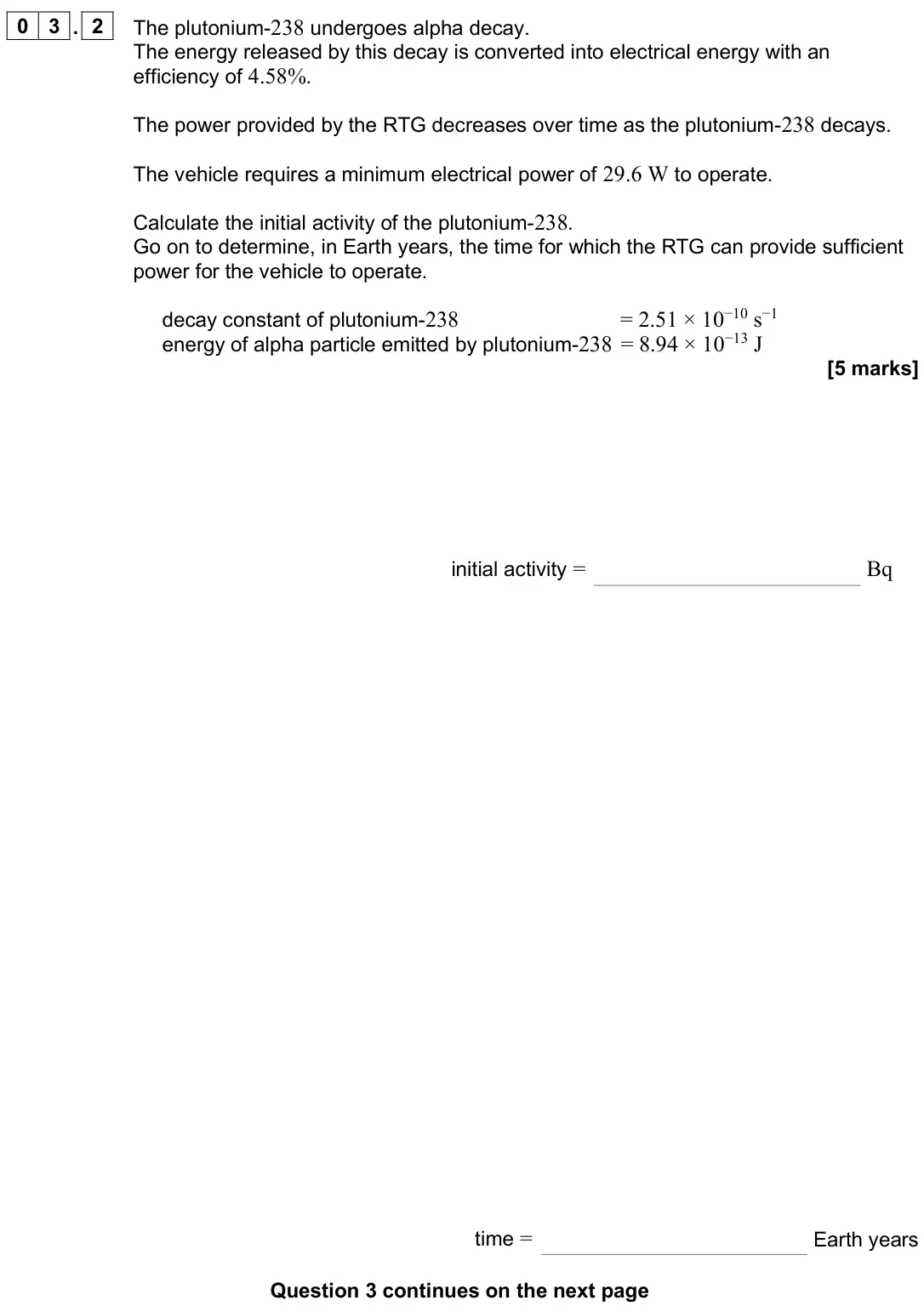
Q04.1
The whole paper ↗
Q04.1
The whole paper ↗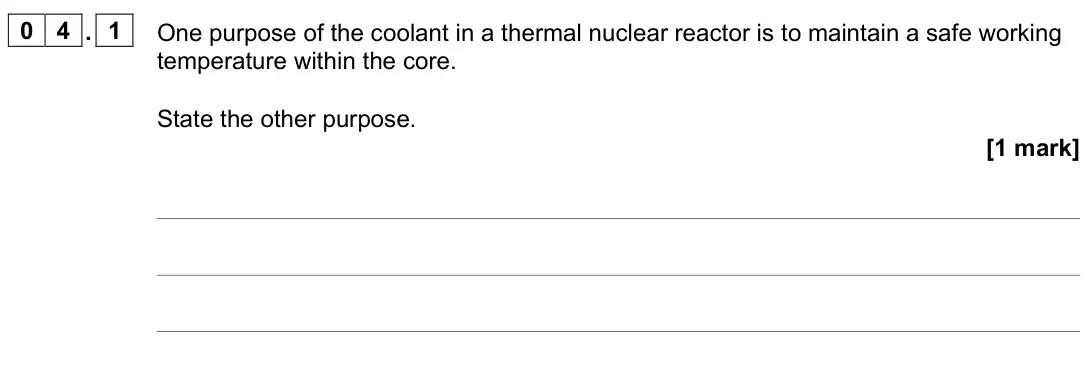
Q04.2
The whole paper ↗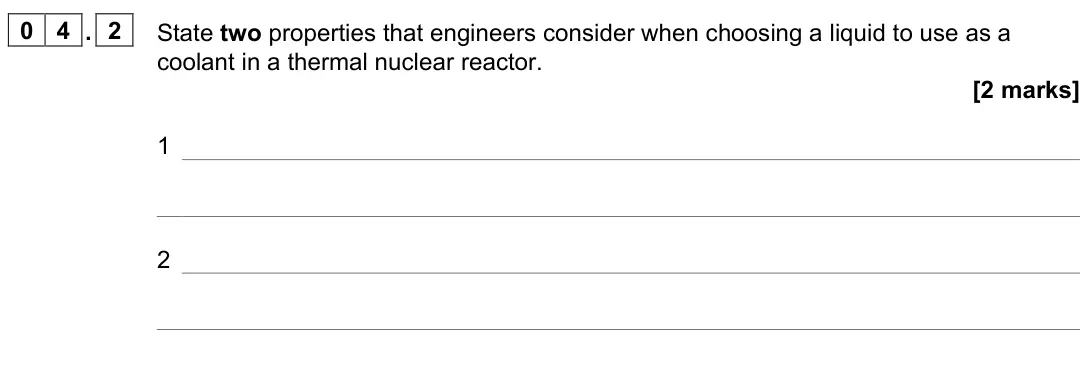
Q04.3
The whole paper ↗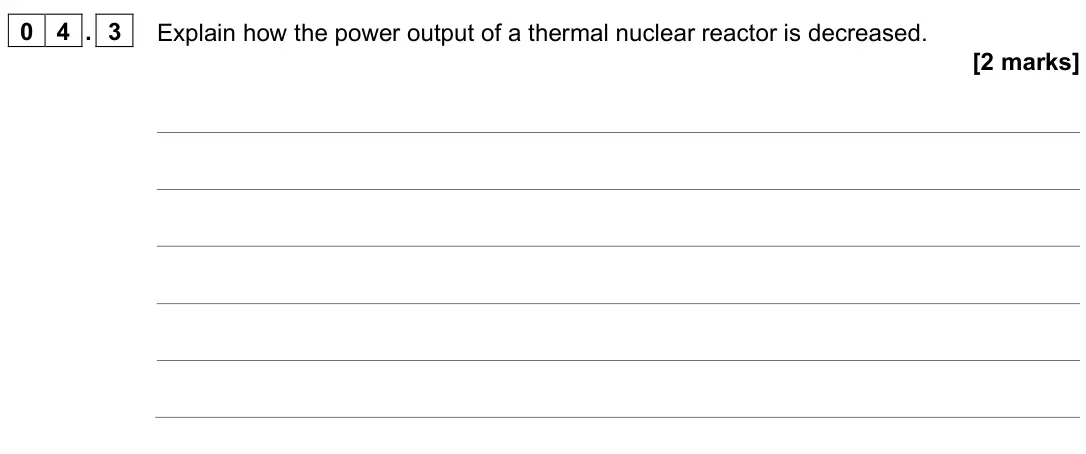
Q07.1
The whole paper ↗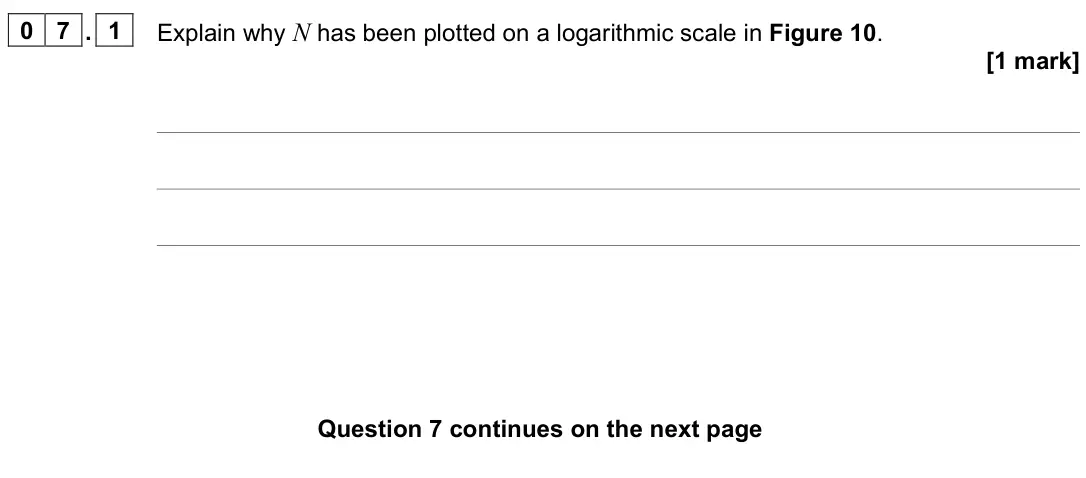
Q07.2
The whole paper ↗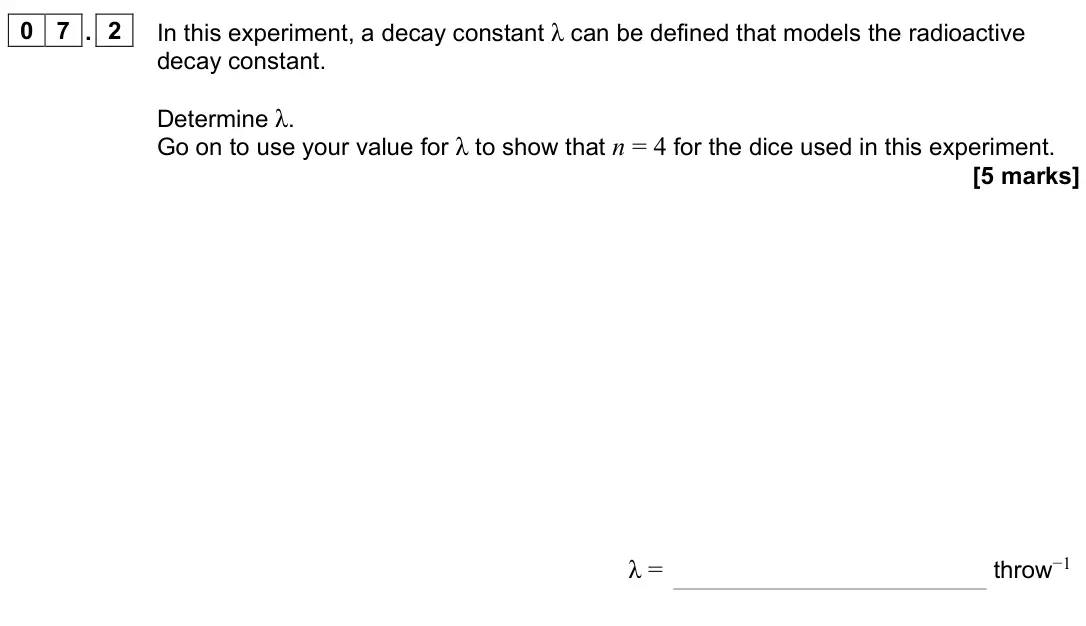
Q07.3
The whole paper ↗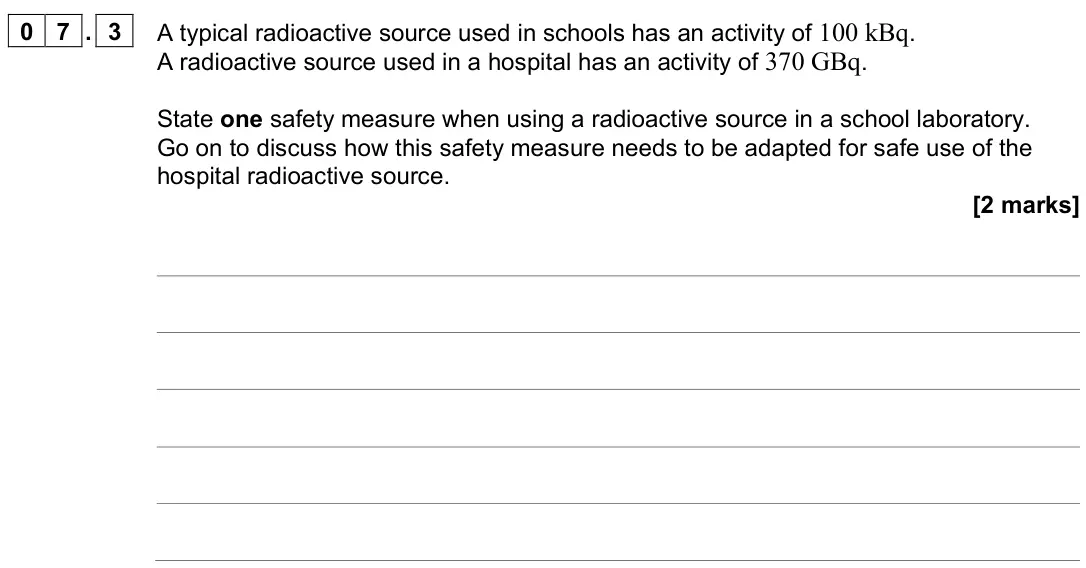
All 164 questions on Radioactivity, as a list
- June 2025, Paper 2, Q01.1 (3 marks): Alpha particles, each with a kinetic energy of 5.59 MeV, are fired at a thin foil made of gold ( ) 197 Au 79 atoms. Some of the alpha particles are scattered th
- June 2025, Paper 2, Q01.2 (2 marks): Explain why your answer to Question 01.1 is an estimate. [2 marks]
- June 2025, Paper 2, Q01.3 (2 marks): Electron diffraction gives a more precise value for the radius of the nucleus. Sketch, on Figure 1, a graph of intensity against angle for electron diffraction
- June 2025, Paper 2, Q01.4 (2 marks): Results from electron-diffraction experiments lead to the equation: 1 3 0 = R R A Show that the equation provides evidence for the constant density of nuclear m
- June 2025, Paper 2, Q03.1 (2 marks): Determine the initial mass of plutonium-238 in the RTG. [2 marks] initial mass = kg
- June 2025, Paper 2, Q03.2 (5 marks): The plutonium-238 undergoes alpha decay. The energy released by this decay is converted into electrical energy with an efficiency of 4.58%. The power provided b
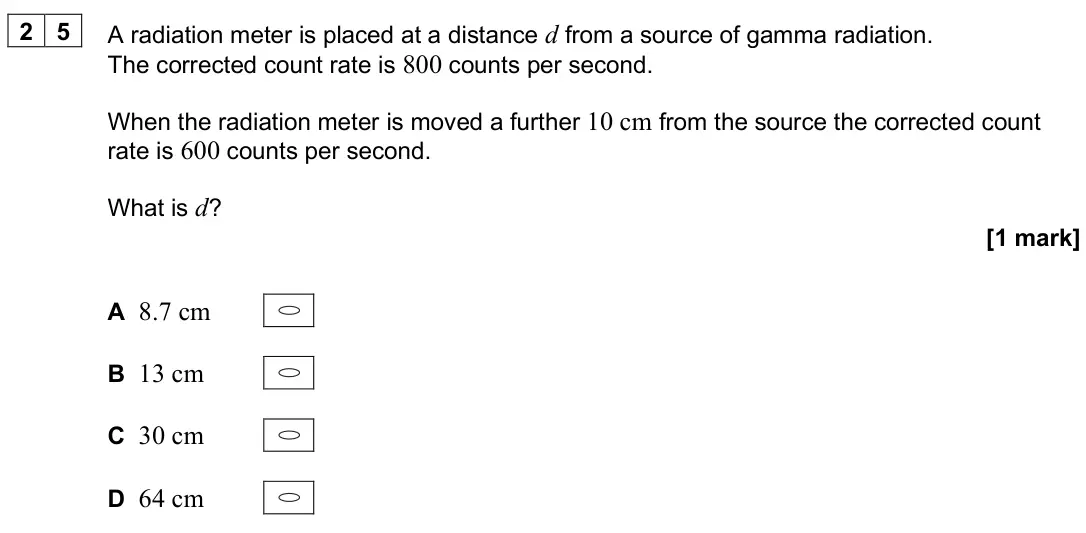
- June 2025, Paper 2, Q25 (1 mark): A radiation meter is placed at a distance d from a source of gamma radiation. The corrected count rate is 800 counts per second. When the radiation meter is mov
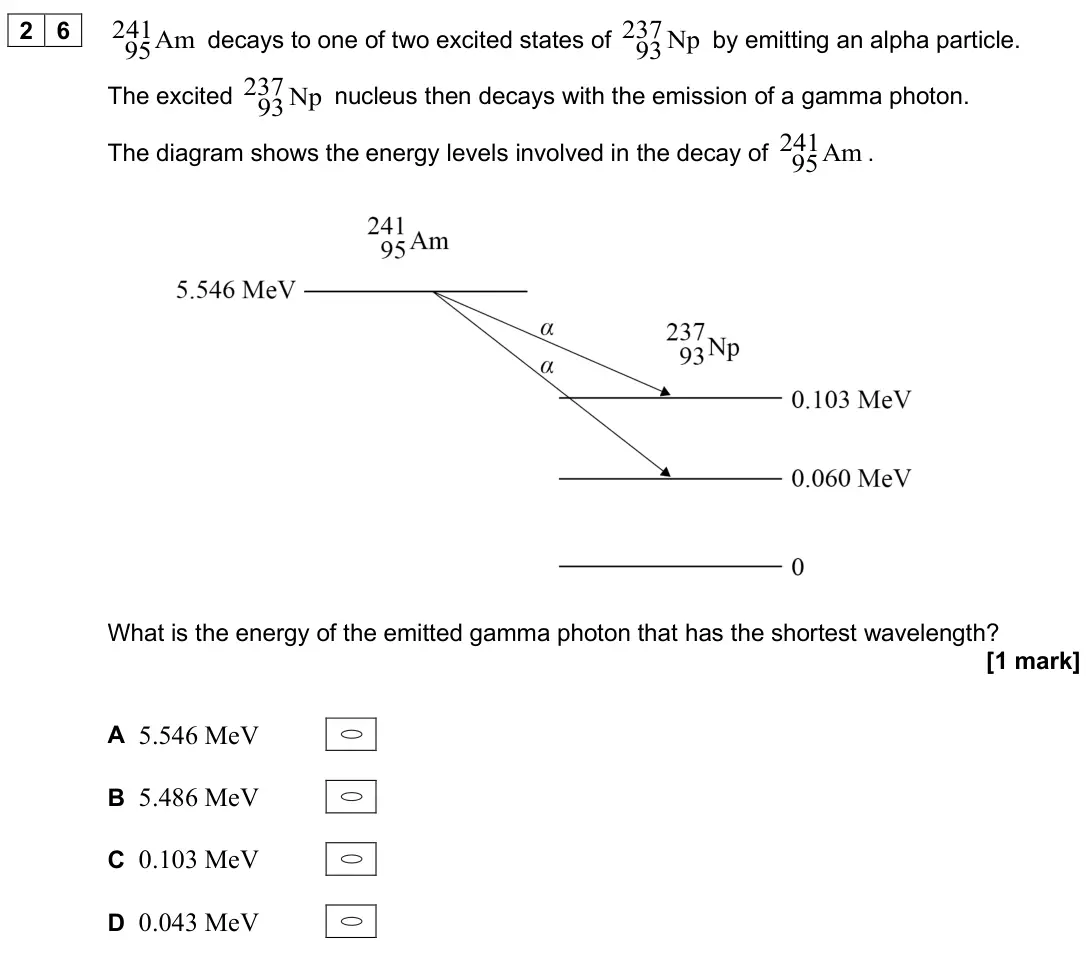
- June 2025, Paper 2, Q26 (1 mark): 241Am 95 decays to one of two excited states of 237 Np 93 by emitting an alpha particle. The excited 237 Np 93 nucleus then decays with the emission of a gamma
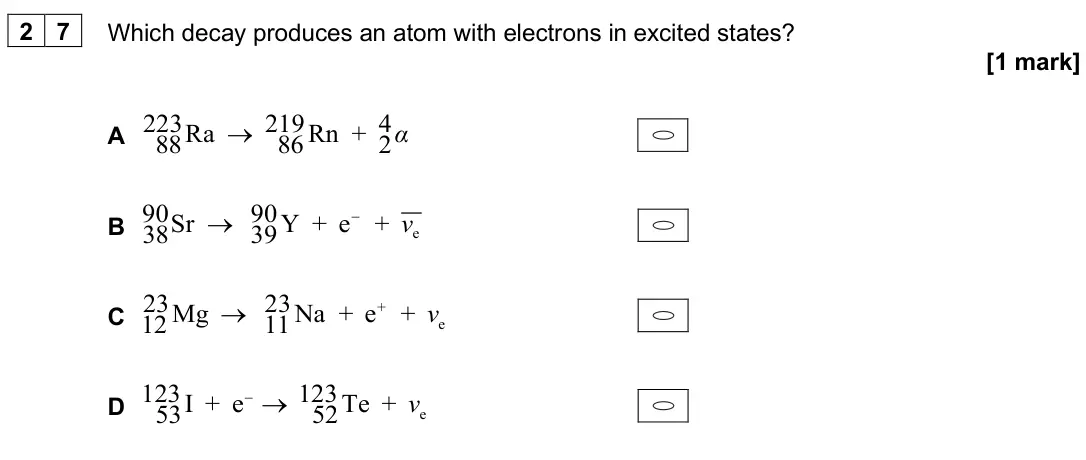
- June 2025, Paper 2, Q27 (1 mark): Which decay produces an atom with electrons in excited states? [1 mark] A 223 219 4 Ra Rn + 88 86 2α → B e 90 90 Sr Y + e + 38 39 v − → C + e 23 23 Mg Na + e +
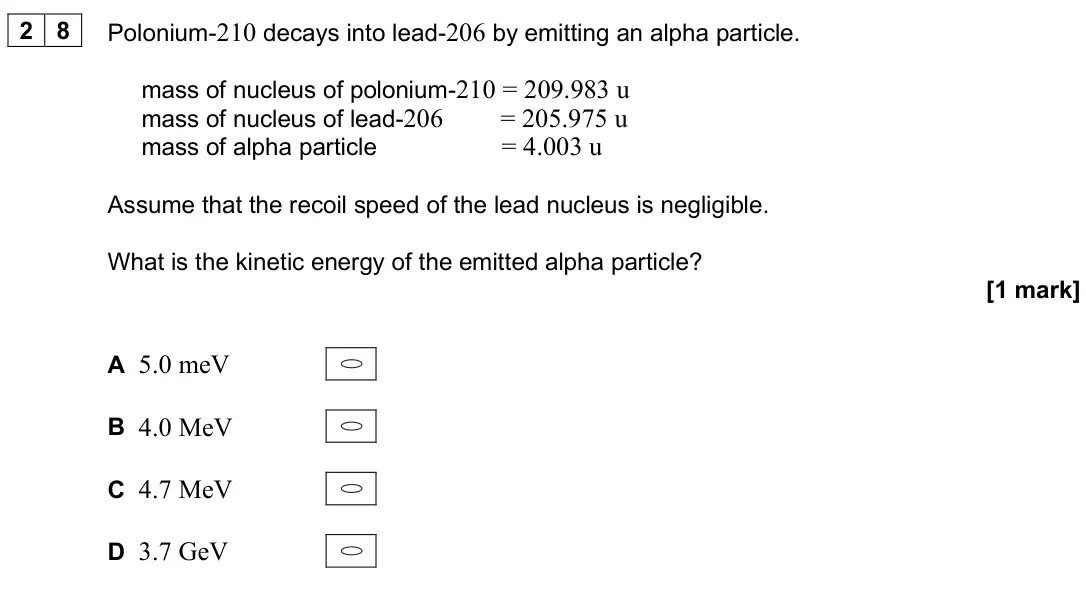
- June 2025, Paper 2, Q28 (1 mark): Polonium-210 decays into lead-206 by emitting an alpha particle. mass of nucleus of polonium-210 = 209.983 u mass of nucleus of lead-206 = 205.975 u mass of alp
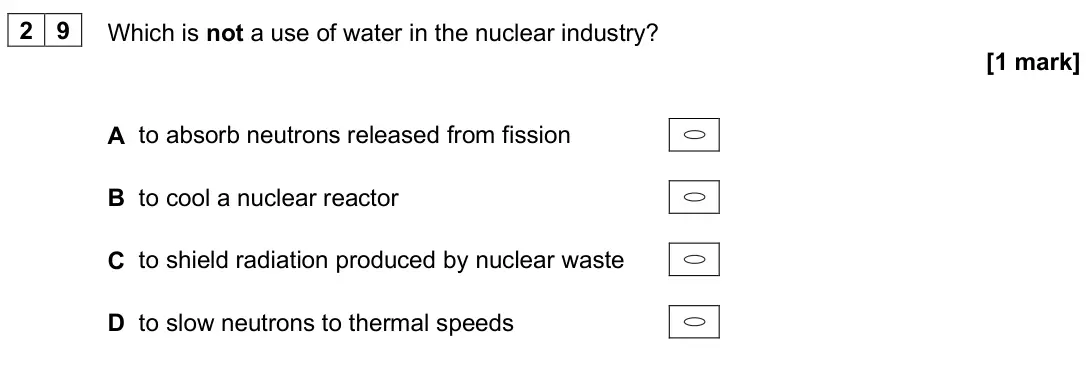
- June 2025, Paper 2, Q29 (1 mark): Which is not a use of water in the nuclear industry? [1 mark] A to absorb neutrons released from fission B to cool a nuclear reactor C to shield radiation produ
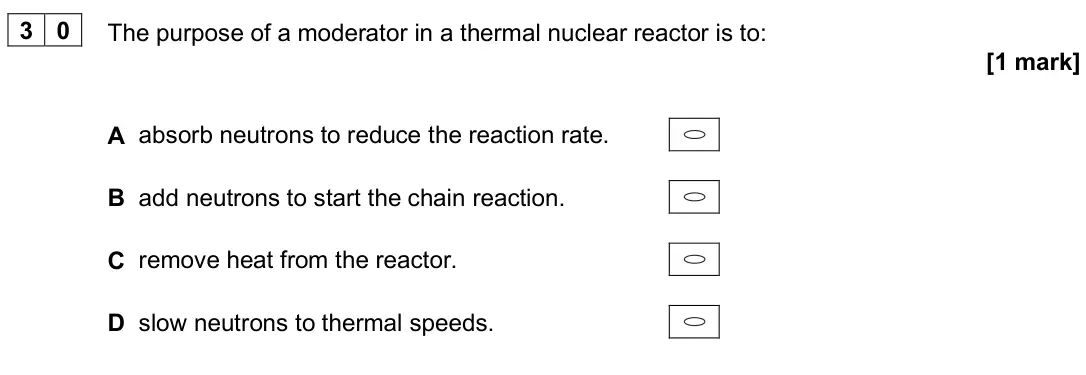
- June 2025, Paper 2, Q30 (1 mark): The purpose of a moderator in a thermal nuclear reactor is to: [1 mark] A absorb neutrons to reduce the reaction rate. B add neutrons to start the chain reactio
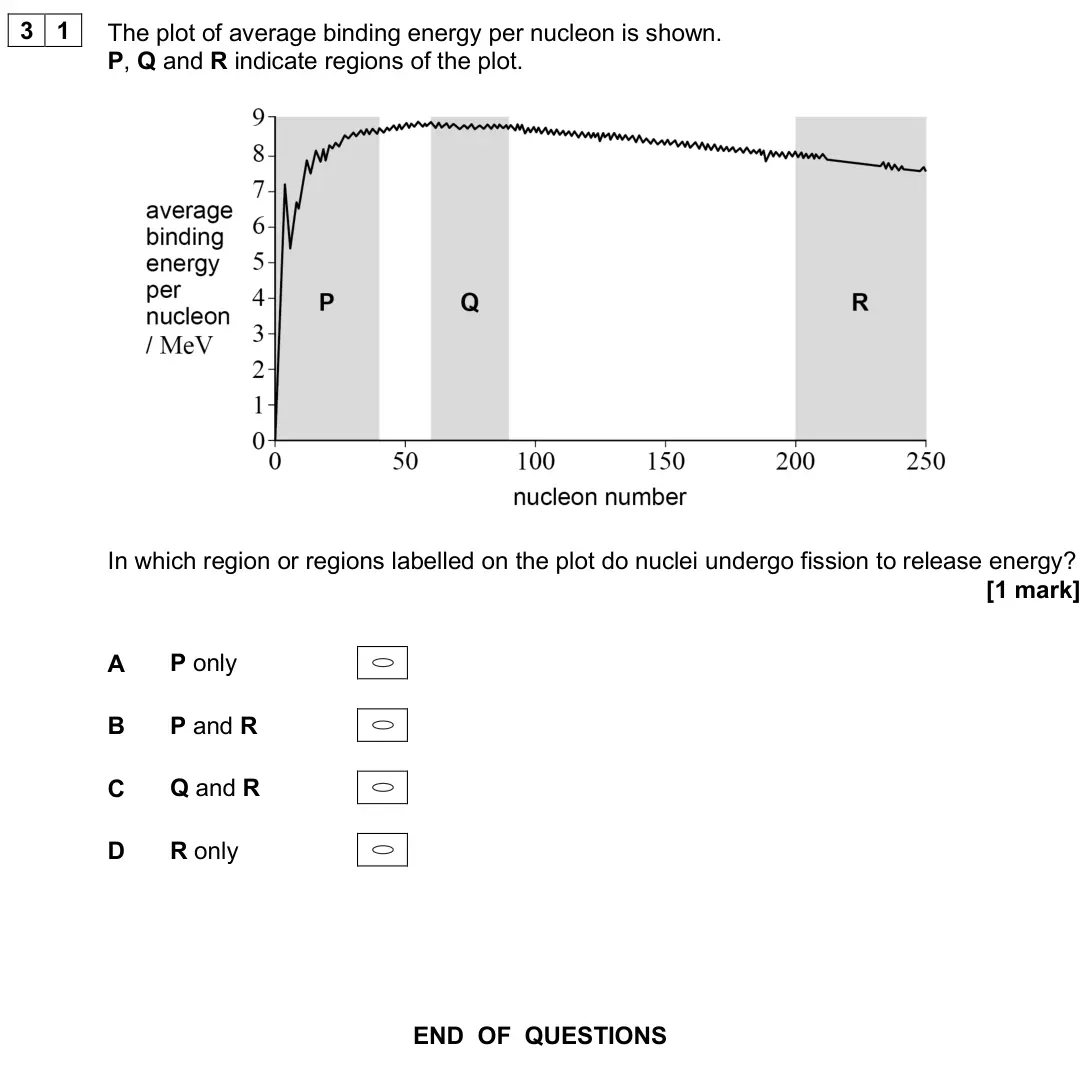
- June 2025, Paper 2, Q31 (1 mark): The plot of average binding energy per nucleon is shown. P, Q and R indicate regions of the plot. In which region or regions labelled on the plot do nuclei unde
- June 2024, Paper 1, Q04.1 (2 marks): Show that the kinetic energy of the neutron represents approximately 80% of the total energy transferred. [2 marks]
- June 2024, Paper 2, Q04.1 (1 mark): One purpose of the coolant in a thermal nuclear reactor is to maintain a safe working temperature within the core. State the other purpose. [1 mark]
- June 2024, Paper 2, Q04.2 (2 marks): State two properties that engineers consider when choosing a liquid to use as a coolant in a thermal nuclear reactor. [2 marks] 1 2
- June 2024, Paper 2, Q04.3 (2 marks): Explain how the power output of a thermal nuclear reactor is decreased. [2 marks]
- June 2024, Paper 2, Q07.1 (1 mark): Explain why N has been plotted on a logarithmic scale in Figure 10. [1 mark]
- June 2024, Paper 2, Q07.2 (5 marks): In this experiment, a decay constant λ can be defined that models the radioactive decay constant. Determine λ. Go on to use your value for λ to show that n = 4
- June 2024, Paper 2, Q07.3 (2 marks): A typical radioactive source used in schools has an activity of 100 kBq. A radioactive source used in a hospital has an activity of 370 GBq. State one safety me
- June 2024, Paper 2, Q07.4 (2 marks): X-rays are a form of ionising radiation. A person has check-ups with a dentist every six months. The dentist only takes X-ray images when the person has reporte
- June 2024, Paper 2, Q17 (1 mark): The following reaction occurs when a proton and a carbon-13 ( ) 13C 6 nucleus fuse. 13 1 14 C p N 6 1 7 + → mass of 13C 6 nucleus = 13.00007 u mass of 14 N 7 nu
- June 2024, Paper 2, Q18 (1 mark): The equation represents a typical fission reaction. 235 1 87 146 1 U n Br La 3 n 92 0 35 57 0 + → + + Which statement about this reaction is not true? [1 mark]
- June 2024, Paper 2, Q19 (1 mark): 5.6 kW h of heat energy is released when 1.0 kg of wood pellets are burnt in a power station. What is the mass lost in burning 1.0 kg of wood pellets? [1 mark]
- June 2024, Paper 2, Q20 (1 mark): The nuclear radius of an element with nucleon number x is r. What is the nuclear radius of an element with nucleon number y? [1 mark] A 3 x r y B 3
- June 2024, Paper 2, Q29 (1 mark): What can be deduced about the radius r of a nucleus of gold from the scattering of alpha particles by gold nuclei? [1 mark] A r < 10−14 m B r < 10−15 m C r ≈ 10
- June 2024, Paper 2, Q30 (1 mark): The graph shows a plot of neutron number N against proton number Z for the known atomic nuclei. The nuclide 115 Rh 45 is likely to decay by [1 mark] A α emissio
- June 2024, Paper 2, Q31 (1 mark): Uranium-238 absorbs a neutron in the first stage in a series of nuclear reactions that end in a nucleus Z. 238U n X 92 + → e X Y v + + − → β e Y Z v + + − → β H
- June 2024, Paper 2, Q32 (1 mark): A rock sample is found to contain the stable isotope lead-207. When it was formed, the rock contained uranium-235 but did not contain any lead-207. Uranium-235
- June 2023, Paper 2, Q04.4 (3 marks): The alpha source in Figure 4 is moved to different heights h above the mesh. Figure 7 shows how the number of sparks N produced in 10 minutes varies with h. No
- June 2023, Paper 2, Q06.1 (2 marks): Nuclear radii can be estimated using either alpha particles or high-energy electrons. State two advantages of using high-energy electrons rather than alpha part
- June 2023, Paper 2, Q06.2 (2 marks): Figure 11 shows a beam of electrons, each with the same high energy, incident on a target gas. The electrons are diffracted by the nuclei in the gas. The intens
- June 2023, Paper 2, Q06.3 (2 marks): The radius R of a nucleus is related to its nucleon number by 1 3 0 R R A = . Show that this equation is consistent with the idea that all nuclei have the same
- June 2023, Paper 2, Q06.4 (1 mark): The equation 1 3 0 R R A = is derived from experimental data. Suggest one reason why the constant density of nuclear material derived from this equation is only
- June 2023, Paper 2, Q06.5 (3 marks): The measured radius R of 35Cl 17 is 4.02 × 10⁻¹⁵ m. Calculate an estimate of • the constant R0 • the density of nuclear material. [3 marks] R0 = m density = kg
- June 2023, Paper 2, Q07.1 (1 mark): Carbon is used as the moderator in some thermal nuclear reactors. Identify one other material commonly used as a moderator. [1 mark]
- June 2023, Paper 2, Q07.2 (2 marks): State two benefits of slowing down the neutrons released during fission. [2 marks] 1 2
- June 2023, Paper 2, Q07.3 (2 marks): The collision of a neutron with the nucleus of a moderator atom is modelled using two gliders on a horizontal frictionless air track. In Figures 13 and 14 the g
- June 2023, Paper 2, Q07.4 (3 marks): In a reactor, the speed of a fast-moving neutron is reduced by a series of y random collisions with carbon-12 nuclei. The final kinetic energy Ef of the neutron
- June 2023, Paper 2, Q07.5 (2 marks): Explain, with reference to Figure 15, why elements with a small nucleon number are preferred as moderator materials. [2 marks] END OF SECTION A Section B
- June 2023, Paper 2, Q25: After radioactive waste is removed from a cooling pond, it is often stored in underground caves. This is to protect workers from the effects of A alpha particle
- June 2023, Paper 2, Q26 (1 mark): Alpha particle scattering can be demonstrated using a thin gold foil. Which statement about this demonstration is not true? [1 mark] A The foil is thin enough t
- June 2023, Paper 2, Q28 (1 mark): The random nature of radioactive decay means that it is never possible to predict [1 mark] A when a particular nucleus will decay. B whether a β− particle or a
- June 2023, Paper 2, Q29 (1 mark): Radiation is used to measure the thickness of an aluminium sheet accurately. The thickness of the sheet is about 0.5 mm. Which type of radiation is most appropr
- June 2023, Paper 2, Q30 (1 mark): Tritium is a radioactive nuclide used in ‘Exit’ signs. When a sign was manufactured the activity of the tritium in it was 37 MBq. After 10 years the tritium in
- June 2023, Paper 2, Q31 (1 mark): The mass of fuel in a nuclear reactor decreases at a rate of 4.0 × 10⁻⁶ kg per hour. What is the rate at which energy is transferred due to nuclear fission? [1
- June 2023, Paper 2, Q32 (1 mark): The graph shows the variation of activity with time for a sample of a nuclide X. What was the initial number of nuclei of X in the sample? [1 mark] A 4.67 × 10⁵
- June 2023, AS Paper 2, Q22 (1 mark): A nucleus of bismuth-209 209Bi 83 absorbs a neutron. The newly formed nucleus subsequently decays in two stages to form a nucleus of nuclide X.
- June 2022, Paper 1, Q01.1 (2 marks): An atom of 4 2He is produced in a rock that contains uranium. It is produced following the radioactive decay of a 238 92U atom. The decay also creates an atom o
- June 2022, Paper 2, Q06.1 (2 marks): State what is meant by the binding energy of a nucleus. [2 marks]
- June 2022, Paper 2, Q06.2 (3 marks): Calculate, in MeV, the binding energy for a nucleus of iron 56Fe 26 . mass of 56Fe 26 nucleus = 9.288 × 10⁻²⁶ kg [3 marks] binding energy = MeV
- June 2022, Paper 2, Q06.3 (2 marks): The nuclide labelled X in Figure 10 undergoes fission. Annotate Figure 10 with F1 and F2 to show one possible pair of nuclides resulting from the fission of X.
- June 2022, Paper 2, Q06.4 (3 marks): Figure 11 shows a graph of N against Z for stable nuclides. Figure 11 Deduce the likely initial mode of decay of F1 and F2. Refer to Figure 11 in your answer. [
- June 2022, Paper 2, Q25 (1 mark): What was deduced or observed in the Rutherford scattering experiment? [1 mark] A All gold atoms are not alike. B Alpha particles are helium nuclei. C Some parti
- June 2022, Paper 2, Q26 (1 mark): Which row is correct for α, β and γ radiation? [1 mark] α β γ A Is it deflected by a magnetic field? yes yes no B Is it deflected by an electric field? yes yes
- June 2022, Paper 2, Q27 (1 mark): A sample of radioactive material consists of 200 g of nuclide P and 100 g of nuclide Q. Nuclide P has a half-life of 2 days and nuclide Q has a half-life of 4 d
- June 2022, Paper 2, Q28 (1 mark): A nuclide has a half-life of 10 ms. The decay constant for this nuclide lies between [1 mark] A 1 s−1 and 10 s−1. B 10 s−1 and 102 s−1. C 102 s−1 and 103 s−1. D
- June 2022, Paper 2, Q29 (1 mark): Which provides evidence for the existence of energy levels in nuclei? [1 mark] A the Rutherford alpha particle scattering experiment B the existence of X-ray li
- June 2022, Paper 2, Q30 (1 mark): Which is not true for gamma radiation? [1 mark] A It is more penetrating than alpha or beta radiation of the same energy through the same material. B Its intens
- June 2022, Paper 2, Q31 (1 mark): In a thermal reactor, induced fission occurs when a 235U 92 nucleus captures a neutron. Which statement is true? [1 mark] A The moderator absorbs excess neutron
- November 2021, Paper 1, Q10 (1 mark): The proton number of uranium is 92 and the proton number of radon is 88 Which series of decays turns a uranium nucleus into a radon nucleus? [1 mark] A α + β− +
- November 2021, Paper 2, Q06.1 (2 marks): Explain, in terms of binding energy, why energy can be released when two nuclei undergo nuclear fusion. [2 marks]
- November 2021, Paper 2, Q06.2 (2 marks): During the collapse of a supermassive star, helium-3 and oxygen-17 fuse to release energy. The equation for this reaction is 3 17 20 He + O Ne 2 8 10 → Table 2
- November 2021, Paper 2, Q06.3 (2 marks): One model of nuclear fusion suggests that fusion happens when nuclei touch. Initially the helium nucleus and oxygen nucleus are separated so that the force betw
- November 2021, Paper 2, Q06.4 (3 marks): 3He 2 can undergo fusion reactions with either 34S 16 or 17O 8 at the same temperature in a star. The nucleus has properties that depend on its proton number an
- November 2021, Paper 2, Q26 (1 mark): The diagram shows the path of a proton being deflected by the nucleus of an atom. Point P is the position of the proton when it is closest to the nucleus. What
- November 2021, Paper 2, Q27 (1 mark): The diagram shows an area of 0.10 m2 normal to a line connecting it to a point source of gamma radiation. The source emits photons uniformly in all directions.
- November 2021, Paper 2, Q28 (1 mark): X and Y are two radioactive nuclides. X has a half-life of 3.0 minutes and Y has a half-life of 9.0 minutes. Two freshly prepared samples of X and Y start decay
- November 2021, Paper 2, Q29 (1 mark): What is the main purpose of a moderator in a thermal nuclear reactor? [1 mark] A to shield the surroundings from ionising radiations B to decrease the number of
- November 2021, Paper 2, Q30 (1 mark): In the core of a nuclear reactor, the mass of fuel decreases at a rate of 9.0 × 10⁻⁶ kg hour−1 due to nuclear reactions. What is the maximum power output of the
- November 2021, Paper 2, Q31 (1 mark): 27Mg 12 can decay by beta minus emission to one of two possible excited states of 27Al. 13 Both excited states decay by the emission of a gamma photon directly
- November 2021, Paper 3A, Q01.1 (2 marks): Describe a procedure for the student to find the value of d, the vertical distance between the open end of the source and the radiation detector. In your answer
- November 2021, Paper 3A, Q01.2 (2 marks): Before the source was brought into the room, a background count Cb was recorded. Cb = 630 counts in 15 minutes With the source and detector in the positions sho
- November 2021, Paper 3A, Q01.3 (2 marks): The apparatus is adjusted so that d = 380 mm. Counts are made that show RC = 0.76 s−1. The student predicts that: RC = 2 k d where k is a constant. Explain whet
- November 2021, Paper 3A, Q01.4 (2 marks): Describe a safe procedure to reduce d. Give a reason for your procedure. [2 marks]
- November 2021, Paper 3A, Q01.5 (2 marks): Determine ∆d. [2 marks] ∆d = mm
- November 2021, Paper 3A, Q01.6 (3 marks): Explain how the student could confirm whether Figure 2 supports the prediction: RC = 2 k d No calculation is required. [3 marks]
- November 2021, Paper 3A, Q01.7 (1 mark): The distance between the source and the detector is adjusted so that d is very small and R1 is 100 s−1. On average, two of the gamma photons that enter the dete
- November 2021, Paper 3A, Q01.8 (2 marks): A student says that if 100 gamma photons enter a detector in one second and td is 0.01 s, all the photons should be detected. Explain, with reference to the nat
- November 2020, Paper 1, Q09 (1 mark): A deuterium nucleus and a tritium nucleus fuse together to produce a helium nucleus and particle X. 2 3 4 H + H He + 1 1 2 → X What is X? [1 mark] A an electron
- November 2020, Paper 1, Q10 (1 mark): The radioactive nuclide 232Th 90 decays by one α emission followed by two β− emissions. Which nuclide is formed as a result of these decays? [1 mark] A 238U 92
- November 2020, Paper 2, Q05.1 (1 mark): State the fundamental force involved when alpha particle 1 is scattered by the nucleus in Figure 11. [1 mark]
- November 2020, Paper 2, Q05.2 (1 mark): Draw an arrow at position X on Figure 11 to show the direction of the rate of change in momentum of alpha particle 1 [1 mark]
- November 2020, Paper 2, Q05.3 (2 marks): Suggest one of the alpha particles in Figure 11 which may be deflected downwards with a scattering angle of 90° Justify your answer. [2 marks] alpha particle nu
- November 2020, Paper 2, Q05.4 (3 marks): Alpha particle 4 comes to rest at a distance of 5.5 × 10⁻¹⁴ m from the centre of the Au 79 197 nucleus. Calculate the speed of alpha particle 4 when it is at a
- November 2020, Paper 2, Q05.5 (2 marks): The nuclear radius of Au 79 197 is 6.98 × 10⁻¹⁵ m. Calculate the nuclear radius of Ag 47 107 . [2 marks] radius = m
- November 2020, Paper 2, Q05.6 (1 mark): All nuclei have approximately the same density. State one conclusion about the nucleons in a nucleus that can be deduced from this fact. [1 mark]
- November 2020, Paper 2, Q06.1 (3 marks): Describe what happens when neutrons interact with U-235 and U-238 nuclei in a thermal nuclear reactor. [3 marks]
- November 2020, Paper 2, Q06.2 (2 marks): The amounts of U-235 and U-238 in the ore decrease due to radioactive decay at different rates. A sample of uranium ore today contains 993 g of U-238 The mass o
- November 2020, Paper 2, Q06.3 (1 mark): A thermal nuclear reactor requires a minimum of 3.0% of its uranium mass to be U-235 The ratio of U-235 to U-238 in the ore has changed over time. 2.00 × 10⁹ ye
- November 2020, Paper 2, Q28 (1 mark): A point source emits gamma radiation. The intensity I of the radiation is measured at different distances d from the source. Which graph will show a straight li
- November 2020, Paper 2, Q29 (1 mark): The number of parent nuclei in a sample of a radioactive element is N at time t. The radioactive element has a half-life 1 2 t The rate of decay is proportional
- November 2020, Paper 2, Q30 (1 mark): The table shows the masses of three particles. Particle Mass / u proton 1.00728 neutron 1.00867 nucleus of lithium Li 3 7 7.01436 What is the mass difference of
- November 2020, Paper 2, Q31 (1 mark): The mass of the fuel in a fission reactor decreases at a rate of 6.0 × 10⁻⁶ kg hour−1. What is the maximum possible power output of the reactor? [1 mark] A 75 M
- November 2020, AS Paper 2, Q07 (1 mark): Tl 81 x decays to Pb 82 206 by a series of four radioactive decays. Each decay involves the emission of either a single α particle or a single β− particle. What
- June 2019, Paper 2, Q06.1 (1 mark): Explain why the kinetic energy of neutrons must be reduced in a thermal nuclear reactor. [1 mark]
- June 2019, Paper 2, Q06.2 (2 marks): As a result of a collision with an atom of a particular moderator, a neutron loses 63% of its kinetic energy. A neutron has an initial kinetic energy of 2.0 MeV
- June 2019, Paper 2, Q06.3 (2 marks): The kinetic energy of a neutron in a thermal nuclear reactor is reduced from about 2 MeV to about 1 eV. Explain why the number of collisions needed to do this d
- June 2019, Paper 2, Q06.4 (3 marks): One fission process which can occur in a thermal nuclear reactor is represented by the equation U 92 235 + n 0 1 = Xe 54 142 + Sr 38 90 + 4 n 0 1 Calculate in M
- June 2019, Paper 2, Q06.5 (3 marks): Many magazine and newspaper articles focus on the risks of using nuclear power. State three benefits of using nuclear power. [3 marks] 1 2 3 END OF SECTION A Se
- June 2019, Paper 2, Q18 (1 mark): When a small radioactive source is placed in a cloud chamber, straight tracks about 4 cm long are observed. The same source is placed 10 cm from a Geiger tube a
- June 2019, Paper 2, Q30 (1 mark): A deuterium nucleus and a tritium nucleus fuse together to form a helium nucleus and a particle X. The equation for this process is: 2 3 4 1 1 2 H + H He + X →
- June 2019, Paper 2, Q31 (1 mark): What effect are the control rods intended to have on the average kinetic energy and number of fission neutrons in a thermal nuclear reactor? [1 mark] Average ki
- June 2019, Paper 3A, Q01.1 (2 marks): State two safety procedures to reduce risk when using this type of source. [2 marks] Safety procedure 1 Safety procedure 2
- June 2019, Paper 3A, Q01.2 (1 mark): A sealed source contains radium-226 ( 226 88Ra ). 226 88Ra decays by emitting α and β– particles to produce 206 82Pb which is stable. Figure 2 is a graph of neu
- June 2019, Paper 3A, Q01.3 (3 marks): Identify which of the nuclei A to M are common to all the possible ways that 226 88Ra decays into 206 82Pb . [3 marks]
- June 2019, Paper 3A, Q01.4 (3 marks): The sealed source emits γ radiation in addition to α and β– particles. A student uses the sealed source to investigate the inverse-square law for γ radiation. T
- June 2019, Paper 3A, Q01.5 (3 marks): Figure 3 shows an aluminium absorber placed between the sealed source and a radiation detector. This is to make sure that only γ radiation from the source reach
- June 2019, Paper 3A, Q01.6 (5 marks): Ionisation takes place inside the detector. The effective distance travelled by γ radiation from the source is (d + e). The distance e, shown in Figure 5, canno
- June 2019, Paper 3A, Q01.7 (2 marks): Determine e using Figure 6. [2 marks] e = mm
- June 2019, Paper 3A, Q02.5 (2 marks): Figure 10 shows part of the graph drawn from the student’s data. Figure 10 It can be shown that y decreases exponentially with t. Show that , the decay constant
- June 2019, Paper 3A, Q02.6 (1 mark): T1 2⁄ is the time for y to decrease by 50%, as shown in Figure 11. Figure 11 Determine T1 2 ⁄ . [1 mark] T1 2⁄ = s
- June 2019, AS Paper 1, Q01.4 (3 marks): Tritium is an isotope of hydrogen. Its nucleus contains one proton and two neutrons. Tritium undergoes radioactive decay. Three modes of radioactive decay are •
- June 2019, AS Paper 2, Q07 (1 mark): Unstable nuclide P decays to nuclide T through a series of alpha (α) and beta-minus (β–) decays. α β– β– α P → Q → R → S → T Which statement is correct? [1 mark
- June 2018, Paper 2, Q05.1 (1 mark): Suggest, with a reason, which type of radiation is likely to be the most appropriate for the sterilisation of metallic surgical instruments. [1 mark]
- June 2018, Paper 2, Q05.2 (1 mark): Explain why the public need not worry that irradiated surgical instruments become radioactive once sterilised. [1 mark]
- June 2018, Paper 2, Q05.3 (2 marks): A student detects the counts from a radioactive source using a G-M radiation detector as shown in Figure 10. Figure 10 The student measures the count rate for t
- June 2018, Paper 2, Q05.4 (2 marks): State two possible reasons why the results do not follow the expected inverse-square law. [2 marks] Reason 1 Reason 2
- June 2018, Paper 2, Q06.1 (1 mark): Determine the predicted depth of water when the time is 57 s [1 mark] depth = cm
- June 2018, Paper 2, Q06.2 (1 mark): Suggest how the apparatus in Figure 11 may be changed to represent a radioactive sample of the same nuclide with a greater number of nuclei. [1 mark]
- June 2018, Paper 2, Q06.3 (1 mark): Suggest how the apparatus in Figure 11 may be changed to represent a radioactive sample of a nuclide with a smaller decay constant. [1 mark]
- June 2018, Paper 2, Q06.4 (1 mark): The age of the Moon has been estimated from rock samples containing rubidium (Rb) and strontium (Sr), brought back from Moon landings. Rb 37 87 decays to Sr 38
- June 2018, Paper 2, Q06.5 (3 marks): A sample of Moon rock contains 1.23 mg of Rb 37 87 . Calculate the mass, in g, of Rb 37 87 that the rock sample contained when it was formed 4.47 × 10⁹ years ag
- June 2018, Paper 2, Q06.6 (3 marks): Calculate the activity of a sample of Rb 37 87 of mass 1.23 mg Give an appropriate unit for your answer. [3 marks] activity = unit
- June 2018, Paper 2, Q07.1 (2 marks): Draw four arrows on Figure 13 to show the sequence of changes to N and Z that occur as the polonium nucleus is transformed into Pb 82 208 . [2 marks]
- June 2018, Paper 2, Q07.2 (4 marks): A nucleus of the stable isotope Pb 82 208 has more neutrons than protons. Explain why there is this imbalance between proton and neutron numbers by referring to
- June 2018, Paper 2, Q07.3 (1 mark): Many, but not all, isotopes of lead are stable. For example, Pb 82 205 decays by electron capture to become an isotope of thallium, Tl. Write the equation to re
- June 2018, Paper 2, Q07.4 (2 marks): The thallium nucleus is formed in an excited state. Electromagnetic radiation is emitted from the thallium atom following its formation. Explain the origin and
- June 2018, Paper 2, Q07.5 (2 marks): Other nuclides also emit electromagnetic radiation. Explain why the metastable form of the isotope of technetium Tc 43 99 is a radioactive source suitable for u
- June 2018, Paper 2, Q29 (1 mark): Which graph shows how intensity I varies with angle when electrons are diffracted by a nucleus? [1 mark] A B C D
- June 2018, Paper 2, Q30 (1 mark): The radius of a uranium U 92 238 nucleus is 7.75 × 10⁻¹⁵ m What is the radius of a C 6 12 nucleus? [1 mark] A 1.10 × 10⁻¹⁸ m B 3.91 × 10⁻¹⁶ m C 2.86 × 10⁻¹⁵ m D
- June 2018, Paper 2, Q31 (1 mark): During a single fission event of uranium-235 in a nuclear reactor the total mass lost is 0.23 u. The reactor is 25% efficient. How many events per second are re
- June 2018, Paper 2, Q32 (1 mark): Which of the following substances can be used as a moderator in a nuclear reactor? [1 mark] A Boron B Concrete C Uranium-238 D Water
- June 2018, AS Paper 2, Q03.3 (3 marks): An alpha particle transfers all its kinetic energy to air molecules and produces 5.1 × 10⁴ ions per centimetre over its range of 3.5 cm Calculate the average io
- June 2018, AS Paper 2, Q06 (1 mark): 236 92U undergoes a series of decays to produce 204 82Pb. How many alpha decays are involved in this decay series? [1 mark] A 5 B 6 C 8 D 10
- June 2017, Paper 1, Q01.4 (3 marks): The potassium isotope can also decay by a second decay process to form a calcium-40 nuclide ( Ca 20 40 ). Suggest how the emissions from a nucleus of decaying p
- June 2017, Paper 2, Q04.1 (1 mark): State what happens to a neutron that is incident on the moderator. [1 mark]
- June 2017, Paper 2, Q04.2 (1 mark): State what happens to a neutron that is incident on a control rod. [1 mark]
- June 2017, Paper 2, Q04.3 (3 marks): A slow-moving neutron is in collision with a nucleus of an atom of the fuel which causes fission. Describe what happens in the process. [3 marks]
- June 2017, Paper 2, Q04.4 (6 marks): A thermal nuclear reactor produces radioactive waste. State the source of this waste and discuss some of the problems faced in dealing with the waste at various
- June 2017, Paper 2, Q05.1 (3 marks): Calculate the binding energy, in MeV, of a nucleus of Co 27 59 . nuclear mass of Co 27 59 = 58.93320 u [3 marks] binding energy = MeV
- June 2017, Paper 2, Q05.2 (2 marks): A nucleus of iron Fe-59 decays into a stable nucleus of cobalt Co-59. It decays by β− emission followed by the emission of γ-radiation as the Co-59 nucleus de-e
- June 2017, Paper 2, Q26 (1 mark): The Rutherford scattering experiment led to [1 mark] A the discovery of the electron. B the quark model of hadrons. C the discovery of the nucleus. D evidence f
- June 2017, Paper 2, Q27 (1 mark): A Geiger counter is placed near a radioactive source and different materials are placed between the source and the Geiger counter. The results of the tests are
- June 2017, Paper 2, Q28 (1 mark): Nobelium-259 has a half-life of 3500 s. What is the decay constant of nobelium-259? [1 mark] A 8.7 × 10⁻⁵ s−1 B 2.0 × 10⁻⁴ s−1 C 1.7 × 10⁻² s−1 D 1.2 × 10⁻² s−1
- June 2017, Paper 2, Q29 (1 mark): A pure sample of nuclide X containing N nuclei has an activity A. The half-life of X is 6000 years. A pure sample of nuclide Y containing 3N nuclei has an activ
- June 2017, Paper 2, Q30 (1 mark): Cobalt-60 has a half-life of 5.27 years. What is the total activity of 1.0 g of cobalt-60? [1 mark] A 4.2 × 10¹³ Bq B 2.2 × 10¹⁴ Bq C 2.5 × 10¹⁵ Bq D 1.3 × 10²¹
- June 2017, Paper 2, Q31 (1 mark): The radius of a nucleus of the iron nuclide Fe 27 56 is 4.35 × 10⁻¹⁵ m. What is the radius of a nucleus of the uranium nuclide U 92 238 ? [1 mark] A 2.69 × 10⁻¹
- June 2017, Paper 2, Q32 (1 mark): Uranium-236 undergoes nuclear fission to produce barium-144, krypton-89 and three free neutrons. What is the energy released in this process? Nuclide Binding en
- June 2016, AS Paper 2, Q04.1 (2 marks): Complete the equation for the alpha decay of plutonium-238. [2 marks]
- June 2016, AS Paper 2, Q04.2 (1 mark): Only 6% of the energy from the decay is used to generate electricity. Calculate the rate at which energy is transferred from the decay of plutonium-238 on Curio
- June 2016, AS Paper 2, Q05 (1 mark): A nucleus of a particular element decays, emitting a series of α and β– particles. Which of the following series of emissions would result in an isotope of the
- Specimen, Paper 1, Q01.3 (3 marks): A common type of smoke detector contains a very small amount of americium-241, Am 95 241 0 1 An americium-241 nucleus decays into nuclide X by emitting an alpha
- Specimen, Paper 1, Q01.4 (1 mark): A common type of smoke detector contains a very small amount of americium-241, Am 95 241 0 1 The alpha radiation produced by americium-241 causes the ionisation
- Specimen, Paper 1, Q01.5 (2 marks): A common type of smoke detector contains a very small amount of americium-241, Am 95 241 0 1 A friend who has not studied physics suggests that a smoke detector
- Specimen, Paper 2, Q04.1 (1 mark): An ancient sealed flask contains a liquid, assumed to be water. An archaeologist asks a scientist to determine the volume of liquid in the flask without opening
- Specimen, Paper 2, Q04.2 (3 marks): An ancient sealed flask contains a liquid, assumed to be water. An archaeologist asks a scientist to determine the volume of liquid in the flask without opening
- Specimen, Paper 2, Q04.3 (3 marks): An ancient sealed flask contains a liquid, assumed to be water. An archaeologist asks a scientist to determine the volume of liquid in the flask without opening
- Specimen, Paper 2, Q04.4 (2 marks): An ancient sealed flask contains a liquid, assumed to be water. An archaeologist asks a scientist to determine the volume of liquid in the flask without opening
- Specimen, Paper 2, Q27 (1 mark): A radioactive nucleus emits a β− particle then an α particle and finally another β− particle. The final nuclide is [1 mark] A an isotope of the original element
- Specimen, Paper 2, Q28 (1 mark): Which of the following best describes the decay constant for a radioisotope? [1 mark] A The reciprocal of the half-life of the radioisotope. B The rate of decay
- Specimen, Paper 2, Q29 (1 mark): Which of the following is equal to radius of a nucleus of Sb 51 125 radius of a nucleus of Zn 30 64 ? [1 mark] A 1.19 B 1.25 C 1.33 D 1.40 2 9
- Specimen, Paper 2, Q30 (1 mark): After 64 days the activity of a radioactive nuclide has fallen to one sixteenth of its original value. The half-life of the radioactive nuclide is [1 mark] A 2
- Specimen, Paper 2, Q31 (1 mark): The graph shows how the binding energy per nucleon varies with the nucleon number for stable nuclei. What is the approximate total binding energy for a nucleus
Questions, mark schemes and examiner’s reports are © AQA, from their published past papers. Plumi isn’t affiliated with any exam board. Want whole papers? Every AQA A-Level Physics paper.
Rather write your answers by hand on iPad? Plumi marks them against the same mark schemes.