 plumi
Physics of vision: AQA A‑Level Physics questions
AQA A-Level Physics past-paper questions on 3.10.1.1 Physics of vision, 2008–2025, with mark schemes and examiner’s reports where available.
Paper
All papers
Exam
All years
Calculations
Q01.1
The whole paper ↗Q01.2
The whole paper ↗Q02.1
The whole paper ↗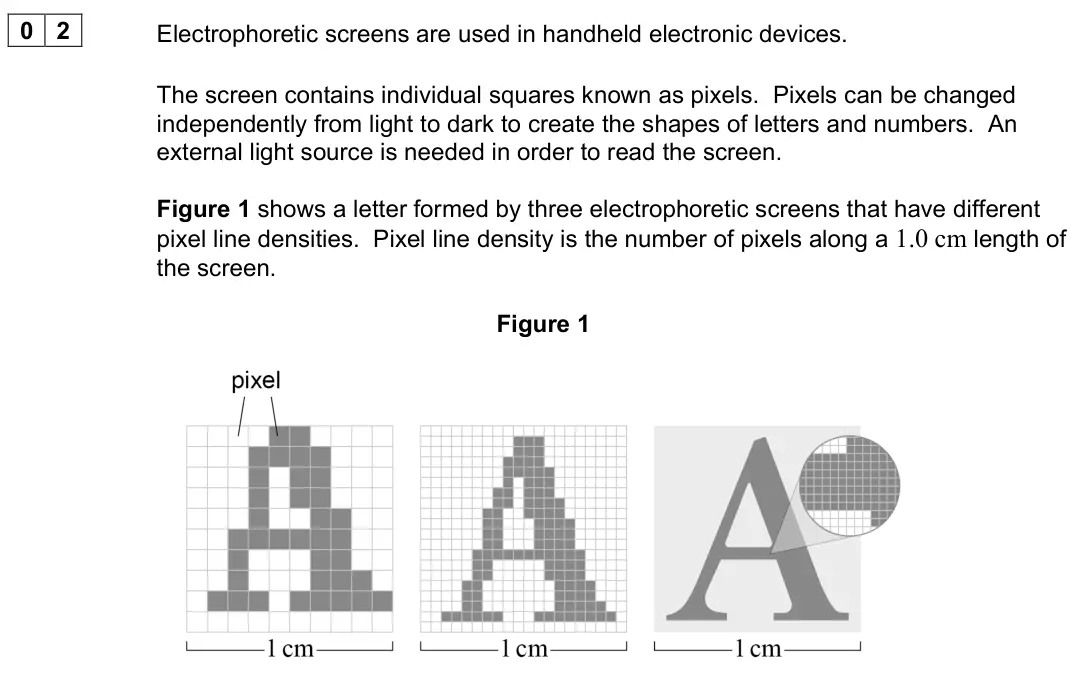
Q02.2
The whole paper ↗Q02.3
The whole paper ↗Q02.4
The whole paper ↗Q01.3
The whole paper ↗
Q01.1
The whole paper ↗Q01.2
The whole paper ↗Q01.3
The whole paper ↗Q02.1
The whole paper ↗Q02.2
The whole paper ↗Q01.4
The whole paper ↗
Q01.5
The whole paper ↗Q1(a)(i)
The whole paper ↗
Q1(a)(ii)
The whole paper ↗Q1(a)(iii)
The whole paper ↗Q1(b)(i)
The whole paper ↗Q1(b)(ii)
The whole paper ↗Q1(a)
The whole paper ↗
All 30 questions on Physics of vision, as a list
- June 2025, Paper 3 Medical physics, Q01.1 (2 marks): Figure 1 shows a simplified diagram of an eye that has no sight defects. The eye is viewing a distant point object. Complete, on Figure 1, the paths of the two
- June 2025, Paper 3 Medical physics, Q01.2 (1 mark): Accommodation is the ability of the eye to change its optical power. Which part of the eye enables accommodation? Tick () one box. [1 mark] cornea iris lens Th
- June 2023, Paper 3 Medical physics, Q02.1 (3 marks): A particular screen is designed so that two dark pixels separated by one light pixel cannot be resolved as separate images by the eye when viewed from a distanc
- June 2023, Paper 3 Medical physics, Q02.2 (3 marks): On a different electrophoretic screen, two dark pixels separated by one light pixel can just be resolved at a particular distance when the external light source
- June 2023, Paper 3 Medical physics, Q02.3 (1 mark): The eye is illuminated by light of wavelength 603 nm. Show that the response of a red-sensitive cone is approximately double the response of a green-sensitive c
- June 2023, Paper 3 Medical physics, Q02.4 (3 marks): Other types of screen use blue, green and red pixels to produce coloured images. Table 1 shows the wavelength of the light emitted by each pixel when it is turn
- June 2022, Paper 3 Medical physics, Q01.3 (4 marks): Figure 1 shows a diagram of an eye. Figure 1 State the name and primary optical function of X, Y and Z. [4 marks] Name of X Primary optical function of X Name o
- November 2020, Paper 3 Medical physics, Q01.1 (5 marks): State and explain two differences between the perceived image of a brightly coloured object in bright light and the perceived image of the same object when view
- November 2020, Paper 3 Medical physics, Q01.2 (1 mark): What is the name of the process which occurs when the pirate’s eye is covered by the patch? Tick () one box. [1 mark] aberration accommodation adaptation adjus
- November 2020, Paper 3 Medical physics, Q01.3 (3 marks): Discuss why it was necessary to wear the eye patch for 45 minutes before entering the ship. [3 marks]
- June 2018, Paper 3 Medical physics, Q02.1 (4 marks): The fovea in a typical human eye consists of cones which have an average diameter of 1.5 × 10⁻⁶ m An eye looks directly at two point sources of light which are
- June 2018, Paper 3 Medical physics, Q02.2 (3 marks): Three types of cone are present at the fovea. On Figure 2 sketch and clearly label three curves to show how the relative light absorption of each type of cone v
- June 2017, Paper 3 Medical physics, Q01.4 (3 marks): Draw a ray diagram to show how this spectacle lens forms an image of the object placed 24 cm from the spectacle lens. On your diagram clearly label the object,
- Specimen, Paper 3 Medical physics, Q01.5 (2 marks): Two point sources of light are viewed by a normal eye and their images are formed at the fovea. State, in terms of the active receptors, the conditions necessar
- June 2016, PHYA5 Medical physics (old spec), Q1(a)(i) (1 mark): State the condition needed for the images to be resolved by the retina. [1 mark] ______________________________________________________________________________
- June 2016, PHYA5 Medical physics (old spec), Q1(a)(ii) (1 mark): The images are formed on the retina at the fovea. Explain which type of receptor in the retina is being used to detect the images. [1 mark] ____________________
- June 2016, PHYA5 Medical physics (old spec), Q1(a)(iii) (2 marks): The sources subtend an angle of 0.13 mrad at the naked eye. The eyeball may be assumed to be spherical with a diameter of 52 mm. Calculate the maximum diameter
- June 2016, PHYA5 Medical physics (old spec), Q1(b)(i) (2 marks): Describe the changes which occur in a normal eye when the eye changes from viewing a near object to viewing a distant object, both objects being viewed in brigh
- June 2016, PHYA5 Medical physics (old spec), Q1(b)(ii) (3 marks): Describe the changes which occur in a normal eye as the eye changes from viewing an object in bright light to viewing the same object in very dim light. [3 mark
- June 2014, PHYA5 Medical physics (old spec), Q1(a) (3 marks): A person views a flashing white light source in a darkened room. Each flash lasts for 0.01 s and initially the light is flashing at a frequency of 1 Hz. State h
- June 2013, PHYA5 Medical physics (old spec), Q1(a) (2 marks): Describe how the rods and cones are distributed over the surface of the retina. (2 marks)
- June 2013, PHYA5 Medical physics (old spec), Q1(b) (3 marks): On the axes below sketch three curves to show how the response of each of the three types of cone found in the retina varies with the wavelength of light. Label
- June 2013, PHYA5 Medical physics (old spec), Q1(c) (1 mark): State the condition that must be satisfied for two objects to be resolved as individual images on the retina. (1 mark)
- June 2013, PHYA5 Medical physics (old spec), Q1(d) (2 marks): Explain how the resolution of the image of an object seen in very dim white light compares to that of the image of the same object seen in bright white light. (
- June 2012, PHYA5 Medical physics (old spec), Q1(a)(i) (2 marks): the eye changes from focussing on a distant object to focussing on a near object, both objects being viewed in bright light (2 marks)
- June 2012, PHYA5 Medical physics (old spec), Q1(a)(ii) (2 marks): the eye changes from viewing an object in very dim light to viewing the same object in bright light. (2 marks)
- June 2012, PHYA5 Medical physics (old spec), Q1(b) (2 marks): State two differences in the perceived image of a coloured object viewed in bright white light compared to the perceived image of the same object viewed in very
- June 2011, PHYA5 Medical physics (old spec), Q1(c) (2 marks): Explain what is meant by persistence of vision and state a practical situation where it is important.
- June 2008, PHA6W (2008 spec), Q2(a) (3 marks): 2 (a) On the axes sketch and clearly label three curves to show how the response of each of the three types of cone in the fovea varies with the wavelength of l
- June 2008, PHA6W (2008 spec), Q2(b) (4 marks): 2 (b) An eye looks directly at two point sources of light which are 8 mm apart and 40 m distant from the eye. The fovea is 19 mm behind the eye lens at the cent
Questions, mark schemes and examiner’s reports are © AQA, from their published past papers. Plumi isn’t affiliated with any exam board. Want whole papers? AQA A-Level Physics past papers.
The Plumi iPad app also offers exam-style questions with AI feedback on your handwritten working.