 plumi
Perfect competition: AQA A‑Level Economics questions
Every AQA A-Level Economics exam question on 4.1.5.3 Perfect competition, 2020–2025, with its mark scheme and examiner’s report.
Find questions686
Calculations

All 9 questions on Perfect competition, as a list
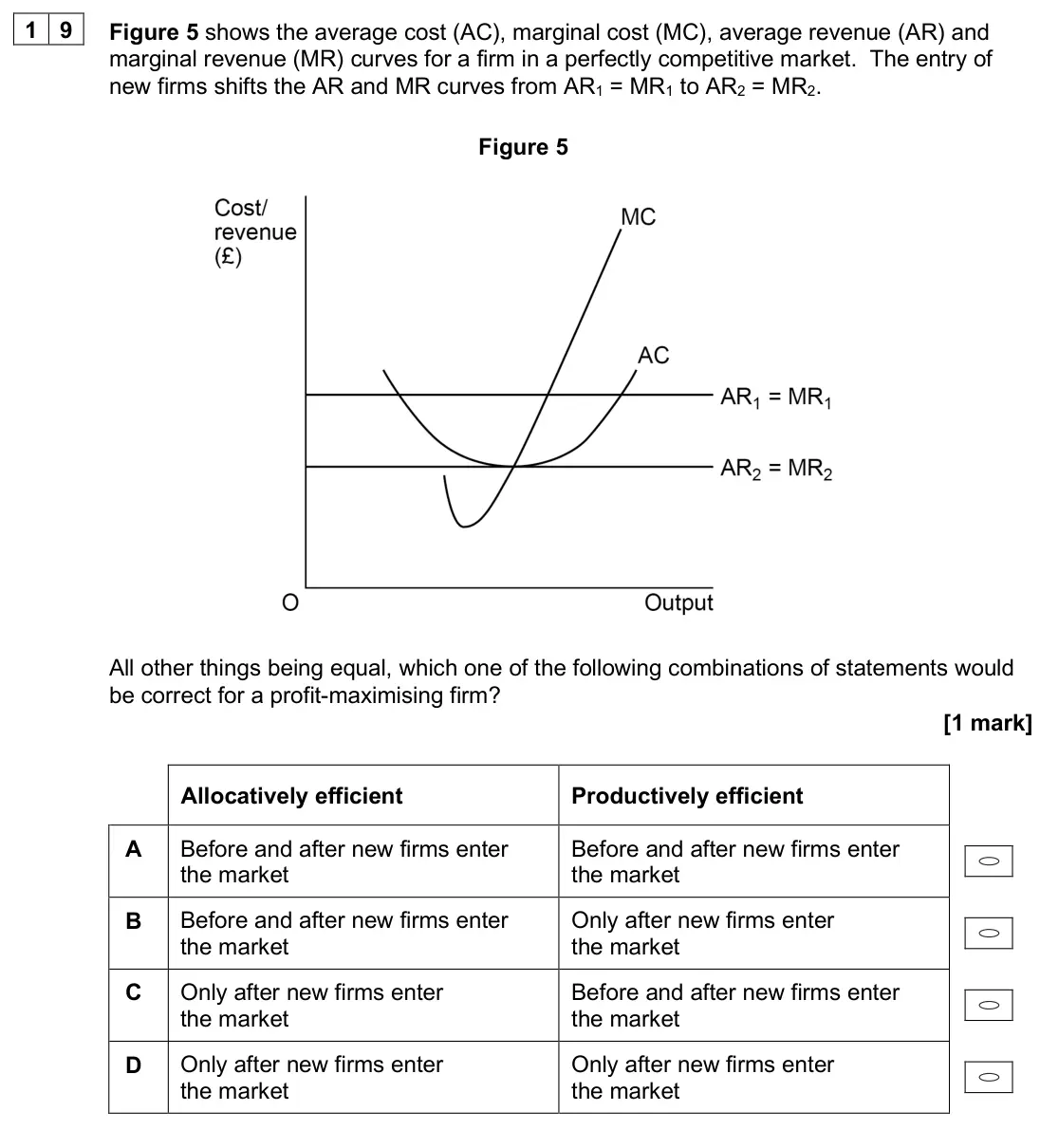
- June 2025, Paper 3, Q19 (1 mark): Figure 5 shows the average cost (AC), marginal cost (MC), average revenue (AR) and marginal revenue (MR) curves for a firm in a perfectly competitive market. Th
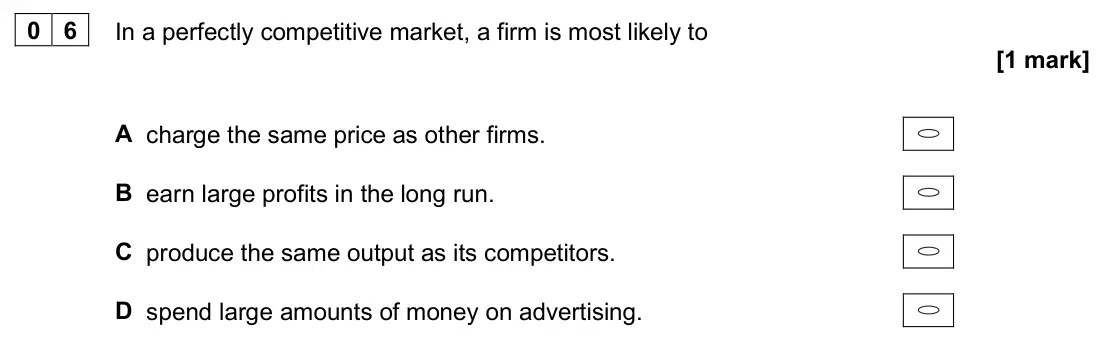
- June 2024, AS Paper 1, Q06 (1 mark): In a perfectly competitive market, a firm is most likely to [1 mark] A charge the same price as other firms. B earn large profits in the long run. C produce the
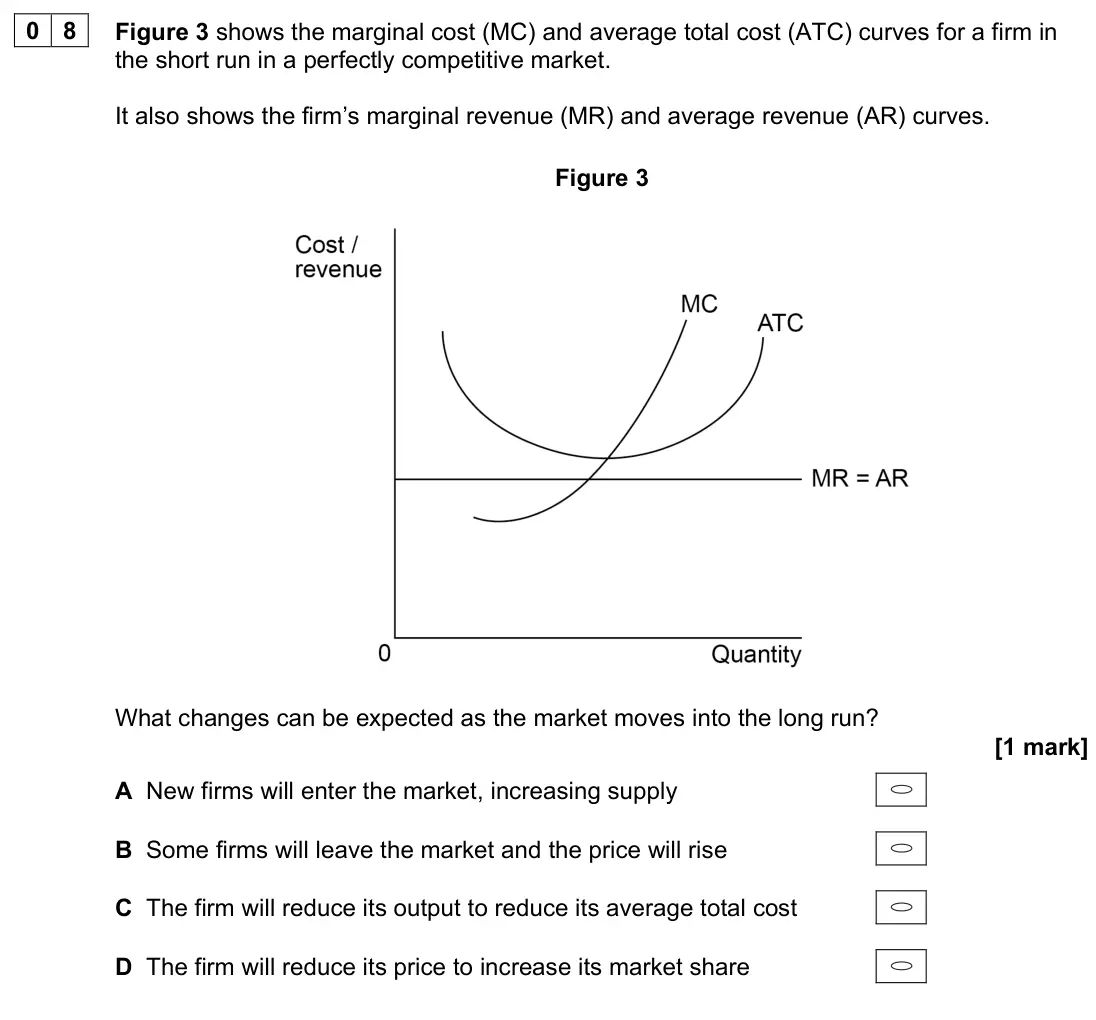
- June 2023, Paper 3, Q08 (1 mark): Figure 3 shows the marginal cost (MC) and average total cost (ATC) curves for a firm in the short run in a perfectly competitive market. It also shows the firm’
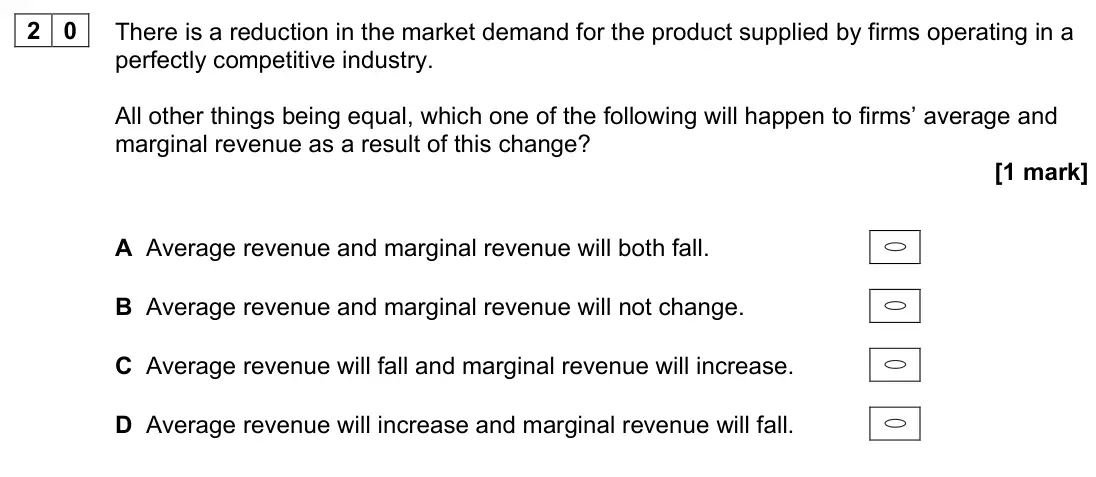
- June 2022, Paper 3, Q20 (1 mark): There is a reduction in the market demand for the product supplied by firms operating in a perfectly competitive industry. All other things being equal, which o
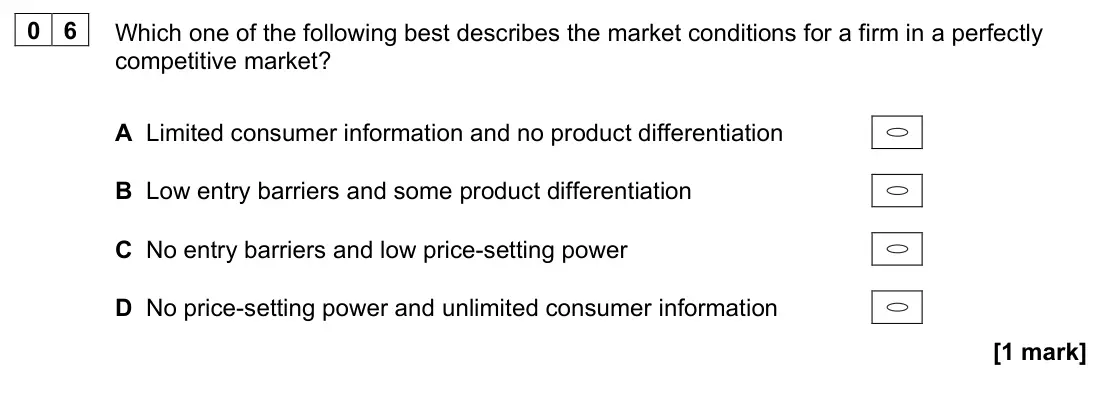
- June 2022, AS Paper 1, Q06 (1 mark): Which one of the following best describes the market conditions for a firm in a perfectly competitive market? A Limited consumer information and no product diff
- November 2021, Paper 1, Q09 (15 marks): Explain how perfect competition should lead to outcomes which are both productively and allocatively efficient. [15 marks] Essay 1 Price comparison websites wer
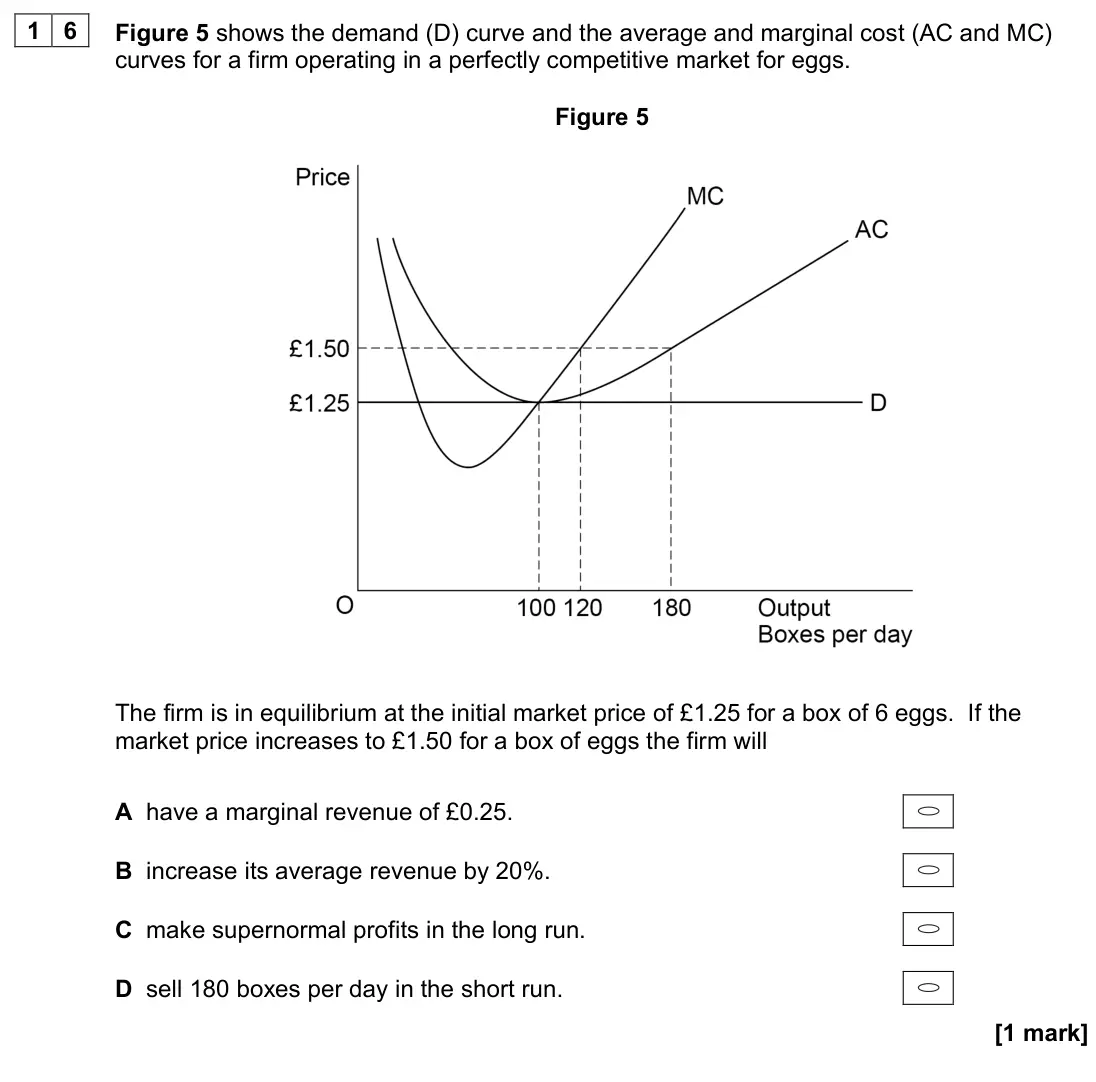
- November 2021, Paper 3, Q16 (1 mark): Figure 5 shows the demand (D) curve and the average and marginal cost (AC and MC) curves for a firm operating in a perfectly competitive market for eggs. Figure
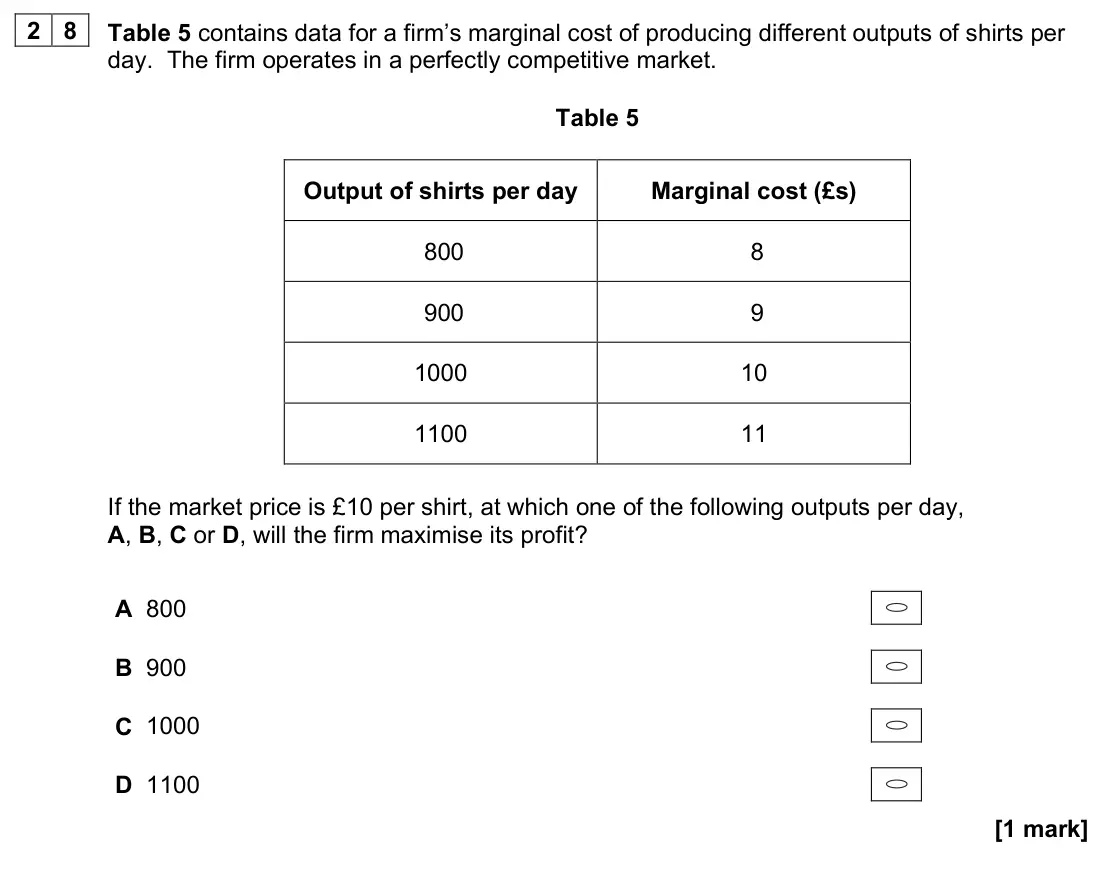
- November 2020, Paper 3, Q28 (1 mark): Table 5 contains data for a firm’s marginal cost of producing different outputs of shirts per day. The firm operates in a perfectly competitive market. Table 5
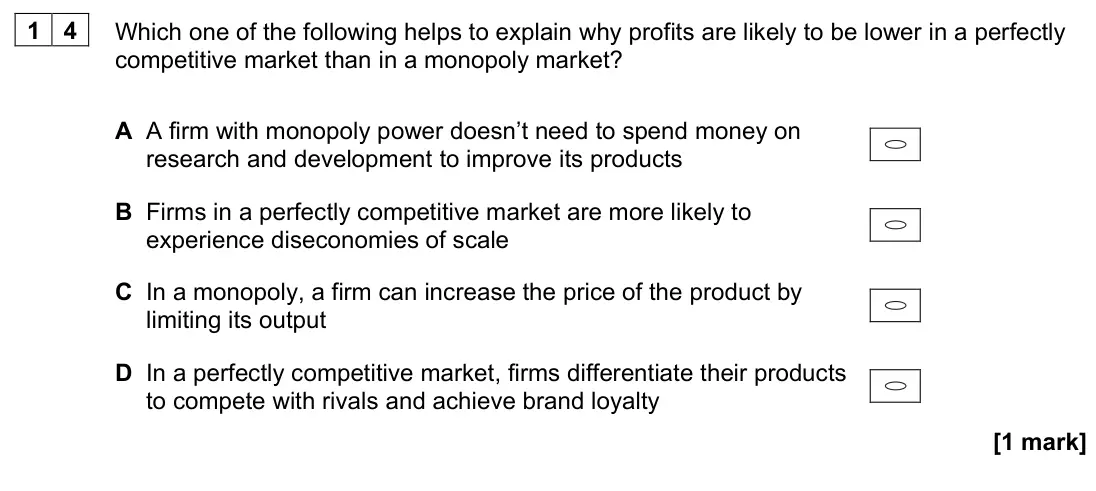
- November 2020, AS Paper 1, Q14 (1 mark): Which one of the following helps to explain why profits are likely to be lower in a perfectly competitive market than in a monopoly market? A A firm with monopo
Questions, mark schemes and examiner’s reports are © AQA, from their published past papers. Plumi isn’t affiliated with any exam board. Want whole papers? Full past papers.
Rather write your answers by hand on iPad? Plumi marks them against the same mark schemes.